Problems
Filters
4 problems found
2005 Paper 3 Q12
Five independent timers time a runner as she runs four laps of a track. Four of the timers measure the individual lap times, the results of the measurements being the random variables \(T_1\) to \(T_4\), each of which has variance \(\sigma^2\) and expectation equal to the true time for the lap. The fifth timer measures the total time for the race, the result of the measurement being the random variable \(T\) which has variance \(\sigma^2\) and expectation equal to the true race time (which is equal to the sum of the four true lap times). Find a random variable \(X\) of the form \(aT+b(T_1+T_2+T_3+T_4)\), where \(a\) and \(b\) are constants independent of the true lap times, with the two properties:
- whatever the true lap times, the expectation of \(X\) is equal to the true race time;
- the variance of \(X\) is as small as possible.
Solution: Let the expected total time for the race be \(\mu\). Let \(X = aT + b(T_1 + T_2+T_3+T_4)\) then \(\E[X] = a\E[T] + b\E[T_1+\cdots+T_4] = a \mu + b \mu = (a+b)\mu\). So \(a+b=1\). \begin{align*} && \var[X] &= a^2\var[T] + b^2(\var[T_1] + \var[T_2] + \var[T_3] + \var[T_4]) \\ &&&= a^2\sigma^2 + 4b^2 \sigma^2 \\ &&& = \sigma^2 (a^2 + 4(1-a)^2 ) \\ &&&= \sigma^2 (5a^2 - 8a + 4) \\ &&&= \sigma^2 \left ( 5 \left ( a - \frac45 \right)^2 - \frac{16}{5}+4 \right)\\ &&&= \sigma^2 \left ( 5 \left ( a - \frac45 \right)^2 + \frac{4}{5}\right) \end{align*} Therefore variance is minimised when \(a = \frac45, b = \frac15\). Let \(Y = cT + d(T_1 + T_2+T_3+T_4)\) then \begin{align*} && \E[Y^2] &= \E \left [c^2T^2 + 2cd T(T_1+T_2+T_3+T_4) + d^2(T_1+T_2+T_3+T_4)^2 \right] \\ &&&= c^2 (\mu^2 + \sigma^2) + 2cd \mu^2 + d^2 (\var[T_1 + \cdots + T_4] + \mu^2) \\ &&&= c^2(\mu^2+\sigma^2) + 2cd \mu^2 + d^2(4\sigma^2 + \mu^2) \\ &&&= (c^2 + 2cd + d^2) \mu^2 + (c^2+4d^2) \sigma^2 \\ &&&= (c+d)^2 \mu^2 + (c^2+4d^2) \sigma^2 \\ \\ \Rightarrow && d &= -c \\ && 1 &= c^2 + 4d^2 \\ \Rightarrow && c &= \pm \frac{1}{\sqrt5} \\ && d &= \mp \frac{1}{\sqrt5} \end{align*} Given our results, our best estimate for \(\mu\) is \(\frac45 \cdot 220 + \frac15 220.5 = 220.1\). Our estimate for \(\sigma^2 = \left( \frac{1}{\sqrt{5}}(220.5-220) \right)^2 = \frac{1}{20}\). Note that \(\var[X] = \frac45\sigma^2 \approx \frac{1}{25}\) so we are looking at an interval \((220.1 - 0.4, 220.1 + 0.4) = (219.7, 220.5)\) using an interval of two standard errors.
2001 Paper 2 Q14
Two coins \(A\) and \(B\) are tossed together. \(A\) has probability \(p\) of showing a head, and \(B\) has probability \(2p\), independent of \(A\), of showing a head, where \(0 < p < \frac12\). The random variable \(X\) takes the value 1 if \(A\) shows a head and it takes the value \(0\) if \(A\) shows a tail. The random variable \(Y\) takes the value 1 if \(B\) shows a head and it takes the value \(0\) if \(B\) shows a tail. The random variable \(T\) is defined by \[ T= \lambda X + {\textstyle\frac12} (1-\lambda)Y. \] Show that \(\E(T)=p\) and find an expression for \(\var(T)\) in terms of \(p\) and \(\lambda\). Show that as \(\lambda\) varies, the minimum of \(\var(T)\) occurs when \[ \lambda =\frac{1-2p}{3-4p}\;. \] The two coins are tossed \(n\) times, where \(n>30\), and \(\overline{T}\) is the mean value of \(T\). Let \(b\) be a fixed positive number. Show that the maximum value of \(\P\big(\vert \overline{T}-p\vert < b\big)\) as \(\lambda\) varies is approximately \(2\Phi(b/s)-1\), where \(\Phi\) is the cumulative distribution function of a standard normal variate and \[ s^2= \frac{p(1-p)(1-2p)}{(3-4p)n}\;. \]
Solution: \begin{align*} && \E[T] &= \E[\lambda X + \tfrac12(1-\lambda)Y] \\ &&&= \lambda \E[X] + \tfrac12(1-\lambda) \E[Y] \\ &&&= \lambda p + \tfrac12 (1-\lambda) 2p \\ &&&= p \\ \\ && \var[T] &= \var[\lambda X + \tfrac12(1-\lambda)Y] \\ &&&= \lambda^2 \var[X] + \tfrac14(1-\lambda)^2 \var[Y] \\ &&&= \lambda^2 p(1-p) + \tfrac14(1-\lambda)^22p(1-2p) \\ &&&= p(\lambda^2 + \tfrac12(1-\lambda)^2) -p^2(\lambda^2+(1-\lambda)^2)\\ &&&= p(\tfrac32\lambda^2 - \lambda + \tfrac12) -p^2(2\lambda^2 -2\lambda + 2) \end{align*} Differentiating \(\var[T]\) with respect to \(\lambda\), and noting it is a quadratic with positive leading coefficient, we get \begin{align*} && \frac{\d \var[T]}{\d \lambda} &= p(2\lambda -(1-\lambda)) - p^2(2 \lambda -2(1-\lambda)) \\ &&&= p(3\lambda - 1)-p^2(4\lambda - 2) \\ \Rightarrow && \lambda(4p-3) &= 2p-1 \\ \Rightarrow && \lambda &= \frac{1-2p}{3-4p} \end{align*} By the central limit theorem \(\overline{T} \sim N(p, \frac{\sigma^2}{n})\) in particular, \(\mathbb{P}(|\overline{T} - p| < b) = \mathbb{P}(\left \lvert |\frac{\overline{T}-p}{\frac{\sigma}{\sqrt{n}}} \right \lvert < \frac{b}{\frac{\sigma}{\sqrt{n}}}) = \mathbb{P}(|Z| < \frac{b\sqrt{n}}{\sigma}) = 2\Phi(b/s) - 1\) where \(s = \frac{\sigma}{\sqrt{n}}\) so \begin{align*} && s^2 &= \frac1n \sigma^2 \\ &&&= \frac1n \left ( \left (\left ( \frac{1-2p}{3-4p} \right)^2 + \tfrac12 \left (1-\frac{1-2p}{3-4p} \right)^2 \right)p - \left ( \left ( \frac{1-2p}{3-4p} \right)^2 + \left (1-\frac{1-2p}{3-4p} \right)^2\right)p^2 \right) \\ &&&= \frac1n \left ( \left (\left ( \frac{1-2p}{3-4p} \right)^2 + \tfrac12 \left (\frac{2-2p}{3-4p} \right)^2 \right)p - \left ( \left ( \frac{1-2p}{3-4p} \right)^2 + \left (\frac{2-2p}{3-4p} \right)^2\right)p^2 \right) \\ &&&= \frac{p}{n(3-4p)^2} \left ( (1 -4p + 4p^2 + 2-4p+2p^2) - (1-4p+4p^2+4-8p+4p^2)p \right) \\ &&&= \frac{p}{n(3-4p)^2} \left (3-13p+18p^2-8p^3 \right) \\ &&&= \frac{p}{n(3-4p)^2} (3-4p)(1-2p)(1-p) \\ &&&= \frac{p(1-p)(1-2p)}{(3-4p)n} \end{align*}
2001 Paper 3 Q14
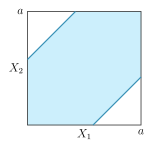
A random variable \(X\) is distributed uniformly on \([\, 0\, , \, a\,]\). Show that the variance of \(X\) is \({1 \over 12} a^2\). A sample, \(X_1\) and \(X_2\), of two independent values of the random variable is drawn, and the variance \(V\) of the sample is determined. Show that \(V = {1 \over 4} \l X_1 -X_2 \r ^2\), and hence prove that \(2 V\) is an unbiased estimator of the variance of X. Find an exact expression for the probability that the value of \(V\) is less than \({1 \over 12} a^2\) and estimate the value of this probability correct to one significant figure.
Solution: \begin{align*} && \E[X] &= \frac{a}{2}\tag{by symmetry} \\ &&\E[X^2] &= \int_0^a \frac{1}{a} x^2 \d x \\ &&&= \frac{a^3}{3a} = \frac{a^2}{3} \\ \Rightarrow && \var[X] &= \frac{a^2}{3} - \frac{a^2}{4} = \frac{a^2}{12} \\ \end{align*} \begin{align*} && V &=\frac{1}{2} \left ( \left ( X_1 - \frac{X_1+X_2}{2} \right )^2+\left ( X_2- \frac{X_1+X_2}{2} \right )^2 \right ) \\ &&&= \frac{1}{8} ((X_1 - X_2)^2 + (X_2 - X_1)^2 ) \\ &&&= \frac14 (X_1-X_2)^2 \\ \\ && \E[2V] &= \E \left [ \frac12 (X_1 - X_2)^2 \right] \\ &&&= \frac12 \E[X_1^2] - \E[X_1X_2] + \frac12 \E[X_2^2] \\ &&&= \frac{a^2}{3} - \frac{a^2}{4} = \frac{a^2}{12} \end{align*} Therefore \(2V\) is an unbiased estimator of the variance of \(X\).
1998 Paper 3 Q14
A hostile naval power possesses a large, unknown number \(N\) of submarines. Interception of radio signals yields a small number \(n\) of their identification numbers \(X_i\) (\(i=1,2,...,n\)), which are taken to be independent and uniformly distributed over the continuous range from \(0\) to \(N\). Show that \(Z_1\) and \(Z_2\), defined by $$ Z_1 = {n+1\over n} {\max}\{X_1,X_2,...,X_n\} \hspace{0.3in} {\rm and} \hspace{0.3in} Z_2 = {2\over n} \sum_{i=1}^n X_i \;, $$ both have means equal to \(N\). Calculate the variance of \(Z_1\) and of \(Z_2\). Which estimator do you prefer, and why?