Problems
Filters
1 problem found
2007 Paper 1 Q14
D: 1500.0
B: 1484.0
Poisson distribution
curve sketching
stationary points
uniqueness
conditional probability
exponential function
turning point
The discrete random variable \(X\) has a Poisson distribution with mean \(\lambda\).
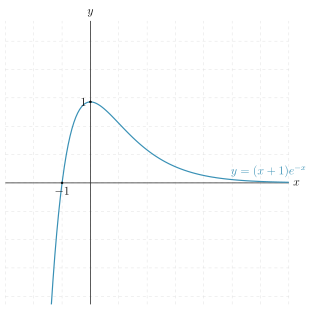
- Sketch the graph \(y=\l x+1 \r \e^{-x}\), stating the coordinates of the turning point and the points of intersection with the axes. It is known that \(\P(X \ge 2) = 1-p\), where \(p\) is a given number in the range \(0 < p <1\). Show that this information determines a unique value (which you should not attempt to find) of \(\lambda\).
- It is known (instead) that \(\P \l X = 1 \r = q\), where \(q\) is a given number in the range \(0 < q <1\). Show that this information determines a unique value of \(\lambda\) (which you should find) for exactly one value of \(q\) (which you should also find).
- It is known (instead) that \(\P \l X = 1 \, \vert \, X \le 2 \r = r\), where \(r\) is a given number in the range \(0 < r < 1\). Show that this information determines a unique value of \(\lambda\) (which you should find) for exactly one value of \(r\) (which you should also find).
Solution: Let \(X \sim Po(\lambda)\), then
- \(\,\)
Suppose \(\mathbb{P}(X \geq 2) = 1-p\) then \(\mathbb{P}(X=0) + \mathbb{P}(X=1) = p\), ie \(e^{-\lambda} +\lambda e^{-\lambda} = p\) If \(f(x) = (1+x)e^{-x}\) we have see it is strictly decreasing on \(x \geq 0\) and takes all values from \(1\) to \(0\), therefore we can find a unique value such that \(f(\lambda) = p\) which is our desired \(\lambda\).
- Note that \(\mathbb{P}(X = 1) = \lambda e^{-\lambda}\)
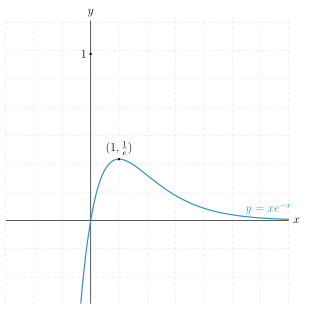
Sketching \(y = xe^{-x}\) and finding it's turning point we can see that there is a unique value of \(\lambda = 1\) when \(q = \frac{1}{e}\), otherwise there is either no solution (\(p > \frac1{e}\)) or two solutions (\(0 < q > \frac1{e}\)).
- Suppose \(\mathbb{P}(X = 1 | X \leq 2) = r\), ie \begin{align*} && r &= \frac{\lambda e^{-\lambda}}{e^{-\lambda} + \lambda e^{-\lambda} + \frac12 \lambda^2 e^{-\lambda}} \\ &&&= \frac{2\lambda}{2+2\lambda+\lambda^2} \\ \Rightarrow && 0 &= r\lambda^2 + 2(r-1) \lambda + 2r\\ \Rightarrow && \Delta &= 4(r-1)^2 - 4\cdot r \cdot 2 r \\ &&&= 4((r-1)^2-2r^2) \\ &&&= 4(r-1-\sqrt{2}r)(r-1+\sqrt{2}r) \\ &&&= -4((\sqrt{2}-1)r + 1)((1+\sqrt{2})r-1) \end{align*} Therefore our quadratic in \(r\) has a unique solution if \(r = \frac{1}{1+\sqrt{2}}\). If it has a positive solution then note since \(2r > 0\) both solutions are positive, so \(\lambda\) is not unique by excluding other solutions.