Problems
Filters
3 problems found
2009 Paper 2 Q9
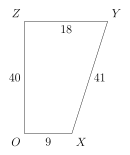
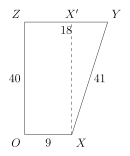
- A uniform lamina \(OXYZ\) is in the shape of the trapezium shown in the diagram. It is right-angled at \(O\) and \(Z\), and \(OX\) is parallel to \(YZ\). The lengths of the sides are given by \(OX=9\,\)cm, \(XY=41\,\)cm, \(YZ=18\,\)cm and \(ZO=40\,\)cm. Show that its centre of mass is a distance \(7\,\)cm from the edge \(OZ\).
- The diagram shows a tank with no lid made of thin sheet metal. The base \(OXUT\), the back \(OTWZ\) and the front \(XUVY\) are rectangular, and each end is a trapezium as in part (i). The width of the tank is \(d\,\)cm.
Show that the centre of mass of the tank, when empty, is a distance \[ \frac {3(140+11d)}{5(12+d)}\,\text{cm} \] from the back of the tank. The tank is then filled with a liquid. The mass per unit volume of this liquid is \(k\) times the mass per unit area of the sheet metal. In the case \(d=20\), find an expression for the distance of the centre of mass of the filled tank from the back of the tank.

Solution:
- \begin{array}{c|c|c|c} & OXX'Z & XX'Y & OXYZ \\ \hline \text{Area} & 360 & 180 & 540\\ \text{COM} & \binom{4.5}{20} & \binom{12}{\frac{80}{3}} & \binom{\overline{x}}{\overline{y}} \end{array} \begin{align*} && 2 \binom{3}{20} + \binom{12}{\frac{80}{3}} &= 3 \binom{\overline{x}}{\overline{y}} \\ \Rightarrow && \binom{\overline{x}}{\overline{y}} &= \frac13 \binom{21}{\frac{200}{3}} \\ &&&= \binom{7}{\frac{200}{9}} \end{align*} ie, the centre of mass is \(7\text{ cm}\) from \(OZ\)
- \begin{align*} && \underbrace{540 \cdot 7}_{OXYZ} + \underbrace{540 \cdot 7}_{TUVW} + \underbrace{40d\cdot 0}_{OTWZ} + \underbrace{9d\cdot 4.5}_{OXUT} + \underbrace{41d \cdot 13.5}_{XUVY} &= (540+540+40d+9d+41d) \overline{x} \\ \Rightarrow && \overline{x} &= \frac{540\cdot 14 + 50d \cdot 4.5 + 41d \cdot 9}{1080 + 90d} \\ &&&= \frac{90 \cdot 84 + 225d + 369d}{1080+90d} \\ &&&= \frac{90 \cdot 84 + 594d}{1080+90d} \\ &&&= \frac{54(140+11d)}{90(12+d)} \\ &&&= \frac{3(140+11d)}{5(12+d)} \end{align*} The volume of the prizm is \(540d\), it's center of mass is \(7\). For the tank, it COM is \(\frac{3(140+11\cdot20)}{5(12+20)} = \frac{27}4\) and area is \(2880\) Therefore for the combined shape we have: \begin{align*} && 540dk \cdot 7 + 2880 \cdot \frac{27}{4} &= (540 \cdot20 k+2880) \overline{x} \\ \Rightarrow && \overline{x} &= \frac{720(150k+27)}{720(15k + 4)} \\ &&&= \frac{3(50k+9)}{15k+4} \end{align*} \begin{align*} && \end{align*}
2006 Paper 2 Q8
Show that the line through the points with position vectors \(\bf x\) and \(\bf y\) has equation \[{\bf r} = (1-\alpha){\bf x} +\alpha {\bf y}\,, \] where \(\alpha\) is a scalar parameter. The sides \(OA\) and \(CB\) of a trapezium \(OABC\) are parallel, and \(OA>CB\). The point \(E\) on \(OA\) is such that \(OE : EA = 1:2\), and \(F\) is the midpoint of \(CB\). The point \(D\) is the intersection of \(OC\) produced and \(AB\) produced; the point \(G\) is the intersection of \(OB\) and \(EF\); and the point \(H\) is the intersection of \(DG\) produced and \(OA\). Let \(\bf a\) and \(\bf c\) be the position vectors of the points \(A\) and \(C\), respectively, with respect to the origin \(O\).
- Show that \(B\) has position vector \(\lambda {\bf a} + {\bf c}\) for some scalar parameter \(\lambda\).
- Find, in terms of \(\bf a\), \(\bf c\) and \(\lambda\) only, the position vectors of \(D\), \(E\), \(F\), \(G\) and \(H\). Determine the ratio \(OH:HA\).
2003 Paper 1 Q10
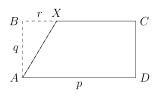
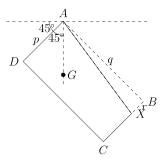
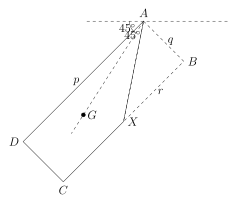
\(ABCD\) is a uniform rectangular lamina and \(X\) is a point on \(BC\,\). The lengths of \(AD\), \(AB\) and \(BX\) are \(p\,\), \(q\) and \(r\) respectively. The triangle \(ABX\) is cut off the lamina. Let \((a,b)\) be the position of the centre of gravity of the lamina, where the axes are such that the coordinates of \(A\,\), \(D\) and \(C\) are \((0,0)\,\), \((p,0)\) and \((p,q)\) respectively. Derive equations for \(a\) and \(b\) in terms of \(p\,\), \(q\) and \(r\,\). When the resulting trapezium is freely suspended from the point \(A\,\), the side \(AD\) is inclined at \(45^\circ\) below the horizontal. Show that \(\displaystyle r = q - \sqrt{q^2 - 3pq + 3p^2}\,\). You should justify carefully the choice of sign in front of the square root.
Solution: