Problems
Filters
8 problems found
2024 Paper 2 Q9
A long straight trench, with rectangular cross section, has been dug in otherwise horizontal ground. The width of the trench is \(d\) and its depth \(2d\). A particle is projected at speed \(v\), where \(v^2 = \lambda dg\), at an angle \(\alpha\) to the horizontal, from a point on the ground a distance \(d\) from the nearer edge of the trench. The vertical plane in which it moves is perpendicular to the trench.
- The particle lands on the base of the trench without first touching either of its sides.
- By considering the vertical displacement of the particle when its horizontal displacement is \(d\), show that \((\tan\alpha - \lambda)^2 < \lambda^2 - 1\) and deduce that \(\lambda > 1\).
- Show also that \((2\tan\alpha - \lambda)^2 > \lambda^2 + 4(\lambda - 1)\) and deduce that \(\alpha > 45^\circ\).
- Show that, provided \(\lambda > 1\), \(\alpha\) can always be chosen so that the particle lands on the base of the trench without first touching either of its sides.
2017 Paper 2 Q11
Two thin vertical parallel walls, each of height \(2a\), stand a distance \(a\) apart on horizontal ground. The projectiles in this question move in a plane perpendicular to the walls.
- A particle is projected with speed \(\sqrt{5ag}\) towards the two walls from a point \( A\) at ground level. It just clears the first wall. By considering the energy of the particle, find its speed when it passes over the first wall. Given that it just clears the second wall, show that the angle its trajectory makes with the horizontal when it passes over the first wall is \(45^\circ\,\). Find the distance of \(A\) from the foot of the first wall.
- A second particle is projected with speed \(\sqrt{5ag}\) from a point \(B\) at ground level towards the two walls. It passes a distance \(h\) above the first wall, where \(h>0\). Show that it does not clear the second wall.
Solution:
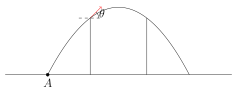
- \(\,\) \begin{align*} \bf{COE}: && \frac12 m \cdot 5ag &= mg\cdot 2a + \frac12 m v^2 \\ \Rightarrow && v^2 &= ag \\ && v &= \sqrt{ag} \end{align*} If it just clears the second wall, we must have: \begin{align*} && 0 &= \sqrt{ag} \sin \theta t - \frac12 gt^2 \\ \Rightarrow && t &= \frac{2\sqrt{ag}\sin \theta}{g} \\ && a &= \sqrt{ag} \cos \theta t \\ &&&=\sqrt{ag} \cos \theta \frac{2\sqrt{ag}\sin \theta}{g} \\ &&&= a \sin 2 \theta \\ \Rightarrow && \theta &= 45^{\circ} \end{align*} Imagine firing the particle backwards from the top of the wall at \(45^\circ\) then \begin{align*} && -2a &= \sqrt{ag}\cdot \left ( -\frac1{\sqrt{2}} \right) t - \frac12 g t^2 \\ \Rightarrow && 0 &= gt^2+\sqrt{2ag} t -4a \\ &&&= (\sqrt{g}t -\sqrt{2} \sqrt{a})(\sqrt{g}t +2\sqrt{2} \sqrt{a}) \\ \Rightarrow && t &= \sqrt{\frac{2a}{g}} \\ \Rightarrow && s &= \left ( -\frac1{\sqrt{2}} \right) \sqrt{ag} \sqrt{\frac{2a}{g}} \\ &&&= -a \end{align*} Therefore the \(A\) is \(a\) from the wall.
- When it passes over the first wall, \begin{align*} \bf{COE}: && \frac52amg &= (2a+h)mg + \frac12 m v^2 \\ \Rightarrow && v^2 &= (a-2h)g \end{align*} Now imagine firing a particle with this speed in any direction. The question is asking whether we can ever travel \(2a\) without descending more than \(h\). \begin{align*} && a &= \sqrt{(a-2h)g} \cos \beta t \\ \Rightarrow && t &= \frac{a}{\sqrt{(a-2h)g} \cos \beta}\\ && -h &= \sqrt{(a-2h)g} \sin \beta t - \frac12 g t^2 \\ &&&= a \tan \beta - \frac12 \frac{a^2}{(a-2h)} \sec^2 \beta \\ &&&= a \tan \beta - \frac{a^2}{2(a-2h)}(1+ \tan^2 \beta )\\ \Rightarrow && 0 &= \frac{a^2}{2(a-2h)} \tan^2 \beta-a \tan \beta + \frac{a^2-2ah+4h^2}{2(a-2h)} \\ && \Delta &= a^2 - \frac{a^2}{a-2h} \frac{a^2-2ah+4h^2}{a-2h} \\ &&&= \frac{a^2}{(a-2h)^2}\left ( a^2-4ah+4h^2-a^2+2ah-4h^2\right) \\ &&&= \frac{a^2}{(a-2h)^2}\left ( -2ah\right) < 0 \\ \end{align*} So there are no solutions if \(h > 0\)
2009 Paper 3 Q9
A particle is projected under gravity from a point \(P\) and passes through a point \(Q\). The angles of the trajectory with the positive horizontal direction at \(P\) and at \(Q\) are \(\theta\) and \(\phi\), respectively. The angle of elevation of \(Q\) from \(P\) is \(\alpha\).
- Show that \(\tan\theta +\tan\phi = 2\tan\alpha\).
- It is given that there is a second trajectory from \(P\) to \(Q\) with the same speed of projection. The angles of this trajectory with the positive horizontal direction at \(P\) and at \(Q\) are \(\theta'\) and \(\phi'\), respectively. By considering a quadratic equation satisfied by \(\tan\theta\), show that \(\tan(\theta+\theta') = -\cot\alpha\). Show also that \(\theta+\theta'=\pi+\phi+\phi'\,\).
2008 Paper 1 Q10
On the (flat) planet Zog, the acceleration due to gravity is \(g\) up to height \(h\) above the surface and \(g'\) at greater heights. A particle is projected from the surface at speed \(V\) and at an angle \(\alpha\) to the surface, where \(V^2 \sin^2\alpha > 2 gh\,\). Sketch, on the same axes, the trajectories in the cases \(g'=g\) and \(g' < g\). Show that the particle lands a distance \(d\) from the point of projection given by \[ d = \left(\frac {V-V'} g + \frac {V'}{ g'} \right) V\sin2\alpha\,, \] where \(V' = \sqrt{V^2-2gh\,\rm{cosec}^2\alpha\,}\,\).
2008 Paper 2 Q9
In this question, use \(g=10\,\)m\,s\(^{-2}\). In cricket, a fast bowler projects a ball at \(40\,\)m\,s\(^{-1}\) from a point \(h\,\)m above the ground, which is horizontal, and at an angle \(\alpha\) above the horizontal. The trajectory is such that the ball will strike the stumps at ground level a horizontal distance of \(20\,\)m from the point of projection.
- Determine, in terms of \(h\), the two possible values of \(\tan\alpha\). Explain which of these two values is the more appropriate one, and deduce that the ball hits the stumps after approximately half a second.
- State the range of values of \(h\) for which the bowler projects the ball below the horizontal.
- In the case \(h=2.5\), give an approximate value in degrees, correct to two significant figures, for \(\alpha\). You need not justify the accuracy of your approximation.
2006 Paper 1 Q10
A particle \(P\) is projected in the \(x\)-\(y\) plane, where the \(y\)-axis is vertical and the \(x\)-axis is horizontal. The particle is projected with speed \(V\) from the origin at an angle of \(45 ^\circ\) above the positive \(x\)-axis. Determine the equation of the trajectory of \(P\). The point of projection (the origin) is on the floor of a barn. The roof of the barn is given by the equation \(y= x \tan \alpha +b\,\), where \(b>0\) and \(\alpha\) is an acute angle. Show that, if the particle just touches the roof, then \(V(-1+ \tan\alpha) =-2 \sqrt{bg}\); you should justify the choice of the negative root. If this condition is satisfied, find, in terms of \(\alpha\), \(V\) and \(g\), the time after projection at which touching takes place. A particle \(Q\) can slide along a smooth rail fixed, in the \(x\)-\(y\) plane, to the under-side of the roof. It is projected from the point \((0,b)\) with speed \(U\) at the same time as \(P\) is projected from the origin. Given that the particles just touch in the course of their motions, show that \[ 2 \sqrt 2 \, U \cos \alpha = V \big(2 + \sin\alpha\cos\alpha -\sin^2\alpha) . \]
1997 Paper 2 Q11
A tennis player serves from height \(H\) above horizontal ground, hitting the ball downwards with speed \(v\) at an angle \(\alpha\) below the horizontal. The ball just clears the net of height \(h\) at horizontal distance \(a\) from the server and hits the ground a further horizontal distance \(b\) beyond the net. Show that $$v^2 = \frac{ g(a+b)^2(1+\tan^2\alpha)}{ 2[H-(a+b)\tan\alpha]}$$ and $$\tan\alpha = \frac{2a+b }{ a(a+b)}H - \frac{a+b }{ ab}h \,.$$ By considering the signs of \(v^2\) and \(\tan\alpha\), find upper and lower bounds on \(H\) for such a serve to be possible.
Solution: We have \begin{align*} \rightarrow: && a &= v\cos \alpha t_{net} \\ \Rightarrow && t_{net} &= \frac{a}{v \cos \alpha} \\ \downarrow: && H-h &= v\sin \alpha t_{net} + \frac12 g t_{net}^2 \\ &&&= a \tan \alpha + \frac12 g \frac{a^2}{v^2} \sec^2 \alpha \\ &&&= a \tan \alpha + \frac{a^2g}{2v^2}(1 + \tan^2 \alpha) \tag{*}\\ \\ \rightarrow: && a+b &= v \cos \alpha t_{ground} \\ && t_{ground} &= \frac{a+b}{v \cos \alpha}\\ \downarrow: && H &= v\sin \alpha t_{ground} + \frac12 g t_{ground}^2 \\ &&&= (a+b)\tan \alpha + \frac{(a+b)^2g}{2v^2}(1+\tan^2\alpha) \tag{**} \\ \\ (**): && v^2 &= \frac{g(a+b)^2(1+\tan^2\alpha)}{2[H-(a+b)\tan \alpha]} \\ (a+b)^2(*) - a^2(**): && (a+b)^2(H-h) -a^2H &= [(a+b)^2a - a^2(a+b)]\tan \alpha \\ \Rightarrow && (2ab+b^2)H - (a+b)^2h &= ab(a+b) \tan \alpha \\ \Rightarrow && \tan \alpha &= \frac{2a+b}{a(a+b)}H - \frac{a+b}{ab} h \end{align*} Noting that \(v^2 \geq 0\) and the numerator is positive, we must have \begin{align*} && H &> (a+b)\tan \alpha \\ &&&= \frac{2a+b}{a}H - \frac{(a+b)^2}{ab} h \\ \Rightarrow && \frac{a+b}{a}H &< \frac{(a+b)^2}{ab} h \\ \Rightarrow && H &< \frac{a+b}{b} h \end{align*} Noting that \(\tan \alpha > 0\) we must have \begin{align*} && \frac{2a+b}{a(a+b)} H & > \frac{a+b}{ab} h \\ \Rightarrow && H &> \frac{(a+b)^2}{b(2a+b)}h \end{align*}
1991 Paper 2 Q11
The Ruritanian army is supplied with shells which may explode at any time in flight but not before the shell reaches its maximum height. The effect of the explosion on any observer depends only on the distance between the exploding shell and the observer (and decreases with distance). Ruritanian guns fire the shells with fixed muzzle speed, and it is the policy of the gunners to fire the shell at an angle of elevation which minimises the possible damages to themselves (assuming the ground is level) - i.e. they aim so that the point on the descending trajectory that is nearest to them is as far away as possible. With that intention, they choose the angle of elevation that minimises the damage to themselves if the shell explodes at its maximum height. What angle do they choose? Does the shell then get any nearer to the gunners during its descent?