Problems
Filters
3 problems found
1997 Paper 2 Q9
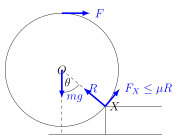
A uniform solid sphere of diameter \(d\) and mass \(m\) is drawn very slowly and without slipping from horizontal ground onto a step of height \(d/4\) by a horizontal force which is always applied to the highest point of the sphere and is always perpendicular to the vertical plane which forms the face of the step. Find the maximum horizontal force throughout the movement, and prove that the coefficient of friction between the sphere and the edge of the step must exceed \(1/\sqrt{3}\).
Solution:
1993 Paper 3 Q11
In this question, all gravitational forces are to be neglected. A rigid frame is constructed from 12 equal uniform rods, each of length \(a\) and mass \(m,\) forming the edges of a cube. Three of the edges are \(OA,OB\) and \(OC,\) and the vertices opposite \(O,A,B\) and \(C\) are \(O',A',B'\) and \(C'\) respectively. Forces act along the lines as follows, in the directions indicated by the order of the letters: \begin{alignat*}{3} 2mg\mbox{ along }OA, & \qquad & mg\mbox{ along }AC', & \qquad & \sqrt{2}mg\mbox{ along }O'A,\\ \sqrt{2}mg\mbox{ along }OA', & & 2mg\mbox{ along }C'B, & & mg\mbox{ along }A'C. \end{alignat*}
- The frame is freely pivoted at \(O\). Show that the direction of the line about which it will start to rotate is $\begin{pmatrix}1\\ 1\\ 2 \end{pmatrix}$ with respect to axes along \(OA\), \(OB\) and \(OC\) respectively.
- Show that the moment of inertia of the rod \(OA\) about the axis \(OO'\) is \(2ma^2/9\) and about a parallel axis through its mid-point is \(ma^2/18\). Hence find the moment of inertia of \(B'C\) about \(OO'\) and show that the moment of inertia of the frame about \(OO'\) is \(14ma^2/3\). If the frame is freely pivoted about the line \(OO'\) and the forces continue to act along the specified lines, find the initial angular acceleration of the frame.
1992 Paper 2 Q12
In the figure, \(W_{1}\) and \(W_{2}\) are wheels, both of radius \(r\). Their centres \(C_{1}\) and \(C_{2}\) are fixed at the same height, a distance \(d\) apart, and each wheel is free to rotate, without friction, about its centre. Both wheels are in the same vertical plane. Particles of mass \(m\) are suspended from \(W_{1}\) and \(W_{2}\) as shown, by light inextensible strings would round the wheels. A light elastic string of natural length \(d\) and modulus elasticity \(\lambda\) is fixed to the rims of the wheels at the points \(P_{1}\) and \(P_{2}.\) The lines joining \(C_{1}\) to \(P_{1}\) and \(C_{2}\) to \(P_{2}\) both make an angle \(\theta\) with the vertical. The system is in equilibrium. \noindent
- sep}{3mm}
- \(\bf (i)\) no equilibrium positions,
- \(\bf (ii)\) just one equilibrium position,
- \(\bf (iii)\) exactly two equilibrium positions,
- \(\bf (iv)\) more than two equilibrium positions?