Problems
Filters
2 problems found
2024 Paper 2 Q4
In this question, if \(O\), \(C\) and \(D\) are non-collinear points in three dimensional space, we will call the non-zero vector \(\mathbf{v}\) a \emph{bisecting vector} for angle \(COD\) if \(\mathbf{v}\) lies in the plane \(COD\), the angle between \(\mathbf{v}\) and \(\overrightarrow{OC}\) is equal to the angle between \(\mathbf{v}\) and \(\overrightarrow{OD}\), and both angles are less than \(90^\circ\).
- Let \(O\), \(X\) and \(Y\) be non-collinear points in three-dimensional space, and define \(\mathbf{x} = \overrightarrow{OX}\) and \(\mathbf{y} = \overrightarrow{OY}\).
Let \(\mathbf{b} = |\mathbf{x}|\mathbf{y} + |\mathbf{y}|\mathbf{x}\).
- Show that \(\mathbf{b}\) is a bisecting vector for angle \(XOY\). Explain, using a diagram, why any other bisecting vector for angle \(XOY\) is a positive multiple of \(\mathbf{b}\).
- Find the value of \(\lambda\) such that the point \(B\), defined by \(\overrightarrow{OB} = \lambda\mathbf{b}\), lies on the line \(XY\). Find also the ratio in which the point \(B\) divides \(XY\).
- Show, in the case when \(OB\) is perpendicular to \(XY\), that the triangle \(XOY\) is isosceles.
- Let \(O\), \(P\), \(Q\) and \(R\) be points in three-dimensional space, no three of which are collinear. A bisecting vector is chosen for each of the angles \(POQ\), \(QOR\) and \(ROP\). Show that the three angles between them are either all acute, all obtuse or all right angles.
1989 Paper 1 Q4
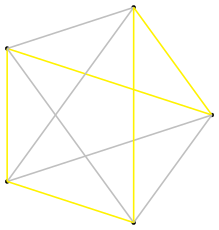
Six points \(A,B,C,D,E\) and \(F\) lie in three dimensional space and are in general positions, that is, no three are collinear and no four lie on a plane. All possible line segments joining pairs of points are drawn and coloured either gold or silver. Prove that there is a triangle whose edges are entirely of one colour. {[}\(Hint\): consider segments radiating from \(A.\){]} Give a sketch showing that the result is false for five points in general positions.
Solution: Consider the \(5\) segements radiating from \(A\). By the pigeonhole principle, at least \(3\) of them must be the same colour (say gold and say reaching \(B,C,D\)). If any of the segments joining any of \(B,C,D\) are gold then we have found a monochromatic gold triangle. But if none of them are gold, they are all silver, therefore \(BCD\) is a monochromatic silver triangle.