Two identical uniform cylinders, each of mass \(m,\) lie in contact with one another on a horizontal plane and a third identical cylinder rests symmetrically on them in such a way that the axes of the three cylinders are parallel. Assuming that all the surfaces in contact are equally rough, show that the minimum possible coefficient of friction is \(2-\sqrt{3}.\)
Solution:
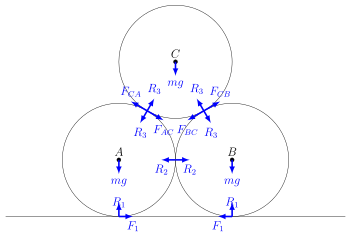
First observe that many forces are equal by symmetry.
Also notice that \(A\) and \(B\) are trying to roll in opposite directions, therefore there is no friction between \(A\) and \(B\).
Considering the system as a whole \(R_1 = \frac32 mg\).
\begin{align*}
\text{N2}(\uparrow,C): && 0 &= -mg +2R_3\cos 30^{\circ} + 2F_{CA} \cos 60^{\circ} \\
\Rightarrow && mg &= \sqrt{3}R_3 + F_{CA} \\
\\
\text{N2}(\uparrow, A): && 0 &= -mg + \frac32mg-R_3\cos 30^{\circ} -F_{AC} \cos 60^\circ \\
\Rightarrow && mg &= \sqrt{3}R_3+F_{AC} \\
\text{N2}(\rightarrow, A): && 0 &= F_{AC}\cos 30^{\circ}+F_1-R_3 \cos 60^\circ -R_2 \\
\Rightarrow && 0 &=F_{AC}\sqrt{3}+2F_1-R_3-2R_2 \\
\overset{\curvearrowleft}{A}: && 0 &= F_1 - F_{AC}
\end{align*}
Since \(F_1 = F_{AC} = F_{CA}\) we can rewrite everything in terms of \(F= F_1\) so.
\begin{align*}
&& mg &= \sqrt{3}R_3 + F \\
&& 0 &= (2+\sqrt{3})F -R_3-2R_2 \\
\Rightarrow && (2+\sqrt3)F &\geq R_3 \\
\Rightarrow && F &\geq (2-\sqrt{3})R_3 \\
\Rightarrow && \mu & \geq 2 - \sqrt{3}
\end{align*}