Problems
Filters
1 problem found
2024 Paper 2 Q3
D: 1500.0
B: 1500.0
coordinate geometry
unit circle
trigonometric identities
half-angle formulae
geometric transformations
rotation
tangent half-angle substitution
The unit circle is the circle with radius 1 and centre the origin, \(O\). \(N\) and \(P\) are distinct points on the unit circle. \(N\) has coordinates \((-1, 0)\), and \(P\) has coordinates \((\cos\theta, \sin\theta)\), where \(-\pi < \theta < \pi\). The line \(NP\) intersects the \(y\)-axis at \(Q\), which has coordinates \((0, q)\).
- Show that \(q = \tan\frac{1}{2}\theta\).
- In this part, \(q \neq 1\).
- Let \(\mathrm{f}_1(q) = \dfrac{1+q}{1-q}\). Show that \(\mathrm{f}_1(q) = \tan\frac{1}{2}\!\left(\theta + \frac{1}{2}\pi\right)\).
- Let \(Q_1\) be the point with coordinates \((0, \mathrm{f}_1(q))\) and \(P_1\) be the point of intersection (other than \(N\)) of the line \(NQ_1\) and the unit circle. Describe geometrically the relationship between \(P\) and \(P_1\).
- \(P_2\) is the image of \(P\) under an anti-clockwise rotation about \(O\) through angle \(\frac{1}{3}\pi\). The line \(NP_2\) intersects the \(y\)-axis at the point \(Q_2\) with co-ordinates \((0, \mathrm{f}_2(q))\). Find \(\mathrm{f}_2(q)\) in terms of \(q\), for \(q \neq \sqrt{3}\).
- In this part, \(q \neq -1\). Let \(\mathrm{f}_3(q) = \dfrac{1-q}{1+q}\), let \(Q_3\) be the point with coordinates \((0, \mathrm{f}_3(q))\) and let \(P_3\) be the point of intersection (other than \(N\)) of the line \(NQ_3\) and the unit circle. Describe geometrically the relationship between \(P\) and \(P_3\).
- In this part, \(0 < q < 1\). Let \(\mathrm{f}_4(q) = \mathrm{f}_2^{-1}\!\Big(\mathrm{f}_3\!\big(\mathrm{f}_2(q)\big)\Big)\), let \(Q_4\) be the point with coordinates \((0, \mathrm{f}_4(q))\) and let \(P_4\) be the point of intersection (other than \(N\)) of the line \(NQ_4\) and the unit circle. Describe geometrically the relationship between \(P\) and \(P_4\).
Solution:
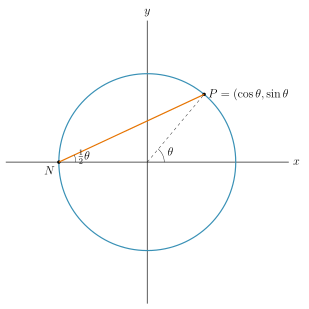
- \(\,\) \begin{align*} && \frac{y-0}{x-(-1)} &= \frac{\sin \theta }{\cos \theta + 1} \\ \Rightarrow && y_0 &= \frac{\sin \theta}{\cos \theta + 1} \\ &&&= \frac{\frac{2t}{1+t^2}}{\frac{1-t^2}{1+t^2}+1} \\ &&&= t = \tan \tfrac{\theta}{2} \end{align*} Alternatively, it is straightforward to see from the angles.
- \(f_1(q) = \frac{1+q}{1-q}\) so \begin{align*} && f_1(\tan\tfrac12\theta) &= \frac{1+\tan\tfrac12\theta}{1-\tan\tfrac12\theta} \\ &&&= \frac{\cos \tfrac12 \theta + \sin \tfrac12 \theta}{\cos \tfrac12 \theta - \sin \tfrac12 \theta} \\ &&&= \frac{\sin(\tfrac14 \pi + \tfrac12 \theta)}{\cos(\tfrac14 \pi + \tfrac12 \theta)} \\ &&&= \tan \tfrac12(\theta + \tfrac{\pi}{2}) \end{align*}
- \(Q_1\) is the point \((0, f_1(q))\) so \(P_1\) will be the point \((\cos (\theta + \tfrac{\pi}{2}), \sin (\theta + \tfrac{\pi}{2}))\) which is a rotation anticlockwise by \(\frac{\pi}{2}\)
- \(P_2 = (\cos(\theta + \tfrac{\pi}{3}), \sin( \theta + \tfrac{\pi}{3})\) and so \(f_2(q) = \tan (\tfrac12(\theta + \tfrac{\pi}{3}))\) so \begin{align*} && f_2(q) &= \tan (\tfrac12(\theta + \tfrac{\pi}{3})) \\ &&&= \frac{q + \tan \frac{\pi}{3}}{1 - \tan \frac{\pi}{3} \cdot q} \\ &&&= \frac{q + \frac{1}{\sqrt3}}{1 - \frac{q}{\sqrt{3}}} \\ &&&= \frac{\sqrt3 q + 1}{\sqrt3-q} \end{align*}
- Since \(q \to -q\) reflects \((0,q)\) in the \(x\)-axis, \(f_3(q) = f_1(-q)\) so \(P_3\) is the reflection of \(P_1\) so it's rotation by \(\frac{\pi}{2}\) followed by reflection in the \(x\)-axis, which is reflection in \(y=x\). [ie \(\theta \to -\theta + \frac{\pi}{2} \to \frac{\pi}{2}-\theta\)]
- We are rotating by \(\frac{\pi}{3}\) then reflecting in \(y=x\) and then rotating by \(-\frac{\pi}{3}\), ie \(\theta \to \theta + \frac{\pi}{3} \to \frac{\pi}{6}-\theta \to -\theta -\frac{\pi}{6} \)