Problems
Filters
10 problems found
2024 Paper 3 Q11
In this question, you may use without proof the results \[\sum_{r=0}^{n} \binom{n}{r} = 2^n \quad \text{and} \quad \sum_{r=0}^{n} r\binom{n}{r} = n\,2^{n-1}.\]
- Show that \[r\binom{2n}{r} = (2n+1-r)\binom{2n}{2n+1-r}\] for \(1 \leqslant r \leqslant 2n\). Hence show that \[\sum_{r=0}^{2n} r\binom{2n}{r} = 2\sum_{r=n+1}^{2n} r\binom{2n}{r}.\]
- A fair coin is tossed \(2n\) times. The value of the random variable \(X\) is whichever is the larger of the number of heads and the number of tails shown. If \(n\) heads and \(n\) tails are shown, then \(X = n\). Show that \[\mathrm{E}(X) = n\left(1 + \frac{1}{2^{2n}}\binom{2n}{n}\right).\]
- Show that \(\dfrac{1}{2^{2n}}\dbinom{2n}{n}\) decreases as \(n\) increases.
- In a game, you choose a value of \(n\) and pay \(\pounds n\); then a fair coin is tossed \(2n\) times. You win an amount in pounds equal to the larger of the number of heads and the number of tails shown. If \(n\) heads and \(n\) tails are shown, then you win \(\pounds n\). How should you choose \(n\) to maximise your expected winnings per pound paid?
2018 Paper 2 Q3
- Let \[ \f(x) = \frac 1 {1+\tan x} \] for \(0\le x < \frac12\pi\,\). Show that \(\f'(x)= -\dfrac{1}{1+\sin 2x}\) and hence find the range of \(\f'(x)\). Sketch the curve \(y=\f(x)\).
- The function \(\g(x)\) is continuous for \(-1\le x \le 1\,\). Show that the curve \(y=\g(x)\) has rotational symmetry of order 2 about the point \((a,b)\) on the curve if and only if \[ \g(x) + \g(2a-x) = 2b\,. \] Given that the curve \(y=\g(x)\) passes through the origin and has rotational symmetry of order 2 about the origin, write down the value of \[\displaystyle \int_{-1}^1 \g(x)\,\d x\,. \]
- Show that the curve \(y=\dfrac{1}{1+\tan^kx}\,\), where \(k\) is a positive constant and \(0 < x < \frac12\pi\,\), has rotational symmetry of order 2 about a certain point (which you should specify) and evaluate \[ \int_{\frac16\pi}^{\frac13\pi} \frac 1 {1+\tan^kx} \, \d x \,. \]
Solution:
- \(\,\) \begin{align*}
&& f(x) &= \frac1{1+\tan x} \\
&& f'(x) &=-(1+\tan x)^{-2} \cdot \sec^2 x \\
&&&= - (\cos x+ \sin x)^{-2} \\
&&&= - (1 + 2 \sin x \cos x)^{-1} \\
&&&= - \frac{1}{1+\sin 2x}
\end{align*}
\(\sin 2x \in [0, 1]\) so \(1+\sin 2x \in [1,2]\) and \(f'(x) \in [-1, -\tfrac12]\)
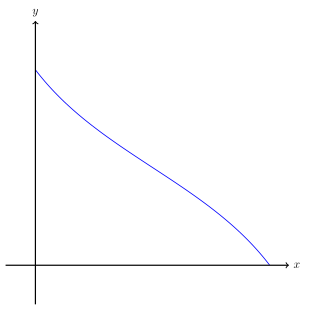
- \(\displaystyle \int_{-1}^1 g(x) \d x = 2g(0) \)
- Let \(g(x) = \frac{1}{1 + \tan^k x}\) then \(g(x)\) has rotational symmetry of order \(2\) about the point \((\frac{\pi}{4}, \frac12)\) which we can see since \begin{align*} g(x) + g(\tfrac12\pi - x) &= \frac{1}{1 + \tan^k x} + \frac{1}{1 + \tan^k(\tfrac12\pi - x)} \\ &= \frac{1}{1+\tan^k x} + \frac{1}{1+\cot^k x} \\ &= \frac{1}{1+\tan^k x} + \frac{\tan^k x}{\tan^k x + 1} \\ &= 1 = 2 \cdot \tfrac12 \end{align*} Therefore \[ \int_{\frac16\pi}^{\frac13\pi} \frac 1 {1+\tan^kx} \, \d x = \frac{\pi}{6} \cdot \frac12 = \frac{\pi}{12}\]
2016 Paper 1 Q12
- Alice tosses a fair coin twice and Bob tosses a fair coin three times. Calculate the probability that Bob gets more heads than Alice.
- Alice tosses a fair coin three times and Bob tosses a fair coin four times. Calculate the probability that Bob gets more heads than Alice.
- Let \(p_1\) be the probability that Bob gets the same number of heads as Alice, and let~\(p_2\) be the probability that Bob gets more heads than Alice, when Alice and Bob each toss a fair coin \(n\) times. Alice tosses a fair coin \(n\) times and Bob tosses a fair coin \(n+1\) times. Express the probability that Bob gets more heads than Alice in terms of \(p_1\) and \(p_2\), and hence obtain a generalisation of the results of parts (i) and (ii).
Solution:
- There are several possibilities \begin{array}{c|c|c} \text{Alice} & \text{Bob} & P \\ \hline 0 & 1 & \frac1{2^2} \cdot 3 \cdot \frac{1}{2^3} = \frac{3}{2^5} \\ 0 & 2 & \frac1{2^2} \cdot 3 \cdot \frac{1}{2^3} = \frac{3}{2^5} \\ 0 & 3 & \frac1{2^2} \cdot \frac{1}{2^3} = \frac{1}{2^5} \\ 1 & 2 & 2 \cdot \frac1{2^2} \cdot 3 \cdot \frac{1}{2^3} = \frac{6}{2^5} \\ 1 & 3 & 2\cdot \frac1{2^2} \cdot \frac{1}{2^3} = \frac{2}{2^5} \\ 2 & 3 & \frac1{2^2} \cdot \frac{1}{2^3} = \frac{1}{2^5} \\ \hline && \frac{1}{2^5}(3+3+1+6+2+1) = \frac{16}{2^5} = \frac12 \end{array}
- There are several possibilities \begin{array}{c|c|c} A & B & \text{count} \\ \hline 0 & 1 & 4 \\ 0 & 2 & 6 \\ 0 & 3 & 4 \\ 0 & 4 & 1 \\ 1 & 2 & 3\cdot6 \\ 1 & 3 & 3\cdot4 \\ 1 & 4 & 3 \\ 2 & 3 & 3\cdot4 \\ 2 & 4 & 3 \\ 3 & 4 & 1 \\ \hline && 64 \end{array} Therefore the total probability is \(\frac12\)
- \(\mathbb{P}(\text{Bob more than Alice}) = p_1 \cdot \underbrace{\frac12}_{\text{he wins by breaking the tie on his last flip}} + p_2\) If \(p_3\) is the probability that Alice gets more heads than Bob, then by symmetry \(p_3 = p_2\) and \(p_1 + p_2 + p_3 = 1\). Therefore \(p_1 + 2p_2 = 1\). ie \(\frac12 p_1 + p_2 = \frac12\) therefore the answer is always \(\frac12\) for all values of \(n\).
2014 Paper 2 Q4
- By using the substitution \(u=1/x\), show that for \(b>0\) \[ \int_{1/b}^b \frac{x \ln x}{(a^2+x^2)(a^2x^2+1)} \d x =0 \,. \]
- By using the substitution \(u=1/x\), show that for \(b>0\), \[ \int_{1/b}^b \frac{\arctan x}{x} \d x = \frac{\pi \ln b} 2\,. \]
- By using the result \( \displaystyle \int_0^\infty \frac 1 {a^2+x^2} \d x = \frac {\pi}{2 a} \) (where \(a > 0\)),and a substitution of the form \(u=k/x\), for suitable \(k\), show that \[ \int_0^\infty \frac 1 {(a^2+x^2)^2} \d x = \frac {\pi}{4a^3 } \, \ \ \ \ \ \ (a > 0). \]
Solution:
- \begin{align*} && I &= \int_{1/b}^b \frac{x \ln x}{(a^2+x^2)(a^2x^2+1} \d x \\ u = 1/x, \d u = -1/x^2 \d x: &&&= \int_{u=b}^{u=1/b} \frac{1/u \ln(1/u)}{(a^2+u^{-2})(a^2u^{-2}+1)} (- \frac{1}{u^2}) \d u \\ &&&= \int_{1/b}^b \frac{-u\ln u}{(a^2u^2+1)(a^2+u^2)} \d u \\ &&&= -I \\ \Rightarrow && I &= 0 \end{align*}
- \(\,\) \begin{align*} && I &= \int_{1/b}^b \frac{\arctan x}{x} \d x \\ u = 1/x, \d x = -1/u^2 \d u: &&&= \int_{u=b}^{u=1/b} \frac{\arctan \frac1u}{\frac1u} \frac{-1}{u^2} \d u \\ &&&= \int_{1/b}^b \frac{\arctan \frac1u}{u} \d u \\ \Rightarrow && 2I &= \int_{1/b}^b \frac{\arctan x + \arctan \frac1x}{x} \d x \\ &&&= \int_{1/b}^b \frac{\frac{\pi}2}{x} \d x \\ &&&= \pi \ln b \\ \Rightarrow && I &= \frac{\pi}{2} \ln b \end{align*}
- \(\,\) \begin{align*} && I_a &= \int_0^{\infty} \frac{1}{(a^2+x^2)^2} \d x \\ u = a/x, \d x = -a/u^2 \d u:&&&= \int_{u=0}^{u=\infty} \frac{1}{\left (a^2+\frac{a^2}{u^2} \right)^2} \frac{a}{u^2} \d u \\ &&&= \frac1{a^3}\int_0^{\infty} \frac{1}{(u+1/u)^2} \d u \\ &&&= \frac{1}{a^3} \int_0^{\infty} \frac{u^2}{(u^2+1)^2} \d u \\ &&&= \frac{1}{a^3} \int_0^{\infty} \frac{u^2+1-1}{(u^2+1)^2} \d u \\ &&&= \frac{1}{a^3} \int_0^{\infty} \frac{1}{(u^2+1)} - \frac{1}{(u^2+1)^2} \d u \\ &&&= \frac1{a^3} \frac{\pi}{2} - \frac{1}{a^3} I_1 \\ \Rightarrow && 2I_1 &= \frac{\pi}{2} \\ \Rightarrow && I_1 &= \frac{\pi}{4} \\ \Rightarrow && I_a &= \frac{\pi}{4a^3} \end{align*}
1999 Paper 3 Q9
The gravitational force between two point particles of masses \(m\) and \(m'\) is mutually attractive and has magnitude $$ {G m m' \over r^2}\,, $$ where \(G\) is a constant and \(r\) is the distance between them. A particle of unit mass lies on the axis of a thin uniform circular ring of radius \(r\) and mass \(m\), at a distance \(x\) from its centre. Explain why the net force on the particle is directed towards the centre of the ring and show that its magnitude is $$ {G m x \over (x^2 + r^2)^{3/2}} \,. $$ The particle now lies inside a thin hollow spherical shell of uniform density, mass \(M\) and radius \(a\), at a distance \(b\) from its centre. Show that the particle experiences no gravitational force due to the shell. %Explain without calculation the effect on this result if %the shell has finite thickness \(x\).
1994 Paper 1 Q8
By means of the change of variable \(\theta=\frac{1}{4}\pi-\phi,\) or otherwise, show that \[ \int_{0}^{\frac{1}{4}\pi}\ln(1+\tan\theta)\,\mathrm{d}\theta=\tfrac{1}{8}\pi\ln2. \] Evaluate \[ {\displaystyle \int_{0}^{1}\frac{\ln(1+x)}{1+x^{2}}\,\mathrm{d}x}\qquad\mbox{ and }\qquad{\displaystyle \int_{0}^{\frac{1}{2}\pi}\ln\left(\frac{1+\sin x}{1+\cos x}\right)\,\mathrm{d}x}. \]
Solution: \begin{align*} && I &= \int_0^{\frac14\pi} \ln (1 + \tan \theta) \d \theta \\ \theta = \tfrac14\pi - \phi, \d \theta = -\d\phi: &&&= \int_0^{\frac14 \pi} \ln ( 1 + \tan (\tfrac14\pi - \phi)) \d \phi \\ &&&= \int_0^{\frac14 \pi} \ln \left ( 1 + \frac{1 - \tan \phi}{1+\tan \phi} \right) \d \phi \\ &&&= \int_0^{\frac14 \pi} \ln \left ( \frac{2}{1+\tan \phi} \right) \d \phi \\ &&&= \tfrac14 \pi \ln 2 - I \\ \Rightarrow && I &= \tfrac18\pi \ln 2 \end{align*} \begin{align*} && J &= \int_0^1 \frac{\ln(1+x)}{1+x^2} \d x \\ x= \tan \theta \d \theta, \d \theta = \frac{\d x}{1+x^2} &&&= \int_0^{\frac14 \pi} \ln(1 + \tan \theta) \d \theta \\ &&&= \tfrac18 \pi \ln 2 \end{align*} \begin{align*} && K &= \int_0^{\frac12 \pi} \ln \left ( \frac{1 + \sin x}{1 + \cos x} \right) \d x \\ y = \tfrac12\pi - x, \d y = -\d x: &&&= \int_0^{\frac12\pi} \ln \left ( \frac{1+\cos y}{1+\sin y}\right) \d y \\ &&&= -K \\ \Rightarrow && K &= 0 \end{align*}
1993 Paper 1 Q4
By making the change of variable \(t=\pi-x\) in the integral \[ \int_{0}^{\pi}x\mathrm{f}(\sin x)\,\mathrm{d}x, \] or otherwise, show that, for any function \(\mathrm{f},\) \[ \int_{0}^{\pi}x\mathrm{f}(\sin x)\,\mathrm{d}x=\frac{\pi}{2}\int_{0}^{\pi}\mathrm{f}(\sin x)\,\mathrm{d}x\,. \] Evaluate \[ \int_{0}^{\pi}\frac{x\sin x}{1+\cos^{2}x}\,\mathrm{d}x\quad\mbox{ and }\quad\int_{0}^{2\pi}\frac{x\sin x}{1+\cos^{2}x}\,\mathrm{d}x\,. \]
Solution: \begin{align*} && I &= \int_0^{\pi} x f(\sin x) \d x \\ t = \pi - x, \d t = -\d t : &&&= \int_{t = \pi}^{t = 0} (\pi - t) f(\sin (\pi - t)) -\d t \\ &&&= \int_0^{\pi} (\pi - t) f(\sin t) \d t \\ \Rightarrow && 2 I &= \pi \int_0^\pi f(\sin t) \d t \\ \Rightarrow && I &= \frac{\pi}{2} \int_0^{\pi} f(\sin x) \d x \end{align*} \begin{align*} && I &= \int_{0}^{\pi}\frac{x\sin x}{1+\cos^{2}x}\,\mathrm{d}x \\ &&&= \frac{\pi}{2}\int_0^\pi \frac{\sin x}{1 + \cos^2 x} \d x \\ &&&= \frac{\pi}{2}\left [ -\tan^{-1} \cos x\right]_0^{\pi} \\ &&&= \tan 1 - \tan (-1) = \frac{\pi^2}{4} \\ \\ && I &= \int_{0}^{2\pi}\frac{x\sin x}{1+\cos^{2}x}\,\mathrm{d}x \\ &&&= \int_{0}^{\pi}\frac{x\sin x}{1+\cos^{2}x}\,\mathrm{d}x + \int_{\pi}^{2\pi} \frac{x\sin x}{1+\cos^{2}x}\,\mathrm{d}x \\ u = x - \pi, \d u = \d x: &&&= \frac{\pi^2}{4} + \int_{0}^{\pi} \frac{(u+\pi)(-\sin u)}{1 + \cos^2 u}\d u \\ &&&= \frac{\pi^2}{4} -\frac{3\pi}{2} \int_0^{\pi} \frac{\sin u}{1+\cos^2 u} \d u \\ &&&= - \frac{\pi^2}2 \end{align*}
1991 Paper 1 Q8
- By a substitution of the form \(y=k-x\) for suitable \(k\), prove that, for any function \(\mathrm{f}\), \[ \int_{0}^{\pi}x\mathrm{f}(\sin x)\,\mathrm{d}x=\pi\int_{0}^{\frac{1}{2}\pi}\mathrm{f}(\sin x)\,\mathrm{d}x. \] Hence or otherwise evaluate \[ \int_{0}^{\pi}\frac{x}{2+\sin x}\,\mathrm{d}x. \]
- Evaluate \[ \int_{0}^{1}\frac{(\sin^{-1}t)\cos\left[(\sin^{-1}t)^{2}\right]}{\sqrt{1-t^{2}}}\,\mathrm{d}t. \] {[}No credit will be given for numerical answers obtained by use of a calculator.{]}
Solution:
- \begin{align*} y = \pi - x, \d y = -\d x: && \int_0^{\pi} x f(\sin x) &= \int_{y = \pi}^{y = 0}(\pi - y) f(\sin(\pi-y))- \d y \\ &&&= \int_0^{\pi} (\pi -y) f(\sin y) \d y \\ \Rightarrow && 2 \int_0^{\pi} x f(\sin x)\d x &= \pi \int_0^{\pi} f(\sin x) \d x \\ &&&= \pi \int_0^{\pi/2} f(\sin x ) \d x + \pi \int_{\pi/2}^{\pi} f(\sin x ) \d x \\ &&&= \pi \int_0^{\pi/2} f(\sin x ) \d x +\pi \int_{y=\pi/2}^{y=0} f(\sin (\pi-y) ) (-\d y) \\ &&&= 2 \pi \int_0^{\pi/2} f(\sin x) \d x \\ \Rightarrow && \int_0^{\pi} x f(\sin x)\d x &= \pi \int_0^{\pi/2} f(\sin x) \d x \end{align*} Therefore if \(f(x) = \frac1{2+\sin x}\), letting \(t = \tan \frac{x}{2}\) we have \(\sin x = \frac{2 t}{1+t^2}, \frac{dt}{\d x} = \frac12 (1+t^2)\) \begin{align*} && \int_0^{\pi} \frac{x}{2 + \sin x } \d x &= \pi \int_0^{\pi/2} \frac{1}{2 + \sin x} \d x \\ &&&= \pi \int_{t = 0}^{t = 1} \frac{1}{2+\frac{2t}{1+t^2}} \frac{2}{1+t^2} \d t \\ &&&=\pi \int_0^1 \frac{2}{2t^2+2t+2} \d t\\ &&&=\pi \int_0^1 \frac{1}{(t+\tfrac12)^2 + \tfrac34} \d t\\ &&&= \pi \left [\frac{1}{\sqrt{3/4}} \tan^{-1} \frac{u}{\sqrt{3/4}} \right ]_{u=1/2}^{3/2} \\ &&&= \frac{2 \pi}{\sqrt{3}} \left ( \tan^{-1} \sqrt{3} - \tan^{-1} \frac1{\sqrt{3}} \right) \\ &&&= \frac{2 \pi}{\sqrt{3}} \left ( \frac{\pi}{3} - \frac{\pi}{6} \right) \\ &&&= \frac{\pi^2}{3\sqrt{3}} \end{align*}
- Let \(u = (\sin^{-1} t)^2, \frac{\d u}{\d t} = 2(\sin^{-1} t) \frac{1}{\sqrt{1-t^2}}\) \begin{align*} \int_{0}^{1}\frac{(\sin^{-1}t)\cos\left[(\sin^{-1}t)^{2}\right]}{\sqrt{1-t^{2}}}\,\mathrm{d}t &= \int_{u=0}^{\pi^2/4} \frac12 \cos u \d u \\ &= \frac12 \sin \frac{\pi^2}{4} \end{align*}
1991 Paper 3 Q7
- Prove that \[ \int_{0}^{\frac{1}{2}\pi}\ln(\sin x)\,\mathrm{d}x=\int_{0}^{\frac{1}{2}\pi}\ln(\cos x)\,\mathrm{d}x=\tfrac{1}{2}\int_{0}^{\frac{1}{2}\pi}\ln(\sin2x)\,\mathrm{d}x-\tfrac{1}{4}\pi\ln2 \] and \[ \int_{0}^{\frac{1}{2}\pi}\ln(\sin2x)\,\mathrm{d}x=\tfrac{1}{2}\int_{0}^{\pi}\ln(\sin x)\,\mathrm{d}x=\int_{0}^{\frac{1}{2}\pi}\ln(\sin x)\,\mathrm{d}x. \] Hence, or otherwise, evaluate \({\displaystyle \int_{0}^{\frac{1}{2}\pi}\ln(\sin x)\,\mathrm{d}x.}\) You may assume that all the integrals converge.
- Given that \(\ln u< u\) for \(u\geqslant1\) deduce that \[ \tfrac{1}{2}\ln x < \sqrt{x}\qquad\mbox{ for }\quad x\geqslant1. \] Deduce that \(\dfrac{\ln x}{x}\rightarrow0\) as \(x\rightarrow\infty\) and that \(x\ln x\rightarrow0\) as \(x\rightarrow0\) through positive values.
- Using the results of parts (i) and (ii), or otherwise, evaluate \({\displaystyle \int_{0}^{\frac{1}{2}\pi}x\cot x\,\mathrm{d}x.}\)
Solution:
- \begin{align*} u = \frac{\pi}{2} - x :&& \int_0^{\tfrac12 \pi} \ln (\sin x) \d x &= \int_{\frac12\pi}^0 \ln (\cos u) (- 1)\d u \\ &&&= \int_0^{\frac12 \pi} \ln (\cos x) \d x \\ \Rightarrow && 2 \int_0^{\tfrac12 \pi} \ln (\sin x) \d x &= \int_0^{\tfrac12 \pi} \ln (\sin x) \d x +\int_0^{\tfrac12 \pi} \ln (\cos x) \d x \\ &&&= \int_0^{\tfrac12 \pi}\left (\ln (\sin x)+ \ln (\cos x) \right) \d x \\ &&&= \int_0^{\frac12 \pi} \ln \left (\frac12 \sin 2x \right) \d x \\ &&&= \int_0^{\frac12 \pi} \left ( \ln \left (\sin 2x \right) - \ln 2 \right)\d x \\ &&&= \int_0^{\frac12 \pi} \ln \left (\sin 2x \right)\d x - \frac{\pi}{2} \ln 2\\ \Rightarrow && \int_0^{\tfrac12 \pi} \ln (\sin x) \d x &= \frac12 \int_0^{\frac12 \pi} \ln \left (\sin 2x \right)\d x - \frac{\pi}{4} \ln 2 \end{align*} \begin{align*} u = 2x, \d u = 2 \d x && \int_0^{\frac12 \pi} \ln \left (\sin 2x \right)\d x &= \int_0^{\pi} \ln (\sin u) \frac12 \d u \\ &&&= \frac12 \int_0^{\pi} \ln (\sin u) \d u \\ &&&=\frac12 \left ( \int_0^{\pi/2} \ln (\sin u) \d u + \int_{\pi/2}^{\pi} \ln (\sin u) \d u \right)\\ &&&= \int_0^{\pi/2} \ln (\sin u) \d u \\ \Rightarrow && I &= \frac12 I - \frac14 \pi \ln 2 \\ \Rightarrow && I &= -\frac12 \pi \ln 2 \end{align*}
- \begin{align*} && \ln u &< u & \quad (u \geq 1)\\ \underbrace{\Rightarrow}_{u = \sqrt{x}} && \ln \sqrt{x} &< \sqrt{x} \\ \Rightarrow && \frac12 \ln x &< \sqrt{x} \\ \Rightarrow && \frac{\ln x}{x} &< \frac{2\sqrt{x}}{x} \\ &&&= \frac{2}{\sqrt{x}} \\ &&&\to 0 & (x \to \infty) \\ && x \ln x &= \frac{\ln 1/y}{y} \\ &&&= -\frac{\ln y}{y} \\ &&&\to 0 & (y \to \infty, x \to 0) \end{align*}
- \begin{align*} \int_{0}^{\frac{1}{2}\pi}x\cot x\,\mathrm{d}x &= \left [ x \ln(\sin x) \right]_0^{\pi/2} - \int_0^{\pi/2} \ln (\sin x) \d x \\ &= \left ( \frac{\pi}{2} \ln 1 - \lim_{x \to 0} x \ln (\sin x) \right) - \left ( -\frac12 \pi \ln 2 \right) \\ &= \frac12 \pi \ln 2 \end{align*}
1987 Paper 2 Q6
Let \[ I=\int_{-\frac{1}{2}\pi}^{\frac{1}{2}\pi}\frac{\cos^{2}\theta}{1-\sin\theta\sin2\alpha}\,\mathrm{d}\theta\, , \] where \(0<\alpha<\frac{1}{4}\pi\). Show that \[ I=\int_{-\frac{1}{2}\pi}^{\frac{1}{2}\pi}\frac{\cos^{2}\theta}{1+\sin\theta\sin2\alpha}\,\mathrm{d}\theta\, , \] and hence that \[ I=\frac{\pi}{\sin^{2}2\alpha}-\cot^{2}2\alpha\int_{-\frac{1}{2}\pi}^{\frac{1}{2}\pi}\frac{\sec^{2}\theta}{1+\cos^{2}2\alpha\tan^{2}\theta}\,\mathrm{d}\theta. \] Show that \(I=\frac{1}{2}\pi\sec^{2}\alpha\), and state the value of \(I\) if \(\frac{1}{4}\pi<\alpha<\frac{1}{2}\pi\).
Solution: \begin{align*} \int_{-\frac{1}{2}\pi}^{\frac{1}{2}\pi}\frac{\cos^{2}\theta}{1-\sin\theta\sin2\alpha}\,\mathrm{d}\theta &= \int_{u = \frac12 \pi}^{u = -\frac12 \pi} \frac{\cos^2 (-u)}{1-\sin(-u) \sin 2 \alpha} -\d u \tag{\(u = -\theta\)} \\ &= \int_{\frac12 \pi}^{-\frac12 \pi} \frac{\cos^2 u}{1+\sin u \sin 2 \alpha} -\d u \\ &= \int_{-\frac12 \pi}^{\frac12 \pi} \frac{\cos^2 u}{1+\sin u \sin 2 \alpha} \d u \\ &= \int_{-\frac12 \pi}^{\frac12 \pi} \frac{\cos^2 \theta}{1+\sin \theta \sin 2 \alpha} \d \theta \\ \end{align*} Since \(\displaystyle \frac{1}{(1-a^2u^2)} = \frac12 \l \frac{1}{1+au} + \frac1{1-au} \r\) \begin{align*} \int_{-\frac12 \pi}^{\frac12 \pi} \frac{\cos^2 \theta}{1+\sin \theta \sin 2 \alpha} \d \theta &= \int_{-\frac12 \pi}^{\frac12 \pi} \frac{\cos^2 \theta}{1-\sin ^2\theta \sin^2 2 \alpha} \d \theta \\ &= \int_{-\frac12 \pi}^{\frac12 \pi} \frac{1-\sin^2 \theta}{1-\sin ^2\theta \sin^2 2 \alpha} \d \theta \\ &= \int_{-\frac12 \pi}^{\frac12 \pi} \frac{(1-\sin ^2\theta \sin^2 2 \alpha) \frac{1}{\sin^2 2\alpha} + 1 - \cosec^2 2\alpha}{1-\sin ^2\theta \sin^2 2 \alpha} \d \theta \\ &= \frac{\pi}{\sin^2 2\alpha} -\cot^2 2\alpha \int_{-\frac{\pi}2}^{\frac{\pi}2} \frac{1}{1 - \sin^2 \theta \sin^2 2 \alpha} \d \theta \\ &= \frac{\pi}{\sin^2 2\alpha} -\cot^2 2\alpha \int_{-\frac{\pi}2}^{\frac{\pi}2} \frac{1}{1 - \sin^2 \theta (1-\cos^2 2 \alpha)} \d \theta \\ &= \frac{\pi}{\sin^2 2\alpha} -\cot^2 2\alpha \int_{-\frac{\pi}2}^{\frac{\pi}2} \frac{1}{\cos^2 \theta +\sin^2 \theta \cos^2 2 \alpha} \d \theta \\ &= \frac{\pi}{\sin^2 2\alpha} -\cot^2 2\alpha \int_{-\frac{\pi}2}^{\frac{\pi}2} \frac{\sec^2 \theta}{1 +\tan^2 \theta \cos^2 2 \alpha} \d \theta \\ \end{align*} Finally, using the substitution \(u =|\cos 2 \alpha | \tan \theta, \d u = |\cos 2 \alpha |\sec^2 \theta \d \theta\) \begin{align*} \int_{-\frac{\pi}2}^{\frac{\pi}2} \frac{\sec^2 \theta}{1 +\tan^2 \theta \cos^2 2 \alpha} \d \theta &= |\sec 2\alpha|\int_{u = -\infty}^{u = \infty} \frac{1}{1 + u^2} \d u \\ &= |\sec 2 \alpha|\pi \end{align*} and so \begin{align*} I &= \frac{\pi}{\sin^2 2\alpha} -\cot^2 2\alpha |\sec 2 \alpha|\pi \\ &= \frac{\pi}{\sin^2 2\alpha} \l 1-\cos 2\alpha \r \\ &= \frac{\pi}{4\sin^2 \alpha\cos^2 \alpha} \l 2 \sin^2 \alpha \r \\ &= \frac{\pi}{2 \cos^2 \alpha} = \frac{\pi}{2} \sec^2 \alpha \end{align*} When \(\alpha\) small enough that the modulus doesn't flip the sign. When if \(\frac{1}{4}\pi<\alpha<\frac{1}{2}\pi\) we have: \begin{align*} I &= \frac{\pi}{\sin^2 2\alpha} -\cot^2 2\alpha |\sec 2 \alpha|\pi \\ &= \frac{\pi}{\sin^2 2\alpha} \l 1+\cos 2\alpha \r \\ &= \frac{\pi}{4\sin^2 \alpha\cos^2 \alpha} \l 2 \cos^2 \alpha \r \\ &= \frac{\pi}{2 \sin^2 \alpha} = \frac{\pi}{2} \cosec^2 \alpha \end{align*}