Problems
Filters
47 problems found
2025 Paper 2 Q5
You need not consider the convergence of the improper integrals in this question.
- Use the substitution \(x = u^{-1}\) to show that \[\int_0^{\infty} \frac{\sqrt{x}-1}{\sqrt{x(x^3+1)}} \, dx = 0.\]
- Use the substitution \(x = u^{-2}\) to show that \[\int_0^{\infty} \frac{1}{\sqrt{x^3+1}} \, dx = 2\int_0^{\infty} \frac{1}{\sqrt{x^6+1}} \, dx.\]
- Find, in terms of \(p\) and \(s\), a value of \(r\) for which \[\int_0^{\infty} \frac{x^r - 1}{\sqrt{x^s(x^p+1)}} \, dx = 0,\] given that \(p\) and \(s\) are fixed values for which the required integrals converge.
- Show that, for any positive value of \(k\), it is possible to find values of \(p\) and \(q\) for which \[\int_0^{\infty} \frac{1}{\sqrt{x^p+1}} \, dx = k\int_0^{\infty} \frac{1}{\sqrt{x^q+1}} \, dx.\]
Solution:
- \begin{align*} && I &= \int_0^{\infty} \frac{\sqrt{x}-1}{\sqrt{x(x^3+1)}} \, dx \\ x = u^{-1}, \d x = -u^{-2} \d u: && &= \int_{u=\infty}^{u = 0} \frac{u^{-1/2} - 1}{\sqrt{u^{-1}(u^{-3}+1)}} (-u^{-2}) \d u \\ &&&= \int_0^\infty \frac{u^{-1/2} -1}{\sqrt{1+u^3}} \d u \\ &&&= \int_0^\infty \frac{1-\sqrt{u}}{\sqrt{u(u^3+1)}} \d u \\ &&&= -I \\ \Rightarrow && I &= 0 \end{align*}
- \begin{align*} && I &= \int_0^{\infty} \frac{1}{\sqrt{x^3+1}} \, dx \\ x = u^{-2}, \d x = -2u^{-3} \d u: && &= \int_{u = \infty}^{u = 0} \frac{1}{\sqrt{u^{-6}+1}} (-2u^{-3}) \d u \\ &&&= \int_0^\infty \frac{2}{\sqrt{1+u^6}} \d u \\ &&&= 2\int_0^{\infty} \frac{1}{\sqrt{x^6+1}} \, \d x \end{align*}
- \begin{align*} && I &= \int_0^{\infty} \frac{x^r - 1}{\sqrt{x^s(x^p+1)}} \, dx \\ x = u^{-1}, \d x = - u^{-2} \d t: &&&= \int_{u=\infty}^{u = 0} \frac{u^{-r}-1}{\sqrt{u^{-s}(u^{-p}+1)}} (- u^{-2}) \d u \\ &&&= \int_0^\infty \frac{u^{-r}-1}{\sqrt{u^{4-s}(u^{-p}+1)}} \d u \\ &&&= \int_0^\infty \frac{1-u^{r}}{\sqrt{u^{4-s+2r}(u^{-p}+1)}} \d u \\ &&&= \int_0^\infty \frac{1-u^{r}}{\sqrt{u^{4-s+2r-p}(1+u^p)}} \d u \\ \end{align*} Therefore if \(4-s+2r-p = s\) or \(r = \frac{p}2+s-2\) we have \(I = -I\), ie \(I = 0\).
- \begin{align*} && I &= \int_0^{\infty} \frac{1}{\sqrt{x^p+1}} \, dx \\ x = u^{-t}, \d x = -t u^{-t-1}:&&&= \int_{u = -\infty}^{u = 0} \frac{1}{\sqrt{u^{-pt}+1}} (-t u^{-t-1}) \d u \\ &&&= t \int_0^\infty \frac1{\sqrt{u^{-pt+2t+2}+u^{2t+2}}} \d u \end{align*} Therefore if \(\begin{cases} 2t+2 &= q \\ 2t+2 -pt &= 0 \end{cases}\), ie \(q = 2t+2, p = 2 + 2/t\) we will have found the \(p, q\) desired for any \(t\) (or \(k\)). [Alternatively] Let \(\displaystyle I(p) =\int_0^{\infty} \frac{1}{\sqrt{x^p+1}} \, dx\), then clearly \(I(p)\) is decreasing and as \(p \to \infty\) \(I(p) \to 1\), so our integral can take any values on \((1, \infty)\) and so for any positive value we can find two values with a given ratio. In particular given \(k\) and \(p\) we can find a suitable \(q\).
2025 Paper 3 Q1
You need not consider the convergence of the improper integrals in this question. For \(p, q > 0\), define $$b(p,q) = \int_0^1 x^{p-1}(1-x)^{q-1} \, dx$$
- Show that \(b(p,q) = b(q,p)\).
- Show that \(b(p+1,q) = b(p,q) - b(p,q+1)\) and hence that \(b(p+1,p) = \frac{1}{2}b(p,p)\).
- Show that $$b(p,q) = 2\int_0^{\pi/2} (\sin\theta)^{2p-1}(\cos\theta)^{2q-1} \, d\theta$$ Hence show that \(b(p,p) = \frac{1}{2^{2p-1}}b(p,\frac{1}{2})\).
- Show that $$b(p,q) = \int_0^\infty \frac{t^{p-1}}{(1+t)^{p+q}} \, dt$$
- Evaluate $$\int_0^\infty \frac{t^{3/2}}{(1+t)^6} \, dt$$
Solution:
- \begin{align*} && b(p,q) &= \int_0^1 x^{p-1}(1-x)^{q-1}\, \d x \\ u = 1-x, \d u = -\d x && &= \int_{u=1}^{u = 0} (1-u)^{p-1}u^{q-1} (-1) \, \d u \\ &&&= \int_0^1 (1-u)^{p-1}u^{q-1} \d u \\ &&&= \int_0^1 u^{q-1}(1-u)^{p-1} \d u \\ &&&= b(q,p) \end{align*}
- \begin{align*} b(p+1,q) + b(p,q+1) &= \int_0^1 x^p(1-x)^{q-1} \d x + \int_0^1 x^{p-1}(1-x)^{q} \d x \\ &= \int_0^1 \left (x^p(1-x)^{q-1} + x^{p-1}(1-x)^{q}\right) \d x \\ &= \int_0^1 x^{p-1}(1-x)^{q-1} \left (x + (1-x) \right) \d x \\ &= \int_0^1 x^{p-1}(1-x)^{q-1} \d x \\ &= b(p,q) \end{align*} Therefore \(b(p+1,q) = b(p,q) - b(p,q+1)\), in particular \(2b(p+1,p) = b(p+1,p)+b(p,p+1) = b(p,p) \Rightarrow b(p+1,p) = \frac12 b(p,p)\) as required.
- \begin{align*} && b(p,q) &= \int_0^1 x^{p-1} (1-x)^{q-1} \d x \\ x = \sin^2 \theta, \d x = 2 \sin \theta \cos \theta \d \theta && &= \int_{u=0}^{u = \pi/2} \sin^{2p-2} \theta (1-\sin^2 \theta)^{q-1} \cdot 2 \sin \theta \cos \theta \d \theta \\ &&&= 2 \int_0^{\pi/2} \sin^{2p-1} \theta \cos^{2q-2} \cos \theta \d \theta \\ &&&= 2 \int_0^{\pi/2} \sin^{2p-1} \theta \cos^{2q-1} \theta \d \theta \end{align*} \begin{align*} b(p,p) &= 2\int_0^{\pi/2} (\sin \theta)^{2p-1}(\cos \theta)^{2p-1} \d \theta \\ &= 2 \int_0^{\pi/2} \left (\frac12 \sin 2\theta \right)^{2p-1} \d \theta \\ &= \frac1{2^{2p-1}} 2 \int_0^{\pi/2} (\sin 2 \theta)^{2p-1} \d \theta \\ &= \frac1{2^{2p-1}} 2 \int_{x=0}^{x=\pi} (\sin x)^{2p-1} 2 \d x\\ &= \frac1{2^{2p-1}} 2 \int_{x=0}^{x=\pi/2} (\sin x)^{2p-1} \d x\\ &= \frac1{2^{2p-1}} 2 \int_{0}^{\pi/2} (\sin x)^{2p-1} (\cos x)^{0} \d x\\ &= \frac1{2^{2p-1}} b(p,\tfrac12) \end{align*}
- \begin{align*} &&b(p,q) &= \int_0^1 x^{p-1}(1-x)^{q-1} \d x \\ t = \frac{x}{1-x}, \d t = (1-x)^{-2} \d x &&&= \int_{t=0}^{t = \infty} \left ( \frac{t}{1+t} \right)^{p-1} \left ( 1-\frac{t}{1+t} \right)^{q+1} \d t\\ x = \frac{t}{1+t} && &=\int_0^\infty t^{p-1} (1+t)^{-(p-1)-(q+1)} \d t \\ &&&= \int_0^{\infty} \frac{t^{p-1}}{(1+t)^{p+q}} \d t \end{align*}
- \begin{align*} I &= \int_0^\infty \frac{t^{3/2}}{(1+t)^6} \, dt \\ &= b( \tfrac52, \tfrac72) \\ &= b( \tfrac52, \tfrac52+1) \\ &= \tfrac12 b( \tfrac52, \tfrac52) \\ &= \frac12 \cdot \frac1{2^{4}} b(\tfrac52, \tfrac12) \\ &= \frac{1}{2^5} \cdot 2 \int_0^{\pi/2} (\sin \theta)^{4} \d \theta \\ &= \frac1{2^4} \int_0^{\pi/2}\left (\frac{1-\cos 2 \theta}{2} \right)^2 \d \theta \\ &= \frac1{2^6} \int_0^{\pi/2}\left (1 - 2 \cos 2 \theta + \cos^{2} 2 \theta \right) \d \theta \\ &= \frac1{2^6} \int_0^{\pi/2}\left (1 - 2 \cos 2 \theta + \frac{\cos 4 \theta + 1}{2} \right) \d \theta \\ &= \frac1{2^6} \left [\frac32 \theta - \sin 2 \theta + \frac18 \sin 4 \theta \right]_0^{\pi/2} \\ &= \frac1{2^6} \frac{3 \pi}{4} \\ &= \frac{3 \pi}{2^8} \end{align*}
2025 Paper 3 Q7
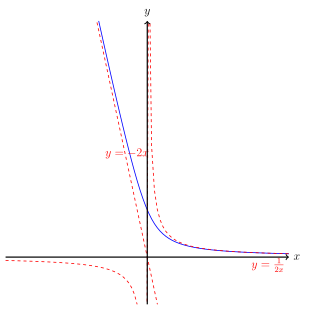
Let \(f(x) = \sqrt{x^2 + 1} - x\).
- Using a binomial series, or otherwise, show that, for large \(|x|\), \(\sqrt{x^2 + 1} \approx |x| + \frac{1}{2|x|}\). Sketch the graph \(y = f(x)\).
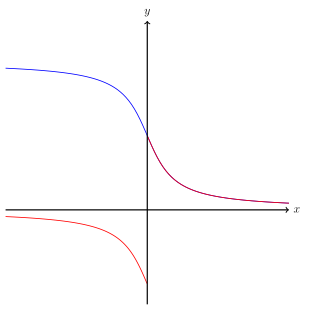
- Let \(g(x) = \tan^{-1} f(x)\) and, for \(x \neq 0\), let \(k(x) = \frac{1}{2}\tan^{-1}\frac{1}{x}\).
- Show that \(g(x) + g(-x) = \frac{1}{2}\pi\).
- Show that \(k(x) + k(-x) = 0\).
- Show that \(\tan k(x) = \tan g(x)\) for \(x > 0\).
- Sketch the graphs \(y = g(x)\) and \(y = k(x)\) on the same axes.
- Evaluate \(\int_0^1 k(x) \, dx\) and hence write down the value of \(\int_{-1}^0 g(x) \, dx\).
Solution:
- \begin{align*}
\sqrt{x^2+1} &= |x|\sqrt{1+\frac{1}{x^2}} \\
&=|x| \left (1 + \frac12 \frac{1}{x^2} + \cdots \right) & \text{if } \left (\frac{1}{x^2} < 1 \right) \\
&= |x| + \frac12 \frac{1}{|x|} + \cdots \\
&\approx |x| + \frac{1}{2|x|}
\end{align*}
- \begin{align*} && \tan( g(x) + g(-x)) &= \tan \left ( \tan^{-1}(\sqrt{x^2+1}-x) + \tan^{-1}(\sqrt{x^2+1}+x) \right) \\ &&&= \frac{\sqrt{x^2+1}-x+\sqrt{x^2+1}+x}{1-1} \\ \Rightarrow && g(x) + g(-x) &\in \left \{\cdots, -\frac{\pi}{2}, \frac{\pi}{2}, \cdots \right\} \end{align*} But \(g(x), g(-x) > 0\) and \(g(x), g(-x) \in (-\frac{\pi}{2}, \frac{\pi}{2})\), therefore it must be \(\frac{\pi}{2}\).
- \begin{align*} && \tan(2(k(x) + k(-x))) &= \tan(\tan^{-1}x + \tan^{-1}(-x)) \\ &&&= 0 \\ \Rightarrow && k(x)+k(-x) &\in \left \{\cdots, -\frac{\pi}{2}, 0, \frac{\pi}{2}, \cdots \right\} \\ \end{align*} But \(k(x) \in (-\frac{\pi}{4}, \frac{\pi}{4})\), therefore \(k(x) + k(-x) = 0\).
- Let \(t = \tan k(x)\). \begin{align*} && \tan \left ( \tan^{-1} \frac{1}{x} \right) &= \frac{2 \tan\left ( \frac12 \tan^{-1} \frac1x \right)}{ 1-\tan^2\left ( \frac12 \tan^{-1} \frac1x \right)} \\ \Rightarrow && \frac1x &= \frac{2t}{1-t^2} \\ \Rightarrow && 1-t^2 &= 2tx \\ \Rightarrow && 0 &= t^2+2tx - 1 \\ \Rightarrow && 0 &= (t+x)^2 - 1-x^2 \\ \Rightarrow && t &= -x \pm \sqrt{1+x^2} \end{align*} Since \(t > 0\), \(t = \sqrt{1+x^2}-x = f(x) = \tan g(x)\)
- \begin{align*} \int_0^1 k(x) \d x &= \int_0^1 \frac12 \tan^{-1} \left ( \frac1x \right) \d x \\ &= \left [ \frac{x}{2} \tan^{-1}\left ( \frac1x \right) \right]_0^1 - \int_0^1 \frac{x}{2} \frac{-1/x^2}{1+1/x^2} \d x \\ &= \left [ \frac{x}{2} \tan^{-1}\left ( \frac1x \right) \right]_0^1 + \frac14 \int_0^1 \frac{2x}{1+x^2} \d x \\ &= \frac12 \frac{\pi}{4} + \frac14 \ln(2) \\ &= \frac{\pi + \ln 4}{8}\end{align*} Therefore \(\displaystyle \int_{-1}^0 g(x) \d x = -\frac{\pi + \ln 4}{8}\)
2023 Paper 2 Q1
- Show that making the substitution \(x = \frac{1}{t}\) in the integral \[\int_a^b \frac{1}{(1+x^2)^{\frac{3}{2}}}\,\mathrm{d}x\,,\] where \(b > a > 0\), gives the integral \[\int_{b^{-1}}^{a^{-1}} \frac{-t}{(1+t^2)^{\frac{3}{2}}}\,\mathrm{d}t\,.\]
- Evaluate:
- \(\displaystyle\int_{\frac{1}{2}}^{2} \frac{1}{(1+x^2)^{\frac{3}{2}}}\,\mathrm{d}x\,;\)
- \(\displaystyle\int_{-2}^{2} \frac{1}{(1+x^2)^{\frac{3}{2}}}\,\mathrm{d}x\,.\)
- Show that \[\int_{\frac{1}{2}}^{2} \frac{1}{(1+x^2)^2}\,\mathrm{d}x = \int_{\frac{1}{2}}^{2} \frac{x^2}{(1+x^2)^2}\,\mathrm{d}x = \frac{1}{2}\int_{\frac{1}{2}}^{2} \frac{1}{1+x^2}\,\mathrm{d}x\,,\] and hence evaluate \[\int_{\frac{1}{2}}^{2} \frac{1}{(1+x^2)^2}\,\mathrm{d}x\,.\]
- Evaluate \[\int_{\frac{1}{2}}^{2} \frac{1-x}{x(1+x^2)^{\frac{1}{2}}}\,\mathrm{d}x\,.\]
2022 Paper 3 Q11
A fair coin is tossed \(N\) times and the random variable \(X\) records the number of heads. The mean deviation, \(\delta\), of \(X\) is defined by \[ \delta = \mathrm{E}\big(|X - \mu|\big) \] where \(\mu\) is the mean of \(X\).
- Let \(N = 2n\) where \(n\) is a positive integer.
- Show that \(\mathrm{P}(X \leqslant n-1) = \frac{1}{2}\big(1 - \mathrm{P}(X=n)\big)\).
- Show that \[ \delta = \sum_{r=0}^{n-1}(n-r)\binom{2n}{r}\frac{1}{2^{2n-1}}\,. \]
- Show that for \(r > 0\), \[ r\binom{2n}{r} = 2n\binom{2n-1}{r-1}\,. \] Hence show that \[ \delta = \frac{n}{2^{2n}}\binom{2n}{n}\,. \]
- Find a similar expression for \(\delta\) in the case \(N = 2n+1\).
Solution:
- When \(N = 2n+1\), \(\mu = n +\frac12\) and so \begin{align*} && \delta &= \E[|X-\mu|] \\ &&&= \sum_{i=0}^n (n + \tfrac12 - i) \frac{1}{2^{2n+1}} \binom{2n+1}{i} + \sum_{i=n+1}^{2n+1} (i-n - \tfrac12) \frac{1}{2^{2n+1}} \binom{2n+1}{i} \\ &&&= 2\sum_{i=0}^n (n + \tfrac12 - i) \frac{1}{2^{2n+1}} \binom{2n+1}{i} \\ &&&= \frac{(2n +1)}{2^{2n+1}}\sum_{i=0}^n \binom{2n+1}i - \frac{2}{2^{2n+1}}\sum_{i=0}^n i \binom{2n+1}{i} \\ &&&= \frac{(2n +1)}{2^{2n+1}}\sum_{i=0}^n \binom{2n+1}i - \frac{2}{2^{2n+1}}\sum_{i=1}^n (2n+1) \binom{2n}{i-1} \\ &&&= \frac{(2n +1)}{2^{2n+1}}2^{2n} - \frac{2(2n+1)}{2^{2n+1}}\sum_{i=0}^{n-1} \binom{2n}{i} \\ &&&= \frac{(2n +1)}{2} - \frac{2(2n+1)}{2^{2n+1}} \frac12\left (2^{2n} - \binom{2n}{n} \right) \\ &&&= \frac{2n+1}{2^{2n+1}}\binom{2n}{n} \end{align*}
2020 Paper 2 Q2
The curves \(C_1\) and \(C_2\) both satisfy the differential equation \[\frac{\mathrm{d}y}{\mathrm{d}x} = \frac{kxy - y}{x - kxy},\] where \(k = \ln 2\). All points on \(C_1\) have positive \(x\) and \(y\) co-ordinates and \(C_1\) passes through \((1,\,1)\). All points on \(C_2\) have negative \(x\) and \(y\) co-ordinates and \(C_2\) passes through \((-1,\,-1)\).
- Show that the equation of \(C_1\) can be written as \((x-y)^2 = (x+y)^2 - 2^{x+y}\). Determine a similar result for curve \(C_2\). Hence show that \(y = x\) is a line of symmetry of each curve.
- Sketch on the same axes the curves \(y = x^2\) and \(y = 2^x\), for \(x \geqslant 0\). Hence show that \(C_1\) lies between the lines \(x + y = 2\) and \(x + y = 4\). Sketch curve \(C_1\).
- Sketch curve \(C_2\).
2020 Paper 2 Q8
In this question, \(\mathrm{f}(x)\) is a quartic polynomial where the coefficient of \(x^4\) is equal to \(1\), and which has four real roots, \(0\), \(a\), \(b\) and \(c\), where \(0 < a < b < c\). \(\mathrm{F}(x)\) is defined by \(\mathrm{F}(x) = \displaystyle\int_0^x \mathrm{f}(t)\,\mathrm{d}t\). The area enclosed by the curve \(y = \mathrm{f}(x)\) and the \(x\)-axis between \(0\) and \(a\) is equal to that between \(b\) and \(c\), and half that between \(a\) and \(b\).
- Sketch the curve \(y = \mathrm{F}(x)\), showing the \(x\) co-ordinates of its turning points. Explain why \(\mathrm{F}(x)\) must have the form \(\mathrm{F}(x) = \frac{1}{5}x^2(x-c)^2(x-h)\), where \(0 < h < c\). Find, in factorised form, an expression for \(\mathrm{F}(x) + \mathrm{F}(c-x)\) in terms of \(c\), \(h\) and \(x\).
- If \(0 \leqslant x \leqslant c\), explain why \(\mathrm{F}(b) + \mathrm{F}(x) \geqslant 0\) and why \(\mathrm{F}(b) + \mathrm{F}(x) > 0\) if \(x \neq a\). Hence show that \(c - b = a\) or \(c > 2h\). By considering also \(\mathrm{F}(a) + \mathrm{F}(x)\), show that \(c = a + b\) and that \(c = 2h\).
- Find an expression for \(\mathrm{f}(x)\) in terms of \(c\) and \(x\) only. Show that the points of inflection on \(y = \mathrm{f}(x)\) lie on the \(x\)-axis.
2019 Paper 2 Q7
- The points \(A\), \(B\) and \(C\) have position vectors \(\mathbf{a}\), \(\mathbf{b}\) and \(\mathbf{c}\), respectively. Each of these vectors is a unit vector (so \(\mathbf{a} \cdot \mathbf{a} = 1\), for example) and $$\mathbf{a} + \mathbf{b} + \mathbf{c} = \mathbf{0}.$$ Show that \(\mathbf{a} \cdot \mathbf{b} = -\frac{1}{2}\). What can be said about the triangle ABC? You should justify your answer.
- The four distinct points \(A_i\) (\(i = 1, 2, 3, 4\)) have unit position vectors \(\mathbf{a}_i\) and
$$\sum_{i=1}^{4} \mathbf{a}_i = \mathbf{0}.$$
Show that \(\mathbf{a}_1 \cdot \mathbf{a}_2 = \mathbf{a}_3 \cdot \mathbf{a}_4\).
- Given that the four points lie in a plane, determine the shape of the quadrilateral with vertices \(A_1\), \(A_2\), \(A_3\) and \(A_4\).
- Given instead that the four points are the vertices of a regular tetrahedron, find the length of the sides of this tetrahedron.
Solution:
- Given \(\mathbf{a} + \mathbf{b} + \mathbf{c} = \mathbf{0}\), we can form the following results: \begin{align*} && \begin{cases} \mathbf{a} \cdot (\mathbf{a} + \mathbf{b} + \mathbf{c}) &= 0 \\ \mathbf{b} \cdot (\mathbf{a} + \mathbf{b} + \mathbf{c}) &= 0 \\ \mathbf{c} \cdot (\mathbf{a} + \mathbf{b} + \mathbf{c}) &= 0 \\ \end{cases} \\ \Rightarrow && \begin{cases} \mathbf{a} \cdot \mathbf{a} + \mathbf{a} \cdot\mathbf{b} + \mathbf{a} \cdot\mathbf{c} &= 0 \\ \mathbf{b} \cdot \mathbf{a} + \mathbf{b} \cdot \mathbf{b} + \mathbf{b} \cdot \mathbf{c} &= 0 \\ \mathbf{c} \cdot \mathbf{a} + \mathbf{c} \cdot \mathbf{b} + \mathbf{c} \cdot \mathbf{c} &= 0 \\ \end{cases} \\ \Rightarrow && \begin{cases} \mathbf{a} \cdot\mathbf{b} + \mathbf{a} \cdot\mathbf{c} &= -1 \\ \mathbf{a} \cdot \mathbf{b} + \mathbf{b} \cdot \mathbf{c} &= -1 \\ \mathbf{a} \cdot \mathbf{c} + \mathbf{b} \cdot \mathbf{c} &= -1 \\ \end{cases} \\ \Rightarrow && \begin{cases} \mathbf{a} \cdot\mathbf{b} + \mathbf{a} \cdot\mathbf{c} &= -1 \\ \mathbf{a} \cdot \mathbf{b} + \mathbf{b} \cdot \mathbf{c} &= -1 \\ \mathbf{a} \cdot \mathbf{c} + \mathbf{b} \cdot \mathbf{c} &= -1 \\ \mathbf{a} \cdot \mathbf{b} +\mathbf{a} \cdot \mathbf{c} + \mathbf{b} \cdot \mathbf{c} &= -\frac12 \\ \end{cases} \\ \Rightarrow && \begin{cases} \mathbf{a} \cdot \mathbf{b} = -\frac12 \\ \mathbf{a} \cdot \mathbf{c} = -\frac12 \\ \mathbf{b} \cdot \mathbf{c} = -\frac12 \\ \end{cases} \end{align*} The triangle must be equilateral since the angles between each vertex are the same.
- We have \(\displaystyle \sum_{i=1}^{4} \mathbf{a}_i = \mathbf{0}\) so \(\displaystyle \mathbf{a}_i \cdot \sum_{i=1}^{4} \mathbf{a}_i = 0\) or for each \(i\), \(\displaystyle \sum_{j \neq i} \mathbf{a}_i \cdot \mathbf{a}_j = -1\).
\begin{align*}
&& \begin{cases}
\mathbf{a}_1 \cdot \mathbf{a}_2 + \mathbf{a}_1 \cdot \mathbf{a}_3 + \mathbf{a}_1 \cdot \mathbf{a}_4 = -1 \\
\mathbf{a}_1 \cdot \mathbf{a}_2 + \mathbf{a}_2 \cdot \mathbf{a}_3 + \mathbf{a}_2 \cdot \mathbf{a}_4 = -1 \\
\mathbf{a}_1 \cdot \mathbf{a}_3 + \mathbf{a}_2 \cdot \mathbf{a}_3 + \mathbf{a}_3 \cdot \mathbf{a}_4 = -1 \\
\mathbf{a}_2 \cdot \mathbf{a}_4 + \mathbf{a}_2 \cdot \mathbf{a}_4 + \mathbf{a}_3 \cdot \mathbf{a}_4 = -1 \\
\end{cases} \\
&& \text{adding the first two, subtracting the last two} \\
\Rightarrow && \begin{cases}
\mathbf{a}_1 \cdot \mathbf{a}_2 +\cancel{\mathbf{a}_1 \cdot \mathbf{a}_3} + \cancel{\mathbf{a}_1 \cdot \mathbf{a}_4} = -1 \\
\mathbf{a}_1 \cdot \mathbf{a}_2 + \cancel{\mathbf{a}_2 \cdot \mathbf{a}_3} + \cancel{\mathbf{a}_2 \cdot \mathbf{a}_4} = -1 \\
\cancel{\mathbf{a}_1 \cdot \mathbf{a}_3} + \cancel{\mathbf{a}_2 \cdot \mathbf{a}_3} + \mathbf{a}_3 \cdot \mathbf{a}_4 = -1 \\
\cancel{\mathbf{a}_1 \cdot \mathbf{a}_4} + \cancel{\mathbf{a}_2 \cdot \mathbf{a}_4} + \mathbf{a}_3 \cdot \mathbf{a}_4 = -1 \\
\end{cases} \\
\Rightarrow && 2 (\mathbf{a}_1 \cdot \mathbf{a}_2) - 2(\mathbf{a}_3 \cdot \mathbf{a}_4) = 0
\end{align*}
Rather than adding the first two and last two, we could have done any pair, resulting in the relations:
\begin{align*}
\mathbf{a}_1 \cdot \mathbf{a}_2 &= \mathbf{a}_3 \cdot \mathbf{a}_4 \\
\mathbf{a}_1 \cdot \mathbf{a}_3 &= \mathbf{a}_2 \cdot \mathbf{a}_4 \\
\mathbf{a}_1 \cdot \mathbf{a}_4 &= \mathbf{a}_2 \cdot \mathbf{a}_3
\end{align*}
- The shape must be a parallelogram (from the angle requirement, but also cyclic quadrilateral (since all vectors are unit length), therefore it must be a rectangle
- Given it's a regular tetrahedron, \(\mathbf{a}_i \cdot \mathbf{a}_j\) must be the same for all \(i \neq j\), ie \(-\frac13\). We are interested in \(|\mathbf{a}_i - \mathbf{a}_j|\) so consider, \begin{align*} |\mathbf{a}_i - \mathbf{a}_j|^2 &= (\mathbf{a}_i - \mathbf{a}_j) \cdot (\mathbf{a}_i - \mathbf{a}_j) \\ &= \mathbf{a}_i \cdot \mathbf{a}_i - 2 \mathbf{a}_i \cdot \mathbf{a}_j + \mathbf{a}_j \cdot \mathbf{a}_j \\ &= 1 - \frac23 + 1 \\ &= \frac43 \end{align*} Therefore the unit side lengths are \(\frac{2}{\sqrt{3}}\)
2019 Paper 3 Q7
The Devil's Curve is given by $$y^2(y^2 - b^2) = x^2(x^2 - a^2),$$ where \(a\) and \(b\) are positive constants.
- In the case \(a = b\), sketch the Devil's Curve.
- Now consider the case \(a = 2\) and \(b = \sqrt{5}\), and \(x \geq 0\), \(y \geq 0\).
- Show by considering a quadratic equation in \(x^2\) that either \(0 \leq y \leq 1\) or \(y \geq 2\).
- Describe the curve very close to and very far from the origin.
- Find the points at which the tangent to the curve is parallel to the \(x\)-axis and the point at which the tangent to the curve is parallel to the \(y\)-axis.
- Sketch the Devil's Curve in the case \(a = 2\) and \(b = \sqrt{5}\) again, but with \(-\infty < x < \infty\) and \(-\infty < y < \infty\).
Solution:
- Suppose \(a=b\), ie
\begin{align*}
&& y^2(y^2-a^2) &= x^2(x^2-a^2) \\
\Rightarrow && 0 &= x^4-y^4-a^2(x^2-y^2) \\
&&&= (x^2-y^2)(x^2+y^2-a^2)
\end{align*}
Therefore we have the lines \(y = \pm x\) and a circle radius \(a\).

- Since \(x^4 - 4x^2 - y^2(y^2-5)= 0\), we must have \(0 \leq \Delta = 16 + 4y^2(y^2-5) \Rightarrow y^4-5y^2+4 = (y^2-4)(y^2-1) \geq 0\), therefore \(0 \leq y \leq 1\) or \(y \geq 2\) (since we are only considering positive values of \(y\)).
- When \((x, y) \approx 0\) the equation is more like \(4x^2 \approx 5y^2\) or \(y \approx \frac{2}{\sqrt{5}}x\) If \(|x|, |y|\) are very large, it is more like \(x^4 \approx y^4\), ie \(y \approx x\)
- \(\,\) \begin{align*} && (2y(y^2-5)+y^2(2y))y' &= 2x(x^2-4)+2x^3 \\ \Rightarrow && (4y^3-10y)y' &= 4x^3-8x \end{align*} Therefore the gradient is parallel to the \(x\)-axis when \(x = 0, x = \sqrt{2}\). We need \(x = 0, y \neq 0\), ie \(y = \sqrt{5}\), so \((0, \sqrt{5})\) and \((\sqrt{2}, 0)\) It is parallel to the \(y\)-axis when \(y = 0\) or \(y = \sqrt{\frac52}\), ie \((2, 0)\)

- \(\,\)

2018 Paper 1 Q4
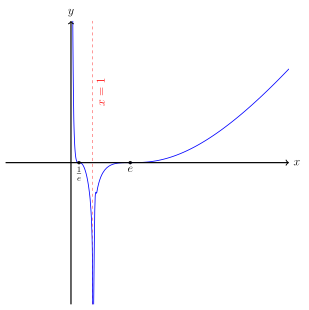
The function \(\f\) is defined by \[ \phantom{\ \ \ \ \ \ \ \ \ \ \ \ (x>0, \ \ x\ne1)} \f(x) = \frac{1}{x\ln x} \left(1 - (\ln x)^2 \right)^2 \ \ \ \ \ \ \ \ \ \ \ \ (x>0, \ \ x\ne1) \,.\] Show that, when \(( \ln x )^2 = 1\,\), both \(\f(x)=0\) and \(\f'(x)=0\,\). The function \(F\) is defined by \begin{align*} F(x) = \begin{cases} \displaystyle \int_{ 1/\text{e}}^x \f(t) \; \mathrm{d}t & \text{ for } 0 < x < 1\,, \\[7mm] \displaystyle \int_{\text{e}}^x \f(t) \; \mathrm{d}t & \text{ for } x > 1\,. \\ \end{cases} \end{align*}
- Find \(F(x)\) explicitly and hence show that \(F(x^{-1})=F(x)\,\).
- Sketch the curve with equation \(y=F(x)\,\). [You may assume that \(\dfrac{ (\ln x)^k} x\to 0\) as \(x\to\infty\) for any constant \(k\).]
Solution: When \((\ln x)^2 = 1\) we have \(f(x) = \frac{1}{x\ln x}(1 - 1^2)^2 = 0\) \(f'(x) = \frac{2(1 - (\ln x)^2) \cdot (-2 \ln x ) \cdot \frac1x \cdot (x \ln x) - (\ln x +1)(1-(\ln x)^2)^2}{(x\ln x)^2} = \frac{2\cdot 0 \cdot (-2 \ln x ) \cdot \frac1x \cdot (x \ln x) - (\ln x +1) \cdot 0}{(x\ln x)^2} = 0\)
- First consider \(0 < x < 1\), so \begin{align*} && F(x) &= \int_{1/e}^x f(t) \d t \\ &&&= \int_{1/e}^x \frac{1}{t\ln t} \left(1 - (\ln t)^2 \right)^2 \d t \\ u = \ln t, \d u = \frac1t \d t: &&&= \int_{u=-1}^{u=\ln x} \frac{1}{u}(1-u^2)^2 \d u \\ &&&= \int_{-1}^{\ln x} \left ( u^3 - 2u+\frac1u \right) \d u \\ &&&= \left [ \frac{u^4}{4} - u^2+ \ln |u| \right]_{-1}^{\ln x} \\ &&&= \frac{(\ln x)^4}{4} -(\ln x)^2 + \ln |\ln x| - \frac14+1 \end{align*} Now consider \(x > 1\) \begin{align*} && F(x) &= \int_{e}^x f(t) \d t \\ &&&= \int_{e}^x \frac{1}{t\ln t} \left(1 - (\ln t)^2 \right)^2 \d t \\ u = \ln t, \d u = \frac1t \d t: &&&= \int_{u=1}^{u=\ln x} \frac{1}{u}(1-u^2)^2 \d u \\ &&&= \int_{1}^{\ln x} \left ( u^3 - 2u+\frac1u \right) \d u \\ &&&= \left [ \frac{u^4}{4} - u^2+ \ln |u| \right]_{1}^{\ln x} \\ &&&= \frac{(\ln x)^4}{4} -(\ln x)^2 + \ln| \ln x| - \frac14+1 \end{align*} Notice that \begin{align*} F(x^{-1}) &= \frac{(\ln x^{-1})^4}{4} -(\ln x^{-1})^2 + \ln| \ln x^{-1}| - \frac14+1 \\ &= \frac{(-\ln x)^4}{4} -(-\ln x)^2 + \ln| -\ln x| - \frac14+1 \\ &= \frac{(\ln x)^4}{4} -(\ln x)^2 + \ln| \ln x| - \frac14+1 \\ &= F(x) \end{align*}
- \(\,\)
2018 Paper 2 Q13
Four children, \(A\), \(B\), \(C\) and \(D\), are playing a version of the game `pass the parcel'. They stand in a circle, so that \(ABCDA\) is the clockwise order. Each time a whistle is blown, the child holding the parcel is supposed to pass the parcel immediately exactly one place clockwise. In fact each child, independently of any other past event, passes the parcel clockwise with probability \(\frac{1}{4}\), passes it anticlockwise with probability \(\frac{1}{4}\) and fails to pass it at all with probability \(\frac{1}{2}\). At the start of the game, child \(A\) is holding the parcel. The probability that child \(A\) is holding the parcel just after the whistle has been blown for the \(n\)th time is \(A_n\), and \(B_n\), \(C_n\) and \(D_n\) are defined similarly.
- Find \(A_1\), \(B_1\), \(C_1\) and \(D_1\). Find also \(A_2\), \(B_2\), \(C_2\) and \(D_2\).
- By first considering \(B_{n+1}+D_{n+1}\), or otherwise, find \(B_n\) and \(D_n\). Find also expressions for \(A_n\) and \(C_n\) in terms of \(n\).
Solution:
- \(\,\) \begin{align*} && A_1 &= \frac12 \\ && B_1 &= \frac14 \\ && C_1 &= 0 \\ && D_1 &= \frac14 \end{align*} \begin{align*} && A_2 &= \frac12 \cdot \frac12 + 2 \cdot \frac14 \cdot \frac14 = \frac38 \\ && B_2 &= \frac14 \cdot \frac12 + \frac12 \cdot \frac14 = \frac14 \\ && C_2 &=2 \cdot \frac14 \cdot \frac14 =\frac18 \\ && D_2 &= B_2 = \frac14 \end{align*}
- \begin{align*} && A_{n+1} &= \frac12 A_n+ \frac14(B_n + D_n) \\ && B_{n+1} &= \frac12 B_n+ \frac14(A_n + C_n) \\ && C_{n+1} &= \frac12 C_n+ \frac14(D_n +B_n) \\ && D_{n+1} &= \frac12 D_n+ \frac14(C_n +A_n) \\ \\ \Rightarrow && B_{n+1}+D_{n+1} &= \frac12 (B_n+D_n) + \frac12(A_n+C_n) \\ &&&= \frac12 \\ \Rightarrow && B_{n+1}&=D_{n+1} = \frac14 \\ \\ && C_{n+1} &= \frac12C_n + \frac14 \cdot \frac12 \\ &&&= \frac12 C_n + \frac18\\ &&&= \frac12 C_{n-1} + \frac1{8} + \frac1{16} \\ &&&= \frac1{8} + \frac{1}{16} + \cdots + \frac{1}{8 \cdot 2^{n-1}} \\ &&&= \frac18 \left (1 + \frac12 + \cdots + \frac1{2^{n-1}} \right) \\ &&&= \frac18\left ( \frac{1-\frac1{2^n}}{1-\frac12} \right) \\ &&&= \frac18 \left (2 - \frac{1}{2^{n-1}} \right) \\ &&&= \frac14 - \frac{1}{2^{n-1}} \\ \Rightarrow && A_n &= \frac14 + \frac1{2^{n-1}} \end{align*}
2017 Paper 2 Q3
- Sketch, on \(x\)-\(y\) axes, the set of all points satisfying \(\sin y = \sin x\), for \(-\pi \le x \le \pi\) and \(-\pi \le y \le \pi\). You should give the equations of all the lines on your sketch.
- Given that \[ \sin y = \tfrac12 \sin x \] obtain an expression, in terms of \(x\), for \(y'\) when \(0\le x \le \frac12 \pi\) and \(0\le y \le \frac12 \pi\), and show that \[ y'' = - \frac {3\sin x}{(4-\sin^2 x)^{\frac32}} \;. \] Use these results to sketch the set of all points satisfying \(\sin y = \tfrac12 \sin x\) for \(0 \le x \le \frac12 \pi\) and \(0 \le y \le \frac12 \pi\). Hence sketch the set of all points satisfying \(\sin y = \tfrac12 \sin x\) for \(-\pi\! \le \! x \! \le \! \pi\) and \mbox{\( -\pi \, \le\, y\, \le\, \pi\,\)}.
- Without further calculation, sketch the set of all points satisfying \(\cos y = \tfrac12 \sin x\) for \(- \pi \le x \le \pi\) and \( -\pi \le y \le \pi\).
Solution:
- \(\,\)
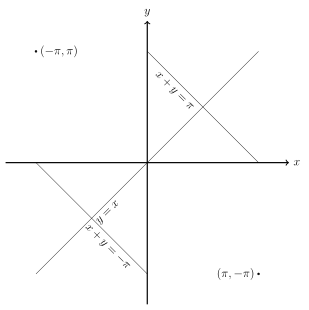
- \(\,\) \begin{align*}
&& \sin y &= \tfrac12 \sin x \\
\Rightarrow && \frac{\d y}{\d x} \cos y &= \tfrac12 \cos x \\
\Rightarrow && \frac{\d y}{\d x} &= \frac{\cos x}{2 \cos y} \\
&&&= \frac{\cos x}{2 \sqrt{1-\sin^2 y}} \\
&&&= \frac{\cos x}{2 \sqrt{1-\frac14 \sin^2 x}} \\
&&&= \frac{\cos x}{\sqrt{4-\sin^2 x}} \\
\\
&& y'' &= \frac{-\sin x \cdot (4-\sin^2 x)^{\frac12} - \cos x \cdot (4-\sin^2 x)^{-\frac12} \cdot 2 \sin x \cos x}{(4-\sin^2 x)} \\
&&&= \frac{-\sin x \cdot (4-\sin^2 x) - \cos x \cdot 2 \sin x \cos x}{(4-\sin^2x)^{\frac32}} \\
&&&= \frac{-\sin x \cdot (4-\sin^2 x) - \sin x (1-\sin^2x)}{(4-\sin^2x)^{\frac32}} \\
&&&= \frac{-3\sin x }{(4-\sin^2x)^{\frac32}} \\
\end{align*}
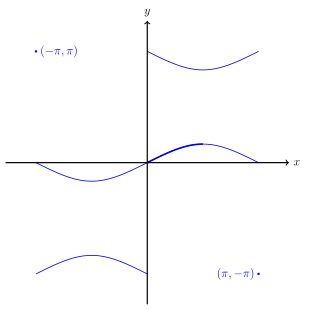
- \(\,\)
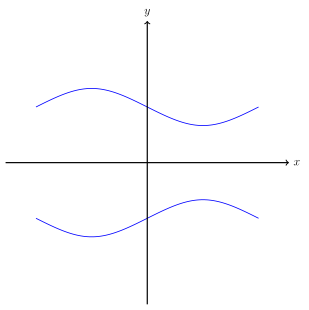
2016 Paper 2 Q7
Show that \[ \int_0^a \f(x) \d x= \int _0^a \f(a-x) \d x\,, \tag{\(*\)} \] where f is any function for which the integrals exist.
- Use (\(*\)) to evaluate \[ \int_0^{\frac12\pi} \frac{\sin x}{\cos x + \sin x} \, \d x \,. \]
- Evaluate \[ \int_0^{\frac14\pi} \frac{\sin x}{\cos x + \sin x} \, \d x \,. \]
- Evaluate \[ \int_0^{\frac14\pi} \ln (1+\tan x) \, \d x \,. \]
- Evaluate \[ \int_0^{\frac14 \pi} \frac x {\cos x \, (\cos x + \sin x)}\, \d x \,. \]
Solution: \begin{align*} u = a-x, \d u = - \d x: && \int_0^a f(x) \d x &= \int_{u=a}^{u=0} f(a-u) (-1) \d u \\ &&&= \int_0^a f(a-u) \d u \\ &&&= \int_0^a f(a-x) \d x \end{align*}
- \begin{align*} && I &= \int_0^{\frac12 \pi} \frac{\sin x}{\cos x + \sin x } \d x\\ &&&= \int_0^{\frac12 \pi} \frac{\sin (\frac12 \pi - x)}{\cos (\frac12 \pi-x) + \sin (\frac12 \pi-x) } \d x\\ &&&= \int_0^{\frac12 \pi} \frac{\cos x}{\sin x + \cos x } \d x\\ \Rightarrow && 2I &= \int_0^{\frac12 \pi} 1 \d x \\ \Rightarrow && I &= \frac{\pi}{4} \end{align*}
- \begin{align*} && I &= \int_0^{\frac14 \pi} \frac{\sin x}{\cos x + \sin x } \d x\\ &&&= \int_0^{\frac14 \pi} \frac{\sin (\frac14 \pi - x)}{\cos (\frac14 \pi-x) + \sin (\frac14 \pi-x) } \d x\\ &&&= \int_0^{\frac14 \pi} \frac{\frac1{\sqrt{2}} \cos x - \frac{1}{\sqrt{2}} \sin x}{\frac1{\sqrt{2}} \cos x + \frac{1}{\sqrt{2}} \sin x + \frac1{\sqrt{2}} \cos x - \frac{1}{\sqrt{2}} \sin x} \d x \\ &&&= \int_0^{\frac14 \pi} \frac{\cos x - \sin x}{2 \cos x} \d x \\ &&&= \left [\frac12 x + \ln(\cos x) \right]_0^{\pi/4} \\ &&&= \frac{\pi}{8} -\frac12\ln2 - 1 \end{align*}
- \begin{align*} && I &= \int_0^{\frac14\pi} \ln (1+\tan x) \, \d x \\ &&&= \int_0^{\frac14 \pi} \ln \left (1 + \tan \left(\frac{\pi}{4} - x\right) \right) \, \d x\\ &&&= \int_0^{\frac14 \pi} \ln \left (1 +\frac{1 - \tan x}{1+ \tan x} \right) \, \d x\\ &&&= \int_0^{\frac14 \pi} \ln \left (\frac{2}{1+ \tan x} \right) \, \d x\\ &&&= \frac{\pi}{4} \ln 2 - I \\ \Rightarrow && I &= \frac{\pi}{8} \ln 2 \end{align*}
- \begin{align*} && I &= \int_0^{\frac14 \pi} \frac x {\cos x \, (\cos x + \sin x)}\, \d x \\ &&&= \int_0^{\frac14 \pi} \frac {\frac14 \pi - x} {(\frac1{\sqrt{2}} \cos x + \frac{1}{\sqrt{2}} \sin x) \, (\frac{2}{\sqrt{2}}\cos x)}\, \d x \\ &&&= \int_0^{\frac14 \pi} \frac {\frac14 \pi - x} {\cos x \, (\cos x + \sin x)}\, \d x \\ \\ \Rightarrow && I &= \frac{\pi}{8} \int_0^{\pi/4} \frac{\sec^2 x}{1 + \tan x} \d x\\ &&&= \frac{\pi}{8} \left [\ln (1 + \tan x) \right]_0^{\pi/4} \\ &&&= \frac{\pi}{8} \ln 2 \end{align*}
2015 Paper 1 Q1
- Sketch the curve \(y = \e^x (2x^2 -5x+ 2)\,.\) Hence determine how many real values of \(x\) satisfy the equation \(\e^x (2x^2 -5x+ 2)= k\) in the different cases that arise according to the value of \(k\). {\em You may assume that \(x^n \e^x\to 0\) as \(x\to-\infty\) for any integer \(n\).}
- Sketch the curve \(\displaystyle y = \e^{x^2} (2x^4 -5x^2+ 2)\,\).
Solution:
- \(y = e^x(2x^2-5x+2) = e^x(2x-1)(x-2)\), we also have \(y' = e^x(2x^2-5x+2 + 4x-5) = e^x(2x^2-x-3) = e^x(2x-3)(x+1)\)
\(y(-1) = \frac{9}{e}\), \(y(\frac32) = -e^{3/2}\)
If \(k < -e^{3/2}\) there are no solutions. If \(k = -e^{3/2}\) there is a unique solution. If \(-e^{3/2} < k \leq 0\) there are two solutions. If \(0 < k < \frac{9}{e}\) there are three solutions. Otherwise there is a unique solution.


2015 Paper 1 Q3
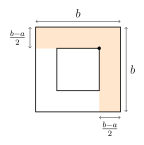
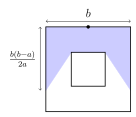
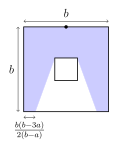
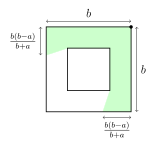
A prison consists of a square courtyard of side \(b\) bounded by a perimeter wall and a square building of side \(a\) placed centrally within the courtyard. The sides of the building are parallel to the perimeter walls. Guards can stand either at the middle of a perimeter wall or in a corner of the courtyard. If the guards wish to see as great a length of the perimeter wall as possible, determine which of these positions is preferable. You should consider separately the cases \(b<3a\) and \(b>3a\,\).
Solution: