Problems
Filters
112 problems found
2025 Paper 2 Q5
You need not consider the convergence of the improper integrals in this question.
- Use the substitution \(x = u^{-1}\) to show that \[\int_0^{\infty} \frac{\sqrt{x}-1}{\sqrt{x(x^3+1)}} \, dx = 0.\]
- Use the substitution \(x = u^{-2}\) to show that \[\int_0^{\infty} \frac{1}{\sqrt{x^3+1}} \, dx = 2\int_0^{\infty} \frac{1}{\sqrt{x^6+1}} \, dx.\]
- Find, in terms of \(p\) and \(s\), a value of \(r\) for which \[\int_0^{\infty} \frac{x^r - 1}{\sqrt{x^s(x^p+1)}} \, dx = 0,\] given that \(p\) and \(s\) are fixed values for which the required integrals converge.
- Show that, for any positive value of \(k\), it is possible to find values of \(p\) and \(q\) for which \[\int_0^{\infty} \frac{1}{\sqrt{x^p+1}} \, dx = k\int_0^{\infty} \frac{1}{\sqrt{x^q+1}} \, dx.\]
Solution:
- \begin{align*} && I &= \int_0^{\infty} \frac{\sqrt{x}-1}{\sqrt{x(x^3+1)}} \, dx \\ x = u^{-1}, \d x = -u^{-2} \d u: && &= \int_{u=\infty}^{u = 0} \frac{u^{-1/2} - 1}{\sqrt{u^{-1}(u^{-3}+1)}} (-u^{-2}) \d u \\ &&&= \int_0^\infty \frac{u^{-1/2} -1}{\sqrt{1+u^3}} \d u \\ &&&= \int_0^\infty \frac{1-\sqrt{u}}{\sqrt{u(u^3+1)}} \d u \\ &&&= -I \\ \Rightarrow && I &= 0 \end{align*}
- \begin{align*} && I &= \int_0^{\infty} \frac{1}{\sqrt{x^3+1}} \, dx \\ x = u^{-2}, \d x = -2u^{-3} \d u: && &= \int_{u = \infty}^{u = 0} \frac{1}{\sqrt{u^{-6}+1}} (-2u^{-3}) \d u \\ &&&= \int_0^\infty \frac{2}{\sqrt{1+u^6}} \d u \\ &&&= 2\int_0^{\infty} \frac{1}{\sqrt{x^6+1}} \, \d x \end{align*}
- \begin{align*} && I &= \int_0^{\infty} \frac{x^r - 1}{\sqrt{x^s(x^p+1)}} \, dx \\ x = u^{-1}, \d x = - u^{-2} \d t: &&&= \int_{u=\infty}^{u = 0} \frac{u^{-r}-1}{\sqrt{u^{-s}(u^{-p}+1)}} (- u^{-2}) \d u \\ &&&= \int_0^\infty \frac{u^{-r}-1}{\sqrt{u^{4-s}(u^{-p}+1)}} \d u \\ &&&= \int_0^\infty \frac{1-u^{r}}{\sqrt{u^{4-s+2r}(u^{-p}+1)}} \d u \\ &&&= \int_0^\infty \frac{1-u^{r}}{\sqrt{u^{4-s+2r-p}(1+u^p)}} \d u \\ \end{align*} Therefore if \(4-s+2r-p = s\) or \(r = \frac{p}2+s-2\) we have \(I = -I\), ie \(I = 0\).
- \begin{align*} && I &= \int_0^{\infty} \frac{1}{\sqrt{x^p+1}} \, dx \\ x = u^{-t}, \d x = -t u^{-t-1}:&&&= \int_{u = -\infty}^{u = 0} \frac{1}{\sqrt{u^{-pt}+1}} (-t u^{-t-1}) \d u \\ &&&= t \int_0^\infty \frac1{\sqrt{u^{-pt+2t+2}+u^{2t+2}}} \d u \end{align*} Therefore if \(\begin{cases} 2t+2 &= q \\ 2t+2 -pt &= 0 \end{cases}\), ie \(q = 2t+2, p = 2 + 2/t\) we will have found the \(p, q\) desired for any \(t\) (or \(k\)). [Alternatively] Let \(\displaystyle I(p) =\int_0^{\infty} \frac{1}{\sqrt{x^p+1}} \, dx\), then clearly \(I(p)\) is decreasing and as \(p \to \infty\) \(I(p) \to 1\), so our integral can take any values on \((1, \infty)\) and so for any positive value we can find two values with a given ratio. In particular given \(k\) and \(p\) we can find a suitable \(q\).
2025 Paper 3 Q1
You need not consider the convergence of the improper integrals in this question. For \(p, q > 0\), define $$b(p,q) = \int_0^1 x^{p-1}(1-x)^{q-1} \, dx$$
- Show that \(b(p,q) = b(q,p)\).
- Show that \(b(p+1,q) = b(p,q) - b(p,q+1)\) and hence that \(b(p+1,p) = \frac{1}{2}b(p,p)\).
- Show that $$b(p,q) = 2\int_0^{\pi/2} (\sin\theta)^{2p-1}(\cos\theta)^{2q-1} \, d\theta$$ Hence show that \(b(p,p) = \frac{1}{2^{2p-1}}b(p,\frac{1}{2})\).
- Show that $$b(p,q) = \int_0^\infty \frac{t^{p-1}}{(1+t)^{p+q}} \, dt$$
- Evaluate $$\int_0^\infty \frac{t^{3/2}}{(1+t)^6} \, dt$$
Solution:
- \begin{align*} && b(p,q) &= \int_0^1 x^{p-1}(1-x)^{q-1}\, \d x \\ u = 1-x, \d u = -\d x && &= \int_{u=1}^{u = 0} (1-u)^{p-1}u^{q-1} (-1) \, \d u \\ &&&= \int_0^1 (1-u)^{p-1}u^{q-1} \d u \\ &&&= \int_0^1 u^{q-1}(1-u)^{p-1} \d u \\ &&&= b(q,p) \end{align*}
- \begin{align*} b(p+1,q) + b(p,q+1) &= \int_0^1 x^p(1-x)^{q-1} \d x + \int_0^1 x^{p-1}(1-x)^{q} \d x \\ &= \int_0^1 \left (x^p(1-x)^{q-1} + x^{p-1}(1-x)^{q}\right) \d x \\ &= \int_0^1 x^{p-1}(1-x)^{q-1} \left (x + (1-x) \right) \d x \\ &= \int_0^1 x^{p-1}(1-x)^{q-1} \d x \\ &= b(p,q) \end{align*} Therefore \(b(p+1,q) = b(p,q) - b(p,q+1)\), in particular \(2b(p+1,p) = b(p+1,p)+b(p,p+1) = b(p,p) \Rightarrow b(p+1,p) = \frac12 b(p,p)\) as required.
- \begin{align*} && b(p,q) &= \int_0^1 x^{p-1} (1-x)^{q-1} \d x \\ x = \sin^2 \theta, \d x = 2 \sin \theta \cos \theta \d \theta && &= \int_{u=0}^{u = \pi/2} \sin^{2p-2} \theta (1-\sin^2 \theta)^{q-1} \cdot 2 \sin \theta \cos \theta \d \theta \\ &&&= 2 \int_0^{\pi/2} \sin^{2p-1} \theta \cos^{2q-2} \cos \theta \d \theta \\ &&&= 2 \int_0^{\pi/2} \sin^{2p-1} \theta \cos^{2q-1} \theta \d \theta \end{align*} \begin{align*} b(p,p) &= 2\int_0^{\pi/2} (\sin \theta)^{2p-1}(\cos \theta)^{2p-1} \d \theta \\ &= 2 \int_0^{\pi/2} \left (\frac12 \sin 2\theta \right)^{2p-1} \d \theta \\ &= \frac1{2^{2p-1}} 2 \int_0^{\pi/2} (\sin 2 \theta)^{2p-1} \d \theta \\ &= \frac1{2^{2p-1}} 2 \int_{x=0}^{x=\pi} (\sin x)^{2p-1} 2 \d x\\ &= \frac1{2^{2p-1}} 2 \int_{x=0}^{x=\pi/2} (\sin x)^{2p-1} \d x\\ &= \frac1{2^{2p-1}} 2 \int_{0}^{\pi/2} (\sin x)^{2p-1} (\cos x)^{0} \d x\\ &= \frac1{2^{2p-1}} b(p,\tfrac12) \end{align*}
- \begin{align*} &&b(p,q) &= \int_0^1 x^{p-1}(1-x)^{q-1} \d x \\ t = \frac{x}{1-x}, \d t = (1-x)^{-2} \d x &&&= \int_{t=0}^{t = \infty} \left ( \frac{t}{1+t} \right)^{p-1} \left ( 1-\frac{t}{1+t} \right)^{q+1} \d t\\ x = \frac{t}{1+t} && &=\int_0^\infty t^{p-1} (1+t)^{-(p-1)-(q+1)} \d t \\ &&&= \int_0^{\infty} \frac{t^{p-1}}{(1+t)^{p+q}} \d t \end{align*}
- \begin{align*} I &= \int_0^\infty \frac{t^{3/2}}{(1+t)^6} \, dt \\ &= b( \tfrac52, \tfrac72) \\ &= b( \tfrac52, \tfrac52+1) \\ &= \tfrac12 b( \tfrac52, \tfrac52) \\ &= \frac12 \cdot \frac1{2^{4}} b(\tfrac52, \tfrac12) \\ &= \frac{1}{2^5} \cdot 2 \int_0^{\pi/2} (\sin \theta)^{4} \d \theta \\ &= \frac1{2^4} \int_0^{\pi/2}\left (\frac{1-\cos 2 \theta}{2} \right)^2 \d \theta \\ &= \frac1{2^6} \int_0^{\pi/2}\left (1 - 2 \cos 2 \theta + \cos^{2} 2 \theta \right) \d \theta \\ &= \frac1{2^6} \int_0^{\pi/2}\left (1 - 2 \cos 2 \theta + \frac{\cos 4 \theta + 1}{2} \right) \d \theta \\ &= \frac1{2^6} \left [\frac32 \theta - \sin 2 \theta + \frac18 \sin 4 \theta \right]_0^{\pi/2} \\ &= \frac1{2^6} \frac{3 \pi}{4} \\ &= \frac{3 \pi}{2^8} \end{align*}
2023 Paper 2 Q1
- Show that making the substitution \(x = \frac{1}{t}\) in the integral \[\int_a^b \frac{1}{(1+x^2)^{\frac{3}{2}}}\,\mathrm{d}x\,,\] where \(b > a > 0\), gives the integral \[\int_{b^{-1}}^{a^{-1}} \frac{-t}{(1+t^2)^{\frac{3}{2}}}\,\mathrm{d}t\,.\]
- Evaluate:
- \(\displaystyle\int_{\frac{1}{2}}^{2} \frac{1}{(1+x^2)^{\frac{3}{2}}}\,\mathrm{d}x\,;\)
- \(\displaystyle\int_{-2}^{2} \frac{1}{(1+x^2)^{\frac{3}{2}}}\,\mathrm{d}x\,.\)
- Show that \[\int_{\frac{1}{2}}^{2} \frac{1}{(1+x^2)^2}\,\mathrm{d}x = \int_{\frac{1}{2}}^{2} \frac{x^2}{(1+x^2)^2}\,\mathrm{d}x = \frac{1}{2}\int_{\frac{1}{2}}^{2} \frac{1}{1+x^2}\,\mathrm{d}x\,,\] and hence evaluate \[\int_{\frac{1}{2}}^{2} \frac{1}{(1+x^2)^2}\,\mathrm{d}x\,.\]
- Evaluate \[\int_{\frac{1}{2}}^{2} \frac{1-x}{x(1+x^2)^{\frac{1}{2}}}\,\mathrm{d}x\,.\]
2023 Paper 2 Q4
- Show that, if \((x-\sqrt{2})^2 = 3\), then \(x^4 - 10x^2 + 1 = 0\). Deduce that, if \(\mathrm{f}(x) = x^4 - 10x^2 + 1\), then \(\mathrm{f}(\sqrt{2}+\sqrt{3}) = 0\).
- Find a polynomial \(\mathrm{g}\) of degree 8 with integer coefficients such that \(\mathrm{g}(\sqrt{2}+\sqrt{3}+\sqrt{5}) = 0\). Write your answer in a form without brackets.
- Let \(a\), \(b\) and \(c\) be the three roots of \(t^3 - 3t + 1 = 0\). Find a polynomial \(\mathrm{h}\) of degree 6 with integer coefficients such that \(\mathrm{h}(a+\sqrt{2}) = 0\), \(\mathrm{h}(b+\sqrt{2}) = 0\) and \(\mathrm{h}(c+\sqrt{2}) = 0\). Write your answer in a form without brackets.
- Find a polynomial \(\mathrm{k}\) with integer coefficients such that \(\mathrm{k}(\sqrt[3]{2}+\sqrt[3]{3}) = 0\). Write your answer in a form without brackets.
Solution:
- \(\,\) \begin{align*} && 3 &= (x-\sqrt2)^2 \\ &&&= x^2 - 2\sqrt2 x + 2 \\ \Rightarrow && 2\sqrt2 x &= x^2-1 \\ \Rightarrow && 8x^2 &= x^4 - 2x^2 + 1 \\ \Rightarrow && 0 &= x^4 - 10x^2 + 1 \end{align*} Noticing that \((\sqrt2+\sqrt3-\sqrt2)^2 = 3\) we note that \(\sqrt2 + \sqrt3\) is a root of our quartic.
- Suppose \(x = \sqrt2 + \sqrt3 + \sqrt5\) then \begin{align*} && 0 &= (x - \sqrt5)^4 - 10(x-\sqrt5)^2 + 1 \\ &&&= x^4 - 4\sqrt5x^3 + 30x^2-20\sqrt5 x +25 - 10x^2+20\sqrt5x -50 + 1\\ &&&= (x^4+20x^2- 24) - 4\sqrt5 x^3 \\ \Rightarrow && 80x^6 &= (x^4+20x^2-24)^2 \\ &&&= x^8 + 40x^6 + 352x^4 - 960x^2+576 \\ \Rightarrow && 0 &= x^8-40x^6 + 352x^4-960x^2+576 \end{align*} So take \(g(x) = x^8-40x^6 + 352x^4-960x^2+576\).
- Notice that if \(p(t) = t^3-3t+1\) then \(p(t -\sqrt2) = 0\) for \(t = a,b,c\) so \begin{align*} && 0 &= (t - \sqrt2)^3 -3(t - \sqrt2) + 1 \\ &&&= t^3-3\sqrt2 t^2 + 6t - 2\sqrt2 - 3t + 3\sqrt 2 + 1 \\ &&&= (t^3+3t+1) - \sqrt2 (3t^2+1) \\ \Rightarrow && 2(3t^2+1)^2 &= (t^3+3t+1)^2 \\ \Rightarrow && 2(9t^4+6t^2+1) &= t^6 + 6t^4+2t^3+9t^2+6t+1 \\ \Rightarrow && 0 &= t^6-12t^4+2t^3-3t^2+6t-1 \end{align*}
- \(\,\) \begin{align*} && t &= \sqrt[3]{2} + \sqrt[3]{3} \\ \Rightarrow && t^3 &= 2 + 3\sqrt[3]{12} + 3\sqrt[3]{18} + 3 \\ &&&= 5 + 3 \sqrt[3]{6}(\sqrt[3]{2} + \sqrt[3]{3}) \\ &&&= 5 + 3\sqrt[3]{6}t \\ \Rightarrow && 162t^3 &= (t^3-5)^3 \\ &&&= t^9-15t^6+75t^3 -125 \\ \Rightarrow && 0 &= t^9-15t^6-87t^3-125 \end{align*} so \(k(x) = x^9 - 15x^6-87x^3-125\)
2023 Paper 3 Q7
- Let \(\mathrm{f}\) be a continuous function defined for \(0 \leqslant x \leqslant 1\). Show that \[\int_0^1 \mathrm{f}(\sqrt{x})\,\mathrm{d}x = 2\int_0^1 x\,\mathrm{f}(x)\,\mathrm{d}x\,.\]
- Let \(\mathrm{g}\) be a continuous function defined for \(0 \leqslant x \leqslant 1\) such that \[\int_0^1 \big(\mathrm{g}(x)\big)^2\,\mathrm{d}x = \int_0^1 \mathrm{g}(\sqrt{x})\,\mathrm{d}x - \frac{1}{3}\,.\] Show that \(\displaystyle\int_0^1 \big(\mathrm{g}(x) - x\big)^2\,\mathrm{d}x = 0\) and explain why \(\mathrm{g}(x) = x\) for \(0 \leqslant x \leqslant 1\).
- Let \(\mathrm{h}\) be a continuous function defined for \(0 \leqslant x \leqslant 1\) with derivative \(\mathrm{h}'\) such that \[\int_0^1 \big(\mathrm{h}'(x)\big)^2\,\mathrm{d}x = 2\mathrm{h}(1) - 2\int_0^1 \mathrm{h}(x)\,\mathrm{d}x - \frac{1}{3}\,.\] Given that \(\mathrm{h}(0) = 0\), find \(\mathrm{h}\).
- Let \(\mathrm{k}\) be a continuous function defined for \(0 \leqslant x \leqslant 1\) and \(a\) be a real number, such that \[\int_0^1 \mathrm{e}^{ax}\big(\mathrm{k}(x)\big)^2\,\mathrm{d}x = 2\int_0^1 \mathrm{k}(x)\,\mathrm{d}x + \frac{\mathrm{e}^{-a}}{a} - \frac{1}{a^2} - \frac{1}{4}\,.\] Show that \(a\) must be equal to \(2\) and find \(\mathrm{k}\).
2023 Paper 3 Q8
If \[y = \begin{cases} \mathrm{k}_1(x) & x \leqslant b \\ \mathrm{k}_2(x) & x \geqslant b \end{cases}\] with \(\mathrm{k}_1(b) = \mathrm{k}_2(b)\), then \(y\) is said to be \emph{continuously differentiable} at \(x = b\) if \(\mathrm{k}_1'(b) = \mathrm{k}_2'(b)\).
- Let \(\mathrm{f}(x) = x\mathrm{e}^{-x}\). Verify that, for all real \(x\), \(y = \mathrm{f}(x)\) is a solution to the differential equation \[\frac{\mathrm{d}^2 y}{\mathrm{d}x^2} + 2\frac{\mathrm{d}y}{\mathrm{d}x} + y = 0\] and that \(y = 0\) and \(\dfrac{\mathrm{d}y}{\mathrm{d}x} = 1\) when \(x = 0\). Show that \(\mathrm{f}'(x) \geqslant 0\) for \(x \leqslant 1\).
- You are given the differential equation \[\frac{\mathrm{d}^2 y}{\mathrm{d}x^2} + 2\left|\frac{\mathrm{d}y}{\mathrm{d}x}\right| + y = 0\] where \(y = 0\) and \(\dfrac{\mathrm{d}y}{\mathrm{d}x} = 1\) when \(x = 0\). Let \[y = \begin{cases} \mathrm{g}_1(x) & x \leqslant 1 \\ \mathrm{g}_2(x) & x \geqslant 1 \end{cases}\] be a solution of the differential equation which is continuously differentiable at \(x = 1\). Write down an expression for \(\mathrm{g}_1(x)\) and find an expression for \(\mathrm{g}_2(x)\).
- State the geometrical relationship between the curves \(y = \mathrm{g}_1(x)\) and \(y = \mathrm{g}_2(x)\).
- Prove that if \(y = \mathrm{k}(x)\) is a solution of the differential equation \[\frac{\mathrm{d}^2 y}{\mathrm{d}x^2} + p\frac{\mathrm{d}y}{\mathrm{d}x} + qy = 0\] in the interval \(r \leqslant x \leqslant s\), where \(p\) and \(q\) are constants, then, in a suitable interval which you should state, \(y = \mathrm{k}(c - x)\) satisfies the differential equation \[\frac{\mathrm{d}^2 y}{\mathrm{d}x^2} - p\frac{\mathrm{d}y}{\mathrm{d}x} + qy = 0\,.\]
- You are given the differential equation
\[\frac{\mathrm{d}^2 y}{\mathrm{d}x^2} + 2\left|\frac{\mathrm{d}y}{\mathrm{d}x}\right| + 2y = 0\]
where \(y = 0\) and \(\dfrac{\mathrm{d}y}{\mathrm{d}x} = 1\) when \(x = 0\).
Let \(\mathrm{h}(x) = \mathrm{e}^{-x}\sin x\). Show that \(\mathrm{h}'\!\left(\frac{1}{4}\pi\right) = 0\).
It is given that \(y = \mathrm{h}(x)\) satisfies the differential equation in the interval \(-\frac{3}{4}\pi \leqslant x \leqslant \frac{1}{4}\pi\) and that \(\mathrm{h}'(x) \geqslant 0\) in this interval.
In a solution to the differential equation which is continuously differentiable at \((n + \frac{1}{4})\pi\) for all \(n \in \mathbb{Z}\), find \(y\) in terms of \(x\) in the intervals
- \(\frac{1}{4}\pi \leqslant x \leqslant \frac{5}{4}\pi\),
- \(\frac{5}{4}\pi \leqslant x \leqslant \frac{9}{4}\pi\).
2022 Paper 3 Q5
- Show that \[ \int_{-a}^{a} \frac{1}{1+\mathrm{e}^x}\,\mathrm{d}x = a \quad \text{for all } a \geqslant 0. \]
- Explain why, if \(\mathrm{g}\) is a continuous function and \[ \int_0^a \mathrm{g}(x)\,\mathrm{d}x = 0 \quad \text{for all } a \geqslant 0, \] then \(\mathrm{g}(x) = 0\) for all \(x \geqslant 0\). Let \(\mathrm{f}\) be a continuous function with \(\mathrm{f}(x) \geqslant 0\) for all \(x\). Show that \[ \int_{-a}^{a} \frac{1}{1+\mathrm{f}(x)}\,\mathrm{d}x = a \quad \text{for all } a \geqslant 0 \] if and only if \[ \frac{1}{1+\mathrm{f}(x)} + \frac{1}{1+\mathrm{f}(-x)} - 1 = 0 \quad \text{for all } x \geqslant 0, \] and hence if and only if \(\mathrm{f}(x)\mathrm{f}(-x) = 1\) for all \(x\).
- Let \(\mathrm{f}\) be a continuous function such that, for all \(x\), \(\mathrm{f}(x) \geqslant 0\) and \(\mathrm{f}(x)\mathrm{f}(-x) = 1\). Show that, if \(\mathrm{h}\) is a continuous function with \(\mathrm{h}(x) = \mathrm{h}(-x)\) for all \(x\), then \[ \int_{-a}^{a} \frac{\mathrm{h}(x)}{1+\mathrm{f}(x)}\,\mathrm{d}x = \int_0^a \mathrm{h}(x)\,\mathrm{d}x\,. \]
- Hence find the exact value of \[ \int_{-\frac{1}{2}\pi}^{\frac{1}{2}\pi} \frac{\mathrm{e}^{-x}\cos x}{\cosh x}\,\mathrm{d}x\,. \]
Solution:
- \(\,\) \begin{align*} && I &= \int_{-a}^a \frac{1}{1+e^x} \d x \\ &&&= \int_{-a}^a \frac{e^{-x}}{e^{-x}+1} \d x \\ &&&= \left [ -\ln(1 + e^{-x} ) \right ]_{-a}^a \\ &&&= \ln(1 + e^a) - \ln(1 + e^{-a}) \\ &&&= \ln \left ( \frac{1+e^a}{1+e^{-a}} \right) \\ &&&= \ln \left ( e^a \frac{1+e^a}{e^a+1} \right) \\ &&& = a \end{align*}
- Suppose \(g\) is continuous and \(\int_0^a g(x) \d x = 0\) for all \(a \geq 0\) then \(g(x) = 0\) for all \(x\). Proof: Differentiate with respect to \(a\) to obtain \(g(a) = 0\) for all \(a\) as required. \begin{align*} && a &= \int_{-a}^a \frac{1}{1+ f(x)} \d x \\ \Leftrightarrow && 1 &= \frac{1}{1 + f(a)} + \frac{1}{1 + f(-a)} \tag{FTC} \\ \Leftrightarrow && (1+f(x))(1+f(-x)) &= 2+f(-x) + f(x) \\ \Leftrightarrow && f(x) f(-x) & = 1 \end{align*}
- \(\,\) \begin{align*} && J &= \int_{-a}^a \frac{h(x)}{1 + f(x)} \d x \\ y = - x: &&&=\int_{-a}^a \frac{h(-y)}{1 + f(-y)} \d y \\ &&&= \int_{-a}^a \frac{h(y)}{1 + f(-y)} \d y \\ \Rightarrow && 2J &= \int_{-a}^a h(x) \left ( \frac{1}{1+f(x)} + \frac{1}{1+f(-x)} \right) \d x \\ &&&= \int_{-a}^a h(x) \d x \\ &&&= \int_{-a}^0 h(x) \d x + \int_0^a h(x) \d x\\ &&&= \int_0^a h(-x) \d x + \int_0^a h(x) \d x \\ &&&= 2 \int_0^a h(x) \d x \\ \Rightarrow && J &= \int_0^a h(x) \d x \end{align*}
- First notice that \(h(x) = \cos x = h(-x)\). Also notice that if \(f(x) = e^{2x}\) then \(f(x)f(-x) = 1\) so \begin{align*} && K &= \int_{-\frac12 \pi}^{\frac12\pi} \frac{e^{-x}\cos x}{\cosh x} \d x \\ &&&= \int_{-\frac12 \pi}^{\frac12\pi} \frac{2h(x)}{1+f(x)} \d x \\ &&&= 2 \int_0^{\frac12 \pi} h(x) \d x \\ &&&= 2 \int_0^{\frac12 \pi} \cos x \d x \\ &&&= 2 \end{align*}
2021 Paper 2 Q5
- Use the substitution \(y = (x - a)u\), where \(u\) is a function of \(x\), to solve the differential equation \[ (x - a)\frac{dy}{dx} = y - x, \] where \(a\) is a constant.
- The curve \(C\) with equation \(y = f(x)\) has the property that, for all values of \(t\) except \(t = 1\), the tangent at the point \(\bigl(t,\, f(t)\bigr)\) passes through the point \((1, t)\).
- Given that \(f(0) = 0\), find \(f(x)\) for \(x < 1\). Sketch \(C\) for \(x < 1\). You should find the coordinates of any stationary points and consider the gradient of \(C\) as \(x \to 1\). You may assume that \(z\ln|z| \to 0\) as \(z \to 0\).
- Given that \(f(2) = 2\), sketch \(C\) for \(x > 1\), giving the coordinates of any stationary points.
2020 Paper 2 Q1
- Use the substitution \(x = \dfrac{1}{1-u}\), where \(0 < u < 1\), to find in terms of \(x\) the integral \[\int \frac{1}{x^{\frac{3}{2}}(x-1)^{\frac{1}{2}}}\,\mathrm{d}x \quad \text{(where } x > 1\text{).}\]
- Find in terms of \(x\) the integral \[\int \frac{1}{(x-2)^{\frac{3}{2}}(x+1)^{\frac{1}{2}}}\,\mathrm{d}x \quad \text{(where } x > 2\text{).}\]
- Show that \[\int_2^{\infty} \frac{1}{(x-1)(x-2)^{\frac{1}{2}}(3x-2)^{\frac{1}{2}}}\,\mathrm{d}x = \tfrac{1}{3}\pi.\]
Solution:
- \(\,\) \begin{align*} && x &= \frac1{1-u} \\ \Rightarrow && \d x &= \frac{1}{(1-u)^2} \d u \\ && I &= \int \frac{1}{x^{\frac32}(x-1)^{\frac12} } \d x \\ &&&= \int \frac1{(1-u)^{-\frac32}u^{\frac12}(1-u)^{-\frac12}} (1-u)^{-2} \d u \\ &&&= \int u^{-\frac12} \d u \\ &&&= 2\sqrt{u} + C \\ &&&= 2\sqrt{1-\frac{1}{x}} + C \end{align*}
- \(\,\) \begin{align*} && J &= \int \frac{1}{(x-2)^{\frac32}(x+1)^{\frac12}} \d x \\ y = x+1: &&&= \int \frac{1}{(y-3)^{\frac32}y^{\frac12}} \d y \\ y = 9(3-u)^{-1}: &&&= \int \frac1{\left (9(3-u)^{-1}-3 \right)^{\frac32}3(3-u)^{-\frac12}} \frac{9}{(3-u)^2} \d u \\ &&&= \int \frac1{\left (3u(3-u)^{-1} \right)^{\frac32}3(3-u)^{-\frac12}} \frac{9}{(3-u)^2} \d u \\ &&&= \frac{1}{\sqrt3} \int u^{-\frac32} \d u \\ &&&= -\frac2{\sqrt3} u^{-\frac12} + C \\ &&&= -\frac2{\sqrt3} \sqrt{\frac{y}{3(y-3)}} + C \\ &&&= -\frac2{3} \sqrt{\frac{x+1}{x-2}} + C \\ \end{align*}
- \(\,\) \begin{align*} && K &= \int_2^{\infty} \frac{1}{(x-1)(x-2)^{\frac12}(3x-2)^{\frac12}} \d x \\ y = x - 1: &&&=\int_{y=1}^{\infty} \frac{1}{y(y-1)^{\frac12}(3y+1)^{\frac12}} \d y \\ y = (1-u)^{-1}: &&&= \int_{u=0}^{u=1} \frac{1}{(1-u)^{-1}(u(1-u)^{-1})^{\frac12}((4-u)(1-u)^{-1})^{\frac12}} \frac{1}{(1-u)^2} \d u \\ &&&= \int_0^1 \frac{1}{u^{\frac12}(4-u)^{\frac12}} \d u \\ &&&= \int_0^1 \frac{1}{\sqrt{4-(u-2)^2}} \d u \\ &&&= \left [-\sin^{-1} \left ( \frac{2-u}{2} \right) \right]_0^1 \\ &&&= \sin^{-1} 1 - \sin^{-1} \tfrac12 \\ &&&= \frac{\pi}{2} - \frac{\pi}{6} = \frac{\pi}{3} \end{align*}
2020 Paper 3 Q7
- Given that the variables \(x\), \(y\) and \(u\) are connected by the differential equations \[ \frac{\mathrm{d}u}{\mathrm{d}x} + \mathrm{f}(x)u = \mathrm{h}(x) \quad \text{and} \quad \frac{\mathrm{d}y}{\mathrm{d}x} + \mathrm{g}(x)y = u, \] show that \[ \frac{\mathrm{d}^2 y}{\mathrm{d}x^2} + (\mathrm{g}(x) + \mathrm{f}(x))\frac{\mathrm{d}y}{\mathrm{d}x} + (\mathrm{g}'(x) + \mathrm{f}(x)\mathrm{g}(x))y = \mathrm{h}(x). \tag{1} \]
- Given that the differential equation \[ \frac{\mathrm{d}^2 y}{\mathrm{d}x^2} + \left(1 + \frac{4}{x}\right)\frac{\mathrm{d}y}{\mathrm{d}x} + \left(\frac{2}{x} + \frac{2}{x^2}\right)y = 4x + 12 \tag{2} \] can be written in the same form as (1), find a first order differential equation which is satisfied by \(\mathrm{g}(x)\). If \(\mathrm{g}(x) = kx^n\), find a possible value of \(n\) and the corresponding value of \(k\). Hence find a solution of (2) with \(y = 5\) and \(\dfrac{\mathrm{d}y}{\mathrm{d}x} = -3\) at \(x = 1\).
2019 Paper 1 Q8
The function \(f\) is defined, for \(x > 1\), by $$f(x) = \int_1^x \sqrt{\frac{t-1}{t+1}} dt.$$ Do not attempt to evaluate this integral.
- Show that, for \(x > 2\), $$\int_2^x \sqrt{\frac{u-2}{u+2}} du = 2f\left(\frac{1}{2}x\right).$$
- Evaluate in terms of \(f\), for \(x > 0\), $$\int_0^x \sqrt{\frac{u}{u+4}} du.$$
- Evaluate in terms of \(f\), for \(x > 5\), $$\int_5^x \sqrt{\frac{u-5}{u+1}} du.$$
- Evaluate in terms of \(f\) $$\int_1^2 \frac{u^2}{\sqrt{u^2+4}} du.$$
Solution:
- Let \(2t = u\), \begin{align*} \int_2^x \sqrt{\frac{u-2}{u+2}} du &= \int_{t=1}^{t=x/2} \sqrt{\frac{2t-2}{2t+2}}2 \d t \\ &= 2\int_{t=1}^{x/2} \sqrt{\frac{t-1}{t+1}} \d t \\ &= 2f\l\frac{x}{2}\r \end{align*}
- Let \(v = u-2\), \begin{align*} \int_0^x \sqrt{\frac{u}{u+4}} du &= \int_{v = 2}^{x+2} \sqrt{\frac{v-2}{v+2}} \d v \\ &= 2 f \l \frac{x+2}{2} \r \end{align*}
- Let \(v = u-2, \d v = \d u\) \begin{align*} \int_5^x \frac{u-5}{u+1} du &= \int_3^{x-2} \frac{v-3}{v+3} \d v \\ &= \int_1^{\frac{x-2}{3}} \frac{3t - 3}{3t+3} 3 \d t \\ &= 3 f \l \frac{x-2}{3} \r \end{align*}
- Let \(v = u^2, \d v = 2u \d u\)\begin{align*}\int_1^2 \frac{u^2}{\sqrt{u^2+4}} du &= \int_1^2 \sqrt{\frac{u^2}{u^2+4}} u \d u \\ &= \int_1^4 \sqrt{\frac{v}{v+4}} \frac12 \d v \\ &= f \l \frac{4+2}{2} \r - f \l \frac{3}{2} \r \\ &= f(3) - f(\frac32) \end{align*}
2019 Paper 2 Q6
Note: You may assume that if the functions \(y_1(x)\) and \(y_2(x)\) both satisfy one of the differential equations in this question, then the curves \(y = y_1(x)\) and \(y = y_2(x)\) do not intersect.
- Find the solution of the differential equation $$\frac{dy}{dx} = y + x + 1$$ that has the form \(y = mx + c\), where \(m\) and \(c\) are constants. Let \(y_3(x)\) be the solution of this differential equation with \(y_3(0) = k\). Show that any stationary point on the curve \(y = y_3(x)\) lies on the line \(y = -x - 1\). Deduce that solution curves with \(k < -2\) cannot have any stationary points. Show further that any stationary point on the solution curve is a local minimum. Use the substitution \(Y = y + x\) to solve the differential equation, and sketch, on the same axes, the solutions with \(k = 0\), \(k = -2\) and \(k = -3\).
- Find the two solutions of the differential equation $$\frac{dy}{dx} = x^2 + y^2 - 2xy - 4x + 4y + 3$$ that have the form \(y = mx + c\). Let \(y_4(x)\) be the solution of this differential equation with \(y_4(0) = -2\). (Do not attempt to find this solution.) Show that any stationary point on the curve \(y = y_4(x)\) lies on one of two lines that you should identify. What can be said about the gradient of the curve at points between these lines? Sketch the curve \(y = y_4(x)\). You should include on your sketch the two straight line solutions and the two lines of stationary points.
Solution:
- Looking for solution of the form \(y = mx+c\) we find that \(m = mx+c+x+1 \Rightarrow m = -1, c = -2\).
At stationary points \(\frac{\d y}{\d x} = 0 \Rightarrow y = -x-1\).
If \(y_3(0)= k < -2\) then the solution curve lies below \(y = -x-2\) and therefore it cannot cross \(y = -x -2\) to reach \(y = -x-1\) for a stationary point.
Suppose \(Y = y+x\) then \(\frac{\d Y}{\d x} = \frac{\d y}{\d x} + 1=Y+2 \Rightarrow Y = Ae^x-2 \Rightarrow y= (k+2)e^x-x-2\)

- \(\,\)
\begin{align*}
&& m &= x^2 + (mx+c)^2 -2x(mx+c) - 4x+4(mx+c) + 3 \\
&&0&= (m^2-2m+1)x^2+(2mc-2c-4+4m)x + (c^2+4c+3-m)\\
\Rightarrow && m &= 1 \\
\Rightarrow && 0 &= c^2+4c+2 \\
\Rightarrow &&&= (c+2)^2-2 \\
\Rightarrow && c &= -2 \pm \sqrt{2}
\end{align*}
Therefore the lines are \(y = x -2-\sqrt{2}\) and \(y = x -2+\sqrt{2}\).
Any stationary point will satisfy \(y' = 0\), ie \(0 = x^2+y^2-2xy-4x+4y+3 = (x-y)^2-4(x-y)+3 = (x-y-3)(x-y-1)\) therefore they must lie on \(y = x-1\) or \(y = x-3\). Any point between these lines must have negative gradient (since one factor is positive and one factor is negative).

2019 Paper 3 Q5
- Let $$f(x) = \frac{x}{\sqrt{x^2 + p}},$$ where \(p\) is a non-zero constant. Sketch the curve \(y = f(x)\) for \(x \geq 0\) in the case \(p > 0\).
- Let $$I = \int \frac{1}{(b^2 - y^2)\sqrt{c^2 - y^2}} \, dy,$$ where \(b\) and \(c\) are positive constants. Use the substitution \(y = \frac{cx}{\sqrt{x^2 + p}}\), where \(p\) is a suitably chosen constant, to show that $$I = \int \frac{1}{b^2 + (b^2 - c^2)x^2} \, dx.$$ Evaluate $$\int_1^{\sqrt{2}} \frac{1}{(3 - y^2)\sqrt{2 - y^2}} \, dy.$$ [ Note: \(\int \frac{1}{a^2 + x^2} \, dx = \frac{1}{a} \tan^{-1} \frac{x}{a} + \text{constant.}\) ] Hence evaluate $$\int_{\frac{1}{\sqrt{2}}}^1 \frac{y}{(3y^2 - 1)\sqrt{2y^2 - 1}} \, dy.$$
- By means of a suitable substitution, evaluate $$\int_{\frac{1}{\sqrt{2}}}^1 \frac{1}{(3y^2 - 1)\sqrt{2y^2 - 1}} \, dy.$$
Solution:
- \(\,\)
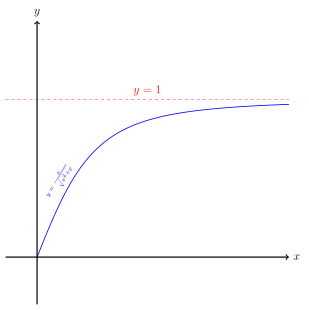
- \(\,\) \begin{align*} && y &= \frac{cx}{\sqrt{x^2+p}} \\ && \d y &= \frac{c(x^2+p)-cx^2}{(x^2+p)^{3/2}} \d x \\ &&&= \frac{cp^2}{(x^2+p)^{3/2}} \d x\\ && I &= \int \frac1{(b^2-y^2)\sqrt{c^2-y^2}} \d y \\ &&&= \int \frac{1}{\left ( b^2 - \frac{c^2x^2}{x^2+p} \right) \sqrt{c^2 - \frac{c^2x^2}{x^2+p} }} \d y \\ &&&= \int \frac{(x^2+p)^{3/2}}{((b^2-c^2)x^2+pb^2)\sqrt{c^2p}}\frac{cp}{(x^2+p)^{3/2}} \d x \\ &&&= \int \frac{\sqrt{p}}{((b^2-c^2)x^2+pb^2)} \d x \\ p=1: &&&= \int \frac{1}{(b^2-c^2)x^2+b^2} \d x \end{align*} When \(b = \sqrt{3}, c = \sqrt{2}\) \begin{align*} && I_1 &= \int_1^{\sqrt{2}} \frac{1}{(3 - y^2)\sqrt{2 - y^2}} \d y\\ &&&= \int_{x =1 }^{x=\infty} \frac{1}{3+x^2} \d x \\ &&&= \left [ \frac{1}{\sqrt{3}} \tan^{-1} \frac{x}{\sqrt{3}} \right]_1^\infty \\ &&&= \frac{\pi}{2\sqrt{3}} - \frac{1}{\sqrt{3}} \frac{\pi}{6} \\ &&&= \frac{\pi}{3\sqrt{3}} \end{align*} \begin{align*} && I_2 &= \int_{\frac{1}{\sqrt{2}}}^1 \frac{y}{(3y^2 - 1)\sqrt{2y^2 - 1}} \d y \\ x = \frac1y, \d x = -\frac1{y^2} \d y &&&= \int_{x=\sqrt{2}}^{x=1} \frac{x^2}{(3-x^2)\sqrt{2-x^2}}\cdot \left ( -\frac{1}{x^2} \right ) \d x \\ &&&= \int_1^{\sqrt{2}} \frac{1}{(3-x^2)\sqrt{2-x^2}} \d x \\ &&&= I_1 = \frac{\pi}{3\sqrt{3}} \end{align*}
- \(\,\) \begin{align*} && I_3 &= \int_{\frac{1}{\sqrt{2}}}^1 \frac{1}{(3y^2 - 1)\sqrt{2y^2 - 1}} \d y \\ x = 1/y, \d x = -1/y^2 \d y &&&= \int_{x=1}^{x=\sqrt{2}} \frac{x}{(3-x^2)\sqrt{2-x^2}} \d x \\ u = x^2, \d u = 2x \d x &&&= \int_{u=1}^{u=2} \frac{\frac12}{(3-u)\sqrt{2-u}} \d u \\ v=2-u, \d v = -\d u &&&= \frac12\int_{v=0}^{v=1} \frac{1}{(1+v)\sqrt{v}} \d v \\ &&&=\left [\tan^{-1}\sqrt{v}\right]_0^1 \\ &&&= \frac{\pi}{4} \end{align*}
2018 Paper 1 Q4
The function \(\f\) is defined by \[ \phantom{\ \ \ \ \ \ \ \ \ \ \ \ (x>0, \ \ x\ne1)} \f(x) = \frac{1}{x\ln x} \left(1 - (\ln x)^2 \right)^2 \ \ \ \ \ \ \ \ \ \ \ \ (x>0, \ \ x\ne1) \,.\] Show that, when \(( \ln x )^2 = 1\,\), both \(\f(x)=0\) and \(\f'(x)=0\,\). The function \(F\) is defined by \begin{align*} F(x) = \begin{cases} \displaystyle \int_{ 1/\text{e}}^x \f(t) \; \mathrm{d}t & \text{ for } 0 < x < 1\,, \\[7mm] \displaystyle \int_{\text{e}}^x \f(t) \; \mathrm{d}t & \text{ for } x > 1\,. \\ \end{cases} \end{align*}
- Find \(F(x)\) explicitly and hence show that \(F(x^{-1})=F(x)\,\).
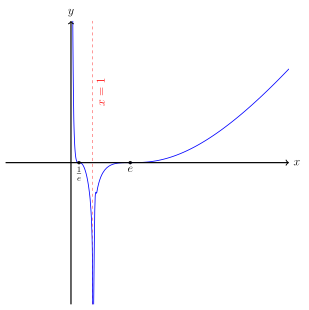
- Sketch the curve with equation \(y=F(x)\,\). [You may assume that \(\dfrac{ (\ln x)^k} x\to 0\) as \(x\to\infty\) for any constant \(k\).]
Solution: When \((\ln x)^2 = 1\) we have \(f(x) = \frac{1}{x\ln x}(1 - 1^2)^2 = 0\) \(f'(x) = \frac{2(1 - (\ln x)^2) \cdot (-2 \ln x ) \cdot \frac1x \cdot (x \ln x) - (\ln x +1)(1-(\ln x)^2)^2}{(x\ln x)^2} = \frac{2\cdot 0 \cdot (-2 \ln x ) \cdot \frac1x \cdot (x \ln x) - (\ln x +1) \cdot 0}{(x\ln x)^2} = 0\)
- First consider \(0 < x < 1\), so \begin{align*} && F(x) &= \int_{1/e}^x f(t) \d t \\ &&&= \int_{1/e}^x \frac{1}{t\ln t} \left(1 - (\ln t)^2 \right)^2 \d t \\ u = \ln t, \d u = \frac1t \d t: &&&= \int_{u=-1}^{u=\ln x} \frac{1}{u}(1-u^2)^2 \d u \\ &&&= \int_{-1}^{\ln x} \left ( u^3 - 2u+\frac1u \right) \d u \\ &&&= \left [ \frac{u^4}{4} - u^2+ \ln |u| \right]_{-1}^{\ln x} \\ &&&= \frac{(\ln x)^4}{4} -(\ln x)^2 + \ln |\ln x| - \frac14+1 \end{align*} Now consider \(x > 1\) \begin{align*} && F(x) &= \int_{e}^x f(t) \d t \\ &&&= \int_{e}^x \frac{1}{t\ln t} \left(1 - (\ln t)^2 \right)^2 \d t \\ u = \ln t, \d u = \frac1t \d t: &&&= \int_{u=1}^{u=\ln x} \frac{1}{u}(1-u^2)^2 \d u \\ &&&= \int_{1}^{\ln x} \left ( u^3 - 2u+\frac1u \right) \d u \\ &&&= \left [ \frac{u^4}{4} - u^2+ \ln |u| \right]_{1}^{\ln x} \\ &&&= \frac{(\ln x)^4}{4} -(\ln x)^2 + \ln| \ln x| - \frac14+1 \end{align*} Notice that \begin{align*} F(x^{-1}) &= \frac{(\ln x^{-1})^4}{4} -(\ln x^{-1})^2 + \ln| \ln x^{-1}| - \frac14+1 \\ &= \frac{(-\ln x)^4}{4} -(-\ln x)^2 + \ln| -\ln x| - \frac14+1 \\ &= \frac{(\ln x)^4}{4} -(\ln x)^2 + \ln| \ln x| - \frac14+1 \\ &= F(x) \end{align*}
- \(\,\)
2018 Paper 1 Q8
The functions \(\s\) and \(\c\) satisfy \(\s(0)= 0\,\), \(\c(0)=1\,\) and \[ \s'(x) = \c(x)^2 ,\] \[ \c'(x)=-\s(x)^2. \] You may assume that \(\s\) and \(\c\) are uniquely defined by these conditions.
- Show that \(\s(x)^3+\c(x)^3\) is constant, and deduce that \(\s(x)^3+\c(x)^3=1\,\).
- Show that \[ \frac{\d }{\d x} \, \Big( \s(x) \c(x) \Big) = 2\c(x)^3-1 \] and find (and simplify) an expression in terms of \(\c(x)\) for $\dfrac{\d }{\d x} \left( \dfrac{\s(x)}{\c(x)} \right) $.
- Find the integrals \[ \int \s(x)^2 \, \d x \ \ \ \ \ \ \text{and} \ \ \ \ \ \ \int \s(x)^5 \, \d x \,. \]
- Given that \(\s\) has an inverse function, \(\s^{-1}\), use the substitution \(u = \s(x)\) to show that \[ \int \frac{1}{(1-u^3)^{\frac{2}{3}}} \, \d u = \s^{-1}(u) \, + \text{constant}. \]
- Find, in terms of \(u\), the integrals \[ \int \frac{1}{{(1-u^3)}^{\frac{4}{3}}} \, \d u \ \ \ \ \ \ \text{and} \ \ \ \ \ \ \int {(1-u^3)}^{\frac{1}{3}} \, \d u \,. \]
Solution: \begin{questionparts} \item \begin{align*} && \dfrac{\d }{\d x} \left( \s(x)^3 + \c(x)^3 \right) &= 3\s(x)^2\s'(x) + 3\c(x)^2 \c'(x) \\ &&&= 3\s(x)^2\c(x)^2 - 3\c(x)^2\s(x)^2 \\ &&&= 0 \\ \\ \Rightarrow && \s(x)^3 + \c(x)^3 &= \text{constant} \\ &&&= \s(0)^3 + \c(0)^3 \\ &&&= 1 \end{align*} \item \begin{align*} \frac{\d }{\d x} \, \Big( \s(x) \c(x) \Big) &= \s'(x) \c(x) + \s(x)\c'(x) \\ &= \c(x)^3 - \s(x)^3 \\ &= \c(x)^3 - (1-\c(x)^3) \\ &= 2\c(x)^3 - 1 \\ \\ \dfrac{\d }{\d x} \left( \dfrac{\s(x)}{\c(x)} \right) &= \frac{\s'(x)\c(x) - \s(x)\c'(x)}{\c(x)^2} \\ &= \frac{\c(x)^3 + \s(x)^3}{\c(x)^2} \\ &= \frac{1}{\c(x)^2} \\ \end{align*} \item \begin{align*} \int \s(x)^2 \d x &= -\int -\s(x)^2 \d x \\ &= -\int \c'(x) \d x \\ &= - \s(x) +C \\ \\ \int \s(x)^5 \, \d x &= \int \s(x)^2 \s(x)^3 \d x \\ &= \int \s(x)^2 (1 - \c(x)^3) \d x \\ &= -\int \c'(x) (1 - \c(x)^3) \d x \\ &= - c(x) + \frac{\c(x)^4}{4} + C \end{align*} \item If \(u = \s(x), \frac{\d u}{\d x} = \c(x)^2\) \begin{align*} \int \frac{1}{(1-u^3)^{\frac{2}{3}}} \, \d u &= \int \frac{1}{(1-\s(x)^3)^{\frac{2}{3}}} \c(x)^2 \d x \\ &= \int 1 \d x \\ &= x + C \\ &= \s^{-1}(u) + C \\ \\ \int \frac{1}{{(1-u^3)^{\frac{4}{3}}}} \d u &= \int \frac1{(1-\s(x)^3)^{\frac43} }\c(x)^2 \d x \\ &= \int \frac1{(\c(x)^3)^{\frac43}} \c(x)^2 \d x \\ &= \int \frac1{\c(x)^2} \d x \\ &= \frac{\s(x)}{\c(x)} + C \\ &= \frac{u}{(1-u^3)^{\frac13}} + C \\ \end{align*} \begin{align*} && \int {(1-u^3)}^{\frac{1}{3}} \, \d u &= \int (1-s(x)^3)^{\frac13} c(x)^2 \d x \\ &&&= \int \c(x)^3 \d x = I\\ &&&= \int \c(x) s'(x) \d x \\ &&&= \left [\c(x) \s(x) \right] + \int \s(x)^2 s(x) \d x \\ &&&= \c(x) \s(x) + \int (1 - \c(x)^3) \d x + C \\ &&&= \c(x) \s(x) + x - I + C \\ \Rightarrow && I &= \frac{x + \c(x) \s(x)}{2} + k \\ \Rightarrow && &= \frac12 \l \s^{-1}(u) + u \sqrt[3](1-u^3)\r + k \end{align*}