Problems
Filters
2 problems found
2016 Paper 1 Q3
D: 1500.0
B: 1487.6
curve sketching
floor function
greatest integer function
trigonometric
piecewise function
discontinuity
step function
In this question, \(\lfloor x \rfloor\) denotes the greatest integer that is less than or equal to \(x\), so that (for example) \(\lfloor 2.9 \rfloor = 2\), \(\lfloor 2\rfloor = 2\) and \(\lfloor -1.5 \rfloor = -2\). On separate diagrams draw the graphs, for \(-\pi \le x \le \pi\), of:
(i) \(y = \lfloor x \rfloor\);
(ii) \(y=\sin\lfloor x \rfloor\);
(iii) \(y = \lfloor \sin x\rfloor\);
(iv) \(y= \lfloor 2\sin x\rfloor\).
In each case,
you should indicate clearly the value of \(y\) at points where the graph
is discontinuous.
Solution:


2000 Paper 1 Q3
D: 1500.0
B: 1500.0
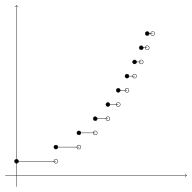
For any number \(x\), the largest integer less than or equal to \(x\) is denoted by \([x]\). For example, \([3.7]=3\) and \([4]=4\). Sketch the graph of \(y=[x]\) for \(0\le x<5\) and evaluate \[ \int_0^5 [x]\;\d x. \] Sketch the graph of \(y=[\e^{x}]\) for \(0\le x< \ln n\), where \(n\) is an integer, and show that \[ \int_{0}^{\ln n}[\e^{x}]\, \d x =n\ln n - \ln (n!). \]
Solution: