Problems
Filters
8 problems found
2015 Paper 1 Q3
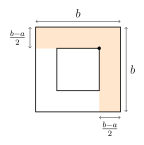
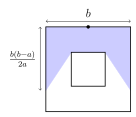
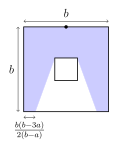
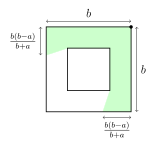
A prison consists of a square courtyard of side \(b\) bounded by a perimeter wall and a square building of side \(a\) placed centrally within the courtyard. The sides of the building are parallel to the perimeter walls. Guards can stand either at the middle of a perimeter wall or in a corner of the courtyard. If the guards wish to see as great a length of the perimeter wall as possible, determine which of these positions is preferable. You should consider separately the cases \(b<3a\) and \(b>3a\,\).
Solution:
2015 Paper 1 Q6
The vertices of a plane quadrilateral are labelled \(A\), \(B\), \(A'\) and \(B'\), in clockwise order. A point \(O\) lies in the same plane and within the quadrilateral. The angles \(AOB\) and \(A'OB'\) are right angles, and \(OA=OB\) and \(OA'=OB'\). Use position vectors relative to \(O\) to show that the midpoints of \(AB\), \(BA'\), \(A'B'\) and \(B'A\) are the vertices of a square. Given that the lengths of \(OA\) and \(OA'\) are fixed (and the conditions of the first paragraph still hold), find the value of angle \(BOA'\) for which the area of the square is greatest.
Solution: Let \(O\) be the origin, and let \(\mathbf{a}, \mathbf{b}, \mathbf{a}', \mathbf{b}'\) be the four points. The conditions give us \begin{align*} && \mathbf{a} \cdot \mathbf{b} &= 0 \\ && |\mathbf{a}| &= |\mathbf{b}| \\ && \mathbf{a}' \cdot \mathbf{b}' &= 0 \\ && |\mathbf{a}'| &= |\mathbf{b}'| \\ \end{align*} So \begin{align*} \text{midpoint }AB \text{ to midpoint } BA' &= (\tfrac12(\mathbf{a}+\mathbf{b}) - \tfrac12(\mathbf{b}+\mathbf{a}'))\cdot (\tfrac12(\mathbf{a}+\mathbf{b}) - \tfrac12(\mathbf{b}+\mathbf{a}')) \\ &= \frac12(\mathbf{a}-\mathbf{a}')\cdot \frac12(\mathbf{a} - \mathbf{a}') \\ \text{midpoint }BA' \text{ to midpoint } A'B' &= (\tfrac12(\mathbf{b}+\mathbf{a}') - \tfrac12(\mathbf{a}'+\mathbf{b}')) \cdot (\tfrac12(\mathbf{b}+\mathbf{a}') - \tfrac12(\mathbf{a}'+\mathbf{b}'))\\ &= \frac12(\mathbf{b}-\mathbf{b}')\cdot \frac12(\mathbf{b} - \mathbf{b}') \\ &= \frac14 (|\mathbf{b}|^2 + |\mathbf{b}'|^2 - 2\mathbf{b}\cdot\mathbf{b}')\\ &= \frac14(|\mathbf{a}|^2 + |\mathbf{a}'|^2 - 2\mathbf{b}\cdot\mathbf{b}') \\ \text{midpoint }A'B' \text{ to midpoint } B'A &= (\tfrac12(\mathbf{a}'+\mathbf{b}') - \tfrac12(\mathbf{b}'+\mathbf{a})) \cdot (\tfrac12(\mathbf{a}'+\mathbf{b}') - \tfrac12(\mathbf{b}'+\mathbf{a}))\\ &= \frac12(\mathbf{a}'-\mathbf{a})\cdot \frac12(\mathbf{a}' - \mathbf{a}) \\ \text{midpoint }B'A \text{ to midpoint } AB &= (\tfrac12(\mathbf{b}'+\mathbf{a}) - \tfrac12(\mathbf{a}+\mathbf{b})) \cdot (\tfrac12(\mathbf{b}'+\mathbf{a}) - \tfrac12(\mathbf{a}+\mathbf{b}))\\ &= \frac12(\mathbf{b}'-\mathbf{b})\cdot \frac12(\mathbf{b}' - \mathbf{b}) \\ \end{align*} So it's sufficient to prove \(\mathbf{a}\cdot \mathbf{a}' = \mathbf{b}\cdot \mathbf{b}'\) but this is clear from looking at a diagram for 1 second. Given the length of the square is what it is, we want to minimise \(\mathbf{b}\cdot \mathbf{b}'\) which is when they are vertically opposite each other, ie \(\angle BOA' = 90^\circ\)
2014 Paper 3 Q5
A quadrilateral drawn in the complex plane has vertices \(A\), \(B\), \(C\) and \(D\), labelled anticlockwise. These vertices are represented, respectively, by the complex numbers \(a\), \(b\), \(c\) and \(d\). Show that \(ABCD\) is a parallelogram (defined as a quadrilateral in which opposite sides are parallel and equal in length) if and only if \(a+c =b+d\,\). Show further that, in this case, \(ABCD\) is a square if and only if \({\rm i}(a-c)=b-d\). Let \(PQRS\) be a quadrilateral in the complex plane, with vertices labelled anticlockwise, the internal angles of which are all less than \(180^\circ\). Squares with centres \(X\), \(Y\), \(Z\) and \(T\) are constructed externally to the quadrilateral on the sides \(PQ\), \(QR\), \(RS\) and \(SP\), respectively.
- If \(P\) and \(Q\) are represented by the complex numbers \(p\) and \(q\), respectively, show that \(X\) can be represented by \[ \tfrac 12 \big( p(1+{\rm i} ) + q (1-{\rm i})\big) \,. \]
- Show that \(XY\!ZT\) is a square if and only if \(PQRS\) is a parallelogram.
Solution: The vector representing the side \(AB\) is \(b - a\) and the vector representing the side \(DC\) is \(c - d\). \(ABCD\) is a parallelogram if and only if these opposite sides are parallel and equal in length, which is given by \(b - a = c - d\), or equivalently \(a + c = b + d\). Similarly, if \(a + c = b + d\), then \(c - b = d - a\), so the side \(BC\) is parallel and equal in length to the side \(AD\). Thus, \(a + c = b + d\) is the necessary and sufficient condition for \(ABCD\) to be a parallelogram. In a parallelogram, the shape is a square if and only if the diagonals are equal in length and perpendicular to each other. The diagonals are represented by the vectors \(c - a\) and \(d - b\). For these to be equal in length and perpendicular, one must be a \(90^\circ\) rotation of the other. Since \(A, B, C, D\) are labeled anticlockwise, a \(90^\circ\) anticlockwise rotation of the vector \(\vec{AC}\) (which is \(c-a\)) would point in the direction of \(\vec{DB}\) (which is \(b-d\) if we consider the relative orientation). Specifically: \(i(c - a) = d - b \implies -i(a - c) = d - b \implies i(a - c) = b - d\). Thus, \(ABCD\) is a square if and only if \(i(a - c) = b - d\).
- The midpoint of the side \(PQ\) is \(\frac{1}{2}(p + q)\). To find the centre \(X\) of the square built externally on \(PQ\), we start at the midpoint and move a distance equal to half the side length in a direction perpendicular to \(PQ\). Since \(P, Q, R, S\) are anticlockwise, the outward direction is a \(90^\circ\) clockwise rotation of the vector \(\vec{PQ}\). A clockwise rotation of \(90^\circ\) corresponds to multiplication by \(-i\). \[ x = \frac{p+q}{2} + (-i)\left(\frac{q-p}{2}\right) = \frac{p + q - iq + ip}{2} = \frac{1}{2} \big( p(1+i) + q(1-i) \big) \]
- From part (i), we have the representations for the centres: \begin{align*} x &= \tfrac{1}{2}(p(1+i) + q(1-i)) \\ y &= \tfrac{1}{2}(q(1+i) + r(1-i)) \\ z &= \tfrac{1}{2}(r(1+i) + s(1-i)) \\ t &= \tfrac{1}{2}(s(1+i) + p(1-i)) \end{align*} As shown in the first part of the problem, \(XYZT\) is a square if and only if: (1) \(x+z = y+t\) (it is a parallelogram) (2) \(i(x-z) = y-t\) (it is a square) First, examine condition (1): \begin{align*} x+z - (y+t) &= \tfrac{1}{2} \big[ (p+r)(1+i) + (q+s)(1-i) - (q+s)(1+i) - (r+p)(1-i) \big] \\ &= \tfrac{1}{2} \big[ (p+r)(1+i - (1-i)) - (q+s)(1+i - (1-i)) \big] \\ &= \tfrac{1}{2} \big[ (p+r)(2i) - (q+s)(2i) \big] \\ &= i(p+r - (q+s)) \end{align*} Thus, \(x+z = y+t\) if and only if \(p+r = q+s\), which is the condition that \(PQRS\) is a parallelogram. Next, examine condition (2): \begin{align*} i(x-z) &= \tfrac{1}{2} i \big[ p(1+i) + q(1-i) - r(1+i) - s(1-i) \big] \\ &= \tfrac{1}{2} \big[ p(i-1) + q(i+1) - r(i-1) - s(i+1) \big] \\ y-t &= \tfrac{1}{2} \big[ q(1+i) + r(1-i) - s(1+i) - p(1-i) \big] \\ \text{So, } i(x-z) - (y-t) &= \tfrac{1}{2} \big[ p(i-1 + 1-i) + q(i+1 - 1-i) + r(-i+1 - 1+i) + s(-i-1 + 1+i) \big] \\ &= 0 \end{align*} Since \(i(x-z) = y-t\) is an identity (always true for any \(PQRS\)), \(XYZT\) is a square if and only if it is a parallelogram. As established above, this occurs if and only if \(PQRS\) is a parallelogram.
2010 Paper 3 Q5
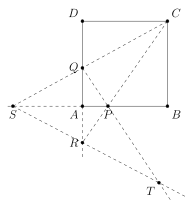
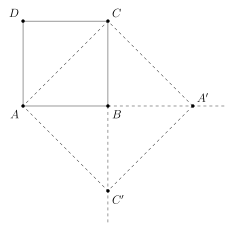
The vertices \(A\), \(B\), \(C\) and \(D\) of a square have coordinates \((0,0)\), \((a,0)\), \((a,a)\) and \((0,a)\), respectively. The points \(P\) and \(Q\) have coordinates \((an,0)\) and \((0,am)\) respectively, where \(0 < m < n < 1\). The line \(CP\) produced meets \(DA\) produced at \(R\) and the line \(CQ\) produced meets \(BA\) produced at \(S\). The line \(PQ\) produced meets the line \(RS\) produced at \(T\). Show that \(TA\) is perpendicular to \(AC\). Explain how, given a square of area \(a^2\), a square of area \(2a^2\) may be constructed using only a straight-edge. [Note: a straight-edge is a ruler with no markings on it; no measurements (and no use of compasses) are allowed in the construction.]
Solution:
2001 Paper 1 Q1
The points \(A\), \(B\) and \(C\) lie on the sides of a square of side 1 cm and no two points lie on the same side. Show that the length of at least one side of the triangle \(ABC\) must be less than or equal to \((\sqrt6 -\sqrt2)\) cm.
1996 Paper 2 Q7
Consider a fixed square \(ABCD\) and a variable point \(P\) in the plane of the square. We write the perpendicular distance from \(P\) to \(AB\) as \(p\), from \(P\) to \(BC\) as \(q\), from \(P\) to \(CD\) as \(r\) and from \(P\) to \(DA\) as \(s\). (Remember that distance is never negative, so \(p,q,r,s\geqslant 0\).) If \(pr=qs\), show that the only possible positions of \(P\) lie on two straight lines and a circle and that every point on these two lines and a circle is indeed a possible position of \(P\).
1993 Paper 1 Q11
A piece of uniform wire is bent into three sides of a square \(ABCD\) so that the side \(AD\) is missing. Show that if it is first hung up by the point \(A\) and then by the point \(B\) then the angle between the two directions of \(BC\) is \(\tan^{-1}18.\)
Solution:

1988 Paper 1 Q3
Two points \(P\) and \(Q\) lie within, or on the boundary of, a square of side 1cm, one corner of which is the point \(O\). Show that the length of at least one of the lines \(OP,PQ\) and \(QO\) must be less than or equal to \((\sqrt{6}-\sqrt{2})\) cm.
Solution: First note that \((\sqrt{6} - \sqrt{2})^2 = 8 - 2\sqrt{12} = 8 - 4\sqrt{3}\) and since \(49 > 16 \times 3\) \(\sqrt{6}-\sqrt{2} > 1\). Therefore we can assume without loss of generality that \(P\) and \(Q\) both do not lie on the same side as each other, a side containing \(O\), otherwise one of those lengths would be \(1 \text{ cm} < (\sqrt{6}-\sqrt{2}) \text{ cm} \). Let \(O = (0,0)\), \(P = (1,x)\), \(Q = (y,1)\), then our lengths squared are: \(1 + x^2, 1 + y^2, (1-x)^2+(1-y)^2\). To maximise the length of the smallest side, each side should be equal in length (otherwise we could increase the length of the smallest side by moving the point between the shortest side and the longest side (without affecting the other side). Therefore \(x = y\) and \(1+x^2 = 2(1-x)^2 \Rightarrow x^2-4x+1 = 0 \Rightarrow x = 2 - \sqrt{3} \). Therefore the distances are all \(\sqrt{1+7-4\sqrt{3}} = \sqrt{8-4\sqrt{3}} = (\sqrt{6}-\sqrt{2}) \text{ cm}\)