Problems
Filters
2 problems found
1988 Paper 2 Q11
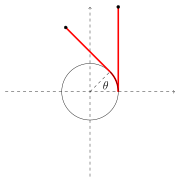
A heavy particle lies on a smooth horizontal table, and is attached to one end of a light inextensible string of length \(L\). The other end of the string is attached to a point \(P\) on the circumference of the base of a vertical post which is fixed into the table. The base of the post is a circle of radius \(a\) with its centre at a point \(O\) on the table. Initially, at time \(t=0\), the string is taut and perpendicular to the line \(OP.\) The particle is then struck in such a way that the string starts winding round the post and remains taut. At a later time \(t\), a length \(a\theta(t)\ (< L)\) of the string is in contact with the post. Using cartesian axes with origin \(O\), find the position and velocity vectors of the particle at time \(t\) in terms of \(a,L,\theta\) and \(\dot{\theta},\) and hence show that the speed of the particle is \((L-a\theta)\dot{\theta}.\) If the initial speed of the particle is \(v\), show that the particle hits the post at a time \(L^{2}/(2av).\)
Solution:
1988 Paper 2 Q12
One end of a thin uniform inextensible, but perfectly flexible, string of length \(l\) and uniform mass per unit length is held at a point on a smooth table a distance \(d(< l)\) away from a small vertical hole in the surface of the table. The string passes through the hole so that a length \(l-d\) of the string hangs vertically. The string is released from rest. Assuming that the height of the table is greater than \(l\), find the time taken for the end of the string to reach the top of the hole.
Solution: Consider some point once the string is moving, there will be \(x\) above the table and \(l - x\) hanging in the air. For the hanging string we must have \((l-x)mg - T = -(l-x)m\ddot{x}\). For the string on the table we must have that \(T = -xm \ddot{x}\). Eliminating T, we have \((l-x)g = -l \ddot{x}\) Solving the differential equation, we must have \(x = A \cosh \sqrt \frac{g}{l}t+B \sinh\sqrt \frac{g}{l}t+l\), Since \(x(0) = d, \dot{x}(0) = 0 \Rightarrow B = 0, A = (-d)\). Therefore \(x = l-(l-d) \cosh \sqrt \frac{g}{l} t \Rightarrow t =\sqrt \frac{l}{g} \cosh^{-1} \l \frac{l-x}{l-d} \r\) and we go over the edge when \(x = 0\), ie \(\sqrt \frac{l}{g} \cosh^{-1} \l \frac{l}{l-d} \r\)