Problems
Filters
2 problems found
2024 Paper 3 Q9
The origin \(O\) of coordinates lies on a smooth horizontal table and the \(x\)- and \(y\)-axes lie in the plane of the table. A smooth sphere \(A\) of mass \(m\) and radius \(r\) is at rest on the table with its lowest point at the origin. A second smooth sphere \(B\) has the same mass and radius and also lies on the table. Its lowest point has \(y\)-coordinate \(2r\sin\alpha\), where \(\alpha\) is an acute angle, and large positive \(x\)-coordinate. Sphere \(B\) is now projected parallel to the \(x\)-axis, with speed \(u\), so that it strikes sphere \(A\). The coefficient of restitution in this collision is \(\frac{1}{3}\).
- Show that, after the collision, sphere \(B\) moves with velocity \[\begin{pmatrix} -\frac{1}{3}u\bigl(1 + 2\sin^2\alpha\bigr) \\ \frac{2}{3}u\sin\alpha\cos\alpha \end{pmatrix}.\]
- Show further that the lowest point of sphere \(B\) crosses the \(y\)-axis at the point \((0, Y)\), where \(Y = 2r(\cos\alpha\tan\beta + \sin\alpha)\) and \[\tan\beta = \frac{2\sin\alpha\cos\alpha}{1 + 2\sin^2\alpha}.\]
- Show that, if \(h > Y + 2r\sec\beta\), sphere \(B\) will not strike sphere \(C\) in its motion after the collision with sphere \(A\).
- Show that \(Y < 2r\sec\beta\). Hence show that sphere \(B\) will not strike sphere \(C\) for any value of \(\alpha\), if \(h > \dfrac{8r}{\sqrt{3}}\).
2019 Paper 3 Q10
Two identical smooth spheres \(P\) and \(Q\) can move on a smooth horizontal table. Initially, \(P\) moves with speed \(u\) and \(Q\) is at rest. Then \(P\) collides with \(Q\). The direction of travel of \(P\) before the collision makes an acute angle \(\alpha\) with the line joining the centres of \(P\) and \(Q\) at the moment of the collision. The coefficient of restitution between \(P\) and \(Q\) is \(e\) where \(e < 1\). As a result of the collision, \(P\) has speed \(v\) and \(Q\) has speed \(w\), and \(P\) is deflected through an angle \(\theta\).
- Show that $$u \sin \alpha = v \sin(\alpha + \theta)$$ and find an expression for \(w\) in terms of \(v\), \(\theta\) and \(\alpha\).
- Show further that $$\sin \theta = \cos(\theta + \alpha) \sin \alpha + e \sin(\theta + \alpha) \cos \alpha$$ and find an expression for \(\tan \theta\) in terms of \(\tan \alpha\) and \(e\). Find, in terms of \(e\), the maximum value of \(\tan \theta\) as \(\alpha\) varies.
Solution:
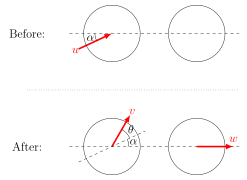
- Since the impulse is along the line of centres, the velocities are as show in the diagram. Additionally, vertical velocity is unchanged, so: \(v \sin (\theta + \alpha) = u \sin \alpha\) \begin{align*} \text{COM}(\rightarrow): && u \cos\alpha &= v \cos(\alpha + \theta) + w \\ \Rightarrow && w &= u \cos \alpha - v \cos (\alpha + \theta) \end{align*}
- Since the approach speed (horizontally) is \(u \cos \alpha\) the speed of separation is \(e u \cos \alpha\), in particular \(w - v \cos(\theta + \alpha) = e u \cos \alpha\) or \(w = v \cos (\theta + \alpha) + e u \cos \alpha\). \begin{align*} && w &= w \\ && v \cos (\theta + \alpha) + e u \cos \alpha &= u \cos \alpha - v \cos (\alpha + \theta) \\ \Rightarrow && \frac{u \sin \alpha}{\sin (\alpha + \theta)} \cos (\theta + \alpha) + e u \cos \alpha &= u \cos \alpha - \frac{u \sin \alpha}{\sin (\alpha + \theta)} \cos (\alpha + \theta) \\ \Rightarrow && \sin \alpha \cos(\theta + \alpha) + e \sin (\alpha+\theta)\cos \alpha &= \sin(\alpha+\theta) \cos \alpha - \cos(\alpha+\theta)\sin \alpha \\ &&&= \sin ((\alpha+\theta)-\alpha) \\ &&&= \sin \theta \end{align*} as required. \begin{align*} && \sin \theta &= \cos(\theta+ \alpha)\sin \alpha + e \sin (\theta + \alpha) \cos \alpha \\ &&&= \cos \theta \cos \alpha \sin \alpha - \sin \theta \sin^2 \alpha + e \sin \theta \cos ^2 \alpha + e \cos \theta \sin \alpha \cos \alpha \\ \Rightarrow && \tan \theta \sec^2 \alpha &= \tan \alpha - \tan \theta \tan^2 \alpha + e \tan \theta + e \tan \alpha \\ \Rightarrow && \tan \theta (1 + \tan^2 \alpha+\tan^2 \alpha-e) &= \tan \alpha + e \tan \alpha \\ \Rightarrow && \tan \theta &= \frac{(1+e)\tan \alpha}{1-e + 2\tan^2 \alpha} \end{align*} We seek to maximise \(y = \frac{x}{c+2x^2}\), \begin{align*} && \frac{\d y}{\d x} &= \frac{c+2x^2-4x^2}{(c+2x^2)^2} \\ &&&= \frac{c-2x^2}{(c+2x^2)^2} \end{align*} Therefore the maximum will occur at \(x = \sqrt{c/2}\), ie \(\tan \alpha = \sqrt{(1-e)/2}\) and theta will be \(\displaystyle \frac{(1+e)\sqrt{(1-e)/2}}{2(1-e)} =\frac{1}{2\sqrt{2}} \frac{1+e}{\sqrt{1-e}}\)