Problems
Filters
5 problems found
2018 Paper 3 Q10
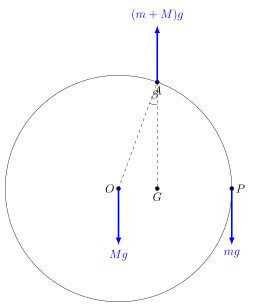
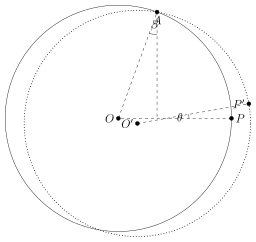
A uniform disc with centre \(O\) and radius \(a\) is suspended from a point \(A\) on its circumference, so that it can swing freely about a horizontal axis \(L\) through \(A\). The plane of the disc is perpendicular to \(L\). A particle \(P\) is attached to a point on the circumference of the disc. The mass of the disc is \(M\) and the mass of the particle is \(m\). In equilibrium, the disc hangs with \(OP\) horizontal, and the angle between \(AO\) and the downward vertical through \(A\) is \(\beta\). Find \(\sin\beta\) in terms of \(M\) and \(m\) and show that \[ \frac{AP}{a} = \sqrt{\frac{2M}{M+m}} \,. \] The disc is rotated about \(L\) and then released. At later time \(t\), the angle between \(OP\) and the horizontal is \(\theta\); when \(P\) is higher than \(O\), \(\theta\) is positive and when \(P\) is lower than \(O\), \(\theta\) is negative. Show that \[ \tfrac12 I \dot\theta^2 + (1-\sin\beta)ma^2 \dot \theta^2 + (m+M)g a\cos\beta \, (1- \cos\theta) \] is constant during the motion, where \(I\) is the moment of inertia of the disc about \(L\). Given that \(m= \frac 32 M\) and that \(I=\frac32Ma^2\), show that the period of small oscillations is \[ 3\pi \sqrt{\frac {3a}{5g}} \,. \]
Solution:

2013 Paper 3 Q9
A sphere of radius \(R\) and uniform density \(\rho_{\text{s}}\) is floating in a large tank of liquid of uniform density \(\rho\). Given that the centre of the sphere is a distance \(x\) above the level of the liquid, where \(x < R\), show that the volume of liquid displaced is \[ \frac \pi 3 (2R^3-3R^2x +x^3)\,. \] The sphere is acted upon by two forces only: its weight and an upward force equal in magnitude to the weight of the liquid it has displaced. Show that \[ 4 R^3\rho_{\text{s}} (g+\ddot x) = (2R^3 -3R^2x +x^3)\rho g\,. \] Given that the sphere is in equilibrium when \(x=\frac12 R\), find \(\rho_{\text{s}}\) in terms of \(\rho\). Find, in terms of \(R\) and \(g\), the period of small oscillations about this equilibrium position.
2003 Paper 3 Q9
A particle \(P\) of mass \(m\) is constrained to move on a vertical circle of smooth wire with centre~\(O\) and of radius \(a\). \(L\) is the lowest point of the circle and \(H\) the highest and \(\angle LOP = \theta\,\). The particle is attached to \(H\) by an elastic string of natural length \(a\) and modulus of elasticity~\(\alpha mg\,\), where \(\alpha > 1\,\). Show that, if \(\alpha>2\,\), there is an equilibrium position with \(0<\theta<\pi\,\). Given that \(\alpha =2+\sqrt 2\,\), and that \(\displaystyle \theta = \tfrac{1}{2}\pi + \phi\,\), show that \[ \ddot{\phi} \approx -\frac{g (\sqrt2+1)}{2a }\, \phi \] when \(\phi\) is small. For this value of \(\alpha\), explain briefly what happens to the particle if it is given a small displacement when \( \theta = \frac{1}{2}\pi\).
1998 Paper 3 Q9
A uniform right circular cone of mass \(m\) has base of radius \(a\) and perpendicular height \(h\) from base to apex. Show that its moment of inertia about its axis is \({3\over 10} ma^2\), and calculate its moment of inertia about an axis through its apex parallel to its base. \newline[{\em Any theorems used should be stated clearly.}] The cone is now suspended from its apex and allowed to perform small oscillations. Show that their period is $$ 2\pi\sqrt{ 4h^2 + a^2\over 5gh} \,. $$ \newline[{\em You may assume that the centre of mass of the cone is a distance \({3\over 4}h\) from its apex.}]
1996 Paper 3 Q11
A smooth circular wire of radius \(a\) is held fixed in a vertical plane with light elastic strings of natural length \(a\) and modulus \(\lambda\) attached to the upper and lower extremities, \(A\) and \(C\) respectively, of the vertical diameter. The other ends of the two strings are attached to a small ring \(B\) which is free to slide on the wire. Show that, while both strings remain taut, the equation for the motion of the ring is $$2ma \ddot\theta=\lambda(\cos\theta-\sin\theta)-mg\sin\theta,$$ where \(\theta\) is the angle \( \angle{CAB}\). Initially the system is at rest in equilibrium with \(\sin\theta=\frac{3}{5}\). Deduce that \(5\lambda=24mg\). The ring is now displaced slightly. Show that, in the ensuing motion, it will oscillate with period approximately $$10\pi\sqrt{a\over91g}\,.$$