Problems
Filters
4 problems found
2015 Paper 2 Q2
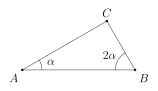
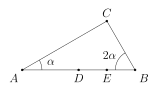
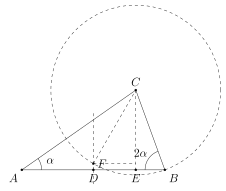
In the triangle \(ABC\), angle \(BAC = \alpha\) and angle \(CBA= 2\alpha\), where \(2\alpha\) is acute, and \(BC= x\). Show that \(AB = (3-4 \sin^2\alpha)x\). The point \(D\) is the midpoint of \(AB\) and the point \(E\) is the foot of the perpendicular from \(C\) to \(AB\). Find an expression for \(DE\) in terms of \(x\). The point \(F\) lies on the perpendicular bisector of \(AB\) and is a distance \(x\) from \(C\). The points \(F\) and \(B\) lie on the same side of the line through \(A\) and \(C\). Show that the line \(FC\) trisects the angle \(ACB\).
Solution:
2011 Paper 1 Q11
A thin non-uniform bar \(AB\) of length \(7d\) has centre of mass at a point \(G\), where \(AG=3d\). A light inextensible string has one end attached to \(A\) and the other end attached to \(B\). The string is hung over a smooth peg \(P\) and the bar hangs freely in equilibrium with \(B\) lower than~\(A\). Show that \[ 3\sin\alpha = 4\sin\beta\,, \] where \(\alpha\) and \(\beta\) are the angles \(PAB\) and \(PBA\), respectively. Given that \(\cos\beta=\frac45\) and that \(\alpha\) is acute, find in terms of \(d\) the length of the string and show that the angle of inclination of the bar to the horizontal is \(\arctan \frac17\,\).
2005 Paper 1 Q7
The notation \(\displaystyle \prod^n_{r=1} \f (r)\) denotes the product $\f (1) \times \f (2) \times \f(3) \times \cdots \times \f(n)$. %For example, \(\displaystyle \prod_{r=1}^4 r = 24\). %Simplify \(\displaystyle \prod^n_{r=1} \frac{\g (r) }{ \g (r-1) }\). %You may assume that \(\g (r) \neq 0\) for any integer \(0 \le r \le n \). Simplify the following products as far as possible:
- \(\displaystyle \prod^n_{r=1} \l \frac{r+ 1 }{ r } \r\,\);
- \(\displaystyle \prod^n_{r=2} \l \frac{r^2 -1}{r^2 } \r\,\);
- $\displaystyle \prod^n_{r=1} \l {\cos \frac{2\pi }{ n} + \sin \frac{2\pi}{ n} \cot \frac{\l 2r-1 \r \pi }{ n} }\r\,$, where \(n\) is even.
Solution:
- \(\,\) \begin{align*} \prod^n_{r=1} \left ( \frac{r+ 1 }{ r } \right) &= \frac{2}{1} \cdot \frac{3}{2} \cdot \frac{4}{3} \cdots \frac{n-1}{n-2} \cdot \frac{n}{n-1} \cdot \frac{n+1}{n} \\ &= \frac{n+1}{1} = n+1 \end{align*}
- \(\,\) \begin{align*} \prod^n_{r=2} \left ( \frac{r^2 -1}{r^2 } \right) &= \prod^n_{r=2} \left ( \frac{(r -1)(r+1)}{r^2 } \right) \\ &= \left ( \frac{1}{2} \cdot \frac{3}{2} \right) \cdot \left ( \frac{2}{3} \cdot \frac{4}{3} \right) \cdots \left ( \frac{r-1}{r} \cdot \frac{r+1}{r}\right) \cdots \frac{n-1}{n} \cdot \frac{n+1}{n} \\ &= \frac{1}{n} \cdot \frac{n+1}{2} \\ &= \frac{n+1}{2n} \end{align*}
- When \(n\) is odd, the product is undefined, since we have a \(\cot \pi\) lurking in there. \begin{align*} \prod^n_{r=1} \left ( {\cos \frac{2\pi }{ n} + \sin \frac{2\pi}{ n} \cot \frac{ (2r-1 ) \pi }{ n} } \right) &= \prod^n_{r=1} \left ( {\cos \frac{2\pi }{ n} + \sin \frac{2\pi}{ n} \frac{\cos \frac{ (2r-1 ) \pi }{ n}}{\sin\frac{ (2r-1 ) \pi }{ n}} } \right) \\ &= \prod^n_{r=1} \frac{1}{\sin\frac{ (2r-1 ) \pi }{ n}} \left ( {\cos \frac{2\pi }{ n} \sin\frac{ (2r-1 ) \pi }{ n} + \sin \frac{2\pi}{ n} \cos \frac{ (2r-1 ) \pi }{ n} } \right) \\ &= \prod^n_{r=1} \frac{1}{\sin\frac{ (2r-1 ) \pi }{ n}} \sin \left ( \frac{2\pi}{n} + \frac{(2r-1)\pi}{n} \right) \\ &= \prod^n_{r=1} \frac{1}{\sin\frac{ (2r-1 ) \pi }{ n}} \sin \left ( \frac{(2r+1)\pi}{n} \right) \\ &= \frac{\sin \frac{3\pi}{n}}{\sin \frac{\pi}{n}} \cdot \frac{\sin \frac{5\pi}{n}}{\sin \frac{3\pi}{n}} \cdots \frac{\sin \frac{(2n+1)\pi}{n}}{\sin \frac{(2n-1)\pi}{n}} \\ &= \frac{\sin \frac{(2n+1)\pi}{n}}{\sin \frac{\pi}{n}} \\ &= 1 \end{align*}
1990 Paper 2 Q2
Prove that if \(A+B+C+D=\pi,\) then \[ \sin\left(A+B\right)\sin\left(A+D\right)-\sin B\sin D=\sin A\sin C. \] The points \(P,Q,R\) and \(S\) lie, in that order, on a circle of centre \(O\). Prove that \[ PQ\times RS+QR\times PS=PR\times QS. \]
Solution: \begin{align*} \sin(A+B)\sin(A+D) - \sin B \sin D &= \sin (A+B)\sin(\pi - B-C) - \sin B \sin (\pi - A - B - C) \\ &= \sin (A+B)\sin(B+C) - \sin B \sin(A+B+C) \\ &= \sin(A+B)\sin (B+C) - \sin B (\sin (A+B)\cos C +\cos(A+B) \sin C) \\ &= \sin(A+B)\cos B \sin C + \cos(A+B)\sin B \sin C \\ &= \sin A \sin C \cos^2 B + \cos A \sin B \cos B \sin C - \cos A \cos B \sin B \sin C + \sin A \sin^2 B \sin C \\ &= \sin A \sin C (\cos^2 B + \sin^2 B) \\ &= \sin A \sin C \end{align*}
