Given that \(0 < k < 1\), show with the help of a sketch that the equation
\[
\sin x = k x
\tag{\(*\)}\]
has a unique solution in the range \(0 < x < \pi\).
Let
\[
I= \int_0^\pi \big\vert \sin x -kx\big\vert \, \d x\,.
\]
Show that
\[
I= \frac{\pi^2 \sin\alpha }{2\alpha} -2\cos\alpha - \alpha \sin\alpha\,,
\]
where
\(\alpha\) is the unique solution of \((*)\).
Show that \(I\), regarded as a function of \(\alpha\), has
a unique stationary value and that this stationary value
is a minimum. Deduce that
the smallest value of \(I\) is
\[
-2 \cos \frac{\pi}{\sqrt2}\,
.\]
Solution:
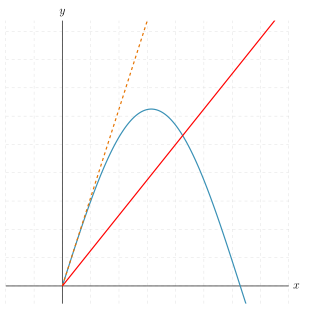
Note that the line \(y = x\) is the tangent \((0,0)\) and \(y = \sin x \) is always below it. For any other line through the origin with gradient \(0 < k < 1\) it must start below \(y = \sin x\), but finish above it at \(x = \pi\). It also can only cross once due the the convexity of \(\sin\) in this interval.
\begin{align*}
&& I &= \int_0^\pi | \sin x -kx | \d x \\
&&&= \int_0^\alpha (\sin x -k x) \d x + \int_{\alpha}^\pi (kx - \sin x) \d x \\
&&&= \left [ -\cos x - \frac{kx^2}{2} \right]_0^{\alpha} + \left [ \cos x +\frac{kx^2}{2} \right]_{\alpha}^\pi \\
&&&= -\cos \alpha - \frac{k \alpha^2}{2} +1+(-1)+\frac{k\pi^2}{2} - \cos \alpha - \frac{k\alpha^2}{2} \\
&&&= -2\cos \alpha - k\left (\alpha^2 - \frac{\pi^2}{2} \right) \\
&&&= -2\cos \alpha - \frac{\sin \alpha}{\alpha}\left (\alpha^2 - \frac{\pi^2}{2} \right) \\
&&&= \frac{\pi^2 \sin \alpha}{\alpha} - \alpha \sin \alpha - 2\cos \alpha
\end{align*}
\begin{align*}
&& \frac{\d I}{\d \alpha} &= \frac{\pi^2(\alpha \cos \alpha - \sin \alpha)}{2\alpha^2} + 2 \sin \alpha - \sin \alpha - \alpha \cos \alpha \\
&&&= \frac{-2\alpha^3 \cos \alpha + 2\alpha \sin\alpha + \pi^2 \alpha \cos \alpha - \pi^2 \sin \alpha}{2\alpha^2} \\
\\
&&&= \left ( \alpha \cos \alpha - \sin \alpha\right) \left ( \frac{\pi^2}{2\alpha^2}-1 \right)\
\end{align*}
Therefore \(I' = 0\) if \(\tan \alpha = \alpha\) or \(\alpha = \frac{\pi}{\sqrt{2}}\). Since \(\tan \alpha = \alpha\) only at \(\alpha = 0\) (between \(0 \leq \alpha < \pi\) (by considering the tangent), we must have a unique turning point when \(\alpha = \frac{\pi}{\sqrt{2}}\).
Note that \(I(\frac{\pi}{\sqrt{2}}) = \frac{\pi^2 \sqrt{2} \sin \alpha}{2\pi} - \frac{\pi}{\sqrt{2}} \sin \alpha - 2\cos \frac{\pi}{\sqrt{2}}=- 2\cos \frac{\pi}{\sqrt{2}}\).
Notice that \(I(0) = \frac{\pi^2}2 - 2 > 2\) and \(I(\pi) = 2\), but \(-2\cos \frac{\pi}{\sqrt{2}} < 2\) so we must be a at a minimum