Problems
Filters
4 problems found
2020 Paper 3 Q10
A light elastic spring \(AB\), of natural length \(a\) and modulus of elasticity \(kmg\), hangs vertically with one end \(A\) attached to a fixed point. A particle of mass \(m\) is attached to the other end \(B\). The particle is held at rest so that \(AB > a\) and is released. Find the equation of motion of the particle and deduce that the particle oscillates vertically. If the period of oscillation is \(\dfrac{2\pi}{\Omega}\), show that \(kg = a\Omega^2\). Suppose instead that the particle, still attached to \(B\), lies on a horizontal platform which performs simple harmonic motion vertically with amplitude \(b\) and period \(\dfrac{2\pi}{\omega}\). At the lowest point of its oscillation, the platform is a distance \(h\) below \(A\). Let \(x\) be the distance of the particle above the lowest point of the oscillation of the platform. When the particle is in contact with the platform, show that the upward force on the particle from the platform is \[ mg + m\Omega^2(a + x - h) + m\omega^2(b - x). \] Given that \(\omega < \Omega\), show that, if the particle remains in contact with the platform throughout its motion, \[ h \leqslant a\left(1 + \frac{1}{k}\right) + \frac{\omega^2 b}{\Omega^2}. \] Find the corresponding inequality if \(\omega > \Omega\). Hence show that, if the particle remains in contact with the platform throughout its motion, it is necessary that \[ h \leqslant a\left(1 + \frac{1}{k}\right) + b, \] whatever the value of \(\omega\).
2001 Paper 3 Q9
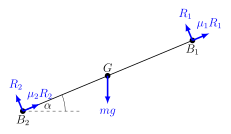
\(B_1\) and \(B_2\) are parallel, thin, horizontal fixed beams. \(B_1\) is a vertical distance \(d \sin \alpha \) above \(B_2\), and a horizontal distance \(d\cos\alpha \) from \(B_2\,\), where \(0<\alpha<\pi/2\,\). A long heavy plank is held so that it rests on the two beams, perpendicular to each, with its centre of gravity at \(B_1\,\). The coefficients of friction between the plank and \(B_1\) and \(B_2\) are \(\mu_1\) and \(\mu_2\,\), respectively, where \(\mu_1<\mu_2\) and \(\mu_1+\mu_2=2\tan\alpha\,\). The plank is released and slips over the beams experiencing a force of resistance from each beam equal to the limiting frictional force (i.e. the product of the appropriate coefficient of friction and the normal reaction). Show that it will come to rest with its centre of gravity over \(B_2\) in a time \[ \pi \left(\frac{d}{g(\mu_2-\mu_1)\cos\alpha }\right)^{\!\frac12}\;. \]
Solution:
1994 Paper 2 Q10
A truck is towing a trailer of mass \(m\) across level ground by means of an elastic rope of natural length \(l\) whose modulus of elasticity is \(\lambda.\) At first the rope is slack and the trailer stationary. The truck then accelerates until the rope becomes taut and thereafter the truck travels in a straight line at a constant speed \(u\). Assuming that the effect of friction on the trailer is negligible, show that the trailer will collide with the truck at a time \[ \pi\left(\frac{lm}{\lambda}\right)^{\frac{1}{2}}+\frac{l}{u} \] after the rope first becomes taut.
1993 Paper 2 Q13
The force \(F\) of repulsion between two particles with positive charges \(Q\) and \(Q'\) is given by \(F=kQQ'/r^{2},\) where \(k\) is a positive constant and \(r\) is the distance between the particles. Two small beads \(P_{1}\) and \(P_{2}\) are fixed to a straight horizontal smooth wire, a distance \(d\) apart. A third bead \(P_{3}\) of mass \(m\) is free to move along the wire between \(P_{1}\) and \(P_{3}.\) The beads carry positive electrical charges \(Q_{1},Q_{2}\) and \(Q_{3}.\) If \(P_{3}\) is in equilibrium at a distance \(a\) from \(P_{1},\) show that \[ a=\frac{d\sqrt{Q_{1}}}{\sqrt{Q_{1}}+\sqrt{Q_{2}}}. \] Suppose that \(P_{3}\) is displaced slightly from its equilibrium position and released from rest. Show that it performs approximate simple harmonic motion with period \[ \frac{\pi d}{(\sqrt{Q_{1}}+\sqrt{Q_{2}})^{2}}\sqrt{\frac{2md\sqrt{Q_{1}Q_{2}}}{kQ_{3}}.} \] {[}You may use the fact that \(\dfrac{1}{(a+y)^{2}}\approx\dfrac{1}{a^{2}}-\dfrac{2y}{a^{3}}\) for small \(y.\){]}