Problems
Filters
3 problems found
2013 Paper 2 Q3
D: 1600.0
B: 1500.0
polynomials
cubic
roots of polynomials
curve sketching
turning points
Vieta's formulas
inequality
sign analysis
- Given that the cubic equation \(x^3+3ax^2 + 3bx +c=0\) has three distinct real roots and \(c<0\), show with the help of sketches that either exactly one of the roots is positive or all three of the roots are positive.
- Given that the equation \(x^3 +3ax^2+3bx+c=0\) has three distinct real positive roots show that \begin{equation*} a^2>b>0, \ \ \ \ a<0, \ \ \ \ c<0\,. \tag{\(*\)} \end{equation*} [Hint: Consider the turning points.]
- Given that the equation \(x^3 +3ax^2+3bx+c=0\) has three distinct real roots and that \begin{equation*} ab<0, \ \ \ \ c>0\,, \end{equation*} determine, with the help of sketches, the signs of the roots.
- Show by means of an explicit example (giving values for \(a\), \(b\) and \(c\)) that it is possible for the conditions (\(*\)) to be satisfied even though the corresponding cubic equation has only one real root.
Solution:
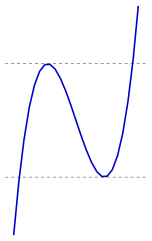
- First notice that this cubic has leading first term \(1\) and three real roots, so it must have the shape:
With the \(x\)-axis running somewhere between the dashed lines. Since \(c < 0\), the \(y\)-axis must meet the curve below the \(x\)-axis, ie somewhere on the blue section of this curve:
 Therefore there will be either \(1\) (if it meets it in the \(\cup\) area) or \(3\) (if it meets it on the far left) positive roots.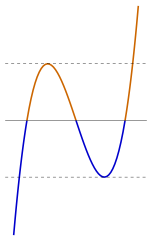
- First notice that if \(c > 0\) we cannot have three positive real roots since the function would need to pass \(0\) between \(0\) and \(-\infty\). Secondly, notice both turning points must be larger than zero, ie \begin{align*} && 0 &= 3x^2 + 6ax + 3b \\ \Leftrightarrow && 0 &= (x+a)^2 + b - a^2 \end{align*} has both roots larger than zero, (and it needs to have two roots, so \(a^2 > b\) and \(-a > 0\), ie \(a < 0\). If \(b < 0\), then just looking at \(x^2+2ax+b\) we can see that it is \(<0\) at \(0\) and one of the roots will be negative, therefore \(c < 0\), \(a^2 > b > 0\) and \(a < 0\)
- Since \(c > 0\) we can see that at least one root is negative.
ie the \(y\)-axis passes through an orange section of this curve. What now matters is where the larger turning point is. Considering \(x^2 + 2ax + b\), we notice that \(ab < 0\) means that \((x-\alpha)(x-\beta)\) we must have \((\alpha + \beta)\alpha \beta > 0\) which isn't possible if both roots are negative. Therefore the \(y\)-axis passes through the orange \(\cap\) and there are \(2\) positive real roots.
- If we take \(a = 1, b = -1, c = 1\) then we have \(x^3 + 3x^2-3x+1\). This has turning points when \(x^2+2x-1 = 0\), ie \(x = -1 \pm \sqrt{2}\) Notice that \begin{align*} && y(-1\pm \sqrt2) &= (-1 \pm \sqrt{2})^3 + 3(-1 \pm \sqrt{2})^2-3(-1 \pm \sqrt{2}) + 1 \\ &&&= (-1\pm \sqrt{2}) \cdot (3 \mp 2\sqrt2) + 3(3 \mp \sqrt2) -3(-1\pm \sqrt2) + 1 \\ &&&= (-7 \pm 5 \sqrt2) + (9 \mp 3\sqrt2) +(3 \mp 3\sqrt2) + 1 \\ &&&= 24 \mp 16\sqrt2 = 8(3 \mp 2 \sqrt2) >0 \end{align*} ie both turning points are above zero and hence only one real root
2003 Paper 1 Q4
D: 1500.0
B: 1500.0
trigonometry
inequality
trigonometric inequality
sign analysis
case analysis
half-angle substitution
Solve the inequality $$\frac{\sin\theta+1}{\cos\theta}\le1\;$$ where \(0\le\theta<2\pi\,\) and \(\cos\theta\ne0\,\).
Solution:

2001 Paper 1 Q2
D: 1500.0
B: 1484.0
Solve the inequalities
- \(1+2x-x^2 >2/x \quad (x\ne0)\) ,
- \(\sqrt{3x+10} > 2+\sqrt{x+4} \quad (x\ge -10/3)\).
Solution:
- \(\,\)
\begin{align*} && 1+2x-x^2 = 2/x \\ \Rightarrow && 0 &= x^3-2x^2-x+2 \\ &&&= (x+1)(x^2-3x+2) \\ &&&= (x+1)(x-1)(x-2) \end{align*} Therefore the inequality is satisfied on \((1,2)\) and \((-1,0)\)

- \(\,\)
\begin{align*} && \sqrt{3x+10} &= 2+\sqrt{x+4} \\ && 3x+10 &= x+8 + 4\sqrt{x+4} \\ && 16(x+4) &= 4(x+1)^2 \\ && 4x+16 &= x^2+2x+1 \\ \Rightarrow && 0 &= x^2-2x-15 \\ &&&= (x-5)(x+3) \end{align*} Therefore \(x > 5\)
