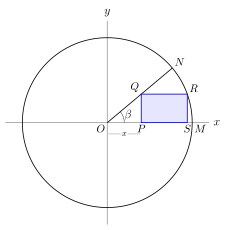
A circle of radius \(a\)
is centred at the origin \(O\). A rectangle \(PQRS\) lies in the
minor sector \(OMN\) of this circle
where \(M\) is \((a,0)\) and \(N\) is \((a \cos \beta, a \sin \beta)\),
and \(\beta\) is a constant with \(0 < \beta < \frac{\pi}{2}\,\).
Vertex \(P\) lies on the positive \(x\)-axis at \((x,0)\);
vertex \(Q\) lies on \(ON\); vertex \(R\) lies on the arc of the circle
between \(M\) and \(N\); and vertex \(S\) lies on the positive \(x\)-axis at \((s,0)\).
Show that the area \(A\) of the rectangle can be written in the form
\[
A= x(s-x)\tan\beta
\,.
\]
Obtain an expression for \(s\) in terms of \(a\), \(x\) and \(\beta\), and use it to
show that
\[
\frac{\d A}{\d x} =
(s-2x) \tan \beta - \frac {x^2} s \tan^3\beta
\,.
\]
Deduce that the greatest possible area of
rectangle \(PQRS\) occurs when
\(s= x(1+\sec\beta)\) and show that this greatest area is \(\tfrac12 a^2 \tan \frac12 \beta\,\).
Show also that this greatest area occurs when \(\angle ROS = \frac12\beta\,\).
Solution:
Clearly the distance \(PS\) is \(s - x\), so it remains to determine the heigh \(PQ\). Notice that \(\tan \beta = \frac{PQ}{OP}\) so the height is \(x \tan \beta\) and the area is \(x(s-x)\tan \beta \)
Notice that \(R\) has a \(y\)-coordinate of \(x \tan \beta\), but is a distance \(a\) from the origin, so
\(s^2 + x^2 \tan^2 \beta = a^2 \Rightarrow s = \sqrt{a^2-x^2 \tan^2 \beta}\)
\begin{align*}
&& \frac{\d A}{\d x} &= (s-x)\tan \beta + x \left (\frac{\d s}{\d x} - 1 \right) \tan \beta \\
&&&= (s-x) \tan \beta + \left (\tfrac12(a^2-x^2\tan^2 \beta)^{-1/2} \cdot (-2x \tan^2 \beta) - 1\right) x \tan \beta \\
&&&= (s-x) \tan \beta + \left ( \frac{-x \tan^2 \beta}{s} -1\right)x \tan \beta \\
&&&= (s-2x) \tan \beta - \frac{x^2}{s}\tan^3\beta \\
\\
\frac{\d A}{\d x} = 0: && 0 &= s(s-2x)-x^2 \tan^2 \beta \\
&&&= s^2-(2x)s-x^2\tan^2 \beta \\
&&&= (s-x)^2-(1+\tan^2\beta)x^2 \\
\Rightarrow && s &= x + x \sec \beta \\
&&&= (1+\sec \beta)x \\
\\
&& a^2 &= x^2(1+\sec\beta)^2 + x^2 \tan^2 \beta \\
&&&= x^2(2\sec \beta +2\sec^2 \beta ) \\
&&&= 2x^2 \sec \beta(1+\sec \beta) \\
\\
&& A &= x^2\sec \beta \tan \beta \\
&&&= \frac12 a^2 \frac{\sec \beta \tan \beta}{\sec \beta(1+\sec \beta)} \\
&&&= \frac12 a^2 \frac{\tan \beta}{1+\sec \beta} = \frac12 a^2 \tan \frac{\beta}{2}\\
\end{align*}
This occurs when
\begin{align*}
&& \frac{RS}{SO} &= \frac{x \tan \beta}{s} \\
&&&= \frac{\tan \beta}{1+\sec \beta} = \tan \frac{\beta}2 \\
\Rightarrow&& \angle ROS &= \frac{\beta}2
\end{align*}