Problems
Filters
4 problems found
2018 Paper 2 Q2
A function \(\f(x)\) is said to be concave for \(a< x < b\) if \[ \ t\,\f(x_1) +(1-t)\,\f(x_2) \le \f\big(tx_1+ (1-t)x_2\big) \, ,\] for \(a< x_1 < b\,\), \(a< x_2< b\) and \(0\le t \le 1\,\). Illustrate this definition by means of a sketch, showing the chord joining the points \(\big(x_1, \f(x_1)\big) \) and \(\big(x_2, \f(x_2)\big) \), in the case \(x_1 < x_2\) and \(\f(x_1)< \f(x_2)\,\). Explain why a function \(\f(x)\) satisfying \(\f''(x)<0\) for \(a< x < b\) is concave for \(a< x < b\,\).
- By choosing \(t\), \(x_1\) and \(x_2\) suitably, show that, if \(\f(x)\) is concave for \(a< x < b\,\), then \[ \f\Big(\frac{u+ v+w}3\Big) \ge \frac{ \f(u) +\f(v) +\f(w)}3 \, ,\] for \(a< u < b\,\), \(a< v < b\,\) and \(a< w < b\,\).
- Show that, if \(A\), \(B\) and \(C\) are the angles of a triangle, then \[ \sin A +\sin B + \sin C \le \frac{3\sqrt3}2 \,. \]
- By considering \(\ln (\sin x)\), show that, if \(A\), \(B\) and \(C\) are the angles of a triangle, then \[ \sin A \times \sin B \times \sin C \le \frac {3 \sqrt 3} 8 \,. \]
Solution:
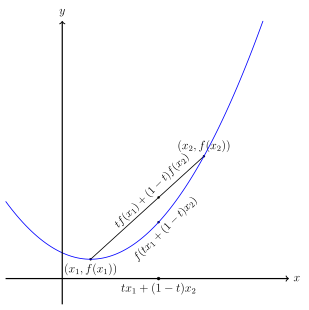
- \(\,\) \begin{align*} && f \left ( \frac{u+v+w}{3} \right) &= f \left ( \frac{2}{3}\cdot \frac{u+v}2+\frac{1}{3}w \right) \\ &&&\geq \frac23 f \left ( \frac{u+v}{2} \right) + \frac13 f(w) \\ &&&\geq \frac23 \left (\frac12 f(u) + \frac12 f(v) \right) + \frac13 f(w) \\ &&&= \frac{f(u)+f(v)+f(w)}{3} \end{align*}
- Notice that if \(A, B, C\) are angles in a triangle then they add to \(\pi\) \(0 < A,B,C < \pi\). We also have \(f(x) = \sin x \Rightarrow f''(x) = - \sin x < 0\) on this interval. Therefore \(\sin A + \sin B + \sin C \leq 3 \sin \frac{A+B+C}{3} = 3 \sin \frac{\pi}{3} = \frac{3\sqrt{3}}2\)
- Also notice that \begin{align*} && f(x) &= \ln ( \sin x) \\ \Rightarrow && f'(x) &= \frac{\cos x}{ \sin x} \\ && f''(x) &= -\textrm{cosec}^2 x < 0 \\ \\ \Rightarrow && \ln( \sin A) + \ln (\sin B) + \ln (\sin C) &\leq 3 \ln \left (\sin \left ( \frac{A + B+ C}{3} \right) \right) \\ &&&= 3 \ln \left ( \frac{\sqrt{3}}{2} \right) = \ln \frac{3\sqrt{3}}{8} \\ \Rightarrow && \sin A \sin B \sin C &\leq \frac{3\sqrt{3}}8 \end{align*}
2014 Paper 3 Q6
Starting from the result that \[ \.h(t) >0\ \mathrm{for}\ 0< t < x \Longrightarrow \int_0^x \.h(t)\ud t > 0 \,, \] show that, if \(\.f''(t) > 0\) for \(0 < t < x_0\) and \(\.f(0)=\.f'(0) =0\), then \(\.f(t)>0\) for \(0 < t < x_0\).
- Show that, for \(0 < x < \frac12\pi\), \[ \cos x \cosh x <1 \,. \]
- Show that, for \(0 < x < \frac12\pi\), \[ \frac 1 {\cosh x} < \frac {\sin x} x < \frac x {\sinh x} \,. \] %
- Show that, for \(0 < x < \frac12\pi\), \(\tanh x < \tan x\).
2002 Paper 1 Q2
Let \(f(x) = x^m(x-1)^n\), where \(m\) and \(n\) are both integers greater than \(1\). Show that the curve \(y=f(x)\) has a stationary point with \(0 < x < 1\). By considering \(f''(x)\), show that this stationary point is a maximum if \(n\) is even and a minimum if \(n\) is odd. Sketch the graphs of \(f(x)\) in the four cases that arise according to the values of \(m\) and \(n\).
Solution: \begin{align*} && f'(x) &= mx^{m-1}(x-1)^n + nx^m(x-1)^{n-1} \\ &&&= (m(x-1)+nx)x^{m-1}(x-1)^{n-1} \\ &&&= (x(m+n) - m)x^{m-1}(x-1)^{n-1} \\ \end{align*} Therefore when \(x = \frac{m}{m+n}\) there is a stationary point with \(0 < x < 1\). \begin{align*} && f''(x) &= m(m-1)x^{m-2}(x-1)^n + 2mnx^{m-1}(x-1)^{n-1} + n(n-1)x^{m}(x-1)^{n-2} \\ &&&= (m(m-1)(x-1)^2 +2mnx(x-1)+n(n-1)x^2)x^{m-2}(1-x)^{n-2} \\ \Rightarrow && f'' \left ( \frac{m}{m+n} \right) &= \left ( m(m-1) \frac{n^2}{(m+n)^2} - 2mn\frac{mn}{(m+n)^2} + n(n-1) \frac{m^2}{(m+n)^2} \right) \frac{m^{m-2}}{(m+n)^{m-2}} \frac{(-1)^{n-2}n^{n-2}}{(m+n)^{n-2}} \\ &&&= (-1)^{n-2}\frac{m^{m-1}n^{n-1}}{(m+n)^{m+n-2}} \left ( (m-1)n-2mn+(n-1)m\right) \\ &&&= (-1)^{n-2}\frac{m^{m-1}n^{n-1}}{(m+n)^{m+n-2}} \left ( -m-n\right) \\ &&&= (-1)^{n-1} \frac{m^{m-1}n^{n-1}}{(m+n)^{m+n-3}} \end{align*} Therefore this is positive (and a minimum) when \(n\) is odd and negative (and a maximum) when \(n\) is even.


1988 Paper 1 Q2
The function \(\mathrm{f}\) and \(\mathrm{g}\) are related (for all real \(x\)) by \[ \mathrm{g}(x)=\mathrm{f}(x)+\frac{1}{\mathrm{f}(x)}\,. \] Express \(\mathrm{g}'(x)\) and \(\mathrm{g}''(x)\) in terms of \(\mathrm{f}(x)\) and its derivatives. If \(\mathrm{f}(x)=4+\cos2x+2\sin x\), find the stationary points of \(\mathrm{g}\) for \(0\leqslant x\leqslant2\pi,\) and determine which are maxima and which are minima.
Solution: \(g'(x) = f'(x) - \frac{f'(x)}{(f(x))^2} = f'(x) \l 1 - \frac{1}{(f(x))^2} \r\) \(g''(x) = f''(x) - \frac{f''(x)f(x)^2-f'(x)\cdot 2f(x) f'(x)}{(f(x))^4} = f''(x) + \frac{f''(x)f(x)-2(f'(x))^2}{(f(x))^3}\) \begin{align*} f(x) &=4+\cos2x+2\sin x \\ f'(x) &=-2\sin2x+2\cos x \\ f''(x) &= -4\cos2x-2\sin x \end{align*} Therefore, since the stationary points of \(g\), ie points where \(g'(x) = 0\) are where \(f'(x) = 0\) or \(f(x) = \pm 1\) we should look at \begin{align*} && 0 &= f'(x) \\ && 0 &= 2 \cos x - 2 \sin 2x \\ &&&= 2 \cos x - 4 \sin x \cos x \\ &&&= 2\cos x (1 - 2 \sin x) \\ \Rightarrow && x &= \frac{\pi}2, \frac{3\pi}{2}, \frac{\pi}{6}, \frac{5\pi}{6} \end{align*} \begin{align*} && 1 &= f(x) \\ && 1 &= 4 + \cos 2x + 2 \sin x \\ \Rightarrow && \cos 2x = -1,& \sin x = -1 \\ \Rightarrow && x &= \frac{3\pi}{2} \end{align*} which we were already checking. For each of these points we have: \begin{array}{c|c|c|c||c} x & f(x) & f'(x) & f''(x) & g''(x) \\ \hline \frac{\pi}{2} & 5 & 0 & 2 & > 0\\ \frac{3\pi}{2} & 1 & 0 & 6 &> 0\\ \frac{\pi}{6} & 5.5 & 0 & -3 & < 0 \\ \frac{5\pi}{6} & 5.5 & 0 & -3 & < 0\\ \end{array} Therefore \(\frac{\pi}{2}, \frac{3\pi}{2}\) are minimums and \(\frac{\pi}{6}\) and \(\frac{5\pi}{6}\) are maxima.