Problems
Filters
1 problem found
2012 Paper 3 Q6
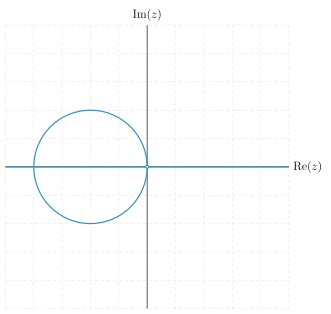
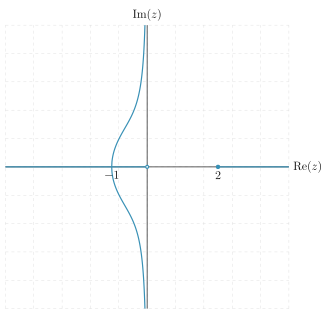
Let \(x+{\rm i} y\) be a root of the quadratic equation \(z^2 + pz +1=0\), where \(p\) is a real number. Show that \(x^2-y^2 +px+1=0\) and \((2x+p)y=0\). Show further that either \(p=-2x\) or \(p=-(x^2+1)/x\) with \(x\ne0\). Hence show that the set of points in the Argand diagram that can (as \(p\) varies) represent roots of the quadratic equation consists of the real axis with one point missing and a circle. This set of points is called the root locus of the quadratic equation. Obtain and sketch in the Argand diagram the root locus of the equation \[ pz^2 +z+1=0\, \] and the root locus of the equation \[ pz^2 + p^2z +2=0\,.\]
Solution: \begin{align*} && 0 &= z^2 + pz + 1\\ &&&= (x+iy)^2 + (x+iy)p + 1 \\ &&& = (x^2-y^2+px+1) + (2xy+py)i \\ \Rightarrow && 0 &= x^2 - y^2 + px + 1 \\ && 0 &= (2x+p)y \\ \Rightarrow && p &= -2x \\ \text{ or } && y &= 0 \\ \Rightarrow && p &= -(x^2+1)/x \end{align*} Therefore as \(p\) varies with either have \(y = 0\) and \(x\) taking any real value except \(0\) ie the real axis minus the origin. Or \(p = -2x\) and \(-y^2-x^2+1 = 0 \Rightarrow x^2 + y^2 = 1\) which is a circle. Suppose \(pz^2 + z + 1 = 0\) \begin{align*} && 0 &= pz^2 + z +1\\ &&&= p(x+iy)^2 + (x+iy) + 1\\ &&&= (px^2-py^2+x+1) + (2xyp + y) i \\ \Rightarrow && 0 &= (2xp+1)y \\ \Rightarrow && y & = 0, p = \frac{-(x+1)}{x^2}, x \neq 0 \\ \text{ or } && p &= -\frac{1}{2x}\\ \Rightarrow && 0 &= -\frac{1}{2}x + \frac{y^2}{2x} + x + 1 \\ &&&= \frac{y^2 - x^2 +2x^2 + 2x}{2x} \\ &&&= \frac{(x+1)^2+y^2-1}{2x} \end{align*} So we either have the real axis (except \(0\)) or a circle radius \(1\) centre \((-1, 0)\) (excluding \(x = 0\)).