Problems
Filters
2 problems found
2022 Paper 3 Q6
D: 1500.0
B: 1500.0
small angle approximation
trigonometric identities
curve sketching
parametric equations
limits
rolling circle
epicycloid
- Show that when \(\alpha\) is small, \(\cos(\theta + \alpha) - \cos\theta \approx -\alpha\sin\theta - \frac{1}{2}\alpha^2\cos\theta\). Find the limit as \(\alpha \to 0\) of \[ \frac{\sin(\theta+\alpha) - \sin\theta}{\cos(\theta+\alpha) - \cos\theta} \qquad (*) \] in the case \(\sin\theta \neq 0\). In the case \(\sin\theta = 0\), what happens to the value of expression \((*)\) when \(\alpha \to 0\)?
- A circle \(C_1\) of radius \(a\) rolls without slipping in an anti-clockwise direction on a fixed circle \(C_2\) with centre at the origin \(O\) and radius \((n-1)a\), where \(n\) is an integer greater than \(2\). The point \(P\) is fixed on \(C_1\). Initially the centre of \(C_1\) is at \((na, 0)\) and \(P\) is at \(\big((n+1)a, 0\big)\).
- Let \(Q\) be the point of contact of \(C_1\) and \(C_2\) at any time in the rolling motion. Show that when \(OQ\) makes an angle \(\theta\), measured anticlockwise, with the positive \(x\)-axis, the \(x\)-coordinate of \(P\) is \(x(\theta) = a(n\cos\theta + \cos n\theta)\), and find the corresponding expression for the \(y\)-coordinate, \(y(\theta)\), of \(P\).
- Find the values of \(\theta\) for which the distance \(OP\) is \((n-1)a\).
- Let \(\theta_0 = \dfrac{1}{n-1}\pi\). Find the limit as \(\alpha \to 0\) of \[ \frac{y(\theta_0 + \alpha) - y(\theta_0)}{x(\theta_0 + \alpha) - x(\theta_0)}\,. \] Hence show that, at the point \(\big(x(\theta_0),\, y(\theta_0)\big)\), the tangent to the curve traced out by \(P\) is parallel to \(OP\).
1992 Paper 2 Q3
D: 1600.0
B: 1485.7
integration
parametric
hypocycloid
curve sketching
trigonometric
area calculation
rolling circle
product of trig functions
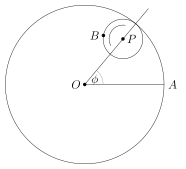
In the figure, the large circle with centre \(O\) has radius \(4\) and the small circle with centre \(P\) has radius \(1\). The small circle rolls around the inside of the larger one. When \(P\) was on the line \(OA\) (before the small circle began to roll), the point \(B\) was in contact with the point \(A\) on the large circle.