Problems
Filters
2 problems found
2019 Paper 2 Q10
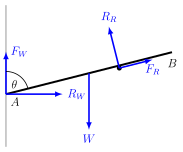
A small light ring is attached to the end \(A\) of a uniform rod \(AB\) of weight \(W\) and length \(2a\). The ring can slide on a rough horizontal rail. One end of a light inextensible string of length \(2a\) is attached to the rod at \(B\) and the other end is attached to a point \(C\) on the rail so that the rod makes an angle of \(\theta\) with the rail, where \(0 < \theta < 90^{\circ}\). The rod hangs in the same vertical plane as the rail. A force of \(kW\) acts vertically downwards on the rod at \(B\) and the rod is in equilibrium.
- You are given that the string will break if the tension \(T\) is greater than \(W\). Show that (assuming that the ring does not slip) the string will break if $$2k + 1 > 4 \sin \theta.$$
- Show that (assuming that the string does not break) the ring will slip if $$2k + 1 > (2k + 3)\mu \tan \theta,$$ where \(\mu\) is the coefficient of friction between the rail and the ring.
- You are now given that \(\mu \tan \theta < 1\). Show that, when \(k\) is increased gradually from zero, the ring will slip before the string breaks if $$\mu < \frac{2 \cos \theta}{1 + 2 \sin \theta}.$$
Solution:

- \(\,\) \begin{align*} \overset{\curvearrowright}{A}:&& W \cos \theta \cdot a + kW \cos \theta \cdot 2a - T \cos \theta \sin \theta \cdot 2a - T \sin \theta \cos \theta \cdot 2a &= 0 \\ && (2k+1) \cos \theta W &= T \cos \theta \cdot 4 \sin \theta \\ \Rightarrow && T &= \frac{2k+1}{4 \sin \theta} W \\ \Rightarrow && \text{breaks if }\quad \quad 2k+1 &> 4 \sin \theta \end{align*}
- \(\,\) \begin{align*} \text{N2}(\uparrow): && R - W - kW - T \sin \theta &= 0 \\ \Rightarrow && R &= (k+1)W - T \sin \theta \\ &&&= (k+1)W - \frac{2k+1}{4} W \\ &&&= \frac{2k+3}{4}W \\ \text{N2}(\leftarrow): && F_A - T \cos \theta &= 0 \\ \Rightarrow && F_A &= \frac{2k+1}{4 }\cot \theta \\ \Rightarrow && \text{slips if }\quad \quad\quad \quad\quad \quad F_A &> \mu R \\ \Rightarrow && \text{slips if }\quad \quad \frac{2k+1}{4 }\cot \theta &> \mu \frac{2k+3}{4}W \\ \Rightarrow && 2k+1 &> (2k+3) \mu \tan \theta \end{align*}
- The condition for breaking is \(k > 2\sin \theta -\frac12\). The condition for slipping is equivalent to: \begin{align*} && 2k+1 &> (2k+3) \mu \tan \theta \\ \Leftrightarrow && 2k(1- \mu \tan \theta) &> 3 \mu \tan \theta-1 \\ \Leftrightarrow && k &> \frac{3 \mu \tan \theta-1}{2(1- \mu \tan \theta)} \end{align*} Therefore we will slip first if: \begin{align*} && \frac{3 \mu \tan \theta-1}{2(1- \mu \tan \theta)} &< 2 \sin \theta - \frac12 \\ \Leftrightarrow && 3 \mu \tan \theta-1 &< 4 \sin \theta (1- \mu \tan \theta) - (1- \mu \tan \theta) \\ &&&=4 \sin \theta - 1 + \mu \tan \theta (1-4 \sin \theta) \\ \Leftrightarrow && 3 \mu \tan \theta &< 4 \sin \theta + \mu \tan \theta (1- 4 \sin \theta) \\ \Leftrightarrow && \mu \tan \theta(3-1+4\sin \theta) &< 4 \sin \theta \\ \Leftrightarrow && \mu &< \frac{2 \cos \theta}{1+2 \sin \theta} \end{align*}
2016 Paper 1 Q9
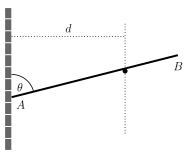
A horizontal rail is fixed parallel to a vertical wall and at a distance \(d\) from the wall. A uniform rod \(AB\) of length \(2a\) rests in equilibrium on the rail with the end \(A\) in contact with the wall. The rod lies in a vertical plane perpendicular to the wall. It is inclined at an angle \(\theta\) to the vertical (where \(0 < \theta < \frac12\pi\)) and \(a\sin\theta < d\), as shown in the diagram.
Solution: