Problems
Filters
1 problem found
2011 Paper 3 Q5
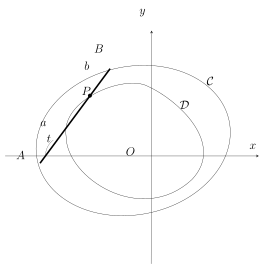
A movable point \(P\) has cartesian coordinates \((x,y)\), where \(x\) and \(y\) are functions of \(t\). The polar coordinates of \(P\) with respect to the origin \(O\) are \(r\) and \(\theta\). Starting with the expression \[ \tfrac12 \int r^2 \, \d \theta \] for the area swept out by \(OP\), obtain the equivalent expression \[ \tfrac12 \int \left( x\frac{\d y}{\d t} - y \frac{\d x}{\d t}\right)\d t \,. \tag{\(*\)} \] The ends of a thin straight rod \(AB\) lie on a closed convex curve \(\cal C\). The point \(P\) on the rod is a fixed distance \(a\) from \(A\) and a fixed distance \(b\) from \(B\). The angle between \(AB\) and the positive \(x\) direction is \(t\). As \(A\) and \(B\) move anticlockwise round \(\cal C\), the angle \(t\) increases from \(0\) to \(2\pi\) and \(P\) traces a closed convex curve \(\cal D\) inside \(\cal C\), with the origin \(O\) lying inside \(\cal D\), as shown in the diagram.
Solution: \begin{align*} && \tan \theta &= y/x \\ \Rightarrow && \sec^2 \theta \frac{\d \theta}{\d t} &= \frac{x \frac{\d y}{\d t} - y \frac{\d x}{\d t}}{x^2} \\ \Rightarrow && \frac{\d \theta}{\d t} &=\left (x \frac{\d y}{\d t} - y \frac{\d x}{\d t} \right) \frac{\cos^2 \theta}{x^2} \\ &&&=\left (x \frac{\d y}{\d t} - y \frac{\d x}{\d t} \right) \frac{\cos^2 \theta}{r^2 \cos^2 \theta } \\ &&&=\left (x \frac{\d y}{\d t} - y \frac{\d x}{\d t} \right) \frac{1}{r^2 } \\ && \tfrac12 \int r^2 \, \d \theta &= \tfrac12 \int \left (x \frac{\d y}{\d t} - y \frac{\d x}{\d t} \right) \d t \end{align*} \(A = (x - a \cos t, y - a \sin t), B = (x + b \cos t , y + b \sin t)\) \begin{align*} && [A] &= \tfrac12 \int_0^{2\pi} \left ((x-a \cos t) \frac{\d (y-a \sin t)}{\d t} - (y-a \sin t) \frac{\d (x-a \cos t)}{\d t} \right) \d t \\ &&&= \tfrac12 \int_0^{2\pi} \left ((x - a \cos t) \left ( \frac{\d y}{\d t} - a \cos t \right) - (y - a \sin t) \left ( \frac{\d x}{\d t} + a \sin t \right)\right) \d t \\ &&&= \tfrac12 \int_0^{2\pi} \left ( x \frac{\d y}{\d t} - y \frac{\d x}{\d t} - a \cos t \frac{\d y}{\d t}-ax \cos t +a^2 \cos^2 t + a \sin t \frac{\d x}{\d t}-y a \sin t + a^2 \sin^2 t \right) \d t \\ &&&= \tfrac12 \int_0^{2\pi} \left ( \underbrace{x \frac{\d y}{\d t} - y \frac{\d x}{\d t}}_{[P]}-a\left ((x + \frac{\d y}{\d x}) \cos t + (y - \frac{\d x}{\d t}) \sin t \right) + \underbrace{a^2}_{\pi a^2} \right) \d t \\ &&&= [P] + \pi a^2 - af \end{align*} \begin{align*} && [B] &= \tfrac12 \int_0^{2\pi} \left ((x+b \cos t) \frac{\d (y+b \sin t)}{\d t} - (y+b \sin t) \frac{\d (x+b \cos t)}{\d t} \right) \d t \\ &&&= \tfrac12 \int_0^{2\pi} \left ((x+b \cos t) (\frac{\d y}{\d t} + b \cos t) - (y+b \sin t)(\frac{\d x}{\d t} - b \sin t) \right) \d t \\ &&&= \tfrac12 \int_0^{2\pi} \left (x \frac{\d y}{\d t} - y \frac{\d x}{\d t} + b^2 + b(\cos t (x + \frac{\d y}{\d t}) +(y - \frac{\d x}{\d t})\sin t\right) \d t \\ &&&= [P] + \pi b^2 + b f \end{align*} Since \(A\) and \(B\) trace out the same area, we must have \(\pi a^2 - af = \pi b^2 + bf \Rightarrow \pi (a^2-b^2) = f(b+a) \Rightarrow f = \pi (a-b)\). In particular the area inbetween is \([A] - [P] = \pi a^2 - a \pi (a-b)\)