Problems
Filters
4 problems found
2019 Paper 3 Q1
The coordinates of a particle at time \(t\) are \(x\) and \(y\). For \(t \geq 0\), they satisfy the pair of coupled differential equations \[ \begin{cases} \dot{x} &= -x -ky \\ \dot{y} &= x - y \end{cases}\] where \(k\) is a constant. When \(t = 0\), \(x = 1\) and \(y = 0\).
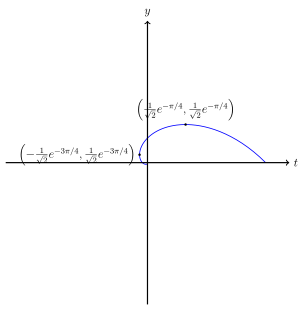
- Let \(k = 1\). Find \(x\) and \(y\) in terms of \(t\) and sketch \(y\) as a function of \(t\). Sketch the path of the particle in the \(x\)-\(y\) plane, giving the coordinates of the point at which \(y\) is greatest and the coordinates of the point at which \(x\) is least.
- Instead, let \(k = 0\). Find \(x\) and \(y\) in terms of \(t\) and sketch the path of the particle in the \(x\)-\(y\) plane.
Solution:
- Let \(k = 1\), then
\begin{align*}
\dot{x} &= - x - y \\
\dot{y} &= x - y \\
\dot{x}-\dot{y} &= -2x \\
\ddot{x} &= -\dot{x}-\dot{y} \\
&= -\dot{x} - (\dot{x}+2x) \\
&= -2\dot{x}- 2x \\
\dot{x}+\dot{y} &= -2y \\
\ddot{y} &= \dot{x}-\dot{y} \\
&= -2y-2\dot{y}
\end{align*}
So we have an auxiliary equation for \(x\) and \(y\) which is \(\lambda^2 + 2 \lambda+2 = 0 \Rightarrow \lambda = -1 \pm i\).
Therefore \(x = Ae^{-t} \cos t + B e^{-t} \sin t, y = Ce^{-t}\cos t + De^{-t} \sin t\). We also must have that, \(A = 1, C = 0\), so \(x = e^{-t} \cos t + Be^{-t} \sin t\) and \(y = De^{-t} \sin x\).
\begin{align*}
\dot{y} &= -De^{-t} \sin t +De^{-t} \cos t \\
&= e^{-t} \cos x + Be^{-t} \sin t- De^{-t} \sin t \\
\end{align*}
therefore \(B = 0, D = 1\) and \(x = e^{-t} \cos t, y = e^{-t} \sin t\)
\begin{align*} y &= e^{-t} \sin t \\ \dot{y} &= -e^{-t} \sin t + e^{-t} \cos t \\ \dot{x} &= e^{-t} \cos t -e^{-t} \sin t \end{align*}

- \begin{align*}
\dot{x} = -x \\
\dot{y} = x-y
\end{align*}
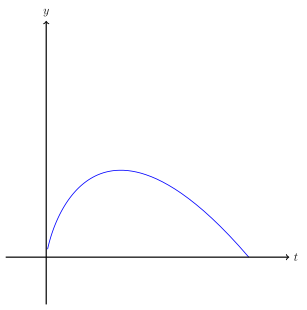
So \(x = e^{-t}\). \(\dot{y} + y = e^{-t}\) so \(y = (t+B)e^{-t}\) and so \(y =te^{-t}\).
2009 Paper 2 Q4
The polynomial \(\p(x)\) is of degree 9 and \(\p(x)-1\) is exactly divisible by \((x-1)^5\).
- Find the value of \(\p(1)\).
- Show that \(\p'(x)\) is exactly divisible by \((x-1)^4\).
- Given also that \(\p(x)+1\) is exactly divisible by \((x+1)^5\), find \(\p(x)\).
Solution: \(p(x) = q(x)(x-1)^5 + 1\) where \(q(x)\) has degree \(4\).
- \(p(1) = q(1)(1-1)^5 + 1 = 1\).
- \(p'(x) = q'(x)(x-1)^5 + 5(x-1)^4q(x) + 0 = (x-1)^4((x-1)q'(x) + 5q(x))\) so \(p'(x)\) is divisible by \((x-1)^4\)
- \(p(x)+1\) divisible by \((x+1)^5\) means that \(p(-1) = -1\) and \(p'(x)\) is divisible by \((x+1)^4\). Since \(p'(x)\) is degree \(8\) it must be \(c(x+1)^4(x-1)^4 = c(x^2 - 1)^4\). Expanding and integrating, we get \(p(x) = c(\frac{1}{9}x^9 -\frac{4}{7}x^7 + \frac{6}{5}x^5 - \frac{4}{3}x^3 + x) + d\). When \(x = 1\) we get \(c \frac{128}{315} + d = 1\) and when \(x = -1\) we get \(-c \frac{128}{315} + d = -1\) so \(2d = 0 \Rightarrow d = 0, c = \frac{315}{128}\) and \[ p(x) =\frac{315}{128} \l \frac{1}{9}x^9 -\frac{4}{7}x^7 + \frac{6}{5}x^5 - \frac{4}{3}x^3 + x\r \]
2000 Paper 2 Q2
Prove that if \({(x-a)^{2}}\) is a factor of the polynomial \(\p(x)\), then \(\p'(a)=0\). Prove a corresponding result if \((x-a)^4\) is a factor of \(\p(x).\) Given that the polynomial $$ x^6+4x^5-5x^4-40x^3-40x^2+32x+k $$ has a factor of the form \({(x-a)}^4\), find \(k\).
Solution: First notice that \(p(x) = (x-a)^2q(x)\) so \(p'(x) = 2(x-a)q(x) + (x-a)^2q'(x) = (x-a)(2q(x)+(x-a)q'(x))\), in particular \(p'(a) = 0\) so \(x-a\) is a root of \(p'(x)\). If \((x-a)^4\) is a root of \(p(x)\) then \(p^{(3)}(a)= 0\). The proof is similar. Differentiating \(3\) times we obtain: \(6 \cdot 5 \cdot 4 x^3 + 4 \cdot 5 \cdot 4 \cdot 3 x^2 - 5\cdot4 \cdot 3 \cdot 2 x-40 \cdot 3 \cdot 2 \cdot 1 = 5!(x^3+2x^2-x-2) = 5!(x+2)(x^2-1)\). So our possible (repeated) roots are \(x=-2,-1,1\). We can check \(p'(x) = 6x^5+20x^4-20x^3-120x^2-80x+32\), and see \(p'(1) = 36 - 200 \neq 0\), \(p'(-1) = -6+20+20-120+80+32 \neq 0\), therefore \(a = -2\)
1992 Paper 2 Q7
The cubic equation \[ x^{3}-px^{2}+qx-r=0 \] has roots \(a,b\) and \(c\). Express \(p,q\) and \(r\) in terms of \(a,b\) and \(c\).
- If \(p=0\) and two of the roots are equal to each other, show that \[ 4q^{3}+27r^{2}=0. \]
- Show that, if two of the roots of the original equation are equal to each other, then \[ 4\left(q-\frac{p^{2}}{3}\right)^{3}+27\left(\frac{2p^{3}}{27}-\frac{pq}{3}+r\right)^{2}=0. \]
Solution: \(p = a+b+c, q = ab+bc+ca, r = abc\)
- Suppose two roots are equal to each other, this means that one of the roots is also a root of the derivative. ie \begin{align*} && 0 &= x^3+qx - r \\ && 0 &= 3x^2+q \end{align*} have a common root, but this root must satisfy \(x^2 = -\frac{q}{3}\). Then \begin{align*} &&0 &= x^3 + qx - r \\ &&&= x^3 -3x^3 - r \\ &&&= -2x^3 -r \\ \Rightarrow && r^2 &= 4x^6 \\ &&&= 4 \left ( -\frac{q}{3}\right)^3 \\ \Rightarrow && 0 &= 27r^2+4q^3 \end{align*}
- Consider \(x = z + \frac{p}{3}\), then the equation is: \begin{align*} x^{3}-px^{2}+qx-r &= (z + \frac{p}{3})^3 - p(z + \frac{p}{3})^2 + q(z + \frac{p}{3}) - r \\ &= z^3 + pz^2 + \frac{p^2}{3}z + \frac{p^3}{27} - \\ &\quad -pz^2-\frac{2p^2}{3}z-\frac{p^3}{9} + \\ &\quad\quad qz + \frac{pq}{3} - r \\ &= z^3+\left (\frac{p^2}{3}-\frac{2p^2}{3}+q \right)z + \left (\frac{p^3}{27}-\frac{p^3}{9}+\frac{pq}{3}-r \right) \\ &= z^3+\left (-\frac{p^2}{3}+q \right)z + \left (-\frac{2p^3}{27}+\frac{pq}{3}-r \right) \\ \end{align*} Since this equation must also have repeated roots we must have: \begin{align*} 4\left (-\frac{p^2}{3}+q \right)^3 + 27 \left (-\frac{2p^3}{27}+\frac{pq}{3}-r \right)^2 = 0 \end{align*} which is exactly our desired result