Problems
Filters
3 problems found
2017 Paper 1 Q5
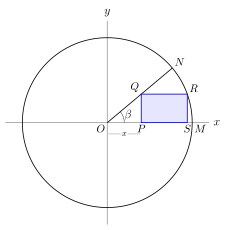
A circle of radius \(a\) is centred at the origin \(O\). A rectangle \(PQRS\) lies in the minor sector \(OMN\) of this circle where \(M\) is \((a,0)\) and \(N\) is \((a \cos \beta, a \sin \beta)\), and \(\beta\) is a constant with \(0 < \beta < \frac{\pi}{2}\,\). Vertex \(P\) lies on the positive \(x\)-axis at \((x,0)\); vertex \(Q\) lies on \(ON\); vertex \(R\) lies on the arc of the circle between \(M\) and \(N\); and vertex \(S\) lies on the positive \(x\)-axis at \((s,0)\). Show that the area \(A\) of the rectangle can be written in the form \[ A= x(s-x)\tan\beta \,. \] Obtain an expression for \(s\) in terms of \(a\), \(x\) and \(\beta\), and use it to show that \[ \frac{\d A}{\d x} = (s-2x) \tan \beta - \frac {x^2} s \tan^3\beta \,. \] Deduce that the greatest possible area of rectangle \(PQRS\) occurs when \(s= x(1+\sec\beta)\) and show that this greatest area is \(\tfrac12 a^2 \tan \frac12 \beta\,\). Show also that this greatest area occurs when \(\angle ROS = \frac12\beta\,\).
Solution:
1998 Paper 1 Q4
Prove that the rectangle of greatest perimeter which can be inscribed in a given circle is a square. The result changes if, instead of maximising the sum of lengths of sides of the rectangle, we seek to maximise the sum of \(n\)th powers of the lengths of those sides for \(n\geqslant 2\). What happens if \(n=2\)? What happens if \(n=3\)? Justify your answers.
Solution: We can always rotate the circle so that sides are parallel to the \(x\) and \(y\) axes. Therefore if one corner is \((a,b)\) the other coordinates are \((-a,b), (a,-b), (-a,-b)\) and the perimeter will be \(4(a+b)\). Therefore we wish to maximise \(4(a+b)\) subject to \(a^2+b^2 = \text{some constant}\). Notice that \(\frac{a+b}{2} \leq \sqrt{\frac{a^2+b^2}{2}}\) with equality when \(a = b\), therefore the maximum is a square. If \(n = 2\) then we are looking at \(2((2a)^2+(2b)^2) = 8(a^2+b^2)\) which is constant for all rectangles. If \(n=3\) we are maximising \(16(a^3+b^3) = 16(a^3+(c^2-a^2)^{3/2})\) which is maximised when \(a = 0, c\)
1989 Paper 1 Q7
Sketch the curve \(y^{2}=1-\left|x\right|\). A rectangle, with sides parallel to the axes, is inscribed within this curve. Show that the largest possible area of the rectangle is \(8/\sqrt{27}\). Find the maximum area of a rectangle similarly inscribed within the curve given by \(y^{2m}=\left(1-\left|x\right|\right)^{n}\), where \(m\) and \(n\) are positive integers, with \(n\) odd.
Solution:
