Problems

Filters
Clear Filters

3 problems found

1992 Paper 3 Q13
D: 1700.0 B: 1500.0

\(\,\)

\psset{xunit=1.0cm,yunit=1.0cm,algebraic=true,dimen=middle,dotstyle=o,dotsize=3pt 0,linewidth=0.3pt,arrowsize=3pt 2,arrowinset=0.25} \begin{pspicture*}(-2.8,-2.34)(3.26,4.36) \pspolygon[linewidth=0.4pt](0.22,-0.18)(0.4,0.04)(0.18,0.22)(0,0) \pscircle(0,0){2} \psline(2,0)(2,4) \rput[tl](2.24,2.64){\(\pi b\)} \rput[tl](2.22,0.02){\(C\)} \rput[tl](2.24,4.3){\(A\)} \rput[tl](1.32,2.1){\(Q\)} \rput[tl](-0.42,0.08){\(O\)} \rput[tl](1.6,-1.38){\(P\)} \psline[linestyle=dashed,dash=3pt 3pt](1.27,1.54)(0,0) \psline[linestyle=dashed,dash=3pt 3pt](0,0)(1.54,-1.27) \rput[tl](0.06,1.1){\(2b\)} \begin{scriptsize} \psdots[dotsize=2pt 0,dotstyle=*](2,4) \end{scriptsize} \end{pspicture*}
A uniform circular disc of radius \(2b,\) mass \(m\) and centre \(O\) is free to turn about a fixed horizontal axis through \(O\) perpendicular to the plane of the disc. A light elastic string of modulus \(kmg\), where \(k>4/\pi,\) has one end attached to a fixed point \(A\) and the other end to the rim of the disc at \(P\). The string is in contact with the rim of the disc along the arc \(PC,\) and \(OC\) is horizontal. The natural length of the string and the length of the line \(AC\) are each \(\pi b\) and \(AC\) is vertical. A particle \(Q\) of mass \(m\) is attached to the rim of the disc and \(\angle POQ=90^{\circ}\) as shown in the diagram. The system is released from rest with \(OP\) vertical and \(P\) below \(O\). Show that \(P\) reaches \(C\) and that then the upward vertical component of the reaction on the axis is \(mg(10-\pi k)/3\).

1991 Paper 3 Q14
D: 1700.0 B: 1486.2

TikZ diagram
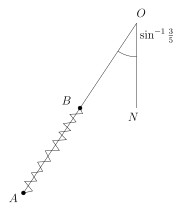
The end \(O\) of a smooth light rod \(OA\) of length \(2a\) is a fixed point. The rod \(OA\) makes a fixed angle \(\sin^{-1}\frac{3}{5}\) with the downward vertical \(ON,\) but is free to rotate about \(ON.\) A particle of mass \(m\) is attached to the rod at \(A\) and a small ring \(B\) of mass \(m\) is free to slide on the rod but is joined to a spring of natural length \(a\) and modulus of elasticity \(kmg\). The vertical plane containing the rod \(OA\) rotates about \(ON\) with constant angular velocity \(\sqrt{5g/2a}\) and \(B\) is at rest relative to the rod. Show that the length of \(OB\) is \[ \frac{(10k+8)a}{10k-9}. \] Given that the reaction of the rod on the particle at \(A\) makes an angle \(\tan^{-1}\frac{13}{21}\) with the horizontal, find the value of \(k\). Find also the magnitude of the reaction between the rod and the ring \(B\).

1988 Paper 2 Q14
D: 1600.0 B: 1488.9

Two particles of mass \(M\) and \(m\) \((M>m)\) are attached to the ends of a light rod of length \(2l.\) The rod is fixed at its midpoint to a point \(O\) on a horizontal axle so that the rod can swing freely about \(O\) in a vertical plane normal to the axle. The axle rotates about a vertical axis through \(O\) at a constant angular speed \(\omega\) such that the rod makes a constant angle \(\alpha\) \((0<\alpha<\frac{1}{2}\pi)\) with the vertical. Show that \[ \omega^{2}=\left(\frac{M-m}{M+m}\right)\frac{g}{l\cos\alpha}. \] Show also that the force of reaction of the rod on the axle is inclined at an angle \[ \tan^{-1}\left[\left(\frac{M-m}{M+m}\right)^{2}\tan\alpha\right] \] with the downward vertical.


Solution:
TikZ diagram
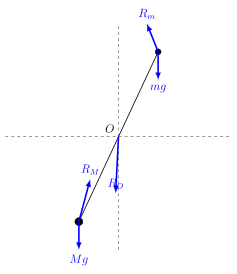
The accelerations of \(M\) and \(m\) are \(l \sin \alpha \omega^2\) and \(-l \sin \alpha \omega^2\) so the forces \(R_M\) and \(R_m\) are \(M\binom{l \sin \alpha \omega^2}{g}, \,m \binom{-l \sin \alpha \omega^2}{g}\). Since the axle is rotating freely, the moment about \(O\) for the rod must be \(O\). The moment for \(M\) will be \(M\binom{l \sin \alpha\omega^2}{g} \cdot \binom{-l\cos \alpha}{l \sin \alpha} = lM\sin\alpha (g - l \cos \alpha\omega^2)\). The moment for \(m\) will be \(m \binom{-l \sin \alpha\omega^2}{g} \cdot \binom{-l\cos \alpha\omega^2}{l \sin \alpha} = lm \sin \alpha(g+l \cos \alpha\omega^2)\) Therefore \begin{align*} && lM\sin\alpha (g - l \cos \alpha\omega^2) &= lm \sin \alpha(g+l \cos \alpha\omega^2) \\ && M(g - l \cos \alpha \omega^2) &= m(g + l \cos \alpha \omega^2 ) \\ \Rightarrow && g(M-m) &= l \cos \alpha (M+m) \omega^2 \\ \Rightarrow && \omega^2 &= \left (\frac{M-m}{M+m} \right) \frac{g}{l \cos \alpha} \end{align*} as required. The total force on the rod is \(\mathbf{0}\) so the reaction force must be \(M\binom{l \sin \alpha \omega^2}{g}+ \,m \binom{-l \sin \alpha \omega^2}{g} = \binom{l \sin \alpha \omega^2 (M-m)}{(M+m)g}\) Therefore the angle this makes with downward vertical is: \begin{align*} \theta &= \tan^{-1} \left ( \frac{l \sin \alpha \omega^2 (M-m)}{(M+m)g} \right) \\ &= \tan^{-1} \left ( \frac{l \sin \alpha (M-m)}{(M+m)g} \omega^2\right) \\ &= \tan^{-1} \left ( \frac{l \sin \alpha (M-m)}{(M+m)g} \left (\frac{M-m}{M+m} \right) \frac{g}{l \cos \alpha}\right) \\ &= \tan^{-1}\left[\left(\frac{M-m}{M+m}\right)^{2}\tan\alpha\right] \end{align*} as required.