Problems
Filters
12 problems found
2016 Paper 1 Q11
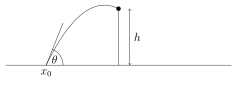
The point \(O\) is at the top of a vertical tower of height \(h\) which stands in the middle of a large horizontal plain. A projectile \(P\) is fired from \(O\) at a fixed speed \(u\) and at an angle \(\alpha\) above the horizontal. Show that the distance \(x\) from the base of the tower when \(P\) hits the plain satisfies \[ \frac{gx^2}{u^2} = h(1+\cos 2\alpha) + x \sin 2\alpha \,. \] Show that the greatest value of \(x\) as \(\alpha\) varies occurs when \(x=h\tan2\alpha\) and find the corresponding value of \(\cos 2\alpha\) in terms of \(g\), \(h\) and \(u\). Show further that the greatest achievable distance between \(O\) and the landing point is \(\dfrac {u^2}g +h\,\).
Solution: \begin{align*} \rightarrow: && x &= u \cos \alpha t\\ \Rightarrow && t &= \frac{x}{u \cos \alpha}\\ \uparrow: && -h &= u\sin \alpha t- \frac12gt^2 \\ && - h &= x\tan \alpha - \frac12 g \frac{x^2}{u^2}\sec^2 \alpha \\ \Rightarrow && \frac{gx^2}{u^2} &= h(2\cos^2 \alpha) + x2 \tan \alpha \cos^2 \alpha \\ &&&= h(1 + \cos 2 \alpha) + x \sin 2\alpha \\ \frac{\d}{\d \alpha}: && \frac{g}{u^2} 2 x \frac{\d x}{\d \alpha} &= -2h \sin 2 \alpha + 2x \cos 2 \alpha +\frac{\d x}{\d \alpha} \sin 2 \alpha \\ \Rightarrow && \frac{\d x}{\d \alpha} \left ( \frac{2xg}{u^2} - \sin 2 \alpha \right) &= 2\cos 2 \alpha (x -h \tan 2 \alpha) \end{align*} Since the turning point will be a maximum must be \(x = h \tan 2 \alpha\). Therefore, let \(c = \cos 2 \alpha\) \begin{align*} && \frac{gh^2}{u^2} \tan^2 2 \alpha &= h(1 + \cos 2 \alpha) + h \tan 2 \alpha \sin 2 \alpha \\ \Rightarrow && \frac{gh}{u^2}(c^{-2}-1) &= 1+c+\frac{1-c^2}{c} \\ \Rightarrow && \frac{gh(1-c^2)}{u^2c^2} &= \frac{c+c^2+1-c^2}{c}\\ &&&= \frac{1+c}{c} \\ \Rightarrow && \frac{gh(1-c)}{u^2c} &= 1 \\ \Rightarrow && u^2c &= gh(1-c) \\ \Rightarrow && c(u^2+gh) &= gh \\ \Rightarrow && \cos 2 \alpha &= \frac{gh}{u^2+gh} \\ \\ \Rightarrow && d_{max}^2 &= h^2 + h^2 \tan^2 2 \alpha \\ &&&= h^2\sec^2 2 \alpha \\ &&&= h^2 \frac{(u^2+gh)^2}{g^2h^2} \\ &&&= \frac{(u^2+gh)^2}{g^2} \\ &&&= \left (\frac{u^2}{g}+h \right)^2 \\ \Rightarrow && d_{max} &= \frac{u^2}{g}+h \end{align*}
2015 Paper 1 Q9
A short-barrelled machine gun stands on horizontal ground. The gun fires bullets, from ground level, at speed \(u\) continuously from \(t=0\) to \(t= \dfrac{\pi}{ 6\lambda}\), where \(\lambda\) is a positive constant, but does not fire outside this time period. During this time period, the angle of elevation \(\alpha\) of the barrel decreases from \(\frac13\pi\) to \(\frac16\pi\) and is given at time \(t\) by \[ \alpha =\tfrac13 \pi - \lambda t\,. \] Let \(k = \dfrac{g}{2\lambda u}\). Show that, in the case \(\frac12 \le k \le \frac12 \sqrt3\), the last bullet to hit the ground does so\\[2pt] at a distance \[ \frac{ 2 k u^2 \sqrt{1-k^2}}{g} \] from the gun. What is the corresponding result if \(k<\frac12\)?
Solution: The bullet fired at time \(t\) will hit the ground at time \(t+\frac{2u \sin (\frac13\pi - \lambda t)}{g}\). To find the last time a bullet hits the ground, we can differentiate, noting that \begin{align*} && T(t) &= t + \frac{2u \sin \alpha}{g} \\ \Rightarrow && T'(t) &= 1 - \frac{2u\lambda}{g} \cos \alpha \\ && T''(t) &= \frac{2u \lambda^2}{g} \sin \alpha > 0 \end{align*} If \(k = \frac{g}{2\lambda u} \in [\frac12, \frac12\sqrt{3}]\) then notice that this turning point is always achieved, and will be a maximum. It will be when \(\cos \alpha = k, \sin \alpha = \sqrt{1-k^2}\). The distance will be \(u \cos \alpha \cdot \frac{2 u \sin \alpha}{g} = \frac{2ku^2\sqrt{1-k^2}}{g}\). If \(k < \frac12\) then the last bullet to hit the ground will be the last bullet fired, ie \(\frac{2u^2 \sin \frac16\pi \cos \frac16\pi}{g} = \frac{u^2 \sin \frac13 \pi}{g} = \frac{\sqrt{3}u^2}{2g}\)
2014 Paper 2 Q10
A particle is projected from a point \(O\) on horizontal ground with initial speed \(u\) and at an angle of \(\theta\) above the ground. The motion takes place in the \(x\)-\(y\) plane, where the \(x\)-axis is horizontal, the \(y\)-axis is vertical and the origin is \(O\). Obtain the Cartesian equation of the particle's trajectory in terms of \(u\), \(g\) and~\(\lambda\), where \(\lambda=\tan\theta\). Now consider the trajectories for different values of \(\theta\) with \(u\)~fixed. Show that for a given value of~\(x\), the coordinate~\(y\) can take all values up to a maximum value,~\(Y\), which you should determine as a function of \(x\), \(u\) and~\(g\). Sketch a graph of \(Y\) against \(x\) and indicate on your graph the set of points that can be reached by a particle projected from \(O\) with speed \(u\). Hence find the furthest distance from \(O\) that can be achieved by such a projectile.
2012 Paper 1 Q9
A tall shot-putter projects a small shot from a point \(2.5\,\)m above the ground, which is horizontal. The speed of projection is \(10\,\text{ms}^{- 1}\) and the angle of projection is \(\theta\) above the horizontal. Taking the acceleration due to gravity to be \(10\,\text{ms}^{-2}\), show that the time, in seconds, that elapses before the shot hits the ground is \[ \frac1{\sqrt2}\left ( \sqrt{1-c}+ \sqrt{2-c}\right), \] where \(c = \cos2\theta\). Find an expression for the range in terms of \(c\) and show that it is greatest when \(c= \frac15\,\). Show that the extra distance attained by projecting the shot at this angle rather than at an angle of \(45^\circ\) is \(5(\sqrt6 -\sqrt2 -1)\,\)m.
Solution: \begin{align*} && s &= ut + \frac12 gt^2 \\ \Rightarrow && -2.5 &= 10 \sin \theta \, T - 5 T^2 \\ \Rightarrow && T &= \frac{10\sin \theta \pm \sqrt{100\sin^2 \theta - 4 \cdot 5 \cdot (-2.5)}}{10} \\ &&&= \sin \theta +\sqrt{\sin^2 \theta + \frac12} \\ &&&= \frac1{\sqrt{2}} \left ( \sqrt{2} \sin \theta +\sqrt{2 \sin^2 \theta +1} \right) \\ &&&= \frac1{\sqrt{2}} \left ( \sqrt{2 (1-\cos^2 \theta)} + \sqrt{2-\cos 2\theta} \right) \\ &&&= \frac1{\sqrt{2}} \left ( \sqrt{1-\cos2 \theta} + \sqrt{2-\cos 2\theta} \right) \\ &&&= \frac{1}{\sqrt{2}}\left ( \sqrt{1-c}+\sqrt{2-c} \right)\\ \\ && s &= 10 \cos \theta T \\ &&&= 10 \sqrt{\frac{\cos 2 \theta +1}{2}}\frac{1}{\sqrt{2}}\left ( \sqrt{1-c}+\sqrt{2-c} \right) \\ &&&= 5 \sqrt{c+1}\left ( \sqrt{1-c}+\sqrt{2-c} \right) \\ \\ && \frac15\frac{\d s}{\d c} &= \frac12(c+1)^{-1/2}((1-c)^{1/2} + (2-c)^{1/2}) - \frac12(c+1)^{1/2}\left ((1-c)^{-1/2}+(2-c)^{-1/2} \right) \\ &&&= \frac{((1-c)(2-c)^{1/2}+(2-c)(1-c)^{1/2})-((c+1)(2-c)^{1/2}+(c+1)(1-c)^{1/2})}{2\sqrt{c+1}\sqrt{1-c}\sqrt{2-c}} \\ &&&= \frac{\sqrt{2-c}\left (1-c-c-1 \right)+\sqrt{1-c}\left(2-c-c-1) \right)}{2\sqrt{c+1}\sqrt{1-c}\sqrt{2-c}} \\ &&&= \frac{\sqrt{1-c}\left(1-2c\right)-2c\sqrt{2-c}}{2\sqrt{c+1}\sqrt{1-c}\sqrt{2-c}} \\ \\ \frac{\d s}{\d c} =0: && \sqrt{1-c}\left(1-2c\right)&=2c\sqrt{2-c} \\ \Rightarrow && (1-c)(1-2c)^2&=4c^2(2-c) \\ \Rightarrow && 1-5c+8c^2-4c^3 &= 8c^2-4c^3 \\ \Rightarrow && 0 &= -5c+1 \\ \Rightarrow && c &= \frac15 \end{align*} When \(\theta = 45^{\circ}, c = 0\), so \(s_{45^{\circ}} = 5(1+\sqrt{2})\) When \(c = \frac15\), \begin{align*} s &= 5 \sqrt{\frac15+1}\left ( \sqrt{1-\frac15}+\sqrt{2-\frac15} \right) \\ &= 5 \sqrt{\frac65} \left ( \sqrt{\frac45} + \sqrt{\frac95} \right) \\ &= 2\sqrt{6}+3\sqrt{6} = 5\sqrt{6} \end{align*} Therefore the additional distance is \(5(\sqrt{6}-\sqrt{2}-1)\)
2012 Paper 2 Q9
A tennis ball is projected from a height of \(2h\) above horizontal ground with speed \(u\) and at an angle of \(\alpha\) below the horizontal. It travels in a plane perpendicular to a vertical net of height \(h\) which is a horizontal distance of \(a\) from the point of projection. Given that the ball passes over the net, show that \[ \frac 1{u^2}< \frac {2(h-a\tan\alpha)}{ga^2\sec^2\alpha}\,. \] The ball lands before it has travelled a horizontal distance of \(b\) from the point of projection. Show that \[ \sqrt{u^2\sin^2\alpha +4gh \ } < \frac{bg}{u\cos\alpha} + u \sin\alpha\,. \] Hence show that \[ \tan\alpha < \frac{h(b^2-2a^2)}{ab(b-a)}\,. \]
Solution: \begin{align*} && s &= ut \\ \Rightarrow && a &= u \cos \alpha t\\ \Rightarrow && t &= \frac{a}{u \cos \alpha}\\ && s &= ut+ \frac12at^2 \\ \Rightarrow && -h &< -u\sin \alpha \frac{a}{u \cos \alpha}-\frac12 g \left (\frac{a}{u \cos \alpha} \right)^2 \\ &&&= -a \tan \alpha-\frac12 g a^2 \frac{1}{u^2} \sec^2 \alpha \\ \Rightarrow && \frac12 g a^2 \frac{1}{u^2} \sec^2 \alpha &< h -a\tan \alpha \\ \Rightarrow &&\frac{1}{u^2} &< \frac{2(h-a\tan \alpha)}{ga^2 \sec^2 \alpha} \end{align*} \begin{align*} && s &= ut + \frac12a t^2 \\ \Rightarrow && 2h &= u\sin \alpha t + \frac12 gt^2 \\ \Rightarrow && t &= \frac{-u\sin \alpha \pm \sqrt{u^2 \sin^2 \alpha+4hg}}{g}\\ && t &= \frac{-u\sin \alpha +\sqrt{u^2 \sin^2 \alpha+4hg}}{g}\\ && s &= ut \\ \Rightarrow && b &> u \cos \alpha t \\ \Rightarrow && \frac{b}{u \cos \alpha} &> \frac{-u\sin \alpha +\sqrt{u^2 \sin^2 \alpha+4hg}}{g} \\ \Rightarrow && \sqrt{u^2 \sin^2 \alpha+4hg} &< \frac{bg}{u \cos \alpha} + u \sin \alpha \\ \end{align*} \begin{align*} \Rightarrow && u^2 \sin^2 \alpha+4hg &< \frac{b^2g^2}{u^2 \cos^2 \alpha} +u^2 \sin^2 \alpha + 2bg \tan \alpha \\ \Rightarrow && 4hg - 2bg \tan \alpha &< \frac{b^2g^2}{u^2 \cos^2 \alpha} \\ &&&< \frac{b^2g^2}{\cos^2 \alpha} \frac{2(h-a\tan \alpha)}{ga^2 \sec^2 \alpha} \\ &&&= \frac{2b^2g(h-a\tan \alpha)}{a^2} \\ \Rightarrow && \tan \alpha \left (\frac{2b^2g}{a} - 2bg \right) &< \frac{2b^2gh}{a^2} - 4hg \\ \Leftrightarrow && \tan \alpha \left (\frac{2b^2g- 2abg}{a} \right) &< \frac{2b^2gh- 4hga^2}{a^2} \\ \Leftrightarrow && \tan \alpha \left (\frac{2bg(b- a)}{a} \right) &< \frac{2hg(b^2- 2a^2)}{a^2} \\ \Rightarrow && \tan \alpha &< \frac{h(b^2-2a^2)}{ab(b-a)} \end{align*}
2011 Paper 1 Q9
A particle is projected at an angle \(\theta\) above the horizontal from a point on a horizontal plane. The particle just passes over two walls that are at horizontal distances \(d_1\) and \(d_2\) from the point of projection and are of heights \(d_2\) and \(d_1\), respectively. Show that \[ \tan\theta = \frac{d_1^2+d_\subone d_\subtwo +d_2^2}{d_\subone d_\subtwo}\,. \] Find (and simplify) an expression in terms of \(d_1\) and \(d_2\) only for the range of the particle.
2007 Paper 3 Q10
A particle is projected from a point on a plane that is inclined at an angle~\(\phi\) to the horizontal. The position of the particle at time \(t\) after it is projected is \((x,y)\), where \((0,0)\) is the point of projection, \(x\) measures distance up the line of greatest slope and \(y\) measures perpendicular distance from the plane. Initially, the velocity of the particle is given by \((\dot x, \dot y) = (V\cos\theta, V\sin\theta)\), where \(V>0\) and \(\phi+\theta<\pi/2\,\). Write down expressions for \(x\) and \(y\). The particle bounces on the plane and returns along the same path to the point of projection. Show that \[2\tan\phi\tan\theta =1\] and that \[ R= \frac{V^2\cos^2\theta}{2g\sin\phi}\,, \] where \(R\) is the range along the plane. Show further that \[ \frac{2V^2}{gR} = 3\sin\phi + {\rm cosec}\,\phi \] and deduce that the largest possible value of \(R\) is \(V^2/ (\sqrt{3}\,g)\,\).
2006 Paper 2 Q11
A projectile of unit mass is fired in a northerly direction from a point on a horizontal plain at speed \(u\) and an angle \(\theta\) above the horizontal. It lands at a point \(A\) on the plain. In flight, the projectile experiences two forces: gravity, of magnitude \(g\); and a horizontal force of constant magnitude \(f\) due to a wind blowing from North to South. Derive an expression, in terms of \(u\), \(g\), \(f\) and \(\theta\) for the distance \(OA\).
- Determine the angle \(\alpha\) such that, for all \(\theta>\alpha\), the wind starts to blow the projectile back towards \(O\) before it lands at \(A\).
- An identical projectile, which experiences the same forces, is fired from \(O\) in a northerly direction at speed \(u\) and angle \(45^\circ\) above the horizontal and lands at a point \(B\) on the plain. Given that \(\theta\) is chosen to maximise \(OA\), show that \[ \frac{OB}{OA} = \frac{ g-f}{\; \sqrt{g^2+f^2\;}- f \;\;}\;. \] Describe carefully the motion of the second projectile when \(f=g\).
2001 Paper 2 Q11
A two-stage missile is projected from a point \(A\) on the ground with horizontal and vertical velocity components \(u\) and \(v\), respectively. When it reaches the highest point of its trajectory an internal explosion causes it to break up into two fragments. Immediately after this explosion one of these fragments, \(P\), begins to move vertically upwards with speed \(v_e\), but retains the previous horizontal velocity. Show that \(P\) will hit the ground at a distance \(R\) from \(A\) given by $$ \frac{gR}u = v+v_e + \sqrt{v_e^2 +v^2}\, . $$ It is required that the range \(R\) should be greater than a certain distance \(D\) (where \(D> 2uv/g\)). Show that this requirement is satisfied if \[ v_e> \frac{gD}{2u}\left( \frac{gD-2uv}{gD-uv}\right). \] \noindent[{\sl The effect of air resistance is to be neglected.}]
1994 Paper 2 Q11
As part of a firework display a shell is fired vertically upwards with velocity \(v\) from a point on a level stretch of ground. When it reaches the top of its trajectory an explosion it splits into two equal fragments each travelling at speed \(u\) but (since momentum is conserved) in exactly opposite (not necessarily horizontal) directions. Show, neglecting air resistance, that the greatest possible distance between the points where the two fragments hit the ground is \(2uv/g\) if \(u\leqslant v\) and \((u^{2}+v^{2})/g\) if \(v\leqslant u.\)
Solution: Since \(v^2 - u^2 = 2as\) we have the initial height reached is \(\frac{v^2}{2g}\). At the point of explosion, the velocities are \(\pm \binom{u \cos \theta}{u \sin \theta}\) where \(0 \leq \theta < \frac{\pi}{2}\). Looking vertically: \begin{align*} && -\frac{v^2}{2g} &= \pm u \sin \theta t - \frac12gt^2 \\ \Rightarrow && t &= \frac{\mp u \sin \theta \pm \sqrt{u^2 \sin^2 \theta - 4 \cdot \left (-\frac12 g \right) \cdot (\frac{v^2}{2g})}}{2(-\frac12g)} \\ &&&= \frac{\pm u \sin \theta \mp \sqrt{u^2 \sin^2 \theta+v^2}}{g}\\ &&&= \frac{\pm u \sin \theta +\sqrt{u^2 \sin^2 \theta+v^2}}{g} \end{align*} Since we always want the positive \(t\). Then the horizontal distance travelled will be \begin{align*} && s &= u \cos \theta (t_1 + t_2) \\ &&&= u \cos \theta \frac{2\sqrt{u^2 \sin^2 \theta+v^2}}{g} \\ &&&= \frac{2u \cos \theta \sqrt{u^2 \sin^2 \theta + v^2}}{g} \\ &&s^2 &= \frac{4u^2}{g^2} \cos^2 \theta ({u^2 \sin^2 \theta + v^2}) \\ &&&= \frac{4u^2}{g^2} \left (-u^2\cos^4 \theta + (v^2+u^2)\cos^2 \theta \right) \\ &&&= \frac{4u^2}{g^2} \left (-u^2\left ( \cos^2 \theta - \frac{v^2+u^2}{2u^2}\right)^2 + \frac{(v^2+u^2)^2}{4u^2} \right) \\ &&&= \frac{(v^2+u^2)^2}{g^2} - \frac{4u^4}{g^2}\left ( \cos^2 \theta - \frac{v^2+u^2}{2u^2}\right)^2 \end{align*} If \(u \geq v\) then such a \(\theta\) exists such that we can achieve the maximum, ie \(s = \frac{v^2+u^2}{g}\). If not, then we will achieve our maximum when \(\cos \theta = 1\), ie \(\sin \theta = 0\) and \(s = \frac{2uv}{g}\)
1991 Paper 3 Q13
A smooth particle \(P_{1}\) is projected from a point \(O\) on the horizontal floor of a room with has a horizontal ceiling at a height \(h\) above the floor. The speed of projection is \(\sqrt{8gh}\) and the direction of projection makes an acute angle \(\alpha\) with the horizontal. The particle strikes the ceiling and rebounds, the impact being perfectly elastic. Show that for this to happen \(\alpha\) must be at least \(\frac{1}{6}\pi\) and that the range on the floor is then \[ 8h\cos\alpha\left(2\sin\alpha-\sqrt{4\sin^{2}\alpha-1}\right). \] Another particle \(P_{2}\) is projected from \(O\) with the same velocity as \(P_{1}\) but its impact with the ceiling is perfectly inelastic. Find the difference \(D\) between the ranges of \(P_{1}\) and \(P_{2}\) on the floor and show that, as \(\alpha\) varies, \(D\) has a maximum value when \(\alpha=\frac{1}{4}\pi.\)
1988 Paper 1 Q10
A sniper at the top of a tree of height \(h\) is hit by a bullet fired from the undergrowth covering the horizontal ground below. The position and elevation of the gun which fired the shot are unknown, but it is known that the bullet left the gun with speed \(v\). Show that it must have been fired from a point within a circle centred on the base of the tree and of radius \((v/g)\sqrt{v^{2}-2gh}\). {[}Neglect air resistance.{]}
Solution: