Problems
Filters
9 problems found
2018 Paper 1 Q8
The functions \(\s\) and \(\c\) satisfy \(\s(0)= 0\,\), \(\c(0)=1\,\) and \[ \s'(x) = \c(x)^2 ,\] \[ \c'(x)=-\s(x)^2. \] You may assume that \(\s\) and \(\c\) are uniquely defined by these conditions.
- Show that \(\s(x)^3+\c(x)^3\) is constant, and deduce that \(\s(x)^3+\c(x)^3=1\,\).
- Show that \[ \frac{\d }{\d x} \, \Big( \s(x) \c(x) \Big) = 2\c(x)^3-1 \] and find (and simplify) an expression in terms of \(\c(x)\) for $\dfrac{\d }{\d x} \left( \dfrac{\s(x)}{\c(x)} \right) $.
- Find the integrals \[ \int \s(x)^2 \, \d x \ \ \ \ \ \ \text{and} \ \ \ \ \ \ \int \s(x)^5 \, \d x \,. \]
- Given that \(\s\) has an inverse function, \(\s^{-1}\), use the substitution \(u = \s(x)\) to show that \[ \int \frac{1}{(1-u^3)^{\frac{2}{3}}} \, \d u = \s^{-1}(u) \, + \text{constant}. \]
- Find, in terms of \(u\), the integrals \[ \int \frac{1}{{(1-u^3)}^{\frac{4}{3}}} \, \d u \ \ \ \ \ \ \text{and} \ \ \ \ \ \ \int {(1-u^3)}^{\frac{1}{3}} \, \d u \,. \]
Solution: \begin{questionparts} \item \begin{align*} && \dfrac{\d }{\d x} \left( \s(x)^3 + \c(x)^3 \right) &= 3\s(x)^2\s'(x) + 3\c(x)^2 \c'(x) \\ &&&= 3\s(x)^2\c(x)^2 - 3\c(x)^2\s(x)^2 \\ &&&= 0 \\ \\ \Rightarrow && \s(x)^3 + \c(x)^3 &= \text{constant} \\ &&&= \s(0)^3 + \c(0)^3 \\ &&&= 1 \end{align*} \item \begin{align*} \frac{\d }{\d x} \, \Big( \s(x) \c(x) \Big) &= \s'(x) \c(x) + \s(x)\c'(x) \\ &= \c(x)^3 - \s(x)^3 \\ &= \c(x)^3 - (1-\c(x)^3) \\ &= 2\c(x)^3 - 1 \\ \\ \dfrac{\d }{\d x} \left( \dfrac{\s(x)}{\c(x)} \right) &= \frac{\s'(x)\c(x) - \s(x)\c'(x)}{\c(x)^2} \\ &= \frac{\c(x)^3 + \s(x)^3}{\c(x)^2} \\ &= \frac{1}{\c(x)^2} \\ \end{align*} \item \begin{align*} \int \s(x)^2 \d x &= -\int -\s(x)^2 \d x \\ &= -\int \c'(x) \d x \\ &= - \s(x) +C \\ \\ \int \s(x)^5 \, \d x &= \int \s(x)^2 \s(x)^3 \d x \\ &= \int \s(x)^2 (1 - \c(x)^3) \d x \\ &= -\int \c'(x) (1 - \c(x)^3) \d x \\ &= - c(x) + \frac{\c(x)^4}{4} + C \end{align*} \item If \(u = \s(x), \frac{\d u}{\d x} = \c(x)^2\) \begin{align*} \int \frac{1}{(1-u^3)^{\frac{2}{3}}} \, \d u &= \int \frac{1}{(1-\s(x)^3)^{\frac{2}{3}}} \c(x)^2 \d x \\ &= \int 1 \d x \\ &= x + C \\ &= \s^{-1}(u) + C \\ \\ \int \frac{1}{{(1-u^3)^{\frac{4}{3}}}} \d u &= \int \frac1{(1-\s(x)^3)^{\frac43} }\c(x)^2 \d x \\ &= \int \frac1{(\c(x)^3)^{\frac43}} \c(x)^2 \d x \\ &= \int \frac1{\c(x)^2} \d x \\ &= \frac{\s(x)}{\c(x)} + C \\ &= \frac{u}{(1-u^3)^{\frac13}} + C \\ \end{align*} \begin{align*} && \int {(1-u^3)}^{\frac{1}{3}} \, \d u &= \int (1-s(x)^3)^{\frac13} c(x)^2 \d x \\ &&&= \int \c(x)^3 \d x = I\\ &&&= \int \c(x) s'(x) \d x \\ &&&= \left [\c(x) \s(x) \right] + \int \s(x)^2 s(x) \d x \\ &&&= \c(x) \s(x) + \int (1 - \c(x)^3) \d x + C \\ &&&= \c(x) \s(x) + x - I + C \\ \Rightarrow && I &= \frac{x + \c(x) \s(x)}{2} + k \\ \Rightarrow && &= \frac12 \l \s^{-1}(u) + u \sqrt[3](1-u^3)\r + k \end{align*}
2016 Paper 1 Q4
- Differentiate $\displaystyle \; \frac z {(1+z^2)^{\frac12}} \;$ with respect to \(z\).
- The {\em signed curvature} \(\kappa\) of the curve \(y=\f(x)\) is defined by \[ \kappa = \frac {\f''(x)}{\big({1+ (\f'(x))^2\big)^{\frac32}}} \,.\] Use this definition to determine all curves for which the signed curvature is a non-zero constant. For these curves, what is the geometrical significance of \(\kappa\)?
Solution:
- Let \(\displaystyle y = \frac z {(1+z^2)^{\frac12}}\) then \(\frac{d y}{d x} = \frac{(1+z^2)^{\frac12} - z^2(1+z^2)^{-\frac12}}{1+z^2} = \frac{(1+z^2)-z^2}{(1+z^2)^\frac32} = \frac{1}{(1+z^2)^\frac32}\)
- \(\kappa = \frac {f''(x)}{\big({1+ (f'(x))^2\big)^{\frac32}}}\) then \begin{align*} && \int \kappa \, dx &= \int \frac{f''(x)}{( 1 + (f'(x))^2)^{\frac32}} \, dx \\ && \kappa x &= \frac{f'(x)}{(1 + (f'(x))^2)^\frac12} + C \\ \Rightarrow && (\kappa x-C)^2 &= \frac{f'(x)^2}{1 + (f'(x))^2} \\ \Rightarrow && f'(x)^2((\kappa x - C)^2 - 1) &= -(\kappa x-C)^2 \\ \Rightarrow && f'(x) &= \frac{\kappa x - C}{\sqrt{1-(\kappa x - C)^2 }} \\ \Rightarrow && f(x) &= \frac{1}{\kappa} \sqrt{1 - (\kappa x - C)^2} \\ \Rightarrow && (\kappa y)^2 + (\kappa x - C)^2 &= 1 \\ \Rightarrow && y^2 + (x - C')^2 &= \frac{1}{\kappa^2} \end{align*} Therefore all the curves are circles and \(\kappa\) is the reciprocal of the radius.
2010 Paper 3 Q8
Given that \({\rm P} (x) = {\rm Q} (x){\rm R}'(x) - {\rm Q}'(x){\rm R}(x)\), write down an expression for \[ \int \frac{{\rm P} ( x)}{ \big( {\rm Q} ( x)\big )^ 2}\, \d x\, . \]
- By choosing the function \({\rm R}(x)\) to be of the form \(a +bx+c x^2\), find \[ \int \frac{5x^2 - 4x - 3} {(1 + 2x + 3x^2 )^2 } \, \d x \,.\] Show that the choice of \({\rm R}(x)\) is not unique and, by comparing the two functions \({\rm R}(x)\) corresponding to two different values of \(a\), explain how the different choices are related.
- Find the general solution of \[ (1+\cos x +2 \sin x) \frac {\d y}{\d x} +(\sin x -2 \cos x)y = 5 - 3 \cos x + 4 \sin x\,. \]
Solution: \begin{align*} && \int \frac{{\rm P} ( x)}{ \big( {\rm Q} ( x)\big )^ 2}\, \d x &= \int \frac{{\rm Q} (x){\rm R}'(x) - {\rm Q}'(x){\rm R}(x)}{ \big( {\rm Q} ( x)\big )^ 2}\, \d x \\ &&&= \int \frac{\d}{\d x} \left ( \frac{R(x)}{Q(x)} \right) \d x \\ &&&= \frac{R(x)}{Q(x)} + C \end{align*}
- Suppose \(Q(x) = 1 + 2x + 3x^2, P(x) = 5x^2-4x-3\), and \(R(x) = a +bx + cx^2\), then \begin{align*} && 5x^2-4x-3 &= (1 + 2x + 3x^2)(2cx+b) - (6x+2)(a+bx+cx^2) \\ &&&= (6c-6c)x^3 + (3b+4c-6b-2c)x^2 + \\ &&&\quad+(2c+2b-6a-2b)x + (b-2a) \\ \Rightarrow && 2c-3b &= 5 \\ && 2c-6a &= -4 \\ && b - 2a &= -3 \\ \Rightarrow && b &= 2a - 3\\ && c &= 3a-2 \end{align*} So say \(a = 0, b = -3, c = -2\) we will have \begin{align*} \int \frac{5x^2 - 4x - 3} {(1 + 2x + 3x^2 )^2 } \, \d x &= \frac{-3x-2x^2}{1+2x+3x^2} + C \end{align*} Suppose we have a different value of \(a\), then we end up with: \begin{align*} \frac{a+(2a-3)x+(3a-2)x^2}{1+2x+3x^2} = a +\frac{-3x-2x^2}{1+2x+3x^2} \end{align*} So the different antiderivatives differ by a constant.
- \(\,\) \begin{align*} && \frac{\d }{\d x} \left ( \frac{1}{1+\cos x + 2 \sin x } y\right) &= \frac{5-3\cos x + 4 \sin x }{(1+\cos x + 2 \sin x)^2} \\ \end{align*} We want to find \(R(x) = A \cos x + B\sin x + C\) such that \begin{align*} &&5-3\cos x + 4 \sin x &= (1+\cos x + 2 \sin x)R'(x) - R(x)(-\sin x + 2 \cos x) \\ &&&= (1+\cos x + 2 \sin x)(-A\sin x + B \cos x) \\ &&&\quad- (A\cos x + B \sin x + C)(-\sin x + 2 \cos x) \\ &&&=(-A+C) \sin x + (B-2C)\cos x +\\ &&&\quad\quad (2B-A+A-2B)\sin x \cos x \\ &&&\quad\quad (-2A+B)\sin^2x+(B-2A)\cos^2x \\ &&&= (-A+C)\sin x + (B-2C)\cos x +(B-2A) \\ \Rightarrow && B-2A &= 5\\ && C-A &= 4 \\ && B-2C &= -3 \\ \end{align*} There are many solutions so WLOG \(C=4, A = 0, B = 5\) and so \begin{align*} && \int \frac{5-3\cos x + 4 \sin x }{(1+\cos x + 2 \sin x)^2} \d x &= \frac{5\sin x +4}{1+\cos x + 2 \sin x} + K \\ \Rightarrow && y &= 5\sin x + 4 + K(1 + \cos x + 2 \sin x) \end{align*}
2003 Paper 3 Q3
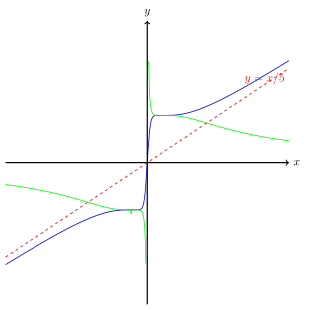
If \(m\) is a positive integer, show that \(\l 1+x \r^m + \l 1-x \r^m \ne 0\) for any real \(x\,\). The function \(\f\) is defined by \[ \f (x) = \frac{ (1+x )^m - ( 1-x )^m}{ (1+x )^m + (1-x )^m} \;. \] Find and simplify an expression for \(\f'(x)\). In the case \(m=5\,\), sketch the curves \(y = \f (x)\) and \(\displaystyle y = \frac1 { \f (x )}\;\).
Solution: If \(m\) is even, clearly that expression is positive since it's the sum of two (different) squares. If \(m\) is odd, then we can expand it as a sum of powers of \(x^2\) with a leading coefficient of \(1\) so it is also positive. \begin{align*} && f (x) = \frac{ (1+x )^m - ( 1-x )^m}{ (1+x )^m + (1-x )^m} \\ && f'(x) &= \frac{(m(1+x )^{m-1} + m( 1-x )^{m-1})((1+x)^m + (1-x)^m ) - ((1+x )^m - ( 1-x )^m)(m(1+x)^{m-1} - m(1-x)^{m-1} )}{\l (1+x)^m + (1-x)^m \r^2} \\ &&&= \frac{2m(1+x)^m(1-x)^{m-1}+2m(1+x)^{m-1}(1-x)^m}{\l (1+x)^m + (1-x)^m \r^2} \\ &&&= \frac{2m(1+x)^{m-1}(1-x)^{m-1}(1+x+1-x)}{\l (1+x)^m + (1-x)^m \r^2} \\ &&&= \frac{4m(1+x)^{m-1}(1-x)^{m-1}}{\l (1+x)^m + (1-x)^m \r^2} \\ \end{align*}
1999 Paper 2 Q6
Find \(\displaystyle \ \frac{\d y}{\d x} \ \) if $$ y = \frac{ax+b}{cx+d}. \tag{*} $$ By using changes of variable of the form \((*)\), or otherwise, show that \[ \int_0^1 \frac{1}{(x+3)^2} \; \ln \left(\frac{x+1}{x+3}\right)\d x = {\frac16} \ln3 - {\frac14}\ln 2 - \frac 1{12}, \] and evaluate the integrals \[ \int_0^1 \frac{1}{(x+3)^2} \; \ln \left(\frac{x^2+3x+2}{(x+3)^2}\right)\d x \mbox{ and } \int_0^1 \frac{1}{(x+3)^2} \; \ln\left(\frac{x+1}{x+2}\right)\d x . \] [Not on original paper:] By changing to the variable \(y\) defined by $$ y=\frac{2x-3}{x+1},$$ evaluate the integral $$ \int_2^4 \frac{2x-3}{(x+1)^3}\; \ln\!\left(\frac{2x-3}{x+1}\right)\d x.$$ Evaluate the integral $$ \int_9^{25} {\big({2z^{-3/2} -5z^{-2}}\big)}\ln{\big(2-5z^{-1/2}\big)}\; \d z.$$
Solution: \begin{align*} && y &= \frac{ax+b}{cx+d} \\ &&&= \frac{\frac{a}{c}(cx+d) - \frac{da}{c} + b}{cx+d} \\ \Rightarrow && y' &= \left (b - \frac{da}{c} \right)(-1)(cx+d)^{-2} \cdot c \\ &&&= (ad-bc)(cx+d)^{-2} \end{align*} \begin{align*} && y &= \frac{x+1}{x+3} \\ && \frac{\d y}{\d x} &= \frac{2}{(x+3)^2} \\ \Rightarrow && I &= \int_0^1 \frac{1}{(x+3)^2} \; \ln \left(\frac{x+1}{x+3}\right)\d x \\ &&&= \int_{y=1/3}^{y=1/2} \frac12 \ln y \, \d y \\ &&&= \frac12 \left [ y \ln y - y \right]_{1/3}^{1/2} \\ &&&= \frac12 \left ( \frac12\ln \frac12 - \frac12 - \frac13 \ln\frac13 + \frac13 \right) \\ &&&= \frac16 \ln 3 -\frac14 \ln 2 -\frac1{12} \end{align*} \begin{align*} && J &= \int_0^1 \frac1{(x+3)^2} \ln \left ( \frac{x^2+3x+2}{(x+3)^2} \right) \d x \\ &&&= \int_0^1 \frac1{(x+3)^2} \left ( \ln \frac{x+1}{x+3} + \ln \frac{x+2}{x+3} \right) \d x \\ &&&= I + \int_0^1 \frac1{(x+3)^2} \ln \left ( \frac{x+2}{x+3} \right) \d x \\ &&&= I + \int_{y=2/3}^{y=3/4} \ln y\, \d y \\ &&&= I + \left [ y \ln y- y\right]_{2/3}^{3/4} \\ &&&= I + \left ( \frac34 \ln \frac34 - \frac34 - \frac23 \ln \frac23 + \frac23 \right) \\ &&&= I + \left ( \frac34 \ln 3 - \frac32 \ln 2- \frac1{12} - \frac23 \ln 2 + \frac23 \ln 3\right) \\ &&&= I + \left ( \frac{17}{12} \ln 3 - \frac{13}6 \ln 2- \frac1{12} \right) \\ &&&= \frac16 \ln 3 -\frac14 \ln 2 -\frac1{12} + \left ( \frac{17}{12} \ln 3 - \frac{13}6 \ln 2- \frac1{12} \right) \\ &&&= \frac{19}{12} \ln 3 -\frac{29}{12}\ln 2 - \frac16 \end{align*} \begin{align*} && K &= \int_0^1 \frac{1}{(x+3)^2} \; \ln\left(\frac{x+1}{x+2}\right)\d x \\ &&&= \int_0^1 \frac{1}{(x+3)^2} \; \left ( \ln\left(\frac{x+1}{x+3}\right) - \ln \left ( \frac{x+3}{x+2} \right) \right)\d x \\ &&&= \frac16 \ln 3 -\frac14 \ln 2 -\frac1{12} - \left ( \frac{17}{12} \ln 3 - \frac{13}6 \ln 2- \frac1{12} \right) \\ &&&= -\frac54 \ln 3 +\frac{23}{12} \ln 2 \end{align*}
1999 Paper 2 Q7
The curve \(C\) has equation $$ y = \frac x {\sqrt{x^2-2x+a}}\; , $$ where the square root is positive. Show that, if \(a>1\), then \(C\) has exactly one stationary point. Sketch \(C\) when (i) \(a=2\) and (ii) \(a=1\).
Solution: \begin{align*} && y &= \frac x {\sqrt{x^2-2x+a}} \\ && y' &= \frac{\sqrt{x^2-2x+a} - \frac{x(x-1)}{\sqrt{x^2-2x+a}}}{x^2-2x+a} \\ &&&= \frac{-x+a}{(x^2-2x+a)^{3/2}} \end{align*} Since the denominator is always positive, the only stationary point is when \(x = a\)


1998 Paper 3 Q1
Let $$ {\rm f}(x)=\sin^2x + 2 \cos x + 1 $$ for \(0 \le x \le 2\pi\). Sketch the curve \(y={\rm f}(x)\), giving the coordinates of the stationary points. Now let $$ \hspace{0.6in}{\rm g}(x)={a{\rm f}(x)+b \over c{\rm f}(x)+d} \hspace{0.8in} ad\neq bc\,,\; d\neq -3c\,,\; d\neq c\;. $$ Show that the stationary points of \(y={\rm g}(x)\) occur at the same values of \(x\) as those of \(y={\rm f}(x)\), and find the corresponding values of \({\rm g}(x)\). Explain why, if \(d/c <-3\) or \(d/c>1\), \(|{\rm g}(x)|\) cannot be arbitrarily large.
1989 Paper 2 Q4
The function \(\mathrm{f}\) is defined by \[ \mathrm{f}(x)=\frac{\left(x-a\right)\left(x-b\right)}{\left(x-c\right)\left(x-d\right)}\qquad\left(x\neq c,\ x\neq d\right), \] where \(a,b,c\) and \(d\) are real and distinct, and \(a+b\neq c+d\). Show that \[ \frac{x\mathrm{f}'(x)}{\mathrm{f}(x)}=\left(1-\frac{a}{x}\right)^{-1}+\left(1-\frac{b}{x}\right)^{-1}-\left(1-\frac{c}{x}\right)^{-1}-\left(1-\frac{d}{x}\right)^{-1}, \] \((x\neq0,x\neq a,x\neq b)\) and deduce that when \(\left|x\right|\) is much larger than each of \(\left|a\right|,\left|b\right|,\left|c\right|\) and \(\left|d\right|,\) the gradient of \(\mathrm{f}(x)\) has the same sign as \((a+b-c-d).\) It is given that there is a real value of real value of \(x\) for which \(\mathrm{f}(x)\) takes the real value \(z\) if and only if \[ [\left(c-d\right)^{2}z+\left(a-c\right)\left(b-d\right)+\left(a-d\right)\left(b-c\right)]^{2}\geqslant4\left(a-c\right)\left(b-d\right)\left(a-d\right)\left(b-c\right). \] Describe briefly a method by which this result could be proved, but do not attempt to prove it. Given that \(a < b\) and \(a < c < d\), make sketches of the graph of \(\mathrm{f}\) in the four distinct cases which arise, indicating the cases for which the range of \(\mathrm{f}\) is not the whole of \(\mathbb{R}.\)
Solution: Notice that \(\ln f(x) = \ln (x - a) + \ln (x-b) - \ln (x-c) - \ln (x-d)\) therefore: \begin{align*} \frac{\d}{\d x}: && \frac{f'(x)}{f(x)} &= (x-a)^{-1}+(x-b)^{-1}-(x-c)^{-1} - (x-d)^{-1} \\ &&&= \frac{1}{x} \left ( (1-\frac{a}{x})^{-1}+(1-\frac{b}{x})^{-1}-(1-\frac{c}{x})^{-1} - (1-\frac{d}{x})^{-1}\right) \end{align*} Multiplying by \(x\) gives the desired result. When \(|x|\) is very large then: \begin{align*} \frac{x f'(x)}{f(x)} &\approx 1 + \frac{a}{x} + o(\frac{1}{x^2})+ 1 + \frac{b}{x} + o(\frac{1}{x^2})-(1 + \frac{c}{x} + o(\frac{1}{x^2}))-(1 + \frac{d}{x} + o(\frac{1}{x^2})) \\ &= \frac{a+b-c-d}{x} + o(x^{-2}) \end{align*} Dividing by \(x\) we obtain \(\frac{f'(x)}{f(x)} \approx \frac{a+b-c-d}{x^2} + o(x^{-3})\) if \(|x|\) is sufficiently large this will be dominated by the \(\frac{a+b-c-d}{x^2}\) term which will have the same sign as \((a+b-c-d)\). When \(|x|\) is very large all of the brackets will have the same sign, and therefore \(f(x)\) will be positive, and so \(f'(x)\) must have the same sign as \(a+b-c-d\). To prove this result, we could set \(f(x) = k\) and rearrange to form a quadratic in \(x\). We could then check the discriminant is non-zero. Case 1: \(a < c < d < b\) and \(a+b > c+d \Rightarrow\) not all values reached and approx asymtope from below on the right and above on the left.


1988 Paper 1 Q2
The function \(\mathrm{f}\) and \(\mathrm{g}\) are related (for all real \(x\)) by \[ \mathrm{g}(x)=\mathrm{f}(x)+\frac{1}{\mathrm{f}(x)}\,. \] Express \(\mathrm{g}'(x)\) and \(\mathrm{g}''(x)\) in terms of \(\mathrm{f}(x)\) and its derivatives. If \(\mathrm{f}(x)=4+\cos2x+2\sin x\), find the stationary points of \(\mathrm{g}\) for \(0\leqslant x\leqslant2\pi,\) and determine which are maxima and which are minima.
Solution: \(g'(x) = f'(x) - \frac{f'(x)}{(f(x))^2} = f'(x) \l 1 - \frac{1}{(f(x))^2} \r\) \(g''(x) = f''(x) - \frac{f''(x)f(x)^2-f'(x)\cdot 2f(x) f'(x)}{(f(x))^4} = f''(x) + \frac{f''(x)f(x)-2(f'(x))^2}{(f(x))^3}\) \begin{align*} f(x) &=4+\cos2x+2\sin x \\ f'(x) &=-2\sin2x+2\cos x \\ f''(x) &= -4\cos2x-2\sin x \end{align*} Therefore, since the stationary points of \(g\), ie points where \(g'(x) = 0\) are where \(f'(x) = 0\) or \(f(x) = \pm 1\) we should look at \begin{align*} && 0 &= f'(x) \\ && 0 &= 2 \cos x - 2 \sin 2x \\ &&&= 2 \cos x - 4 \sin x \cos x \\ &&&= 2\cos x (1 - 2 \sin x) \\ \Rightarrow && x &= \frac{\pi}2, \frac{3\pi}{2}, \frac{\pi}{6}, \frac{5\pi}{6} \end{align*} \begin{align*} && 1 &= f(x) \\ && 1 &= 4 + \cos 2x + 2 \sin x \\ \Rightarrow && \cos 2x = -1,& \sin x = -1 \\ \Rightarrow && x &= \frac{3\pi}{2} \end{align*} which we were already checking. For each of these points we have: \begin{array}{c|c|c|c||c} x & f(x) & f'(x) & f''(x) & g''(x) \\ \hline \frac{\pi}{2} & 5 & 0 & 2 & > 0\\ \frac{3\pi}{2} & 1 & 0 & 6 &> 0\\ \frac{\pi}{6} & 5.5 & 0 & -3 & < 0 \\ \frac{5\pi}{6} & 5.5 & 0 & -3 & < 0\\ \end{array} Therefore \(\frac{\pi}{2}, \frac{3\pi}{2}\) are minimums and \(\frac{\pi}{6}\) and \(\frac{5\pi}{6}\) are maxima.