Problems
Filters
16 problems found
2019 Paper 1 Q4
- Find integers \(m\) and \(n\) such that $$\sqrt{3+2\sqrt{2}} = m + n\sqrt{2}.$$
- Let \(f(x) = x^4 - 10x^2 + 12x - 2\). Given that the equation \(f(x) = 0\) has four real roots, explain why \(f(x)\) can be written in the form $$f(x)=(x^2 + sx + p)(x^2 - sx + q)$$ for some real constants \(s\), \(p\) and \(q\), and find three equations for \(s\), \(p\) and \(q\). Show that $$s^2(s^2 - 10)^2 + 8s^2 - 144 = 0$$ and find the three possible values of \(s^2\). Use the smallest of these values of \(s^2\) to solve completely the equation \(f(x) = 0\), simplifying your answers as far as you can.
Solution:
- \((1+\sqrt{2})^2 = 3 + 2\sqrt{2}\) so \(\sqrt{3 + 2\sqrt{2}} = 1 + \sqrt{2}\)
- We can always factorise any quartic in the form \((x^2+ax+b)(x^2+cx+d)\), since \(x^3\) has a coefficient of \(a+b\) we must have \(a = -b\), ie the form in the question. \begin{align*} && 0 &= (x^2+sx+p)(x^2-sx+q) \\ &&&= x^4+(p+q-s^2)x^2+s(q-p)x+pq \\ \Rightarrow && pq &= -2 \\ && s(q-p) &= 12 \\ && p+q-s^2 &= -10 \\ \\ && p+q &= s^2-10 \\ && (p+q)^2 &= (s^2-10)^2 \\ && (q-p)^2 &= \frac{12}{s^2} \\ \Rightarrow && (s^2-10)^2 &= \frac{12}{s^2} + 4pq \\ && (s^2-10)^2 &= \frac{144}{s^2} -8 \\ && 0 &= s^2(s^2-10)^2+8s^2-144 \\ &&&= s^6-20s^4+108s^2-144 \\ &&&= (s^2-2)(s^2-6)(s^2-12) \end{align*} Suppose \(s = \sqrt{2}\), and we have \begin{align*} && q-p &= 6\sqrt{2} \\ && p+q &= -8 \\ \Rightarrow && q &= 3\sqrt{2}-4 \\ && p &= -4-3\sqrt{2} \end{align*} Solving our quadratic equations, we have \begin{align*} && 0 &= x^2-\sqrt{2}x-4+3\sqrt{2} \\ \Rightarrow && x &= \frac{\sqrt{2}\pm \sqrt{2-4\cdot(-4+3\sqrt{2})}}{2} \\ &&&= \frac{\sqrt{2}\pm \sqrt{18-12\sqrt{2}}}{2} \\ &&&= \frac{\sqrt{2}\pm (2\sqrt{3}-\sqrt{6})}{2} \\ \\ && 0 &= x^2+\sqrt{2}x-3\sqrt{2}-4 \\ && x &= \frac{-\sqrt{2} \pm \sqrt{2-4\cdot(3\sqrt{3}-4)}}{2}\\ && &= \frac{-\sqrt{2} \pm \sqrt{18+12\sqrt{2}}}{2}\\ && &= \frac{-\sqrt{2} \pm (\sqrt{6}+2\sqrt{3})}{2}\\ \end{align*}
2019 Paper 3 Q7
The Devil's Curve is given by $$y^2(y^2 - b^2) = x^2(x^2 - a^2),$$ where \(a\) and \(b\) are positive constants.
- In the case \(a = b\), sketch the Devil's Curve.
- Now consider the case \(a = 2\) and \(b = \sqrt{5}\), and \(x \geq 0\), \(y \geq 0\).
- Show by considering a quadratic equation in \(x^2\) that either \(0 \leq y \leq 1\) or \(y \geq 2\).
- Describe the curve very close to and very far from the origin.
- Find the points at which the tangent to the curve is parallel to the \(x\)-axis and the point at which the tangent to the curve is parallel to the \(y\)-axis.
- Sketch the Devil's Curve in the case \(a = 2\) and \(b = \sqrt{5}\) again, but with \(-\infty < x < \infty\) and \(-\infty < y < \infty\).
Solution:
- Suppose \(a=b\), ie
\begin{align*}
&& y^2(y^2-a^2) &= x^2(x^2-a^2) \\
\Rightarrow && 0 &= x^4-y^4-a^2(x^2-y^2) \\
&&&= (x^2-y^2)(x^2+y^2-a^2)
\end{align*}
Therefore we have the lines \(y = \pm x\) and a circle radius \(a\).

- Since \(x^4 - 4x^2 - y^2(y^2-5)= 0\), we must have \(0 \leq \Delta = 16 + 4y^2(y^2-5) \Rightarrow y^4-5y^2+4 = (y^2-4)(y^2-1) \geq 0\), therefore \(0 \leq y \leq 1\) or \(y \geq 2\) (since we are only considering positive values of \(y\)).
- When \((x, y) \approx 0\) the equation is more like \(4x^2 \approx 5y^2\) or \(y \approx \frac{2}{\sqrt{5}}x\) If \(|x|, |y|\) are very large, it is more like \(x^4 \approx y^4\), ie \(y \approx x\)
- \(\,\) \begin{align*} && (2y(y^2-5)+y^2(2y))y' &= 2x(x^2-4)+2x^3 \\ \Rightarrow && (4y^3-10y)y' &= 4x^3-8x \end{align*} Therefore the gradient is parallel to the \(x\)-axis when \(x = 0, x = \sqrt{2}\). We need \(x = 0, y \neq 0\), ie \(y = \sqrt{5}\), so \((0, \sqrt{5})\) and \((\sqrt{2}, 0)\) It is parallel to the \(y\)-axis when \(y = 0\) or \(y = \sqrt{\frac52}\), ie \((2, 0)\)

- \(\,\)

2018 Paper 2 Q1
Show that, if \(k\) is a root of the quartic equation \[ x^4 + ax^3 + bx^2 + ax + 1 = 0\,, \tag{\(*\)} \] then \(k^{-1}\) is a root. You are now given that \(a\) and \(b\) in \((*)\) are both real and are such that the roots are all real.
- Write down all the values of \(a\) and \(b\) for which \((*)\) has only one distinct root.
- Given that \((*)\) has exactly three distinct roots, show that either \(b=2a-2\) or \(b=-2a-2\,\).
- Solve \((*)\) in the case \(b= 2 a -2\,\), giving your solutions in terms of \(a\).
Solution: Let \(f(x) = x^4 + ax^3 + bx^2 + ax + 1\), and suppose \(f(k) = 0\). Since \(f(0) = 1\), \(k \neq 0\), therefore we can talk about \(k^{-1}\). \begin{align*} && f(k^{-1}) &= k^{-4} + ak^{-3} + bk^{-2} + ak^{-1} + 1 \\ &&&= k^{-4}(1 + ak + bk^2 + ak^3 + k^4) \\ &&&= k^{-4}(k^4+ak^3+bk^2+ak+1) \\ &&&= k^{-4}f(k) = 0 \end{align*} Therefore \(k^{-1}\) is also a root of \(f\)
- If \(f\) has only on distinct root, we must have \(f(x) = (x+k)^4\) therefore \(k = k^{-1} \Rightarrow k^2 = 1 \Rightarrow k = \pm1\), or \(a = 4, b = 6\) or \(a = -4, b = 6\)
- If \(f\) has exactly three distinct roots then one of the roots must be a repeated \(1\) or \(-1\), ie \(0 = f(1) = 1 + a + b + a + 1 = 2 + b +2a \Rightarrow b = -2a-2\) or \(0 = f(-1) = 1 -a + b -a + 1 \Rightarrow b = 2a - 2\)
- If \(b = 2a-2\), we have \begin{align*} && f(x) &= 1 + ax + (2a-2)x^2 + ax^3 + x^4 \\ &&&= (x^2+2x+1)(1+(a-2)x+x^2) \\ \Rightarrow && x &= \frac{2-a \pm \sqrt{(a-2)^2 - 4}}{2} \\ &&&= \frac{2-a \pm \sqrt{a^2-4a}}{2} \end{align*}
2017 Paper 3 Q3
Let \(\alpha\), \(\beta\), \(\gamma\) and \(\delta\) be the roots of the quartic equation \[ x^4 +px^3 +qx^2 +r x +s =0 \,. \] You are given that, for any such equation, \(\,\alpha \beta + \gamma\delta\,\), \(\alpha\gamma+\beta\delta\,\) and \(\,\alpha \delta + \beta\gamma\,\) satisfy a cubic equation of the form \[ y^3+Ay^2+ (pr-4s)y+ (4qs-p^2s -r^2) =0 \,. \] Determine \(A\). Now consider the quartic equation given by \(p=0\,\), \(q= 3\,\), \(r=-6\,\) and \(s=10\,\).
- Find the value of \(\alpha\beta + \gamma \delta\), given that it is the largest root of the corresponding cubic equation.
- Hence, using the values of \(q\) and \(s\), find the value of \((\alpha +\beta)(\gamma+\delta)\,\) and the value of \(\alpha\beta\) given that \(\alpha\beta >\gamma\delta\,\).
- Using these results, and the values of \(p\) and \(r\), solve the quartic equation.
Solution: \begin{align*} A &= -(\alpha \beta + \gamma\delta + \alpha\gamma+\beta\delta+\alpha \delta + \beta\gamma) \\ &= -q \end{align*}
- The corresponding cubic equation is: \begin{align*} && 0 &= y^3 - 3y^2-40y+(120-36) \\ &&&= y^3 -3y^2 - 40y + 84 \\ &&&= (y-7)(y-2)(y+6) \end{align*} Therefore \(\alpha\beta + \gamma \delta = 7\)
- \begin{align*}(\alpha+\beta)(\gamma+\delta) &= \alpha \gamma + \alpha \delta + \beta \gamma + \beta \delta \\ &= 3 -(\alpha\beta + \gamma\delta) \\ &=3-7 = -4 \end{align*} Let \(\alpha\beta\) and \(\gamma\delta\) be the roots of a quadratic; then the quadratic will be \(t^2-7t+10 = 0 \Rightarrow t = 2,5\) so \(\alpha\beta = 5\)
- \(\alpha\beta = 5, \gamma\delta = 2\) Consider the quadratic with roots \(\alpha+\beta\) and \(\gamma+\delta\), then \(t^2-4 = 0 \Rightarrow t = \pm 2\). Suppose \(\alpha+\beta = 2, \gamma+\delta=-2\) then \(\alpha, \beta = 1 \pm 2i, \gamma,\delta = -1 \pm i\) \(\alpha \beta \gamma + \beta\gamma\delta + \gamma\delta\alpha + \delta\alpha\beta = 5\gamma + 2\beta + 2\alpha + 5\delta = -6 \neq 6\) Suppose \(\alpha+\beta = -2, \gamma+\delta=2\) then \(\alpha, \beta = -1 \pm 2i, \gamma,\delta = 1 \pm i\) \(\alpha \beta \gamma + \beta\gamma\delta + \gamma\delta\alpha + \delta\alpha\beta = 5\gamma + 2\beta + 2\alpha + 5\delta = 6\), therefore these are there roots. (In some order): \(1 \pm i, -1 \pm 2i\)
2012 Paper 1 Q2
- Sketch the curve \(y= x^4-6x^2+9\) giving the coordinates of the stationary points. Let \(n\) be the number of distinct real values of \(x\) for which
\[
x^4-6x^2 +b=0.
\]
State the values of \(b\), if any, for which
- \(n=0\,\);
- \(n=1\,\);
- \(n=2\,\);
- \(n=3\,\);
- \(n=4\,\).
- For which values of \(a\) does the curve \(y= x^4-6x^2 +ax +b\) have a point at which both \(\dfrac{\d y}{\d x}=0\) and \(\dfrac{\d^2y}{\d x^2}=0\,\)? For these values of \(a\), find the number of distinct real values of \(x\) for which \(\vphantom{\dfrac{A}{B}}\) \[ x^4-6x^2 +ax +b=0\,, \] in the different cases that arise according to the value of \(b\).
- Sketch the curve \(y= x^4-6x^2 +ax\) in the case \(a>8\,\).
Solution:
- \(\,\)

- \(n = 0\) if \(b > 9\)
- \(n = 1\) is not possible, since by symmetry if \(x\) is a root, so is \(-x\), and \(0\) can never be the only root.
- \(n = 2\) if \(b < 0\) or \(b = 9\)
- \(n = 3\) if \(b = 0\)
- \(n = 4\) if \(0 < b < 9\)
- \(\,\) \begin{align*}
&& y' &= 4x^3-12x+a \\
&& y'' &= 12x^2-12 \\
\Rightarrow && x &= \pm 1 \\
\Rightarrow && 0 &= 4(\pm 1) - 12 (\pm 1) + a \\
&&&= a \mp 8 \\
\Rightarrow && a &= \pm 8
\end{align*}
When \(a = 8\), we have \(y = x^4-6x^2+8x\) and
\begin{align*}
&&y' &= 4x^3-12x+8 \\
&&&= 4(x^3-3x+2) \\
&&&= 4(x-1)^2(x+2) \\
\Rightarrow && y(1) &= 3\\
&& y(-2) &= -24
\end{align*}
Therefore there are no solutions if \(b > 24\), one solution if \(b = 24\) and two solutions otherwise. Similarly, if \(a = -8\), we have \(y = x^4 - 6x^2-8x\) \begin{align*} && y' &= 4x^3-12x-8 \\ &&&= 4(x^3-3x-2) \\ &&&= 4(x-2)(x+1)^2 \end{align*} So we have stationary points at \(x = 2\) and \(x = -1\) (which is also a inflection point) and at \(x = 2\) \(y = -24\), so we have the same story: there are no solutions if \(b > 24\), one solution if \(b = 24\) and two solutions otherwise.
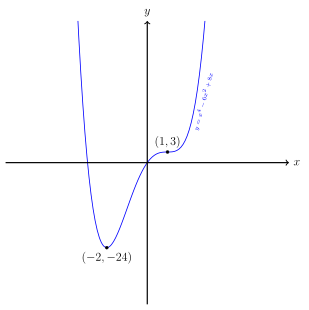
- \(\,\)

2012 Paper 3 Q3
It is given that the two curves \[ y=4-x^2 \text{ and } m x = k-y^2\,, \] where \(m > 0\), touch exactly once.
- In each of the following four cases, sketch the two curves on a single diagram, noting the coordinates of any intersections with the axes:
- \(k < 0\, \);
- \(0 < k < 16\), \(k/m < 2\,\);
- \(k > 16\), \(k/m > 2\,\);
- \(k > 16\), \(k/m < 2\,\).
- Now set \(m=12\). Show that the \(x\)-coordinate of any point at which the two curves meet satisfies \[ x^4-8x^2 +12x +16-k=0\,. \] Let \(a\) be the value of \(x\) at the point where the curves touch. Show that \(a\) satisfies \[ a^3 -4a +3 =0 \] and hence find the three possible values of \(a\). Derive also the equation \[ k= -4a^2 +9a +16\,. \] Which of the four sketches in part (i) arise?
Solution:
- \(\,\)

- \(\,\)

- \(\,\)

- \(\,\)

- \(\,\)
- Suppose \(m = 12\) \begin{align*} && y &= 4-x^2 \\ && 12x &= k-y^2 \\ \Rightarrow && 12 x&=k-(4-x^2)^2 \\ &&&= k-16+8x^2-x^4 \\ \Rightarrow && 0 &= x^4- 8x^2+12x+16-k \end{align*} When the curves touch, we will have repeated root, ie \(a\) is a root of \(4x^3-16x+12 \Rightarrow a^3-4a+3 =0\). \begin{align*} &&0 &= a^3-4a+3 \\ &&&= (a-1)(a^2+a-3) \\ \Rightarrow &&a &= 1, \frac{-1 \pm \sqrt{13}}{2} \end{align*} \begin{align*} && 0 &= a^4-8a^2+12a+16-k \\ \Rightarrow && k &= a(a^3-8a+12)+16 \\ &&&= a(4a-3-8a+12)+16 \\ &&&= -4a^2+9a+16 \\ \\ \Rightarrow && a = 1& \quad k = 21 \\ && k &= -4(3-a)+9a+16 = 13a+4\\ && a = \frac{-1-\sqrt{13}}2& \quad k = \frac{-5 - 13\sqrt{13}}{2} < 0 \\ && a = \frac{-1+\sqrt{13}}2& \quad k = \frac{-5 + 13\sqrt{13}}{2} \\ \end{align*} So we have type (a), and (d).
2007 Paper 3 Q1
In this question, do not consider the special cases in which the denominators of any of your expressions are zero. Express \(\tan(\theta_1+\theta_2+\theta_3+\theta_4)\) in terms of \(t_i\), where \(t_1=\tan\theta_1\,\), etc. Given that \(\tan\theta_1\), \(\tan\theta_2\), \(\tan\theta_3\) and \(\tan\theta_4\) are the four roots of the equation \[at^4+bt^3+ct^2+dt+e=0 \] (where \(a\ne0\)), find an expression in terms of \(a\), \(b\), \(c\), \(d\) and \(e\) for \(\tan(\theta_1+\theta_2+\theta_3+\theta_4)\). The four real numbers \(\theta_1\), \(\theta_2\), \(\theta_3\) and \(\theta_4\) lie in the range \(0\le \theta_i<2\pi\) and satisfy the equation \[ p\cos2\theta+\cos(\theta-\alpha)+p=0\,,\] where \(p\) and \(\alpha\) are independent of \(\theta\). Show that \(\theta_1+\theta_2+\theta_3+\theta_4=n\pi\) for some integer \(n\).
Solution: \begin{align*} \tan(\theta_1 + \theta_2 + \theta_3 + \theta_4) &= \frac{\tan(\theta_1 + \theta_2) + \tan(\theta_3 + \theta_4)}{1 - \tan(\theta_1 +\theta_2)\tan(\theta_3+\theta_4)} \\ &= \frac{\frac{t_1+t_2}{1-t_1t_2}+\frac{t_3+t_4}{1-t_3t_4}}{1-\frac{t_1+t_2}{1-t_1t_2}\frac{t_3+t_4}{1-t_3t_4}} \\ &= \frac{(t_1+t_2)(1-t_3t_4)+(t_3+t_4)(1-t_1t_2)}{(1-t_1t_2)(1-t_3t_4)-(t_1+t_2)(t_3+t_4)} \\ &= \frac{t_1 +t_2+t_3+t_4 - (t_1t_2t_3+t_1t_2t_4+t_1t_3t_4+t_2t_3t_4)}{1-t_1t_2-t_1t_3-t_1t_4-t_2t_3-t_2t_4-t_3t_4} \end{align*} If \(t_1, t_2, t_3, t_4\) are the roots of \(at^4+bt^3+ct^2+dt+e = 0\), then \(t_1+t_2+t_3+t_4 = -\frac{b}{a}, t_1t_2+t_1t_3+t_1t_4+t_2t_3+t_2t_4+t_3t_4 = \frac{c}{a}, t_1t_2t_3+t_1t_2t_4+t_1t_3t_4+t_2t_3t_4 = -\frac{d}{a}\), therefore the expression is: \begin{align*} \tan(\theta_1 + \theta_2 + \theta_3 + \theta_4) &= \frac{-\frac{b}{a}+\frac{d}{a}}{1 - \frac{c}{a}} \\ &= \frac{d-b}{a-c} \end{align*} \begin{align*} &&0 &= p \cos 2\theta + \cos (\theta - \alpha) + p \\ &&&= p (2\cos^2 \theta -1) + \cos \theta \cos \alpha - \sin \theta \sin \alpha + p \\ &&&= 2p \cos^2 \theta + \cos \theta \cos \alpha - \sin \theta \sin \alpha\\ \Rightarrow && 0 &=2p \cos \theta + \cos \alpha - \tan \theta \sin \alpha \\ \Rightarrow && -2p \cos \theta&= \cos \alpha - \tan \theta \sin \alpha \\ \Rightarrow && 4p^2 \cos^2 \theta &= \cos^2 \alpha - 2 \sin \alpha \cos \alpha \tan \theta + \sin^2 \alpha \tan^2 \theta \\ && 4p^2 \frac{1}{1 + \tan^2 \theta} &= \cos^2 \alpha - \sin 2\alpha \tan \theta + \sin^2 \alpha \tan^2 \theta \\ \Rightarrow && 4p^2 &= \cos^2 \alpha - \sin 2\alpha t+t^2-\sin2\alpha t^3+\sin^2 \alpha t^4 \\ \Rightarrow && \tan (\theta_1+\theta_2 + \theta_3+ \theta_4) &= \frac{0}{\sin^2 \alpha - 1} \\ &&&= 0 \\ \Rightarrow && \theta_1 + \theta_2 + \theta_3 + \theta_4 &= n\pi \end{align*}
2005 Paper 3 Q3
Let \(\f(x)=x^2+px+q\) and \(\g(x)=x^2+rx+s\,\). Find an expression for \(\f ( \g (x))\) and hence find a necessary and sufficient condition on \(a\), \(b\) and \(c\) for it to be possible to write the quartic expression \(x^4+ax^3+bx^2+cx+d\) in the form \(\f ( \g (x))\), for some choice of values of \(p\), \(q\), \(r\) and \(s\). Show further that this condition holds if and only if it is possible to write the quartic expression \(x^4+ax^3+bx^2+cx+d\) in the form \((x^2+vx+w)^2-k\), for some choice of values of \(v\), \(w\) and \(k\). Find the roots of the quartic equation \(x^4-4x^3+10x^2-12x+4=0\,\).
Solution: \begin{align*} && f(g(x)) &= (g(x))^2 + p(g(x)) + q \\ &&&= (x^2+rx+s)^2 + p(x^2+rx+s) + q \\ &&&= x^4 + 2rx^3 + (2s+r^2+p)x^2 +(2rs+pr)x + (s^2+ps+q) \end{align*} So we need \(2r=a ,2s+r^2+p = b, r(2s+p) = c\). (We have full control over \(d\) since we can always chance \(q\) only affecting \(d\). \begin{align*} && r &= \frac{a}{2} \\ && b-r^2 & =rc \\ && b - \frac{a^2}{4} & =\frac{ac}{2} \\ \Rightarrow && 4b-a^2&= 2ac \end{align*} Clearly this condition is necessary. It is sufficient since if it is true the equations are solveable. \((x^2+vx+w)^2 = x^4 + 2vx^3 + (2vw+v^2)x^2+2vw x + w^2\). We don't care about the constant term since we can control this with \(k\), so we just need to check \(4(2vw+v^2) - (2v)^2 = 8wv\) so this does satisfy the condition. The reverse is also clear. \begin{align*} && 0 &= x^4-4x^3+10x^2-12x+4 \\ &&&= (x^2-2x+3)^2-5 \\ \Rightarrow && 0 &= x^2 - 2x+3 \pm \sqrt{5} \\ && x &= \frac{2 \pm \sqrt{4 - 4(3 \pm \sqrt{5})}}{2} \\ &&&= 1 \pm \sqrt{\mp \sqrt{5} -2} \\ &&& = 1 \pm \sqrt{\sqrt{5}-2}, 1 \pm i\sqrt{\sqrt{5}+2} \end{align*}
2002 Paper 2 Q2
Show that setting \(z - z^{-1}=w\) in the quartic equation \[ z^4 +5z^3 +4z^2 -5z +1=0 \] results in the quadratic equation \(w^2+5w+6=0\). Hence solve the above quartic equation. Solve similarly the equation \[ 2z^8 -3z^7-12z^6 +12z^5 +22z^4-12z^3 -12 z^2 +3z +2=0 \;. \]
Solution: \begin{align*} && 0 &= z^4 +5z^3 +4z^2 -5z +1 \\ &&0 &= z^2 + z^{-2} + 5(z-z^{-1}) + 4 \\ &&&= (z-z^{-1})^2+2+5(z-z^{-1})+4 \\ &&&= w^2 + 5w + 6 \\ &&&= (w+3)(w+2) \\ \Rightarrow && 0 &= z-z^{-1}+3 \\ \Rightarrow && 0 &= z^2+3z-1 \\ \Rightarrow && z &= \frac{-3 \pm \sqrt{3^2+4}}{2} = \frac{-3 \pm \sqrt{13}}{2} \\ \Rightarrow && 0 &= z-z^{-1}+2 \\ \Rightarrow && 0 &= z^2+2z-1 \\ \Rightarrow && z &= \frac{-2 \pm \sqrt{2^2+4}}{2} = - 1 \pm \sqrt{2} \\ \end{align*} \begin{align*} &&0 &= 2z^8 -3z^7-12z^6 +12z^5 +22z^4-12z^3 -12 z^2 +3z +2 \\ && 0 &= 2(z^4+z^{-4}) - 3(z^3-z^{-3})-12(z^2+z^{-2})+12(z-z^{-1})+22 \\ &&&= 2\left ((z-z^{-1})^4+4(z^2+z^{-2})-6\right)-3 \left ((z-z^{-1})^3+3(z-z^{-1}) \right)-12 \left ((z-z^{-1})^2+2 \right)+12(z-z^{-1})+22 \\ &&&= 2(w^4+4(w^2+2)-6)-3w^3-9w-12w^2-24+12w+22 \\ &&&= 2 w^4-3w^3-4w^2+3w+2 \\ \Rightarrow && 0 &= 2(w^2+w^{-2})-3(w-w^{-1})-4 \\ &&&= 2((w-w^{-1})^2+2)-3(w-w^{-1})-4 \\ &&&= 2x^2-3x \\ &&&= x(2x-3) \\ \Rightarrow && 0 &= w -w^{-1} \\ \Rightarrow && w &= \pm 1 \\ \Rightarrow && \pm 1 &= z-z^{-1} \\ \Rightarrow && 0 &= z^2 \mp z-1 \\ \Rightarrow && z &= \frac{\pm 1 \pm \sqrt{5}}{2} \\ \Rightarrow && \frac32 &= w-w^{-1} \\ \Rightarrow && 0 &= 2w^2-3w -2 \\ &&&= (2w+1)(w-2) \\ \Rightarrow && 2 &= z-z^{-1} \\ \Rightarrow && 0 &= z^2-2z-1 \\ \Rightarrow && z &= 1 \pm \sqrt{2} \\ \Rightarrow && -\frac12 &= z-z^{-1} \\ \Rightarrow && 0 &= 2z^2+z-2 \\ \Rightarrow && z &= \frac{-1 \pm \sqrt{17}}{4} \\ \Rightarrow && z &\in \left \{ \frac{\pm 1 \pm \sqrt{5}}{2}, 1 \pm \sqrt{2}, \frac{-1 \pm \sqrt{17}}{4} \right \} \end{align*}
2002 Paper 3 Q5
Give a condition that must be satisfied by \(p\), \(q\) and \(r\) for it to be possible to write the quadratic polynomial \(px^2 + qx + r\) in the form \(p \l x + h \r^2\), for some \(h\). Obtain an equation, which you need not simplify, that must be satisfied by \(t\) if it is possible to write \[ \l x^2 + \textstyle{{1 \over 2}} bx + t \r^2 - \l x^4 + bx^3 + cx^2 +dx +e \r \] in the form \(k \l x + h \r^2\), for some \(k\) and \(h\). Hence, or otherwise, write \(x^4 + 6x^3 + 9x^2 -2x -7\) as a product of two quadratic factors.
2000 Paper 3 Q6
Given that \[ x^4 + p x^2 + q x + r = ( x^2 - a x + b ) ( x^2 + a x + c ) , \] express \(p\), \(q\) and \(r\) in terms of \(a\), \(b\) and \(c\). Show also that \( a^2\) is a root of the cubic equation $$ u^3 + 2 p u^2 + ( p^2 - 4 r ) u - q^2 = 0 . $$ Explain why this equation always has a non-negative root, and verify that \(u = 9\) is a root in the case \(p = -1\), \(q = -6\), \(r = 15\) . Hence, or otherwise, express $$y^4 - 8 y^3 + 23 y^2 - 34 y + 39$$ as a product of two quadratic factors.
Solution: \begin{align*} && ( x^2 - a x + b ) ( x^2 + a x + c ) &= x^4 + (b+c-a^2)x^2 + a(b-c)x + bc \\ \Rightarrow && x^4 + p x^2 + q x + r &= x^4 + (b+c-a^2)x^2 + a(b-c)x + bc \\ \Rightarrow && p &= b+c-a^2 \tag{1}\\ && q &= a(b-c) \tag{2}\\ && r &= bc \tag{3} \end{align*} \begin{align*} (1): && p+a^2 &= b+ c \\ (2): && \frac{q}{a} &= b - c \\ \Rightarrow && b &= \frac12 (p+a^2 + \frac{q}{a}) \\ && c &= \frac12 (p+a^2 - \frac{q}{a}) \\ (3): && r &= \frac12 (p+a^2 + \frac{q}{a}) \frac12 (p+a^2 - \frac{q}{a}) \\ \Rightarrow && 4ra^2 &= (pa + a^3 + q)(pa+a^3-q) \\ &&&= (pa+a^3)^2 - q^2 \\ &&&= a^2(p+a^2)^2 -q^2 \\ &&&= a^2(p^2 + 2pa^2 + a^4) - q^2 \\ &&&= pa^2 + 2pa^4 + a^6 - q^2 \\ \end{align*} Therefore \(a^2\) is a root of \(u^3 + 2pu^2 + pu - q^2 = 4ru\), ie the given equation. When \(u = 0\), this equation is \(-q^2\), therefore the cubic is negative. But as \(u \to \infty\) the cubic tends to \(\infty\), therefore it must cross the \(x\)-axis and have a positive root. If \(p=-1, q = -6, r = 15\) then the cubic is: \(u^3 - 2u^2 + (1-60)u -36\) and so when \(u = 9\) we have \begin{align*} 9^3 - 2\cdot 9^2 -59 \cdot 9 -36 &= 9(9^2-2\cdot 9 - 29 -4) \\ &= 9(81 -18-59-4) \\ &= 0 \end{align*} so \(u = 9\) is a root Let \(y=z + 2\) \begin{align*} &&y^4 - 8 y^3 + 23 y^2 - 34 y + 39 &= (z+2)^4-8(z+2)^3 + 23(z+2)^2 - 34(z+2) + 39 \\ &&&= z^4+8z^3+24z^2+32z+16 - \\ &&&\quad -8z^3-48z^2-96z-64 \\ &&&\quad\quad +23z^2+92z+92 \\ &&&\quad\quad -34z-68 + 39 \\ &&&= z^4-z^2-6z+15 \end{align*} So conveniently this is \(p = -1, q = -6, r = 15\), so we know that \(a = 3\) is a sensible thing to true. \(b = \frac12(-1 + 9 + \frac{-6}{3}) = 3\) \(c = \frac12(-1+9-\frac{-6}{3}) = 5\) so \begin{align*} && z^4-z^2-6z+15 &= (z^2-3z+3)(z^2+3z+5) \\ &&y^4 - 8 y^3 + 23 y^2 - 34 y + 39 &= ((y-2)^2-3(y-2)+3)((y-2)^2+3(y-2)+5) \\ &&&= (y^2-4y+4-3y+6+3)(y^2-4y+4+3y-6+5) \\ &&&= (y^2-7y+13)(y^2-y+3) \end{align*}
1997 Paper 2 Q7
Let $$y^2=x^2(a^2-x^2),$$ where \(a\) is a real constant. Find, in terms of \(a\), the maximum and minimum values of \(y\). Sketch carefully on the same axes the graphs of \(y\) in the cases \(a=1\) and \(a=2\).
Solution: \begin{align*} && y^2 &= x^2a^2-x^2 \\ &&&= \frac{a^4}{4} -\left ( x^2 -\frac{a^2}{2} \right)^2 \end{align*} Therefore the maximum and minimum values of \(y\) are \(\pm \frac{a^2}2\)

1997 Paper 3 Q4
In this question, you may assume that if \(k_1,\dots,k_n\) are distinct positive real numbers, then \[\frac1n\sum_{r=1}^nk_r>\left({\prod\limits_{r=1}^n} k_r\right )^{\!\! \frac1n},\] i.e. their arithmetic mean is greater than their geometric mean. Suppose that \(a\), \(b\), \(c\) and \(d\) are positive real numbers such that the polynomial \[{\rm f}(x)=x^4-4ax^3+6b^2x^2-4c^3x+d^4\] has four distinct positive roots.
- Show that \(pqr,qrs,rsp\) and \(spq\) are distinct, where \(p,q,r\) and \(s\) are the roots of the polynomial \(\mathrm{f}\).
- By considering the relationship between the coefficients of \(\mathrm{f}\) and its roots, show that \(c > d\).
- Explain why the polynomial \(\mathrm{f}'(x)\) must have three distinct roots.
- By differentiating \(\mathrm{f}\), show that \(b > c\).
- Show that \(a > b\).
Solution:
- Suppose \(pqr = qrs\), since the roots are positive, we can divide by \(qr\) to obtain \(p=s\) (a contradiction. Therefore all those terms are distinct.
- \(4c^3 = pqr+qrs+rsp+spq\), \(d^4 = pqrs\). Applying AM-GM, we obtain: \begin{align*} && c^3 = \frac{ pqr+qrs+rsp+spq}{4} & > \sqrt[4]{p^3q^3r^3s^3} = d^{3} \\ \Rightarrow && c &> d \end{align*}
- There must be a turning point between each root (since there are no repeated roots).
- \(f'(x) = 4x^3-12ax^2+12b^2-4c^3 = 4(x^3-3ax^2+3b^2-c^3)\). Letting the roots of this polynomial be \(\alpha, \beta, \gamma\) and again applying AM-GM, we must have: \begin{align*} && b^2 = \frac{\alpha\beta + \beta \gamma+\gamma \alpha}{3} &> \sqrt[3]{\alpha^2\beta^2\gamma^2} = c^2 \\ \Rightarrow && b &> c \end{align*}
- Again, since there are turning points between the roots of \(f'(x)\) we must have distinct roots for \(f''(x)\), ie: \(f''(x) = 3x^2-6ax+6b^2 = 3(x^2-2ax+b^2)\) has distinct real roots. But for this to occur we must have that \((2a)^2-4b^2 = 4(a^2-b^2) > 0\), ie \(a>b\)
1994 Paper 2 Q5
- Show that the equation \[ (x-1)^{4}+(x+1)^{4}=c \] has exactly two real roots if \(c>2,\) one root if \(c=2\) and no roots if \(c<2\).
- How many real roots does the equation \(\left(x-3\right)^{4}+\left(x-1\right)^{4}=c\) have?
- How many real roots does the equation \(\left|x-3\right|+\left|x-1\right|=c\) have?
- How many real roots does the equation \(\left(x-3\right)^{3}+\left(x-1\right)^{3}=c\) have?
Solution:
- \(\,\) \begin{align*} && c &= (x-1)^4+(x+1)^4 \\ &&&= 2x^4+12x^2+2 \\ \Rightarrow && 0 &= (x^2+6)^2-\frac{c}{2} - 35 \\ \Rightarrow && \underbrace{x^2+6}_{\geq 6} &= \pm \sqrt{35 + \frac{c}{2}}\\ \end{align*} Therefore there are two solutions if \(c > 2\), one solution if \(c = 2\) and no solutions otherwise.
- \(\,\) This equation is the same equation if \(y = x-2\), ie there are two solutions if \(c > 2\), one solution if \(c = 2\) and no solutions otherwise.
- Rewriting as \(|x-1|+|x+1| = c\) we have For \(x < -1\): \(1-x-1-x = -2x\) For \(-1 \leq x \leq 1\): \(1-x+x+1 = 2\) For \(x > 1\): \(x-1+x+1 = 2x\) Therefore there are infinitely many solutions if \(c = 2\) (the interval \([-3,-1]\)), two solutions if \(c > 2\) and none otherwise.
- Rewriting as \((x-1)^3+(x+1)^3\) we have \(x^3+6x = c\). Notice that \(3x^2+6 > 0\) so the function is increasing, ie there is one solution for all \(c\)
1994 Paper 3 Q2
- By setting \(y=x+x^{-1},\) find the solutions of \[ x^{4}+10x^{3}+26x^{2}+10x+1=0. \]
- Solve \[ x^{4}+x^{3}-10x^{2}-4x+16=0. \]
Solution:
- \begin{align*} && x^{4}+10x^{3}+26x^{2}+10x+1 &= 0 \\ \Leftrightarrow && x^2 + 10x + 26 + 10x^{-1} + x^{-2} &= 0 \\ \Leftrightarrow && (x^2 + x^{-2} + 2) + 10(x+x^{-1}) + 24 &= 0 \\ \Leftrightarrow && y^2 + 10y + 24 &= 0 \tag{\(y = x + x^{-1}\)} \\ \Leftrightarrow && (y+6)(y+4) &= 0 \\ \Leftrightarrow && \begin{cases} x+x^{-1} = -4 \\ x+x^{-1} = -6 \\ \end{cases} \\ \Leftrightarrow && \begin{cases} x^2+4x+1 = 0 \\ x^2+6x+1 = 0 \\ \end{cases} \\ \Leftrightarrow && \boxed{\begin{cases} x = -2 \pm \sqrt{3} \\ x = -3 \pm 2\sqrt{2} \\ \end{cases}} \\ \end{align*}
- \begin{align*} && x^{4}+x^{3}-10x^{2}-4x+16=0 &= 0 \\ \Leftrightarrow && x^2 + x - 10 - 4x^{-1} + 4x^{-2} &= 0 \\ \Leftrightarrow && (x^2+4x^{-2} - 4) + (x - 4x^{-1}) - 6 &= 0 \\ \Leftrightarrow && (x^2+4x^{-2} - 4) + (x - 4x^{-1}) - 6 &= 0 \\ \Leftrightarrow && z^2 + z - 6 &= 0 \tag{\(z = x -2x^{-1}\)} \\ \Leftrightarrow && (z+3)(z-2) &= 0 \\ \Leftrightarrow && \begin{cases} x-2x^{-1} = -3 \\ x-2x^{-1} = 2 \\ \end{cases} \\ \Leftrightarrow && \begin{cases} x^2+3x-2 = 0 \\ x^2-2x-2 = 0 \\ \end{cases} \\ \Leftrightarrow && \boxed{\begin{cases} x = \frac{-3 \pm \sqrt{17}}{2} \\ x = 1 \pm \sqrt{3} \\ \end{cases}} \\ \end{align*}