Problems
Filters
11 problems found
2019 Paper 1 Q5
- The four points \(P\), \(Q\), \(R\) and \(S\) are the vertices of a plane quadrilateral. What is the geometrical shape of \(PQRS\) if \(\vec{PQ} = \vec{SR}\)? What is the geometrical shape of \(PQRS\) if \(\vec{PQ} = \vec{SR}\) and \(|\vec{PQ}| = |\vec{PS}|\)?
- A cube with edges of unit length has opposite vertices at \((0,0,0)\) and \((1,1,1)\). The points
$$P(p,0,0), \quad Q(1,q,0), \quad R(r,1,1) \quad \text{and} \quad S(0,s,1)$$
lie on edges of the cube. Given that the four points lie in the same plane, show that
$$rq = (1-s)(1-p).$$
- Show that \(\vec{PQ} = \vec{SR}\) if and only if the centroid of the quadrilateral \(PQRS\) is at the centre of the cube. Note: the centroid of the quadrilateral \(PQRS\) is the point with position vector $$\frac{1}{4}(\vec{OP} + \vec{OQ} + \vec{OR} + \vec{OS}),$$ where \(O\) is the origin.
- Given that \(\vec{PQ} = \vec{SR}\) and \(|\vec{PQ}| = |\vec{PS}|\), express \(q\), \(r\) and \(s\) in terms of \(p\). Show that $$\cos PQR = \frac{4p-1}{5-4p+8p^2}.$$ Write down the values of \(p\), \(q\), \(r\) and \(s\) if \(PQRS\) is a square, and show that the length of each side of this square is greater than \(\frac{21}{20}\).
Solution:
- If \(\vec{PQ} = \vec{SR}\) we have a parallelogram. \(\vec{PQ} = \vec{SR}\) and \(|\vec{PQ}| = |\vec{PS}|\) then we have a rhombus.
- If the four points lie in a plane then
\((\vec{RS} \times \vec{RP}) \cdot \vec{RQ} =0\), so
\begin{align*}
&& 0 &=\left ( \begin{pmatrix}-r\\ s-1 \\ 0 \end{pmatrix} \times \begin{pmatrix}p-r\\ -1 \\ -1 \end{pmatrix}\right) \cdot \begin{pmatrix}1-r\\ q-1 \\ -1 \end{pmatrix} \\
&& &= \begin{pmatrix}1-s \\ -r \\r+(p-r)(1-s) \end{pmatrix} \cdot \begin{pmatrix}1-r\\ q-1 \\ -1 \end{pmatrix} \\
&&&= (1-s)(1-r)-r(q-1)-r-(p-r)(1-s) \\
&&&=(1-s)(1-r-p+r)-rq \\
\Rightarrow && rq &= (1-s)(1-p)
\end{align*}
- \(\,\) \begin{align*} && \vec{PQ} &= \vec{SR} \\ \Leftrightarrow && \begin{pmatrix}1-p\\q \\ 0 \end{pmatrix} &= \begin{pmatrix}r\\1-s \\ 0 \end{pmatrix} \\ \Leftrightarrow && 1-p = r & \quad ; \quad q = 1-s\\ \Leftrightarrow && 1= r+p & \quad ; \quad 1 = q+s\\ \end{align*} The centroid is \(\frac14 (p+1+r, q+s+1, 2)\) which is clearly \(\frac12(1,1,1)\) iff those equations are true.
- \(\,\) \begin{align*} && |\vec{PQ}| &= |\vec{PS}| \\ \Leftrightarrow && (1-p)^2+q^2+ 0^2 &= p^2+s^2+1)\\ \Leftrightarrow && 1-2p+p^2+q^2 &= p^2 + s^2 + 1 \\ \Leftrightarrow && -2p+q^2 &= s^2 \end{align*} From the previous equations we have \(r = 1-p\), and \(-2p+(1-s)^2 = s^2 \Rightarrow -2p + 1 -2s = 0 \Rightarrow s = \frac12 - p\) and \(q = \frac12 + p\) \begin{align*} && \cos PQR &= \frac{\vec{QP}\cdot \vec{QR}}{|\vec{QP}||\vec{QR}|} \\ &&&= \frac{ \begin{pmatrix}p-1\\ -q \\ 0 \end{pmatrix} \cdot \begin{pmatrix}r-1\\ 1-q \\ 1 \end{pmatrix}}{\sqrt{(p-1)^2+q^2}\sqrt{(r-1)^2+(1-q)^2+1^2}} \\ &&&= \frac{ \begin{pmatrix}p-1\\ -\frac12-p \\ 0 \end{pmatrix} \cdot \begin{pmatrix}-p\\ \frac12-p \\ 1 \end{pmatrix}}{\sqrt{(p-1)^2+(-\frac12-p)^2}\sqrt{p^2+(\frac12-p)^2+1^2}} \\ &&&= \frac{ p-p^2-\frac14+p^2}{\sqrt{p^2-2p+1+\frac14+p+p^2}\sqrt{p^2+\frac14-p+p^2+1}} \\ &&&= \frac{4p-1}{\sqrt{8p^2-4p+5}\sqrt{8p^2-4p+5}}\\ &&&= \frac{4p-1}{8p^2-4p+5}\\ \end{align*} For \(PQRS\) to be a square \(\cos PQR = 0\), ie \(p = \frac14\) and so \((p,q,r,s) = (\frac14, \frac34, \frac34, \frac14)\) and \(|PQ| = \sqrt{(1-p)^2+q^2} = \sqrt{\left ( \frac34 \right)^2 + \left ( \frac34 \right)^2 } = \frac{3\sqrt{2}}4\), notice that \(\left ( \frac{21}{20} \right)^2 = \frac{441}{400} < \frac{9}{8}\) (\(441 < 450\)) therefore the sides are at least as long as \(\frac{21}{20}\)
2019 Paper 2 Q7
- The points \(A\), \(B\) and \(C\) have position vectors \(\mathbf{a}\), \(\mathbf{b}\) and \(\mathbf{c}\), respectively. Each of these vectors is a unit vector (so \(\mathbf{a} \cdot \mathbf{a} = 1\), for example) and $$\mathbf{a} + \mathbf{b} + \mathbf{c} = \mathbf{0}.$$ Show that \(\mathbf{a} \cdot \mathbf{b} = -\frac{1}{2}\). What can be said about the triangle ABC? You should justify your answer.
- The four distinct points \(A_i\) (\(i = 1, 2, 3, 4\)) have unit position vectors \(\mathbf{a}_i\) and
$$\sum_{i=1}^{4} \mathbf{a}_i = \mathbf{0}.$$
Show that \(\mathbf{a}_1 \cdot \mathbf{a}_2 = \mathbf{a}_3 \cdot \mathbf{a}_4\).
- Given that the four points lie in a plane, determine the shape of the quadrilateral with vertices \(A_1\), \(A_2\), \(A_3\) and \(A_4\).
- Given instead that the four points are the vertices of a regular tetrahedron, find the length of the sides of this tetrahedron.
Solution:
- Given \(\mathbf{a} + \mathbf{b} + \mathbf{c} = \mathbf{0}\), we can form the following results: \begin{align*} && \begin{cases} \mathbf{a} \cdot (\mathbf{a} + \mathbf{b} + \mathbf{c}) &= 0 \\ \mathbf{b} \cdot (\mathbf{a} + \mathbf{b} + \mathbf{c}) &= 0 \\ \mathbf{c} \cdot (\mathbf{a} + \mathbf{b} + \mathbf{c}) &= 0 \\ \end{cases} \\ \Rightarrow && \begin{cases} \mathbf{a} \cdot \mathbf{a} + \mathbf{a} \cdot\mathbf{b} + \mathbf{a} \cdot\mathbf{c} &= 0 \\ \mathbf{b} \cdot \mathbf{a} + \mathbf{b} \cdot \mathbf{b} + \mathbf{b} \cdot \mathbf{c} &= 0 \\ \mathbf{c} \cdot \mathbf{a} + \mathbf{c} \cdot \mathbf{b} + \mathbf{c} \cdot \mathbf{c} &= 0 \\ \end{cases} \\ \Rightarrow && \begin{cases} \mathbf{a} \cdot\mathbf{b} + \mathbf{a} \cdot\mathbf{c} &= -1 \\ \mathbf{a} \cdot \mathbf{b} + \mathbf{b} \cdot \mathbf{c} &= -1 \\ \mathbf{a} \cdot \mathbf{c} + \mathbf{b} \cdot \mathbf{c} &= -1 \\ \end{cases} \\ \Rightarrow && \begin{cases} \mathbf{a} \cdot\mathbf{b} + \mathbf{a} \cdot\mathbf{c} &= -1 \\ \mathbf{a} \cdot \mathbf{b} + \mathbf{b} \cdot \mathbf{c} &= -1 \\ \mathbf{a} \cdot \mathbf{c} + \mathbf{b} \cdot \mathbf{c} &= -1 \\ \mathbf{a} \cdot \mathbf{b} +\mathbf{a} \cdot \mathbf{c} + \mathbf{b} \cdot \mathbf{c} &= -\frac12 \\ \end{cases} \\ \Rightarrow && \begin{cases} \mathbf{a} \cdot \mathbf{b} = -\frac12 \\ \mathbf{a} \cdot \mathbf{c} = -\frac12 \\ \mathbf{b} \cdot \mathbf{c} = -\frac12 \\ \end{cases} \end{align*} The triangle must be equilateral since the angles between each vertex are the same.
- We have \(\displaystyle \sum_{i=1}^{4} \mathbf{a}_i = \mathbf{0}\) so \(\displaystyle \mathbf{a}_i \cdot \sum_{i=1}^{4} \mathbf{a}_i = 0\) or for each \(i\), \(\displaystyle \sum_{j \neq i} \mathbf{a}_i \cdot \mathbf{a}_j = -1\).
\begin{align*}
&& \begin{cases}
\mathbf{a}_1 \cdot \mathbf{a}_2 + \mathbf{a}_1 \cdot \mathbf{a}_3 + \mathbf{a}_1 \cdot \mathbf{a}_4 = -1 \\
\mathbf{a}_1 \cdot \mathbf{a}_2 + \mathbf{a}_2 \cdot \mathbf{a}_3 + \mathbf{a}_2 \cdot \mathbf{a}_4 = -1 \\
\mathbf{a}_1 \cdot \mathbf{a}_3 + \mathbf{a}_2 \cdot \mathbf{a}_3 + \mathbf{a}_3 \cdot \mathbf{a}_4 = -1 \\
\mathbf{a}_2 \cdot \mathbf{a}_4 + \mathbf{a}_2 \cdot \mathbf{a}_4 + \mathbf{a}_3 \cdot \mathbf{a}_4 = -1 \\
\end{cases} \\
&& \text{adding the first two, subtracting the last two} \\
\Rightarrow && \begin{cases}
\mathbf{a}_1 \cdot \mathbf{a}_2 +\cancel{\mathbf{a}_1 \cdot \mathbf{a}_3} + \cancel{\mathbf{a}_1 \cdot \mathbf{a}_4} = -1 \\
\mathbf{a}_1 \cdot \mathbf{a}_2 + \cancel{\mathbf{a}_2 \cdot \mathbf{a}_3} + \cancel{\mathbf{a}_2 \cdot \mathbf{a}_4} = -1 \\
\cancel{\mathbf{a}_1 \cdot \mathbf{a}_3} + \cancel{\mathbf{a}_2 \cdot \mathbf{a}_3} + \mathbf{a}_3 \cdot \mathbf{a}_4 = -1 \\
\cancel{\mathbf{a}_1 \cdot \mathbf{a}_4} + \cancel{\mathbf{a}_2 \cdot \mathbf{a}_4} + \mathbf{a}_3 \cdot \mathbf{a}_4 = -1 \\
\end{cases} \\
\Rightarrow && 2 (\mathbf{a}_1 \cdot \mathbf{a}_2) - 2(\mathbf{a}_3 \cdot \mathbf{a}_4) = 0
\end{align*}
Rather than adding the first two and last two, we could have done any pair, resulting in the relations:
\begin{align*}
\mathbf{a}_1 \cdot \mathbf{a}_2 &= \mathbf{a}_3 \cdot \mathbf{a}_4 \\
\mathbf{a}_1 \cdot \mathbf{a}_3 &= \mathbf{a}_2 \cdot \mathbf{a}_4 \\
\mathbf{a}_1 \cdot \mathbf{a}_4 &= \mathbf{a}_2 \cdot \mathbf{a}_3
\end{align*}
- The shape must be a parallelogram (from the angle requirement, but also cyclic quadrilateral (since all vectors are unit length), therefore it must be a rectangle
- Given it's a regular tetrahedron, \(\mathbf{a}_i \cdot \mathbf{a}_j\) must be the same for all \(i \neq j\), ie \(-\frac13\). We are interested in \(|\mathbf{a}_i - \mathbf{a}_j|\) so consider, \begin{align*} |\mathbf{a}_i - \mathbf{a}_j|^2 &= (\mathbf{a}_i - \mathbf{a}_j) \cdot (\mathbf{a}_i - \mathbf{a}_j) \\ &= \mathbf{a}_i \cdot \mathbf{a}_i - 2 \mathbf{a}_i \cdot \mathbf{a}_j + \mathbf{a}_j \cdot \mathbf{a}_j \\ &= 1 - \frac23 + 1 \\ &= \frac43 \end{align*} Therefore the unit side lengths are \(\frac{2}{\sqrt{3}}\)
2016 Paper 1 Q6
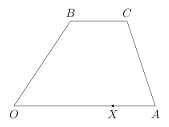
The sides \(OA\) and \(CB\) of the quadrilateral \(OABC\) are parallel. The point \(X\) lies on \(OA\), between \(O\) and \(A\). The position vectors of \(A\), \(B\), \(C\) and \(X\) relative to the origin \(O\) are \(\bf a\), \(\bf b\), \(\bf c\) and \(\bf x\), respectively. Explain why \(\bf c\) and \(\bf x\) can be written in the form \[ {\bf c} = k {\bf a} + {\bf b} \text{ and } {\bf x} = m {\bf a}\,, \] where \(k\) and \(m\) are scalars, and state the range of values that each of \(k\) and \(m\) can take. The lines \(OB\) and \(AC\) intersect at \(D\), the lines \(XD\) and \(BC\) intersect at \(Y\) and the lines \(OY\) and \(AB\) intersect at \(Z\). Show that the position vector of \(Z\) relative to \(O\) can be written as \[ \frac{ {\bf b} + mk {\bf a}}{mk+1}\,. \] The lines \(DZ\) and \(OA\) intersect at \(T\). Show that \[ OT \times OA = OX\times TA \text{ and } \frac 1 {OT} = \frac 1 {OX} + \frac 1 {OA} \,, \] where, for example, \(OT\) denotes the length of the line joining \(O\) and \(T\).
Solution:
2015 Paper 1 Q6
The vertices of a plane quadrilateral are labelled \(A\), \(B\), \(A'\) and \(B'\), in clockwise order. A point \(O\) lies in the same plane and within the quadrilateral. The angles \(AOB\) and \(A'OB'\) are right angles, and \(OA=OB\) and \(OA'=OB'\). Use position vectors relative to \(O\) to show that the midpoints of \(AB\), \(BA'\), \(A'B'\) and \(B'A\) are the vertices of a square. Given that the lengths of \(OA\) and \(OA'\) are fixed (and the conditions of the first paragraph still hold), find the value of angle \(BOA'\) for which the area of the square is greatest.
Solution: Let \(O\) be the origin, and let \(\mathbf{a}, \mathbf{b}, \mathbf{a}', \mathbf{b}'\) be the four points. The conditions give us \begin{align*} && \mathbf{a} \cdot \mathbf{b} &= 0 \\ && |\mathbf{a}| &= |\mathbf{b}| \\ && \mathbf{a}' \cdot \mathbf{b}' &= 0 \\ && |\mathbf{a}'| &= |\mathbf{b}'| \\ \end{align*} So \begin{align*} \text{midpoint }AB \text{ to midpoint } BA' &= (\tfrac12(\mathbf{a}+\mathbf{b}) - \tfrac12(\mathbf{b}+\mathbf{a}'))\cdot (\tfrac12(\mathbf{a}+\mathbf{b}) - \tfrac12(\mathbf{b}+\mathbf{a}')) \\ &= \frac12(\mathbf{a}-\mathbf{a}')\cdot \frac12(\mathbf{a} - \mathbf{a}') \\ \text{midpoint }BA' \text{ to midpoint } A'B' &= (\tfrac12(\mathbf{b}+\mathbf{a}') - \tfrac12(\mathbf{a}'+\mathbf{b}')) \cdot (\tfrac12(\mathbf{b}+\mathbf{a}') - \tfrac12(\mathbf{a}'+\mathbf{b}'))\\ &= \frac12(\mathbf{b}-\mathbf{b}')\cdot \frac12(\mathbf{b} - \mathbf{b}') \\ &= \frac14 (|\mathbf{b}|^2 + |\mathbf{b}'|^2 - 2\mathbf{b}\cdot\mathbf{b}')\\ &= \frac14(|\mathbf{a}|^2 + |\mathbf{a}'|^2 - 2\mathbf{b}\cdot\mathbf{b}') \\ \text{midpoint }A'B' \text{ to midpoint } B'A &= (\tfrac12(\mathbf{a}'+\mathbf{b}') - \tfrac12(\mathbf{b}'+\mathbf{a})) \cdot (\tfrac12(\mathbf{a}'+\mathbf{b}') - \tfrac12(\mathbf{b}'+\mathbf{a}))\\ &= \frac12(\mathbf{a}'-\mathbf{a})\cdot \frac12(\mathbf{a}' - \mathbf{a}) \\ \text{midpoint }B'A \text{ to midpoint } AB &= (\tfrac12(\mathbf{b}'+\mathbf{a}) - \tfrac12(\mathbf{a}+\mathbf{b})) \cdot (\tfrac12(\mathbf{b}'+\mathbf{a}) - \tfrac12(\mathbf{a}+\mathbf{b}))\\ &= \frac12(\mathbf{b}'-\mathbf{b})\cdot \frac12(\mathbf{b}' - \mathbf{b}) \\ \end{align*} So it's sufficient to prove \(\mathbf{a}\cdot \mathbf{a}' = \mathbf{b}\cdot \mathbf{b}'\) but this is clear from looking at a diagram for 1 second. Given the length of the square is what it is, we want to minimise \(\mathbf{b}\cdot \mathbf{b}'\) which is when they are vertically opposite each other, ie \(\angle BOA' = 90^\circ\)
2014 Paper 2 Q7
- The function \(\f\) is defined by \(\f(x)= |x-a| + |x-b| \), where \(a < b\). Sketch the graph of \(\f(x)\), giving the gradient in each of the regions \(x < a\), \(a < x < b\) and \(x > b\). Sketch on the same diagram the graph of \(\g(x)\), where \(\g(x)= |2x-a-b|\). What shape is the quadrilateral with vertices \((a,0)\), \((b,0)\), \((b,\f(b))\) and \((a, \f(a))\)?
- Show graphically that the equation \[ |x-a| + |x-b| = |x-c|\,, \] where \(a < b\), has \(0\), \(1\) or \(2\) solutions, stating the relationship of \(c\) to \(a\) and \(b\) in each case.
- For the equation \[ |x-a| + |x-b| = |x-c|+|x-d|\,, \] where \(a < b\), \(c < d\) and \(d-c < b-a\), determine the number of solutions in the various cases that arise, stating the relationship between \(a\), \(b\), \(c\) and \(d\) in each case.
Solution:
- \(\,\)
\((a,0)\), \((b,0)\), \((b,\f(b))\) and \((a, \f(a))\) forms a rectangle.

- There are no solutions if \(a < c < b\):
There is one solution if \(a=c\) or \(a = b\)
 And there are two solution if \(c \not \in [a,b]\)
 There is exactly one solution unless....
 ... there are infinitely many solutions when the gradients line up perfectly, ie when \(a+b=c+d\)

2014 Paper 3 Q5
A quadrilateral drawn in the complex plane has vertices \(A\), \(B\), \(C\) and \(D\), labelled anticlockwise. These vertices are represented, respectively, by the complex numbers \(a\), \(b\), \(c\) and \(d\). Show that \(ABCD\) is a parallelogram (defined as a quadrilateral in which opposite sides are parallel and equal in length) if and only if \(a+c =b+d\,\). Show further that, in this case, \(ABCD\) is a square if and only if \({\rm i}(a-c)=b-d\). Let \(PQRS\) be a quadrilateral in the complex plane, with vertices labelled anticlockwise, the internal angles of which are all less than \(180^\circ\). Squares with centres \(X\), \(Y\), \(Z\) and \(T\) are constructed externally to the quadrilateral on the sides \(PQ\), \(QR\), \(RS\) and \(SP\), respectively.
- If \(P\) and \(Q\) are represented by the complex numbers \(p\) and \(q\), respectively, show that \(X\) can be represented by \[ \tfrac 12 \big( p(1+{\rm i} ) + q (1-{\rm i})\big) \,. \]
- Show that \(XY\!ZT\) is a square if and only if \(PQRS\) is a parallelogram.
Solution: The vector representing the side \(AB\) is \(b - a\) and the vector representing the side \(DC\) is \(c - d\). \(ABCD\) is a parallelogram if and only if these opposite sides are parallel and equal in length, which is given by \(b - a = c - d\), or equivalently \(a + c = b + d\). Similarly, if \(a + c = b + d\), then \(c - b = d - a\), so the side \(BC\) is parallel and equal in length to the side \(AD\). Thus, \(a + c = b + d\) is the necessary and sufficient condition for \(ABCD\) to be a parallelogram. In a parallelogram, the shape is a square if and only if the diagonals are equal in length and perpendicular to each other. The diagonals are represented by the vectors \(c - a\) and \(d - b\). For these to be equal in length and perpendicular, one must be a \(90^\circ\) rotation of the other. Since \(A, B, C, D\) are labeled anticlockwise, a \(90^\circ\) anticlockwise rotation of the vector \(\vec{AC}\) (which is \(c-a\)) would point in the direction of \(\vec{DB}\) (which is \(b-d\) if we consider the relative orientation). Specifically: \(i(c - a) = d - b \implies -i(a - c) = d - b \implies i(a - c) = b - d\). Thus, \(ABCD\) is a square if and only if \(i(a - c) = b - d\).
- The midpoint of the side \(PQ\) is \(\frac{1}{2}(p + q)\). To find the centre \(X\) of the square built externally on \(PQ\), we start at the midpoint and move a distance equal to half the side length in a direction perpendicular to \(PQ\). Since \(P, Q, R, S\) are anticlockwise, the outward direction is a \(90^\circ\) clockwise rotation of the vector \(\vec{PQ}\). A clockwise rotation of \(90^\circ\) corresponds to multiplication by \(-i\). \[ x = \frac{p+q}{2} + (-i)\left(\frac{q-p}{2}\right) = \frac{p + q - iq + ip}{2} = \frac{1}{2} \big( p(1+i) + q(1-i) \big) \]
- From part (i), we have the representations for the centres: \begin{align*} x &= \tfrac{1}{2}(p(1+i) + q(1-i)) \\ y &= \tfrac{1}{2}(q(1+i) + r(1-i)) \\ z &= \tfrac{1}{2}(r(1+i) + s(1-i)) \\ t &= \tfrac{1}{2}(s(1+i) + p(1-i)) \end{align*} As shown in the first part of the problem, \(XYZT\) is a square if and only if: (1) \(x+z = y+t\) (it is a parallelogram) (2) \(i(x-z) = y-t\) (it is a square) First, examine condition (1): \begin{align*} x+z - (y+t) &= \tfrac{1}{2} \big[ (p+r)(1+i) + (q+s)(1-i) - (q+s)(1+i) - (r+p)(1-i) \big] \\ &= \tfrac{1}{2} \big[ (p+r)(1+i - (1-i)) - (q+s)(1+i - (1-i)) \big] \\ &= \tfrac{1}{2} \big[ (p+r)(2i) - (q+s)(2i) \big] \\ &= i(p+r - (q+s)) \end{align*} Thus, \(x+z = y+t\) if and only if \(p+r = q+s\), which is the condition that \(PQRS\) is a parallelogram. Next, examine condition (2): \begin{align*} i(x-z) &= \tfrac{1}{2} i \big[ p(1+i) + q(1-i) - r(1+i) - s(1-i) \big] \\ &= \tfrac{1}{2} \big[ p(i-1) + q(i+1) - r(i-1) - s(i+1) \big] \\ y-t &= \tfrac{1}{2} \big[ q(1+i) + r(1-i) - s(1+i) - p(1-i) \big] \\ \text{So, } i(x-z) - (y-t) &= \tfrac{1}{2} \big[ p(i-1 + 1-i) + q(i+1 - 1-i) + r(-i+1 - 1+i) + s(-i-1 + 1+i) \big] \\ &= 0 \end{align*} Since \(i(x-z) = y-t\) is an identity (always true for any \(PQRS\)), \(XYZT\) is a square if and only if it is a parallelogram. As established above, this occurs if and only if \(PQRS\) is a parallelogram.
2009 Paper 2 Q1
Two curves have equations \(\; x^4+y^4=u\;\) and \(\; xy = v\;\), where \(u\) and \(v\) are positive constants. State the equations of the lines of symmetry of each curve. The curves intersect at the distinct points \(A\), \(B\), \(C\) and \(D\) (taken anticlockwise from \(A\)). The coordinates of \(A\) are \((\alpha,\beta)\), where \(\alpha > \beta > 0\). Write down, in terms of \(\alpha\) and \(\beta\), the coordinates of \(B\), \(C\) and \(D\). Show that the quadrilateral \(ABCD\) is a rectangle and find its area in terms of \(u\) and \(v\) only. Verify that, for the case \(u=81\) and \(v=4\), the area is \(14\).
Solution: The curve \(x^4 + y^4 = u\) has lines of symmetry:
- \(y = 0\)
- \(x = 0\)
- \(y = x\)
- \(y = -x\)
- \(y = x\)
- \(y = -x\)

2009 Paper 2 Q8
The non-collinear points \(A\), \(B\) and \(C\) have position vectors \(\bf a\), \(\bf b\) and \(\bf c\), respectively. The points \(P\) and \(Q\) have position vectors \(\bf p\) and \(\bf q\), respectively, given by \[ {\bf p}= \lambda {\bf a} +(1-\lambda){\bf b} \text{ \ \ \ and \ \ \ } {\bf q}= \mu {\bf a} +(1-\mu){\bf c} \] where \(0<\lambda<1\) and \(\mu>1\). Draw a diagram showing \(A\), \(B\), \(C\), \(P\) and \(Q\). Given that \(CQ\times BP = AB\times AC\), find \(\mu\) in terms of \(\lambda\), and show that, for all values of \(\lambda\), the the line \(PQ\) passes through the fixed point \(D\), with position vector \({\bf d}\) given by \({\bf d= -a +b +c}\,\). What can be said about the quadrilateral \(ABDC\)?
1997 Paper 1 Q5
Four rigid rods \(AB\), \(BC\), \(CD\) and \(DA\) are freely jointed together to form a quadrilateral in the plane. Show that if \(P\), \(Q\), \(R\), \(S\) are the mid-points of the sides \(AB\), \(BC\), \(CD\), \(DA\), respectively, then \[|AB|^{2}+|CD|^{2}+2|PR|^{2}=|AD|^{2}+|BC|^{2}+2|QS|^{2}.\] Deduce that \(|PR|^{2}-|QS|^{2}\) remains constant however the vertices move. (Here \(|PR|\) denotes the length of \(PR\).)
1990 Paper 1 Q1
\(\,\)
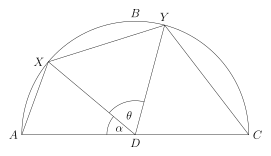
Solution: The area for \(\alpha\) fixed is \(\frac12 r^2 \sin \alpha + \frac12 r^2 \sin \theta + \frac12 r^2 \sin (\pi - \theta - \alpha)\) So we wish to maximise \(V = \sin \theta + \sin(\pi - \theta-\alpha)\) \begin{align*} && V &= \sin \theta + \sin(\pi - \theta-\alpha)\\ &&&= 2\sin \l \frac{\pi-\alpha}2\r\cos \l \frac{2\theta + \alpha - \pi}{2}\r \end{align*} The largest \(\cos\) can be is \(1\) when \(\displaystyle 2\theta + \alpha - \pi = 0 \Rightarrow \theta = \frac{\pi-\alpha}2\). (ie we split the remaining area exactly in half). We are now trying to maximise \(W = \sin \alpha + 2 \sin \frac{\pi - \alpha}2\) ie \begin{align*} && W &= \sin \alpha + 2 \cos \frac{\alpha}{2} \\ \Rightarrow && \frac{\d W}{\d \alpha} &= \cos \alpha-\sin \frac{\alpha}{2} \\ &&&= 1-2 \sin^2 \frac{\alpha}{2} - \sin \frac{\alpha}{2} \\ &&&= (1+\sin \frac{\alpha}{2})(1-2\sin \frac{\alpha}{2}) \end{align*} Therefore \(\frac{\alpha}{2} = -\frac{3\pi}{2}, \frac{\alpha}{2} = \frac{\pi}{6}, \frac{5\pi}{6} \Rightarrow \alpha = -3\pi, \frac{\pi}{3}, \frac{5\pi}{3}\). The only turning point in our range is \(\frac{\pi}{3}\). This is obvious a a maximum by symmetry or checking the end points, but we could also check the second derivative \(\frac{\d^2 W}{\d \alpha^2} = -\sin \frac{\pi}{3}-\cos \frac{\pi}{3} < 0\) so we have a maximum. Therefore the largest possible area is: \(\displaystyle \frac{3\sqrt{3}}{4}r^2\)
1988 Paper 1 Q8
\(ABCD\) is a skew (non-planar) quadrilateral, and its pairs of opposite sides are equal, i.e. \(AB=CD\) and \(BC=AD\). Prove that the line joining the midpoints of the diagonals \(AC\) and \(BD\) is perpendicular to each diagonal.
Solution: Let \(\mathbf{a}\) denote the vector position of \(A\) and similarly for \(B, C, D\). Then we know that \((\mathbf{b}-\mathbf{a})\cdot(\mathbf{b}-\mathbf{a})=(\mathbf{c}-\mathbf{d})\cdot(\mathbf{c}-\mathbf{d})\) and \((\mathbf{b}-\mathbf{c})\cdot(\mathbf{b}-\mathbf{c})=(\mathbf{a}-\mathbf{d})\cdot(\mathbf{a}-\mathbf{d})\). Subtracting these two equations we see that \(|\mathbf{a}|^2 -2\mathbf{a}\cdot\mathbf{b}+2\mathbf{c}\cdot\mathbf{b} - |\mathbf{c}|^2 = |\mathbf{c}|^2-2\mathbf{c}\cdot\mathbf{d}+2\mathbf{a}\cdot\mathbf{d}-|\mathbf{a}|^2\) or \(2|\mathbf{a}|^2 -2\mathbf{a}\cdot\mathbf{b}+2\mathbf{c}\cdot\mathbf{b} - 2|\mathbf{c}|^2 +2\mathbf{c}\cdot\mathbf{d}-2\mathbf{a}\cdot\mathbf{d}=0\) The midpoints of the diagonals \(AC\) and \(BD\) are \(\frac{\mathbf{a}+\mathbf{c}}{2}\) and \(\frac{\mathbf{b}+\mathbf{d}}{2}\), so the line is parallel to: \(\mathbf{a}-\mathbf{b}+\mathbf{c}-\mathbf{d}\). The diagonals are parallel to \(\mathbf{a}-\mathbf{c}\) and \(\mathbf{b}-\mathbf{d}\). So it suffices to prove that \((\mathbf{a}-\mathbf{b}+\mathbf{c}-\mathbf{d}) \cdot (\mathbf{a}-\mathbf{c}) = 0\) (since the other will follow by symmetry, \begin{align*} (\mathbf{a}-\mathbf{b}+\mathbf{c}-\mathbf{d}) \cdot (\mathbf{a}-\mathbf{c}) &= |\mathbf{a}|^2-\mathbf{a}\cdot\mathbf{b}-\mathbf{a}\cdot \mathbf{d}+\mathbf{b}\cdot \mathbf{c}-|\mathbf{c}|^2+\mathbf{c}\cdot \mathbf{d} \\ \end{align*} But this is exactly half the equation we determined earlier, so we are done.