Problems
Filters
2 problems found
2017 Paper 3 Q7
Show that the point \(T\) with coordinates \[ \left( \frac{a(1-t^2)}{1+t^2} \; , \; \frac{2bt}{1+t^2}\right) \tag{\(*\)} \] (where \(a\) and \(b\) are non-zero) lies on the ellipse \[ \frac{x^2}{a^2} + \frac{y^2}{b^2} =1 \,. \]
- The line \(L\) is the tangent to the ellipse at \(T\). The point \((X,Y)\) lies on \(L\), and \(X^2\ne a^2\). Show that \[ (a+X)bt^2 -2aYt +b(a-X) =0 \,.\] Deduce that if \(a^2Y^2>(a^2-X^2)b^2\), then there are two distinct lines through \((X,Y)\) that are tangents to the ellipse. Interpret this result geometrically. Show, by means of a sketch, that the result holds also if \(X^2=a^2\,\).
- The distinct points \(P\) and \(Q\) are given by \((*)\), with \(t=p\) and \(t=q\), respectively. The tangents to the ellipse at \(P\) and \(Q\) meet at the point with coordinates \((X,Y)\), where \(X^2\ne a^2\,\). Show that \[ (a+X)pq = a-X\] and find an expression for \(p+q\) in terms of \(a\), \(b\), \(X\) and \(Y\). Given that the tangents meet the \(y\)-axis at points \((0,y_1)\) and \((0,y_2)\), where \(y_1+y_2 = 2b\,\), show that \[ \frac{X^2}{a^2} +\frac{Y}{b}= 1 \,. \]
Solution:
- The tangent has equation:
\begin{align*}
&& 0 &= \frac{Xx}{a^2} + \frac{Yy}{b^2} -1 \\
\Rightarrow &&&= \frac{Xa(1-t^2)}{a^2(1+t^2)} + \frac{Y2bt}{b^2(1+t^2)} - 1 \\
\Rightarrow &&0&= Xb(1-t^2) + Y2at - ab(1+t^2)\\
&&&= -(b(a+X)t^2 -2aYt +b(a-X)) \\
\Rightarrow && 0 &= (a+X)bt^2-2aYt+b(a-X) \\
\\
&& 0 <\Delta &= 4a^2Y^2 - 4(a+X)b(a-X)b \\
&&&= 4(a^2Y^2-b^2(a^2-X^2)) \\
\Leftrightarrow && a^2Y^2 &> (a^2-X^2)b^2
\end{align*}
Therefore there are two roots to the quadratic, ie two values of the parameter \(t\) which works. The condition is equivalent to \(\frac{X^2}{a^2} + \frac{Y^2}{b^2} > 1\). ie from any point outside the ellipse there are two tangent lies.
Clearly there are two tangents when \(X = \pm a\) (except \((X,Y) = (\pm a, 0)\).
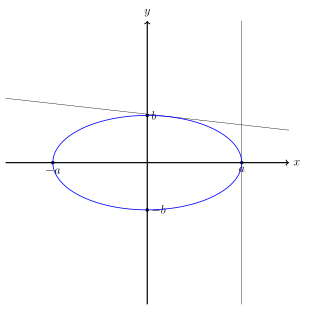
- We must have \(p\) and \(q\) are roots of \(0 = (a+X)bt^2-2aYt+b(a-X)\), ie \(pq = \frac{b(a-X)}{(a+X)b} \Rightarrow (a+X)pq = a-X\). Similarly \(p+q = \frac{2aY}{(a+X)b}\) Given that the tangents meet the \(y\)-axis at \((0, y_i)\) we must have \(abt^2-2ay_it + ab = 0\), so \begin{align*} && 0 &= abp^2-2ay_1p + ab \\ && 0 &= abq^2-2ay_2q + ab \\ \Rightarrow && y_1 &= \frac{ab(p^2+1)}{2ap} \\ && y_2 &= \frac{ab(q^2+1)}{2aq} \\ \Rightarrow && 2b &= \frac{ab(p^2+1)}{2ap} +\frac{ab(q^2+1)}{2aq} \\ &&&= \frac{ab(pq(p+q)+p+q)}{2apq} \\ \Rightarrow && 4pq &= pq(p+q)+p+q \\ \Rightarrow && 4 \frac{b(a-X)}{(a+X)b} &= \frac{2aY}{(a+X)b} \left ( \frac{b(a-X)}{(a+X)b} + 1 \right) \\ && &= \frac{2aY}{(a+X)b} \frac{2ab}{(a+X)b} \\ \Rightarrow && 4b^2(a^2-X^2) &= 4a^2bY \\ \Rightarrow && 1 &= \frac{Y}{b} + \frac{X^2}{a^2} \end{align*} as required.
2014 Paper 2 Q10
A particle is projected from a point \(O\) on horizontal ground with initial speed \(u\) and at an angle of \(\theta\) above the ground. The motion takes place in the \(x\)-\(y\) plane, where the \(x\)-axis is horizontal, the \(y\)-axis is vertical and the origin is \(O\). Obtain the Cartesian equation of the particle's trajectory in terms of \(u\), \(g\) and~\(\lambda\), where \(\lambda=\tan\theta\). Now consider the trajectories for different values of \(\theta\) with \(u\)~fixed. Show that for a given value of~\(x\), the coordinate~\(y\) can take all values up to a maximum value,~\(Y\), which you should determine as a function of \(x\), \(u\) and~\(g\). Sketch a graph of \(Y\) against \(x\) and indicate on your graph the set of points that can be reached by a particle projected from \(O\) with speed \(u\). Hence find the furthest distance from \(O\) that can be achieved by such a projectile.