Problems
Filters
2 problems found
2017 Paper 3 Q3
D: 1700.0
B: 1500.0
roots of polynomials
symmetric functions
quartic
cubic equation
Vieta's formulas
resolvent cubic
quadratic factorisation
Let \(\alpha\), \(\beta\), \(\gamma\) and \(\delta\) be the roots of the quartic equation \[ x^4 +px^3 +qx^2 +r x +s =0 \,. \] You are given that, for any such equation, \(\,\alpha \beta + \gamma\delta\,\), \(\alpha\gamma+\beta\delta\,\) and \(\,\alpha \delta + \beta\gamma\,\) satisfy a cubic equation of the form \[ y^3+Ay^2+ (pr-4s)y+ (4qs-p^2s -r^2) =0 \,. \] Determine \(A\). Now consider the quartic equation given by \(p=0\,\), \(q= 3\,\), \(r=-6\,\) and \(s=10\,\).
- Find the value of \(\alpha\beta + \gamma \delta\), given that it is the largest root of the corresponding cubic equation.
- Hence, using the values of \(q\) and \(s\), find the value of \((\alpha +\beta)(\gamma+\delta)\,\) and the value of \(\alpha\beta\) given that \(\alpha\beta >\gamma\delta\,\).
- Using these results, and the values of \(p\) and \(r\), solve the quartic equation.
Solution: \begin{align*} A &= -(\alpha \beta + \gamma\delta + \alpha\gamma+\beta\delta+\alpha \delta + \beta\gamma) \\ &= -q \end{align*}
- The corresponding cubic equation is: \begin{align*} && 0 &= y^3 - 3y^2-40y+(120-36) \\ &&&= y^3 -3y^2 - 40y + 84 \\ &&&= (y-7)(y-2)(y+6) \end{align*} Therefore \(\alpha\beta + \gamma \delta = 7\)
- \begin{align*}(\alpha+\beta)(\gamma+\delta) &= \alpha \gamma + \alpha \delta + \beta \gamma + \beta \delta \\ &= 3 -(\alpha\beta + \gamma\delta) \\ &=3-7 = -4 \end{align*} Let \(\alpha\beta\) and \(\gamma\delta\) be the roots of a quadratic; then the quadratic will be \(t^2-7t+10 = 0 \Rightarrow t = 2,5\) so \(\alpha\beta = 5\)
- \(\alpha\beta = 5, \gamma\delta = 2\) Consider the quadratic with roots \(\alpha+\beta\) and \(\gamma+\delta\), then \(t^2-4 = 0 \Rightarrow t = \pm 2\). Suppose \(\alpha+\beta = 2, \gamma+\delta=-2\) then \(\alpha, \beta = 1 \pm 2i, \gamma,\delta = -1 \pm i\) \(\alpha \beta \gamma + \beta\gamma\delta + \gamma\delta\alpha + \delta\alpha\beta = 5\gamma + 2\beta + 2\alpha + 5\delta = -6 \neq 6\) Suppose \(\alpha+\beta = -2, \gamma+\delta=2\) then \(\alpha, \beta = -1 \pm 2i, \gamma,\delta = 1 \pm i\) \(\alpha \beta \gamma + \beta\gamma\delta + \gamma\delta\alpha + \delta\alpha\beta = 5\gamma + 2\beta + 2\alpha + 5\delta = 6\), therefore these are there roots. (In some order): \(1 \pm i, -1 \pm 2i\)
1990 Paper 1 Q5
D: 1500.0
B: 1500.0
integration
partial fractions
definite integral
quadratic factorisation
curve sketching
stationary points
roots of equations
polynomial
inequality
- Evaluate \[ \int_{1}^{3}\frac{1}{6x^{2}+19x+15}\,\mathrm{d}x\,. \]
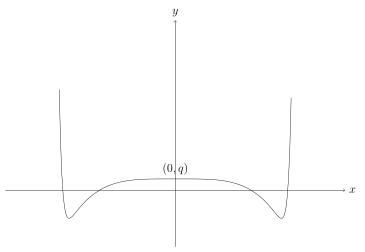
- Sketch the graph of the function \(\mathrm{f}\), where \(\mathrm{f}(x)=x^{1760}-x^{220}+q\), and \(q\) is a constant. Find the possible numbers of \textit{distinct }roots of the equation \(\mathrm{f}(x)=0\), and state the inequalities satisfied by \(q\).
Solution:
- \begin{align*} \int_{1}^{3}\frac{1}{6x^{2}+19x+15}\,\mathrm{d}x &= \int_1^3 \frac1{(2x+3)(3x+5)} \d x \\ &= \int_1^3 \l \frac{2}{2x+3} - \frac{3}{3x+5} \r \d x \\ &= \left [\ln(2x+3) - \ln(3x+5) \right ]_1^3 \\ &= \l \ln9 - \ln14 \r - \l \ln 5 - \ln 8 \r \\ &= \ln \frac{72}{70} \\ &= \ln \frac{36}{35} \end{align*}
- When \(q = 0\) the roots are \(-1, 0, 1\) There can be \(0, 2, 3, 4\) roots. There will be no roots if \(q > -\min (x^{1760} - x^{220})\) since the whole graph will be above the axis. There will be \(2\) roots if \(q = -\min (x^{1760} - x^{220})\) or \(q > 0\) There will be \(4\) roots if \(0 > q > -\min (x^{1760} - x^{220})\). There will be \(3\) roots if \(q =0\)