Problems
Filters
7 problems found
2024 Paper 2 Q5
- The functions \(\mathrm{f}_1\) and \(\mathrm{F}_1\), each with domain \(\mathbb{Z}\), are defined by \[ \mathrm{f}_1(n) = n^2 + 6n + 11, \] \[ \mathrm{F}_1(n) = n^2 + 2. \] Show that \(\mathrm{F}_1\) has the same range as \(\mathrm{f}_1\).
- The function \(\mathrm{g}_1\), with domain \(\mathbb{Z}\), is defined by \[ \mathrm{g}_1(n) = n^2 - 2n + 5. \] Show that the ranges of \(\mathrm{f}_1\) and \(\mathrm{g}_1\) have empty intersection.
- The functions \(\mathrm{f}_2\) and \(\mathrm{g}_2\), each with domain \(\mathbb{Z}\), are defined by \[ \mathrm{f}_2(n) = n^2 - 2n - 6, \] \[ \mathrm{g}_2(n) = n^2 - 4n + 2. \] Find any integers that lie in the intersection of the ranges of the two functions.
- Show that \(p^2 + pq + q^2 \geqslant 0\) for all real \(p\) and \(q\). The functions \(\mathrm{f}_3\) and \(\mathrm{g}_3\), each with domain \(\mathbb{Z}\), are defined by \[ \mathrm{f}_3(n) = n^3 - 3n^2 + 7n, \] \[ \mathrm{g}_3(n) = n^3 + 4n - 6. \] Find any integers that lie in the intersection of the ranges of the two functions.
Solution:
- \(\,\) \begin{align*} && f_1(n) &= n^2 + 6n + 11 \\ &&&= (n+3)^2 + 2 \\ &&&=F_1(n+3) \end{align*} Since \(n \mapsto n+3\) is a bijection on \(\mathbb{Z}\) both functions must have exactly the same range.
- \(g_1(n) = n^2-2n+5 = (n-1)^2 + 4\). Since squares are always \(0, 1 \pmod{4}\) it's impossible for \(f_1\) and \(g_1\) to take the same value therefore the ranges have empty intersection.
- \(\,\) \begin{align*} && f_2(n) &= n^2-2n - 6 \\ &&&= (n-1)^2-7 \\ && g_2(n) &= n^2-4n+2 \\ &&&= (n-2)^2 - 2 \end{align*} so suppose \(x^2 - 7 = y^2 - 2\) then \begin{align*} && x^2 - 7 &= y^2 -2 \\ \Rightarrow && 5 &= y^2 - x^2 \\ &&&= (y-x)(y+x) \end{align*} So we have cases: \(y-x = -5, y + x = -1 \Rightarrow y = -3\) and the output is \(7\) \(y-x=-1, y+x = -5 \Rightarrow y = -3\) same output \(y-x=1, y+x = 5 \Rightarrow y = 3\) same output \(y-x=5, y-x = 1 \Rightarrow y = 3\) same ouput.
- \begin{align*} && 0 &\leq \frac12(p^2+q^2)+\frac12(p+q)^2 \\ &&&= p^2 + q^2 + pq \end{align*} Looking at \(f_3\) we see \begin{align*} && f_3(n) &= n^3 - 3n^2 + 7n \\ &&&= (n-1)^3 -3n + 7n +1 \\ &&&= (n-1)^3 +4(n-1) -3 \\ &&&= g_3(n-1) + 3 \end{align*} So suppose we have two values which are equal, ie \begin{align*} && x^3 + 4x -3 &= y^3 +4y -6 \\ \Rightarrow && 3 &= y^3-x^3+4y-4x \\ &&&= (y-x)(y^2+xy+x^2+4) \end{align*} Since \(x^2+xy+y^2 \geq 0\) then the right hand factor is always a positive integer bigger than \(3\) and in particular there will be no solutions and hence no integers in the intersection of the ranges.
2024 Paper 3 Q8
- Explain why the equation \((y - x + 3)(y + x - 5) = 0\) represents a pair of straight lines with gradients \(1\) and \(-1\). Show further that the equation \[y^2 - x^2 + py + qx + r = 0\] represents a pair of straight lines with gradients \(1\) and \(-1\) if and only if \(p^2 - q^2 = 4r\).
- Explain why the coordinates of any point which lies on both of the curves \(C_1\) and \(C_2\) also satisfy the equation \[y^2 + 2sy + s(s+1) - x + k(y - x^2) = 0\] for any real number \(k\). Given that \(s\) is such that \(C_1\) and \(C_2\) intersect at four distinct points, show that choosing \(k = 1\) gives an equation representing a pair of straight lines, with gradients \(1\) and \(-1\), on which all four points of intersection lie.
- Show that if \(C_1\) and \(C_2\) intersect at four distinct points, then \(s < -\frac{3}{4}\).
- Show that if \(s < -\frac{3}{4}\), then \(C_1\) and \(C_2\) intersect at four distinct points.
2021 Paper 3 Q5
Two curves have polar equations \(r = a + 2\cos\theta\) and \(r = 2 + \cos 2\theta\), where \(r \geqslant 0\) and \(a\) is a constant.
- Show that these curves meet when \[ 2\cos^2\theta - 2\cos\theta + 1 - a = 0. \] Hence show that these curves touch if \(a = \tfrac{1}{2}\) and find the other two values of \(a\) for which the curves touch.
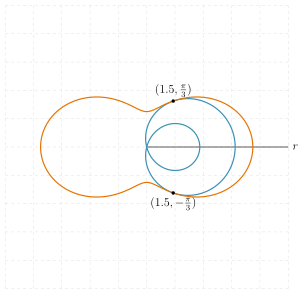
- Sketch the curves \(r = a + 2\cos\theta\) and \(r = 2 + \cos 2\theta\) on the same diagram in the case \(a = \tfrac{1}{2}\). Give the values of \(r\) and \(\theta\) at the points at which the curves touch and justify the other features you show on your sketch.
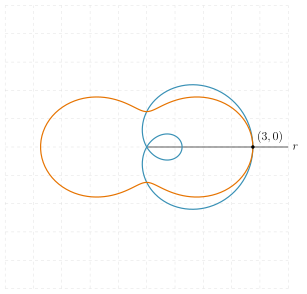
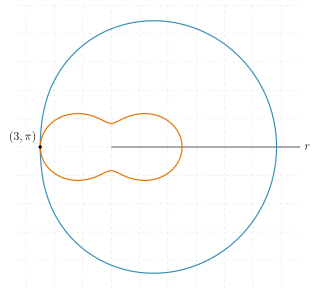
- On two further diagrams, one for each of the other two values of \(a\), sketch both the curves \(r = a + 2\cos\theta\) and \(r = 2 + \cos 2\theta\). Give the values of \(r\) and \(\theta\) at the points at which the curves touch and justify the other features you show on your sketch.
Solution:
- The curves meet when they have the same radius for a given \(\theta\) ie \begin{align*} && a + 2 \cos \theta &= 2 + \cos 2 \theta \\ &&&= 2 + 2\cos^2 \theta - 1 \\ \Rightarrow && 0 &= 2 \cos ^2 \theta - 2 \cos \theta + 1 - a \end{align*} The curves touch if this has a repeated root, ie \(0 = \Delta = 4 - 8(1-a) \Rightarrow a = \frac12\). The second way the curves can touch is if there is a single root, but it's at an extreme value of \(\cos \theta = \pm 1\) ie \(0 = 2 - 2\cdot(\pm1) + 1 - a \Rightarrow a = 3 \pm 2 = 1, 5\)
- Suppose \(a = \frac12\) then the curves touch when \(0 = 2\cos^2 \theta - 2 \cos \theta + \frac12 = (2 \cos \theta-1 )(\cos \theta -\frac12) \Rightarrow \theta = \pm \frac{\pi}{3}\)
- \(a = 1\)
\(a = 5\)
2014 Paper 1 Q9
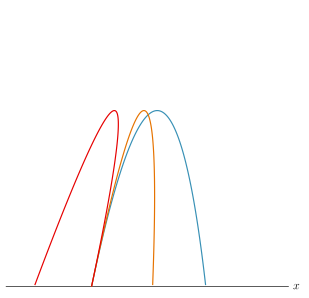
A particle of mass \(m\) is projected due east at speed \(U\) from a point on horizontal ground at an angle \(\theta\) above the horizontal, where \(0 < \theta < 90^\circ\). In addition to the gravitational force \(mg\), it experiences a horizontal force of magnitude \(mkg\), where \(k\) is a positive constant, acting due west in the plane of motion of the particle. Determine expressions in terms of \(U\), \(\theta\) and \(g\) for the time, \(T_H\), at which the particle reaches its greatest height and the time, \(T_L \), at which it lands. Let \(T = U\cos\theta /(kg)\). By considering the relative magnitudes of \(T_H\), \(T_L \) and \(T\), or otherwise, sketch the trajectory of the particle in the cases \(k\tan\theta<\frac12\), \(\frac12 < k\tan\theta<1\), and \(k\tan\theta>1\). What happens when \(k\tan\theta =1\)?
Solution: \begin{align*} && v_{\uparrow} &= U\sin \theta - g t \\ \Rightarrow && T_H &= \frac{U \sin \theta}{g} \\ \\ && s_{\uparrow} &= U \sin \theta t - \frac12 g t^2 \\ \Rightarrow && 0 &= U\sin \theta T_L - \frac12 g T_L^2 \\ && T_L &= \frac{2 U \sin \theta}{g} \end{align*} \(T = U\cos \theta / (kg)\) is the point when the particle's horizontal motion is reversed.
2010 Paper 3 Q4
- The number \(\alpha\) is a common root of the equations \(x^2 +ax +b=0\) and \(x^2+cx+d=0\) (that is, \(\alpha\) satisfies both equations). Given that \(a\ne c\), show that \[ \alpha =- \frac{b-d}{a-c}\,. \] Hence, or otherwise, show that the equations have at least one common root if and only if \[ (b-d)^2 -a(b-d)(a-c) + b(a-c)^2 =0\,. \] Does this result still hold if the condition \(a\ne c\) is not imposed?
- Show that the equations \(x^2+ax+b=0\) and \(x^3+(a+1)x^2+qx+r=0\) have at least one common root if and only if \[ (b-r)^2-a(b-r)(a+b-q) +b(a+b-q)^2=0\,. \] Hence, or otherwise, find the values of \(b\) for which the equations \(2x^2+5 x+2 b=0\) and \(2x^3+7x^2+5x+1=0\) have at least one common root.
Solution:
- \begin{align*} && 0 &= \alpha^2 + a \alpha + b \tag{1} \\ && 0 &= \alpha^2 + c \alpha + d \tag{2} \\ \\ (1) - (2): && 0 & =\alpha ( a-c) + (b-d) \\ \Rightarrow && \alpha &= - \frac{b-d}{a-c} \tag{\(a\neq c\)} \end{align*} (\(\Rightarrow\)) Suppose they have a common root, then given we know it's form, we must have: \begin{align*} && 0 &= \left ( - \frac{b-d}{a-c} \right)^2 +a\left ( - \frac{b-d}{a-c} \right) + b \\ \Rightarrow && 0 &= (b-d)^2 - a(b-d)(a-c) + b(a-c)^2 \end{align*} (\(\Leftarrow\)) Suppose the equation holds, then \begin{align*} && 0 &= (b-d)^2 - a(b-d)(a-c) + b(a-c)^2 \\ \Rightarrow && 0 &= \left ( - \frac{b-d}{a-c} \right)^2 +a\left ( - \frac{b-d}{a-c} \right) + b \\ \end{align*} So \(\alpha\) is a root of the first equation. Considering \((1) - (2)\) we must have that \(\alpha(a-c) +(b-d) = t\) (whatever the second equation is), but that value is clearly \(0\), therefore \(\alpha\) is a root of both equations. If \(a = c\) then the equation becomes \(0 = (b-d)^2\), ie the two equations are the same, therefore they must have common roots!
- \begin{align*} && 0 &= x^2+ax+b \tag{1} \\ && 0 &= x^3+(a+1)x^2+qx+r \tag{2} \\ \\ (2) - x(1) && 0 &= x^2 + (q-b)x + r \tag{3} \end{align*} Therefore if the equations have a common root, \((1)\) and \((3)\) have a common root, ie \((b-r)^2-a(b-r)(a-(q-b))+b(a-(q-b))^2 = 0\) which is exactly our condition. \(a = \frac52, q = \frac52, r = \frac12\) \begin{align*} && 0 &= \left (b-\frac12 \right)^2 - \frac52\left (b-\frac12\right) b + b^3 \\ &&&= b^2 -b + \frac14 - \frac52 b^2+\frac54b + b^3 \\ &&&= b^3 -\frac32 b^2 +\frac14 b + \frac14 \\\Rightarrow && 0 &= 4b^3 - 6b^2+b + 1 \\ &&&= (b-1)(4b^2-2b-1) \\ \Rightarrow && b &= 1, \frac{1 \pm \sqrt{5}}{4}\end{align*}
2008 Paper 2 Q1
A sequence of points \((x_1,y_1)\), \((x_2,y_2)\), \(\ldots\) in the cartesian plane is generated by first choosing \((x_1,y_1)\) then applying the rule, for \(n=1\), \(2\), \(\ldots\), \[ (x_{n+1}, y_{n+1}) = (x_n^2-y_n^2 +a, \; 2x_ny_n+b+2)\,, \] where \(a\) and \(b\) are given real constants.
- In the case \(a=1\) and \(b=-1\), find the values of \((x_1,y_1)\) for which the sequence is constant.
- Given that \((x_1,y_1) = (-1,1)\), find the values of \(a\) and \(b\) for which the sequence has period 2.
1997 Paper 2 Q11
A tennis player serves from height \(H\) above horizontal ground, hitting the ball downwards with speed \(v\) at an angle \(\alpha\) below the horizontal. The ball just clears the net of height \(h\) at horizontal distance \(a\) from the server and hits the ground a further horizontal distance \(b\) beyond the net. Show that $$v^2 = \frac{ g(a+b)^2(1+\tan^2\alpha)}{ 2[H-(a+b)\tan\alpha]}$$ and $$\tan\alpha = \frac{2a+b }{ a(a+b)}H - \frac{a+b }{ ab}h \,.$$ By considering the signs of \(v^2\) and \(\tan\alpha\), find upper and lower bounds on \(H\) for such a serve to be possible.
Solution: We have \begin{align*} \rightarrow: && a &= v\cos \alpha t_{net} \\ \Rightarrow && t_{net} &= \frac{a}{v \cos \alpha} \\ \downarrow: && H-h &= v\sin \alpha t_{net} + \frac12 g t_{net}^2 \\ &&&= a \tan \alpha + \frac12 g \frac{a^2}{v^2} \sec^2 \alpha \\ &&&= a \tan \alpha + \frac{a^2g}{2v^2}(1 + \tan^2 \alpha) \tag{*}\\ \\ \rightarrow: && a+b &= v \cos \alpha t_{ground} \\ && t_{ground} &= \frac{a+b}{v \cos \alpha}\\ \downarrow: && H &= v\sin \alpha t_{ground} + \frac12 g t_{ground}^2 \\ &&&= (a+b)\tan \alpha + \frac{(a+b)^2g}{2v^2}(1+\tan^2\alpha) \tag{**} \\ \\ (**): && v^2 &= \frac{g(a+b)^2(1+\tan^2\alpha)}{2[H-(a+b)\tan \alpha]} \\ (a+b)^2(*) - a^2(**): && (a+b)^2(H-h) -a^2H &= [(a+b)^2a - a^2(a+b)]\tan \alpha \\ \Rightarrow && (2ab+b^2)H - (a+b)^2h &= ab(a+b) \tan \alpha \\ \Rightarrow && \tan \alpha &= \frac{2a+b}{a(a+b)}H - \frac{a+b}{ab} h \end{align*} Noting that \(v^2 \geq 0\) and the numerator is positive, we must have \begin{align*} && H &> (a+b)\tan \alpha \\ &&&= \frac{2a+b}{a}H - \frac{(a+b)^2}{ab} h \\ \Rightarrow && \frac{a+b}{a}H &< \frac{(a+b)^2}{ab} h \\ \Rightarrow && H &< \frac{a+b}{b} h \end{align*} Noting that \(\tan \alpha > 0\) we must have \begin{align*} && \frac{2a+b}{a(a+b)} H & > \frac{a+b}{ab} h \\ \Rightarrow && H &> \frac{(a+b)^2}{b(2a+b)}h \end{align*}