Problems
Filters
6 problems found
2023 Paper 3 Q10
A thin uniform beam \(AB\) has mass \(3m\) and length \(2h\). End \(A\) rests on rough horizontal ground and the beam makes an angle of \(2\beta\) to the vertical, supported by a light inextensible string attached to end \(B\). The coefficient of friction between the beam and the ground at \(A\) is \(\mu\). The string passes over a small frictionless pulley fixed to a point \(C\) which is a distance \(2h\) vertically above \(A\). A particle of mass \(km\), where \(k < 3\), is attached to the other end of the string and hangs freely.
- Given that the system is in equilibrium, find an expression for \(k\) in terms of \(\beta\) and show that \(k^2 \leqslant \dfrac{9\mu^2}{\mu^2 + 1}\).
- A particle of mass \(m\) is now fixed to the beam at a distance \(xh\) from \(A\), where \(0 \leqslant x \leqslant 2\). Given that \(k = 2\), and that the system is in equilibrium, show that \[\frac{F^2}{N^2} = \frac{x^2 + 6x + 5}{4(x+2)^2}\,,\] where \(F\) is the frictional force and \(N\) is the normal reaction on the beam at \(A\). By considering \(\dfrac{1}{3} - \dfrac{F^2}{N^2}\), or otherwise, find the minimum value of \(\mu\) for which the beam can be in equilibrium whatever the value of \(x\).
2012 Paper 3 Q9
A pulley consists of a disc of radius \(r\) with centre \(O\) and a light thin axle through \(O\) perpendicular to the plane of the disc. The disc is non-uniform, its mass is \(M\) and its centre of mass is at \(O\). The axle is fixed and horizontal. Two particles, of masses \(m_1\) and \(m_2\) where \(m_1>m_2\), are connected by a light inextensible string which passes over the pulley. The contact between the string and the pulley is rough enough to prevent the string sliding. The pulley turns and the vertical force on the axle is found, by measurement, to be~\(P+Mg\).
- The moment of inertia of the pulley about its axle is calculated assuming that the pulley rotates without friction about its axle. Show that the calculated value is \[ \frac{((m_1 + m_2)P - 4m_1m_2g)r^2} {(m_1 + m_2)g - P}\,. \tag{\(*\)}\]
- Instead, the moment of inertia of the pulley about its axle is calculated assuming that a couple of magnitude \(C\) due to friction acts on the axle of the pulley. Determine whether this calculated value is greater or smaller than \((*)\). Show that \(C<(m_1-m_2)rg\).
2009 Paper 1 Q10
A triangular wedge is fixed to a horizontal surface. The base angles of the wedge are \(\alpha\) and \(\frac\pi 2-\alpha\). Two particles, of masses \(M\) and \(m\), lie on different faces of the wedge, and are connected by a light inextensible string which passes over a smooth pulley at the apex of the wedge, as shown in the diagram. The contacts between the particles and the wedge are smooth.
- Show that if \(\tan \alpha> \dfrac m M \) the particle of mass \(M\) will slide down the face of the wedge.
- Given that \(\tan \alpha = \dfrac{2m}M\), show that the magnitude of the acceleration of the particles is \[ \frac{g\sin\alpha}{\tan\alpha +2} \] and that this is maximised at \(4m^3=M^3\,\).
2006 Paper 3 Q11
A lift of mass \(M\) and its counterweight of mass \(M\) are connected by a light inextensible cable which passes over a fixed frictionless pulley. The lift is constrained to move vertically between smooth guides. The distance between the floor and the ceiling of the lift is \(h\). Initially, the lift is at rest, and the distance between the top of the lift and the pulley is greater than \(h\). A small tile of mass \(m\) becomes detached from the ceiling of the lift and falls to the floor of the lift. Show that the speed of the tile just before the impact is \[ \sqrt{\frac{(2M-m)gh \;}{M}}\;. \] The coefficient of restitution between the tile and the floor of the lift is \(e\). Given that the magnitude of the impulsive force on the lift due to tension in the cable is equal to the magnitude of the impulsive force on the counterweight due to tension in the cable, show that the loss of energy of the system due to the impact is \(mgh(1-e^2)\). Comment on this result.
1994 Paper 1 Q11
\(\,\)
- Find the condition which \(m,M\) and \(\theta\) must satisfy to ensure that the ball will fall to the ground. Assuming that this condition is satisfied, show that the velocity \(v\) of the ball when it hits the ground satisfies \[ v^{2}=\frac{2g(M-m\sin\theta)d\sin\theta}{M+m}. \]
- Find the condition which \(m,M\) and \(\theta\) must satisfy if the wagon is not to collide with the pulley at the top of the incline.
1989 Paper 2 Q11
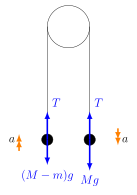
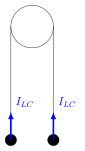
A lift of mass \(M\) and its counterweight of mass \(M\) are connected by a light inextensible cable which passes over a light frictionless pulley. The lift is constrained to move vertically between smooth guides. The distance between the floor and the ceiling of the lift is \(h\). Initially, the lift is at rest, and the distance between the top of the lift and the pulley is greater than \(h\). A small tile of mass \(m\) becomes detached from the ceiling of the lift. Show that the time taken for it to fall to the floor is \[ t=\sqrt{\frac{\left(2M-m\right)h}{Mg}}. \] The collision between the tile and the lift floor is perfectly inelastic. Show that the lift is reduced to rest by the collision, and that the loss of energy of the system is \(mgh\). Note: the question on the STEP database is \[ t=\sqrt{\frac{2\left(M-m\right)h}{Mg}}. \]
Solution: