Problems
Filters
137 problems found
2025 Paper 2 Q2
- Show that if the complex number \(z\) satisfies the equation \[z^2 + |z + b| = a,\] where \(a\) and \(b\) are real numbers, then \(z\) must be either purely real or purely imaginary.
- Show that the equation \[z^2 + \left|z + \frac{5}{2}\right| = \frac{7}{2}\] has no purely imaginary roots.
- Show that the equation \[z^2 + \left|z + \frac{7}{2}\right| = \frac{5}{2}\] has no purely real roots.
- Show that, when \(\frac{1}{2} < b < \frac{3}{4}\), the equation \[z^2 + |z + b| = \frac{1}{2}\] will have at least one purely imaginary root and at least one purely real root.
- Solve the equation \[z^3 + |z + 2|^2 = 4.\]
Solution:
- Suppose \(z^2 + |z + b| = a\), then \(z^2 = a- |z + b| \in \mathbb{R}\), since \(a \in \mathbb{R}\). Since the square root of a real number is either purely real or purely imaginary, \(z\) is purely real or purely imaginary.
- Suppose \(z = it\) for some \(t \in \mathbb{R}\), then \begin{align*} && \frac72 &= -t^2 +\sqrt{t^2 + \frac{25}{4}} \\ \Rightarrow && \left ( \frac72 + t^2\right)^2 &= t^2 + \frac{25}{4} \\ \Rightarrow && t^4 + 7t^2 + \frac{49}{4} &= t^2 + \frac{25}{4} \\ \Rightarrow && t^4 + 6t^2 + 6 &= 0 \end{align*} but since \(\Delta = 6^2 - 4 \cdot 1 \cdot 6 < 0\) there are no real solutions.
- Suppose \(z = t\) for some \(t \in \mathbb{R}\), then either \(t^2 + t + \frac72 = \frac52 \Rightarrow t^2 + t + 1 = 0\) (no solutions) or \(t^2 - t - \frac72 = \frac52 \Rightarrow t^2 - t - 6 = (t-3)(t+2) = 0\). When \(t = 3\) then we must take the positive part for \(|z + \frac72|\) so this cannot work. When \(t = -2\) we also have \(\frac72-2 > 0\) so we are still taking the positive part. Hence no solutions
- Suppose \(\frac{1}{2} < b < \frac{3}{4}\), the equation then consider \(z^2 + |z + b| = \frac{1}{2}\). Case 1: \(z = t \in \mathbb{R}\), then we have two cases: Case 1a: \(z+b > 0\). \(z^2 + z + b = \frac12 \Rightarrow z = \frac{-1 \pm \sqrt{1-4b+2}}{2}\) which clearly is a valid real number an \(z + b > 0\). Case 1b: \(z+b < 0\) \(z^2 - z - b = \frac12 \Rightarrow z = \frac{1 \pm \sqrt{1+4b-2}}{2}\)
- Let \(\omega\) be a (primitive) cube root of unity. \begin{align*} && z^3 &= 4 - |z+2|^2 \\ \Rightarrow && z &\in \mathbb{R} \cup \omega \mathbb{R} \cup \omega^2 \mathbb{R} \end{align*} Case 1:
2025 Paper 2 Q8
If we split a set \(S\) of integers into two subsets \(A\) and \(B\) whose intersection is empty and whose union is the whole of \(S\), and such that
- the sum of the elements of \(A\) is equal to the sum of the elements of \(B\)
- and the sum of the squares of the elements of \(A\) is equal to the sum of the squares of the elements of \(B\),
- Find a balanced partition of the set \(\{1, 2, 3, 4, 5, 6, 7, 8\}\) into two subsets \(A\) and \(B\), each of size 4.
- Given that \(a_1, a_2, \ldots, a_m\) and \(b_1, b_2, \ldots, b_m\) are sequences with \[\sum_{k=1}^m a_k = \sum_{k=1}^m b_k \quad \text{and} \quad \sum_{k=1}^m a_k^2 = \sum_{k=1}^m b_k^2,\] show that \[\sum_{k=1}^m a_k^3 + \sum_{k=1}^m (c + b_k)^3 = \sum_{k=1}^m b_k^3 + \sum_{k=1}^m (c + a_k)^3\] for any real number \(c\).
- Find, with justification, a balanced partition of the set \(\{1, 2, 3, \ldots, 16\}\) into two subsets \(A\) and \(B\), each of size 8, which also has the property that
- the sum of the cubes of the elements of \(A\) is equal to the sum of the cubes of the elements of \(B\).
- You are given that the sets \(A = \{1, 3, 4, 5, 9, 11\}\) and \(B = \{2, 6, 7, 8, 10\}\) form a balanced partition of the set \(\{1, 2, 3, \ldots, 11\}\).
Let \(S = \{n^2, (n+1)^2, (n+2)^2, \ldots, (n+11)^2\}\), where \(n\) is any positive integer. Find, with justification, two subsets \(C\) and \(D\) of \(S\) whose intersection is empty and whose union is the whole of \(S\), and such that
- the sum of the elements of \(C\) is equal to the sum of the elements of \(D\).
Solution:
- \(A = \{1,4,6,7 \}, B = \{2,3,5,8 \}\)
- \begin{align*} && \sum_{k=1}^m a_k^3 + \sum_{k=1}^m (c + b_k)^3 &= \sum_{k=1}^m a_k^3 + mc^3 + 3c^2 \sum_{k=1}^m b_k + 3c \sum_{k=1}^m b_k^2 + \sum_{k=1}^m b_k^3 \\ &&&= \sum_{k=1}^m a_k^3 + mc^3 + 3c^2 \sum_{k=1}^m a_k + 3c \sum_{k=1}^m a_k^2 + \sum_{k=1}^m b_k^3 \\ &&&= \sum_{k=1}^m a_k^3 + 3c \sum_{k=1}^m a_k^2+ 3c^2 \sum_{k=1}^m a_k + mc^3 + \sum_{k=1}^m b_k^3 \\ &&&= \sum_{k=1}^m (a_k+c)^3 + \sum_{k=1}^m b_k^3 \end{align*}
- Note that \begin{align*} && \sum_{k=1}^m a_k^2 + \sum_{k=1}^m (c + b_k)^2 &= \sum_{k=1}^m a_k^2 + mc^2 + 2c \sum_{k=1}^m b_k +\sum_{k=1}^m b_k^2 \\ &&&= \sum_{k=1}^m (a_k+c)^2 + \sum_{k=1}^m b_k^2 \end{align*} Therefore if we take our balanced subsets of \(\{1,2,3,4,5,6,7,8\}\) and take \(A \cup (B+8)\) and \(B \cup (A+8)\) they will be balanced (including the cubes) so: \(A = \{1,4,6,7,10,11,13,16\}, B = \{2,3,5,8,9,12,14,15\}\)
- Notice that: \begin{align*} \sum_{a \in A} (n+a)^2 &= |A|n^2 + 2n \sum_{a \in A} a + \sum_{a \in A} a^2 \\ &= 6 n^2 + 2n \sum_{b \in B}b + \sum_{b \in B} b^2 \\ &= n^2 + \sum_{b \in B}(n+b)^2 \\ \end{align*} Therefore consider the sets \(C = \{(n+i)^2 : i \in A\}, D = \{n^2\} \cup \{(n+i)^2 : i \in B\}\)
2024 Paper 2 Q1
In the equality \[ 4 + 5 + 6 + 7 + 8 = 9 + 10 + 11, \] the sum of the five consecutive integers from 4 upwards is equal to the sum of the next three consecutive integers. Throughout this question, the variables \(n\), \(k\) and \(c\) represent positive integers.
- Show that the sum of the \(n + k\) consecutive integers from \(c\) upwards is equal to the sum of the next \(n\) consecutive integers if and only if \[ 2n^2 + k = 2ck + k^2. \]
- Find the set of possible values of \(n\), and the corresponding values of \(c\), in each of the cases
- \(k = 1\)
- \(k = 2\).
- Show that there are no solutions for \(c\) and \(n\) if \(k = 4\).
- Consider now the case where \(c = 1\).
- Find two possible values of \(k\) and the corresponding values of \(n\).
- Show, given a possible value \(N\) of \(n\), and the corresponding value \(K\) of \(k\), that \[ N' = 3N + 2K + 1 \] will also be a possible value of \(n\), with \[ K' = 4N + 3K + 1 \] as the corresponding value of \(k\).
- Find two further possible values of \(k\) and the corresponding values of \(n\).
Solution:
- Suppose the sum of the \(n + k\) consecutive integers from \(c\) upwards is equal to the sum of the next \(n\) consecutive integers then \begin{align*} && \sum_{i=c}^{i=c+n+k-1} i &= \sum_{i=c+n+k}^{c+2n+k-1} i \\ \Leftrightarrow && \frac{(c+n+k-1)(c+n+k)}{2} - \frac{(c-1)c}{2} &= \frac{(c+2n+k-1)(c+2n+k)}{2} - \frac{(c+n+k-1)(c+n+k)}{2} \\ \Leftrightarrow && 2(c+n+k-1)(c+n+k) &= (c+2n+k-1)(c+2n+k) + c(c-1) \\ \Leftrightarrow && 2c^2+4cn+4ck+2n^2+4kn+2k^2-2c-2n-2k&=2c^2+4cn+2ck+4n^2+4nk+k^2-2c-2n-k \\ \Leftrightarrow && 2ck+k^2&=2n^2+k \\ \end{align*}
- If \(k=1\) then \begin{align*} && 2n^2 + 1 &= 2c + 1 \\ \Rightarrow && c &= n^2 \end{align*} So \(n\) can take any value and \(c = n^2\)
- If \(k=2\) then \begin{align*} && 2n^2+2&= 4c+4 \\ \Rightarrow && n^2-1 &=2c \end{align*} So \(n\) must be odd, and \(c = \frac12(n^2-1)\)
- Suppose \(k=4\) then \(2n^2+4 = 8c+16\) or \(n^2-6 = 4c\) but then the left hand side is \(2, 3 \pmod{4}\) which is a contradiction.
- Suppose \(c =1\)
- Since \(2n^2+k = 2k + k^2\) or \(2n^2 = k^2+k\) we can have \(k = 1, n = 1\) or \(k = 8, n = 6\)
- Suppose \(2N^2 = K^2 + K\) then consider \begin{align*} && 2(N')^2 &= 2(3N+2K+1)^2 \\ &&&= 2(9N^2+4K^2+1+12NK+6N+4K) \\ &&&= 18N^2+8K^2+24NK+12N+8K+2 \\ && (K')^2+K' &= (4N+3K+1)^2 + (4N+3K+1) \\ &&&= 16N^2 + 9K^2+1+24NK+12N+9K+1 \\ &&&= 16N^2+9K^2+24NK+12N+9K+2 \\ \Rightarrow && 2(N')^2-(K')^2-K' &= 2N^2-K^2-K \\ &&&= 0 \end{align*} as required.
- So consider \((k,n) = (1,1), (8,6), (49, 35), (288,204)\)
2024 Paper 2 Q4
In this question, if \(O\), \(C\) and \(D\) are non-collinear points in three dimensional space, we will call the non-zero vector \(\mathbf{v}\) a \emph{bisecting vector} for angle \(COD\) if \(\mathbf{v}\) lies in the plane \(COD\), the angle between \(\mathbf{v}\) and \(\overrightarrow{OC}\) is equal to the angle between \(\mathbf{v}\) and \(\overrightarrow{OD}\), and both angles are less than \(90^\circ\).
- Let \(O\), \(X\) and \(Y\) be non-collinear points in three-dimensional space, and define \(\mathbf{x} = \overrightarrow{OX}\) and \(\mathbf{y} = \overrightarrow{OY}\).
Let \(\mathbf{b} = |\mathbf{x}|\mathbf{y} + |\mathbf{y}|\mathbf{x}\).
- Show that \(\mathbf{b}\) is a bisecting vector for angle \(XOY\). Explain, using a diagram, why any other bisecting vector for angle \(XOY\) is a positive multiple of \(\mathbf{b}\).
- Find the value of \(\lambda\) such that the point \(B\), defined by \(\overrightarrow{OB} = \lambda\mathbf{b}\), lies on the line \(XY\). Find also the ratio in which the point \(B\) divides \(XY\).
- Show, in the case when \(OB\) is perpendicular to \(XY\), that the triangle \(XOY\) is isosceles.
- Let \(O\), \(P\), \(Q\) and \(R\) be points in three-dimensional space, no three of which are collinear. A bisecting vector is chosen for each of the angles \(POQ\), \(QOR\) and \(ROP\). Show that the three angles between them are either all acute, all obtuse or all right angles.
2024 Paper 3 Q5
In this question, \(\mathbf{M}\) and \(\mathbf{N}\) are non-singular \(2 \times 2\) matrices. The \emph{trace} of the matrix \(\mathbf{M} = \begin{pmatrix} a & b \\ c & d \end{pmatrix}\) is defined as \(\operatorname{tr}(\mathbf{M}) = a + d\).
- Prove that, for any two matrices \(\mathbf{M}\) and \(\mathbf{N}\), \(\operatorname{tr}(\mathbf{MN}) = \operatorname{tr}(\mathbf{NM})\) and derive an expression for \(\operatorname{tr}(\mathbf{M}+\mathbf{N})\) in terms of \(\operatorname{tr}(\mathbf{M})\) and \(\operatorname{tr}(\mathbf{N})\).
- Show that \[\frac{1}{\det \mathbf{M}} \frac{\mathrm{d}}{\mathrm{d}t}(\det \mathbf{M}) = \operatorname{tr}\!\left(\mathbf{M}^{-1} \frac{\mathrm{d}\mathbf{M}}{\mathrm{d}t}\right).\]
- In this part, matrix \(\mathbf{M}\) satisfies the differential equation \[\frac{\mathrm{d}\mathbf{M}}{\mathrm{d}t} = \mathbf{MN} - \mathbf{NM},\] where the entries in matrix \(\mathbf{N}\) are also functions of \(t\). Show that \(\det \mathbf{M}\), \(\operatorname{tr}(\mathbf{M})\) and \(\operatorname{tr}(\mathbf{M}^2)\) are independent of \(t\). In the case \(\mathbf{N} = \begin{pmatrix} t & t \\ 0 & t \end{pmatrix}\), and given that \(\mathbf{M} = \begin{pmatrix} A & B \\ C & D \end{pmatrix}\) when \(t = 0\), find \(\mathbf{M}\) as a function of \(t\).
- In this part, matrix \(\mathbf{M}\) satisfies the differential equation \[\frac{\mathrm{d}\mathbf{M}}{\mathrm{d}t} = \mathbf{MN},\] where the entries in matrix \(\mathbf{N}\) are again functions of \(t\). The trace of \(\mathbf{M}\) is non-zero and independent of \(t\). Is it necessarily true that \(\operatorname{tr}(\mathbf{N}) = 0\)?
2023 Paper 2 Q3
Let \(\mathrm{p}(x)\) be a polynomial of degree \(n\) with \(\mathrm{p}(x) > 0\) for all \(x\) and let \[\mathrm{q}(x) = \sum_{k=0}^{n} \mathrm{p}^{(k)}(x)\,,\] where \(\mathrm{p}^{(k)}(x) \equiv \dfrac{\mathrm{d}^k \mathrm{p}(x)}{\mathrm{d}x^k}\) for \(k \geqslant 1\) and \(\mathrm{p}^{(0)}(x) \equiv \mathrm{p}(x)\).
- Explain why \(n\) must be even and show that \(\mathrm{q}(x)\) takes positive values for some values of \(x\).
- Show that \(\mathrm{q}'(x) = \mathrm{q}(x) - \mathrm{p}(x)\).
- In this part you will be asked to show the same result in three different ways.
- Show that the curves \(y = \mathrm{p}(x)\) and \(y = \mathrm{q}(x)\) meet at every stationary point of \(y = \mathrm{q}(x)\). Hence show that \(\mathrm{q}(x) > 0\) for all \(x\).
- Show that \(\mathrm{e}^{-x}\mathrm{q}(x)\) is a decreasing function. Hence show that \(\mathrm{q}(x) > 0\) for all \(x\).
- Show that \[\int_0^{\infty} \mathrm{p}(x+t)\mathrm{e}^{-t}\,\mathrm{d}t = \mathrm{p}(x) + \int_0^{\infty} \mathrm{p}^{(1)}(x+t)\mathrm{e}^{-t}\,\mathrm{d}t\,.\] Show further that \[\int_0^{\infty} \mathrm{p}(x+t)\mathrm{e}^{-t}\,\mathrm{d}t = \mathrm{q}(x)\,.\] Hence show that \(\mathrm{q}(x) > 0\) for all \(x\).
2023 Paper 2 Q7
- The complex numbers \(z\) and \(w\) have real and imaginary parts given by \(z = a + \mathrm{i}b\) and \(w = c + \mathrm{i}d\). Prove that \(|zw| = |z||w|\).
- By considering the complex numbers \(2 + \mathrm{i}\) and \(10 + 11\mathrm{i}\), find positive integers \(h\) and \(k\) such that \(h^2 + k^2 = 5 \times 221\).
- Find positive integers \(m\) and \(n\) such that \(m^2 + n^2 = 8045\).
- You are given that \(102^2 + 201^2 = 50805\). Find positive integers \(p\) and \(q\) such that \(p^2 + q^2 = 36 \times 50805\).
- Find three distinct pairs of positive integers \(r\) and \(s\) such that \(r^2 + s^2 = 25 \times 1002082\) and \(r < s\).
- You are given that \(109 \times 9193 = 1002037\). Find positive integers \(t\) and \(u\) such that \(t^2 + u^2 = 9193\).
2023 Paper 3 Q7
- Let \(\mathrm{f}\) be a continuous function defined for \(0 \leqslant x \leqslant 1\). Show that \[\int_0^1 \mathrm{f}(\sqrt{x})\,\mathrm{d}x = 2\int_0^1 x\,\mathrm{f}(x)\,\mathrm{d}x\,.\]
- Let \(\mathrm{g}\) be a continuous function defined for \(0 \leqslant x \leqslant 1\) such that \[\int_0^1 \big(\mathrm{g}(x)\big)^2\,\mathrm{d}x = \int_0^1 \mathrm{g}(\sqrt{x})\,\mathrm{d}x - \frac{1}{3}\,.\] Show that \(\displaystyle\int_0^1 \big(\mathrm{g}(x) - x\big)^2\,\mathrm{d}x = 0\) and explain why \(\mathrm{g}(x) = x\) for \(0 \leqslant x \leqslant 1\).
- Let \(\mathrm{h}\) be a continuous function defined for \(0 \leqslant x \leqslant 1\) with derivative \(\mathrm{h}'\) such that \[\int_0^1 \big(\mathrm{h}'(x)\big)^2\,\mathrm{d}x = 2\mathrm{h}(1) - 2\int_0^1 \mathrm{h}(x)\,\mathrm{d}x - \frac{1}{3}\,.\] Given that \(\mathrm{h}(0) = 0\), find \(\mathrm{h}\).
- Let \(\mathrm{k}\) be a continuous function defined for \(0 \leqslant x \leqslant 1\) and \(a\) be a real number, such that \[\int_0^1 \mathrm{e}^{ax}\big(\mathrm{k}(x)\big)^2\,\mathrm{d}x = 2\int_0^1 \mathrm{k}(x)\,\mathrm{d}x + \frac{\mathrm{e}^{-a}}{a} - \frac{1}{a^2} - \frac{1}{4}\,.\] Show that \(a\) must be equal to \(2\) and find \(\mathrm{k}\).
2022 Paper 3 Q5
- Show that \[ \int_{-a}^{a} \frac{1}{1+\mathrm{e}^x}\,\mathrm{d}x = a \quad \text{for all } a \geqslant 0. \]
- Explain why, if \(\mathrm{g}\) is a continuous function and \[ \int_0^a \mathrm{g}(x)\,\mathrm{d}x = 0 \quad \text{for all } a \geqslant 0, \] then \(\mathrm{g}(x) = 0\) for all \(x \geqslant 0\). Let \(\mathrm{f}\) be a continuous function with \(\mathrm{f}(x) \geqslant 0\) for all \(x\). Show that \[ \int_{-a}^{a} \frac{1}{1+\mathrm{f}(x)}\,\mathrm{d}x = a \quad \text{for all } a \geqslant 0 \] if and only if \[ \frac{1}{1+\mathrm{f}(x)} + \frac{1}{1+\mathrm{f}(-x)} - 1 = 0 \quad \text{for all } x \geqslant 0, \] and hence if and only if \(\mathrm{f}(x)\mathrm{f}(-x) = 1\) for all \(x\).
- Let \(\mathrm{f}\) be a continuous function such that, for all \(x\), \(\mathrm{f}(x) \geqslant 0\) and \(\mathrm{f}(x)\mathrm{f}(-x) = 1\). Show that, if \(\mathrm{h}\) is a continuous function with \(\mathrm{h}(x) = \mathrm{h}(-x)\) for all \(x\), then \[ \int_{-a}^{a} \frac{\mathrm{h}(x)}{1+\mathrm{f}(x)}\,\mathrm{d}x = \int_0^a \mathrm{h}(x)\,\mathrm{d}x\,. \]
- Hence find the exact value of \[ \int_{-\frac{1}{2}\pi}^{\frac{1}{2}\pi} \frac{\mathrm{e}^{-x}\cos x}{\cosh x}\,\mathrm{d}x\,. \]
Solution:
- \(\,\) \begin{align*} && I &= \int_{-a}^a \frac{1}{1+e^x} \d x \\ &&&= \int_{-a}^a \frac{e^{-x}}{e^{-x}+1} \d x \\ &&&= \left [ -\ln(1 + e^{-x} ) \right ]_{-a}^a \\ &&&= \ln(1 + e^a) - \ln(1 + e^{-a}) \\ &&&= \ln \left ( \frac{1+e^a}{1+e^{-a}} \right) \\ &&&= \ln \left ( e^a \frac{1+e^a}{e^a+1} \right) \\ &&& = a \end{align*}
- Suppose \(g\) is continuous and \(\int_0^a g(x) \d x = 0\) for all \(a \geq 0\) then \(g(x) = 0\) for all \(x\). Proof: Differentiate with respect to \(a\) to obtain \(g(a) = 0\) for all \(a\) as required. \begin{align*} && a &= \int_{-a}^a \frac{1}{1+ f(x)} \d x \\ \Leftrightarrow && 1 &= \frac{1}{1 + f(a)} + \frac{1}{1 + f(-a)} \tag{FTC} \\ \Leftrightarrow && (1+f(x))(1+f(-x)) &= 2+f(-x) + f(x) \\ \Leftrightarrow && f(x) f(-x) & = 1 \end{align*}
- \(\,\) \begin{align*} && J &= \int_{-a}^a \frac{h(x)}{1 + f(x)} \d x \\ y = - x: &&&=\int_{-a}^a \frac{h(-y)}{1 + f(-y)} \d y \\ &&&= \int_{-a}^a \frac{h(y)}{1 + f(-y)} \d y \\ \Rightarrow && 2J &= \int_{-a}^a h(x) \left ( \frac{1}{1+f(x)} + \frac{1}{1+f(-x)} \right) \d x \\ &&&= \int_{-a}^a h(x) \d x \\ &&&= \int_{-a}^0 h(x) \d x + \int_0^a h(x) \d x\\ &&&= \int_0^a h(-x) \d x + \int_0^a h(x) \d x \\ &&&= 2 \int_0^a h(x) \d x \\ \Rightarrow && J &= \int_0^a h(x) \d x \end{align*}
- First notice that \(h(x) = \cos x = h(-x)\). Also notice that if \(f(x) = e^{2x}\) then \(f(x)f(-x) = 1\) so \begin{align*} && K &= \int_{-\frac12 \pi}^{\frac12\pi} \frac{e^{-x}\cos x}{\cosh x} \d x \\ &&&= \int_{-\frac12 \pi}^{\frac12\pi} \frac{2h(x)}{1+f(x)} \d x \\ &&&= 2 \int_0^{\frac12 \pi} h(x) \d x \\ &&&= 2 \int_0^{\frac12 \pi} \cos x \d x \\ &&&= 2 \end{align*}
2021 Paper 2 Q1
Prove, from the identities for \(\cos(A \pm B)\), that \[ \cos a \cos 3a \equiv \tfrac{1}{2}(\cos 4a + \cos 2a). \] Find a similar identity for \(\sin a \cos 3a\).
- Solve the equation \[ 4\cos x \cos 2x \cos 3x = 1 \] for \(0 \leqslant x \leqslant \pi\).
- Prove that if \[ \tan x = \tan 2x \tan 3x \tan 4x \qquad (\dagger) \] then \(\cos 6x = \tfrac{1}{2}\) or \(\sin 4x = 0\). Hence determine the solutions of equation \((\dagger)\) with \(0 \leqslant x \leqslant \pi\).
Solution: \begin{align*} && \cos(A \pm B) &= \cos A \cos B \mp \sin A \sin B \\ A = a, B = 3a&& \cos 4a + \cos 2a &= 2\cos 3a \cos a \\ \Rightarrow && \cos a \cos 3a &= \tfrac12(\cos 4a + \cos 2a) \\ \\ && \sin(A \pm B) &= \sin A \cos B \pm \cos A \sin B \\ && \sin 4a + \sin(- 2a) &= 2 \sin a \cos 3a \\ \Rightarrow && \sin a \cos 3a &= \tfrac12 (\sin 4a - \sin 2a) \end{align*}
- \(\,\) \begin{align*} && 1 &= 4 \cos x \cos 2x \cos 3x \\ &&&= 2(\cos 4x +\cos 2x)\cos 2x \\ c = \cos 2x:&&&= 2(2c^2-1+c)c \\ \Rightarrow && 0 &= 4c^3+2c^2-2c-1 \\ &&&= (2c+1)(2c^2-1) \\ \Rightarrow && \cos 2x &= -\frac12 \\ \Rightarrow && x &= \frac{\pi}{3}, \frac{2\pi}{3} \\ && \cos 2x &= \pm \frac1{\sqrt2} \\ \Rightarrow && x&= \frac{\pi}{8}, \frac{3\pi}{8}, \frac{5\pi}{8}, \frac{7\pi}{8} \end{align*}
- \(\,\) \begin{align*} && \tan x &= \tan 2x \tan 3x \tan 4x \\ \Rightarrow &&1 &= \frac{\cos x\sin 2x \sin 3x \sin 4x}{\sin x \cos 2x \cos 3x \cos 4x} \\ &&&= \frac{\sin 2x \sin 4x (\sin4 x + \sin 2x)}{\cos 2x \cos 4x (\sin 4x - \sin 2x)} \\ &&&= \frac{(\cos 2x - \cos 6x) (\sin4 x + \sin 2x)}{(\cos 6x + \cos 2x) (\sin 4x - \sin 2x)} \\ \Rightarrow && 0 &= 2\cos 6x \sin 4x - 2\cos 2x \sin 2 x\\ &&&= \sin 4 x (2 \cos 6x - 1) \\ \Rightarrow && \sin 4x &= 0 \\ \text{ or }&& \cos 6x &= \frac12 \end{align*} \(\sin 4x = 0 \Rightarrow x = 0, \frac{\pi}{4}, \frac{\pi}{2}, \frac{3\pi}{4}, \pi\) \(\cos 6x = \frac12 \Rightarrow x = \frac{\pi}{18}, \frac{5\pi}{18},\frac{7\pi}{18}, \frac{11\pi}{18}, \frac{13\pi}{18}, \frac{17\pi}{18}\). We should verify these work, since not all of them will, especially where \(\sin 4x = 0\), so our final answer is \(x = 0, \pi, \frac{\pi}{18}, \frac{5\pi}{18},\frac{7\pi}{18}, \frac{11\pi}{18}, \frac{13\pi}{18}, \frac{17\pi}{18}\)
2021 Paper 2 Q7
- The matrix \(\mathbf{R}\) represents an anticlockwise rotation through angle \(\varphi\) (\(0^\circ \leqslant \varphi < 360^\circ\)) in two dimensions, and the matrix \(\mathbf{R} + \mathbf{I}\) also represents a rotation in two dimensions. Determine the possible values of \(\varphi\) and deduce that \(\mathbf{R}^3 = \mathbf{I}\).
- Let \(\mathbf{S}\) be a real matrix with \(\mathbf{S}^3 = \mathbf{I}\), but \(\mathbf{S} \neq \mathbf{I}\). Show that \(\det(\mathbf{S}) = 1\). Given that \[ \mathbf{S} = \begin{pmatrix} a & b \\ c & d \end{pmatrix} \] show that \(\mathbf{S}^2 = (a+d)\mathbf{S} - \mathbf{I}\). Hence prove that \(a + d = -1\).
- Let \(\mathbf{S}\) be a real \(2 \times 2\) matrix. Show that if \(\mathbf{S}^3 = \mathbf{I}\) and \(\mathbf{S} + \mathbf{I}\) represents a rotation, then \(\mathbf{S}\) also represents a rotation. What are the possible angles of the rotation represented by \(\mathbf{S}\)?
2020 Paper 2 Q4
- Given that \(a\), \(b\) and \(c\) are the lengths of the sides of a triangle, explain why \(c < a + b\), \(a < b + c\) and \(b < a + c\).
- Use a diagram to show that the converse of the result in part (i) also holds: if \(a\), \(b\) and \(c\) are positive numbers such that \(c < a + b\), \(a < b + c\) and \(b < c + a\) then it is possible to construct a triangle with sides of length \(a\), \(b\) and \(c\).
- When \(a\), \(b\) and \(c\) are the lengths of the sides of a triangle, determine in each case whether the following sets of three lengths can
- always
- sometimes but not always
- never
- Let \(\mathrm{f}\) be a function defined on the positive real numbers and such that, whenever \(x > y > 0\), \[\mathrm{f}(x) > \mathrm{f}(y) > 0 \quad \text{but} \quad \frac{\mathrm{f}(x)}{x} < \frac{\mathrm{f}(y)}{y}.\] Show that, whenever \(a\), \(b\) and \(c\) are the lengths of the sides of a triangle, then \(\mathrm{f}(a)\), \(\mathrm{f}(b)\) and \(\mathrm{f}(c)\) can also be the lengths of the sides of a triangle.
Solution:
- Not that unless a side is the largest side, it is clearly shorter than the sum of the other two sides (since it's greater than or equal to one on its own). Note also that the distance from one vertex to the other (say \(c\)) is shorter than going via the other vertex \(a+b\), therefore \(c < a+b\).
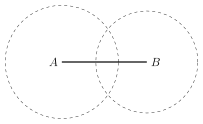
- Draw a line of the length of the largest number, say \(c\), then since \(c < a+b\) we must have circles radius \(a\) and \(b\) at the endpoints cross, and at their intersection we have a vertex of a \(c\)-\(a\)-\(b\) triangle.
- (A) always. Suppose \(c\) is the longest side, then \(c < a+b \Rightarrow c+1 < a + 1 + b+1\) so \((a+1,b+1,c+1)\) are still sides of a triangle. (B) sometimes, but not always. \((1,1,1) \to (1,1,1)\) is still a triangle, but \((10, 10, 1) \to (1, 10, \frac{1}{10})\) is not a triangle since \(10 > 1 + \frac{1}{10}\) (C) never, suppose \(a \leq b \leq c\) then the sides are \(b-a, c-b, c-a\) but \(c-a = (c-b)+(b-a)\) so the triangle inequality cannot be satisfied. (D) always - without loss of generality let \(c\) be the longest side, and since every term is homogeneous degree \(2\) we can divide through by \(c^2\) to see we have the sides \(a^2+b, b^2+a, 1+ab\) and note that \(1 + ab < a+b +ab < a+b+a^2+b^2\), also \(a^2+b < 1 + b < 1 + (a+b)b = 1 + b^2 + ab < (1+ab)+(b^2+a)\).
- Suppose \(f\) is increasing and \(\f(x)/x\) is decreasing, and suppose \(a,b,c\) are side-lengths of a triangle. Wlog \(c\) is the longest side, then note \(f(c) > f(b), f(a)\), so it suffices to prove that \(f(c) < f(a)+f(b)\) \begin{align*} \frac{f(c)}{c} < \frac{f(a)}{a}: && f(a) &> \frac{a}{c} f(c) \\ \frac{f(c)}{c} < \frac{f(b)}{b}: && f(b) &> \frac{b}{c} f(c) \\ \Rightarrow && f(a)+f(b) &> f(c) \underbrace{\left ( \frac{a+b}{c} \right)}_{>1} \\ &&&> f(c) \end{align*} as required
2020 Paper 2 Q5
If \(x\) is a positive integer, the value of the function \(\mathrm{d}(x)\) is the sum of the digits of \(x\) in base 10. For example, \(\mathrm{d}(249) = 2 + 4 + 9 = 15\). An \(n\)-digit positive integer \(x\) is written in the form \(\displaystyle\sum_{r=0}^{n-1} a_r \times 10^r\), where \(0 \leqslant a_r \leqslant 9\) for all \(0 \leqslant r \leqslant n-1\) and \(a_{n-1} > 0\).
- Prove that \(x - \mathrm{d}(x)\) is non-negative and divisible by \(9\).
- Prove that \(x - 44\mathrm{d}(x)\) is a multiple of \(9\) if and only if \(x\) is a multiple of \(9\). Suppose that \(x = 44\mathrm{d}(x)\). Show that if \(x\) has \(n\) digits, then \(x \leqslant 396n\) and \(x \geqslant 10^{n-1}\), and hence that \(n \leqslant 4\). Find a value of \(x\) for which \(x = 44\mathrm{d}(x)\). Show that there are no further values of \(x\) satisfying this equation.
- Find a value of \(x\) for which \(x = 107\mathrm{d}\left(\mathrm{d}(x)\right)\). Show that there are no further values of \(x\) satisfying this equation.
2020 Paper 2 Q6
A \(2 \times 2\) matrix \(\mathbf{M}\) is real if it can be written as \(\mathbf{M} = \begin{pmatrix} a & b \\ c & d \end{pmatrix}\), where \(a\), \(b\), \(c\) and \(d\) are real. In this case, the \emph{trace} of matrix \(\mathbf{M}\) is defined to be \(\mathrm{tr}(\mathbf{M}) = a + d\) and \(\det(\mathbf{M})\) is the determinant of matrix \(\mathbf{M}\). In this question, \(\mathbf{M}\) is a real \(2 \times 2\) matrix.
- Prove that \[\mathrm{tr}(\mathbf{M}^2) = \mathrm{tr}(\mathbf{M})^2 - 2\det(\mathbf{M}).\]
- Prove that \[\mathbf{M}^2 = \mathbf{I} \text{ but } \mathbf{M} \neq \pm\mathbf{I} \iff \mathrm{tr}(\mathbf{M}) = 0 \text{ and } \det(\mathbf{M}) = -1,\] and that \[\mathbf{M}^2 = -\mathbf{I} \iff \mathrm{tr}(\mathbf{M}) = 0 \text{ and } \det(\mathbf{M}) = 1.\]
- Use part (ii) to prove that \[\mathbf{M}^4 = \mathbf{I} \iff \mathbf{M}^2 = \pm\mathbf{I}.\] Find a necessary and sufficient condition on \(\det(\mathbf{M})\) and \(\mathrm{tr}(\mathbf{M})\) so that \(\mathbf{M}^4 = -\mathbf{I}\).
- Give an example of a matrix \(\mathbf{M}\) for which \(\mathbf{M}^8 = \mathbf{I}\), but which does not represent a rotation or reflection. [Note that the matrices \(\pm\mathbf{I}\) are both rotations.]
2019 Paper 2 Q1
Let \(f(x) = (x-p)g(x)\), where g is a polynomial. Show that the tangent to the curve \(y = f(x)\) at the point with \(x = a\), where \(a \neq p\), passes through the point \((p, 0)\) if and only if \(g'(a) = 0\). The curve \(C\) has equation $$y = A(x - p)(x - q)(x - r),$$ where \(p\), \(q\) and \(r\) are constants with \(p < q < r\), and \(A\) is a non-zero constant.
- The tangent to \(C\) at the point with \(x = a\), where \(a \neq p\), passes through the point \((p, 0)\). Show that \(2a = q + r\) and find an expression for the gradient of this tangent in terms of \(A\), \(q\) and \(r\).
- The tangent to \(C\) at the point with \(x = c\), where \(c \neq r\), passes through the point \((r, 0)\). Show that this tangent is parallel to the tangent in part (i) if and only if the tangent to \(C\) at the point with \(x = q\) does not meet the curve again.
Solution: The tangent to the curve \(y = f(x)\) at \(x = a\) has the equation \(\frac{y-f(a)}{x-a} = f'(a) = g(a)+(a-p)g'(a)\). This passes through \((p,0)\) iff \begin{align*} && \frac{-f(a)}{p-a} &= g(a)+(a-p)g'(a) \\ \Leftrightarrow && -f(a) &= (p-a)g(a) -(a-p)^2g'(a) \\ \Leftrightarrow && -f(a) &= -f(a) -(a-p)^2g'(a) \\ \Leftrightarrow && 0 &= g'(a) \\ \end{align*}
- In this case \(g(x) = A(x-q)(x-r) = A(x^2-(q+r)x+qr)\) and so we must have that \(g'(a) = 0\), ie \(A(2a-(q+r)) = 0 \Rightarrow 2a = q+r\) The gradient is \(g(a) +(a-p)g'(a) = g(a) = A(a-q)(a-r)\)
- By the same reasoning, but with \(g(x) = A(x-p)(x-q)\) we have the gradient is \(A(c-p)(c-r)\). This is parallel iff \begin{align*} && (c-p)(c-r) &= (a-q)(a-r) \end{align*} The tangent at \(x = q\) is \(\frac{y-0}{x-q} = A(q-p)(q-r)\) or \( y = A(q-p)(q-r)(x-q)\)