Problems
Filters
51 problems found
2024 Paper 2 Q9
A long straight trench, with rectangular cross section, has been dug in otherwise horizontal ground. The width of the trench is \(d\) and its depth \(2d\). A particle is projected at speed \(v\), where \(v^2 = \lambda dg\), at an angle \(\alpha\) to the horizontal, from a point on the ground a distance \(d\) from the nearer edge of the trench. The vertical plane in which it moves is perpendicular to the trench.
- The particle lands on the base of the trench without first touching either of its sides.
- By considering the vertical displacement of the particle when its horizontal displacement is \(d\), show that \((\tan\alpha - \lambda)^2 < \lambda^2 - 1\) and deduce that \(\lambda > 1\).
- Show also that \((2\tan\alpha - \lambda)^2 > \lambda^2 + 4(\lambda - 1)\) and deduce that \(\alpha > 45^\circ\).
- Show that, provided \(\lambda > 1\), \(\alpha\) can always be chosen so that the particle lands on the base of the trench without first touching either of its sides.
2023 Paper 2 Q10
In this question, the \(x\)- and \(y\)-axes are horizontal and the \(z\)-axis is vertically upwards.
- A particle \(P_\alpha\) is projected from the origin with speed \(u\) at an acute angle \(\alpha\) above the positive \(x\)-axis. The curve \(E\) is given by \(z = A - Bx^2\) and \(y = 0\). If \(E\) and the trajectory of \(P_\alpha\) touch exactly once, show that \[u^2 - 2gA = u^2(1 - 4AB)\cos^2\alpha\,.\] \(E\) and the trajectory of \(P_\alpha\) touch exactly once for all \(\alpha\) with \(0 < \alpha < \frac{1}{2}\pi\). Write down the values of \(A\) and \(B\) in terms of \(u\) and \(g\).
- Describe the set of points which can be hit by particles from the explosion, explaining your answer.
- Show that, at a time \(t\) after the explosion, the particles lie on a sphere whose centre and radius you should find.
- Another particle \(Q\) is projected horizontally from the point \((0, 0, A)\) with speed \(u\) in the positive \(x\) direction. Show that, at all times, \(Q\) lies on the curve \(E\).
- Show that for particles \(Q\) and \(P_\alpha\) to collide, \(Q\) must be projected a time \(\dfrac{u(1-\cos\alpha)}{g\sin\alpha}\) after the explosion.
2022 Paper 2 Q10
- Show that, if a particle is projected at an angle \(\alpha\) above the horizontal with speed \(u\), it will reach height \(h\) at a horizontal distance \(s\) from the point of projection where \[h = s\tan\alpha - \frac{gs^2}{2u^2\cos^2\alpha}\,.\]
- Let a point \(P\) on the plane have coordinates \((x,\, y,\, y\tan\theta)\). Show that the condition for it to be possible for a projectile from the cannon to land at point \(P\) is \[x^2 + \left(y + \frac{u^2\tan\theta}{g}\right)^2 \leqslant \frac{u^4\sec^2\theta}{g^2}\,.\]
- Show that the furthest point directly up the plane that can be reached by a projectile from the cannon is a distance \[\frac{u^2}{g(1+\sin\theta)}\] from the cannon. How far from the cannon is the furthest point directly down the plane that can be reached by a projectile from it?
- Find the length of road which can be reached by projectiles from the cannon. The cannon is now moved to a point on the plane vertically above the \(y\)-axis, and a distance \(r\) from the road. Find the value of \(r\) which maximises the length of road which can be reached by projectiles from the cannon. What is this maximum length?
2020 Paper 2 Q9
Point \(A\) is a distance \(h\) above ground level and point \(N\) is directly below \(A\) at ground level. Point \(B\) is also at ground level, a distance \(d\) horizontally from \(N\). The angle of elevation of \(A\) from \(B\) is \(\beta\). A particle is projected horizontally from \(A\), with initial speed \(V\). A second particle is projected from \(B\) with speed \(U\) at an acute angle \(\theta\) above the horizontal. The horizontal components of the velocities of the two particles are in opposite directions. The two particles are projected simultaneously, in the vertical plane through \(A\), \(N\) and \(B\). Given that the two particles collide, show that \[d\sin\theta - h\cos\theta = \frac{Vh}{U}\] and also that
- \(\theta > \beta\);
- \(U\sin\theta \geqslant \sqrt{\dfrac{gh}{2}}\);
- \(\dfrac{U}{V} > \sin\beta\).
2019 Paper 1 Q10
In this question, the \(x\)-axis is horizontal and the positive \(y\)-axis is vertically upwards. A particle is projected from the origin with speed \(u\) at an angle \(\alpha\) to the vertical. The particle passes through the fixed point \((h \tan \beta, h)\), where \(0 < \beta < 90^{\circ}\) and \(h > 0\).
- Show that
$$c^2 - ck \cot \beta + 1 + k \cot^2 \beta = 0, \quad (*)$$
where \(c = \cot \alpha\) and \(k = \frac{2u^2}{gh}\).
You are given that there are two distinct values of \(\alpha\) that satisfy equation \((*)\). Let \(\alpha_1\) and \(\alpha_2\) be these values.
- Show that $$\cot \alpha_1 + \cot \alpha_2 = k \cot \beta.$$ Show also that $$\alpha_1 + \alpha_2 = \beta.$$
- Show that $$k > 2(1 + \sec \beta).$$
- By considering the greatest height attained by the particle, show that \(k \geq 4 \sec^2 \alpha\).
Solution:
- The horizontal position of the particle at time \(t\) is \(u \sin\alpha t\), so \(T = \frac{h \tan \beta}{u \sin \alpha}\)
The vertical position of the particle at this time \(T\) satisifes:
\begin{align*}
&& h &= u \cos\alpha \frac{h \tan \beta}{u \sin\alpha} - \frac12 g \left ( \frac{h \tan \beta}{u \sin\alpha} \right)^2 \\
&&&= h\cot \alpha \tan \beta - \frac{gh^2}{2u^2} \tan^2 \beta \cosec^2 \beta \\
\Rightarrow && 1 &= c \tan \beta - \frac{1}{k} \tan^2 \beta (1 + c^2) \\
\Rightarrow && k \cot^2 \beta &= kc\cot \beta -1-c^2 \\
\Rightarrow && 0 &= c^2 -ck \cot \beta + 1 + k \cot^2 \beta
\end{align*}
- As a quadratic in \(c\) the sum of the roots is \(k \cot \beta\), therefore \(\cot \alpha_1 + \cot \alpha_2 = k \cot \beta\). We also have that \(\cot \alpha_1 \cot \alpha_2 = 1 + k \cot^2 \beta\), so \begin{align*} && \cot (\alpha_1 + \alpha_2) &= \frac{\cot \alpha_1 \cot \alpha_2-1}{\cot \alpha_1 + \cot \alpha_2} \\ &&&= \frac{1 + k \cot^2 \beta - 1}{k \cot \beta} \\ &&&= \cot \beta \\ \Rightarrow && \beta &= \alpha_1 + \alpha_2 \pmod{\pi} \end{align*} but since \(\alpha_i \in (0, \frac{\pi}{2})\) the equation must hold exactly.
- Since it has two real roots we must have \begin{align*} && 0 &<\Delta = k^2 \cot^2 \beta - 4 (1 + k \cot^2 \beta) \\ &&&= k^2 \cot^2 \beta-4k \cot^2 \beta -4 \\ &&&= \cot^2 \beta (k^2 - 4k - 4(\sec^2 \beta - 1)) \\ &&&= \cot^2 \beta ( (k-2)^2 -4\sec^2 \beta) \\ \Rightarrow && k &> 2 + 2\sec \beta = 2(1+\sec \beta) \end{align*}
- The greatest height will satisfy \(v^2 = u^2 + 2as\) so \(0 = u^2 \cos^2 \alpha - 2gh_{max} \Rightarrow 4\sec^2 \alpha = \frac{2u^2}{gh_{max}} = k_{max}\), but this decreases with \(h\), so the smallest \(k\) can be is \(4\sec^2 \alpha\), ie \(k \geq 4 \sec^2 \alpha\)
2019 Paper 2 Q9
A particle \(P\) is projected from a point \(O\) on horizontal ground with speed \(u\) and angle of projection \(\alpha\), where \(0 < \alpha < \frac{1}{2}\pi\).
- Show that if \(\sin \alpha < \frac{2\sqrt{2}}{3}\), then the distance \(OP\) is increasing throughout the flight. Show also that if \(\sin \alpha > \frac{2\sqrt{2}}{3}\), then \(OP\) will be decreasing at some time before the particle lands.
- At the same time as \(P\) is projected, a particle \(Q\) is projected horizontally from \(O\) with speed \(v\) along the ground in the opposite direction from the trajectory of \(P\). The ground is smooth. Show that if $$2\sqrt{2}v > (\sin \alpha - 2\sqrt{2} \cos \alpha)u,$$ then \(QP\) is increasing throughout the flight of \(P\).
Solution:
- Notice that \(P = \begin{pmatrix} u \cos \alpha t\\ u \sin \alpha t - \frac12 g t^2 \end{pmatrix}\), so \begin{align*} && |OP|^2 &= u^2 \cos^2 \alpha t^2 + \left (u \sin \alpha t - \frac12 g t^2 \right)^2 \\ &&&= u^2 \cos^2 \alpha t^2 +u^2 \sin^2 \alpha t^2 - u \sin \alpha g t^3 +\frac14 g^2 t^4 \\ &&&= u^2 t^2 -u\sin \alpha g t^3 + \frac14g^2t^4 \\ && \frac{\d |OP|^2}{\d t} &= 2u^2 t - 3u \sin \alpha g t^2+g^2 t^3 \\ &&&= t \left (2u^2 - 3u \sin \alpha (gt)+(gt)^2\right) \\ && \Delta &= 9u^2 \sin^2 \alpha -4 \cdot 2u^2 \cdot 1 \\ &&&= u^2 (9\sin^2 \alpha -8) \\ \end{align*} Therefore if \(\sin \alpha < \frac{2\sqrt{2}}3\) the discriminant is negative, the quadratic factor is always positive and the distance \(|OP|\) is always increasing. Similarly, if \(\sin \alpha > \frac{2 \sqrt{2}}3\) then the derivative has a root. This means somewhere on its (possibly extended) trajectory \(OP\) is decreasing. This must be before it lands, since if it were after it 'landed' then both the \(x\) and \(y\) distances are increasing, therefore it cannot occur after it 'lands'.
- Note that \(Q = \begin{pmatrix} -v t \\0 \end{pmatrix}\) \begin{align*} && |QP|^2 &= (u \cos \alpha t+vt)^2 + \left (u \sin \alpha t - \frac12 g t^2 \right)^2 \\ &&&= u^2 \cos^2 \alpha t^2+2u\cos \alpha v t^2 + v^2 t^2 +u^2 \sin^2 \alpha t^2 - u \sin \alpha g t^3 +\frac14 g^2 t^4 \\ &&&= (u^2+2u v \cos \alpha+v^2) t^2 - u \sin \alpha g t^3 + \frac14 g^2 t^4 \\ \\ \Rightarrow && \frac{\d |QP|^2}{\d t} &= 2(u^2+u v \cos \alpha+v^2) t - 3u \sin \alpha g t^2 + g^2 t^3 \\ &&&= t \left ( 2(u^2+2u v \cos \alpha+v^2) - 3u \sin \alpha (g t) + (g t)^2\right) \\ && \Delta &= 9u^2 \sin^2 \alpha - 8(u^2+2u v \cos \alpha+v^2) \\ &&&= (9 \sin^2 \alpha -8)u^2 - 16v \cos \alpha u - 8v^2 \\ &&&= \left (( \sin \alpha-2\sqrt{2}\cos \alpha)u-2\sqrt{2} v \right) \left ( ( \sin \alpha+2\sqrt{2}\cos \alpha)u+2\sqrt{2} v \right) \end{align*} Since the second bracket is clearly positive, the first bracket must be negative (for \(\Delta < 0\) and our derivative to be positive), ie \(2\sqrt{2} v > ( \sin \alpha-2\sqrt{2}\cos \alpha)u\)
2017 Paper 1 Q9
A particle is projected at speed \(u\) from a point \(O\) on a horizontal plane. It passes through a fixed point \(P\) which is at a horizontal distance \(d\) from \(O\) and at a height \(d \tan \beta\) above the plane, where \(d>0\) and \(\beta \) is an acute angle. The angle of projection \(\alpha\) is chosen so that \(u\) is as small as possible.
- Show that \(u^2 = gd \tan \alpha\) and \(2\alpha = \beta + 90^\circ\,\).
- At what angle to the horizontal is the particle travelling when it passes through \(P\)? Express your answer in terms of \(\alpha\) in its simplest form.
Solution:
- \(\,\) \begin{align*} && d &= u \cos \alpha t \\ && d \tan \beta &= u \sin \alpha t - \frac12 gt^2 \\ && &= d\tan \alpha - \frac1{2u^2} g d^2 \sec^2 \alpha \\ \Rightarrow && u^2 &= \frac{gd \sec^2 \alpha}{2(\tan \alpha + \tan \beta)} \\ &&&= \frac{gd t^2}{2(t+\tan \beta)} \\ && \frac{\d}{\d t} \left (u^2 \right) &= \frac{2gdt\cdot 2(t+\tan \beta) - gdt^2 \cdot 2}{4(t+\tan \beta)^2} \\ &&&= \frac{2gdt(2t-t+2\tan \beta)}{4(t+\tan \beta)^2} \\ &&&= \frac{gdt(t+2\tan \beta)}{2(t+\tan \beta)^2} \\ \end{align*} So either \(t = 0\) or \(t = -2 \tan \beta\) \begin{align*} && u^2 &= \frac{gd\cdot 4 \tan^2 \beta}{2(-2\tan \beta + \tan \beta)} \\ &&&= \frac{2gd \tan \beta}{-1} \\ &&&= gd (-2\tan \beta) \\ &&&= gd \tan \alpha \end{align*} \begin{align*} && d \tan \beta &= d \tan \alpha - \frac12 \frac{gd^2}{gd \tan \alpha \cdot \cos^2 \alpha } \\ \Rightarrow && \tan \beta&= \tan \alpha - \frac{1}{2\sin \alpha \cos \alpha} \\ &&&= \frac{2 \sin^2 \alpha - 1}{2 \sin \alpha \cos \alpha} \\ &&&= \frac{-\cos 2 \alpha}{\sin 2 \alpha} \\ &&&= -\cot 2 \alpha \\ &&&= \tan (2\alpha - 90^\circ) \\ \Rightarrow && \beta &= 2\alpha - 90^\circ \\ \Rightarrow && 2\alpha &= \beta + 90^\circ \end{align*}
- Suppose the angle to the horizontal is \(\theta\), then \(\tan \theta = \frac{v_y}{v_x}\) so \begin{align*} && \tan \theta &= \frac{u \sin \alpha - gt}{u \cos \alpha} \\ &&&= \frac{u \sin \alpha - \frac12 g \frac{d}{u \cos \alpha}}{u \cos \alpha} \\ &&&= \frac{u^2\sin \alpha \cos \alpha - gd}{u^2 \cos^2 \alpha} \\ &&&= \frac{gd \tan \alpha \sin \alpha \cos \alpha- gd}{ gd \tan \alpha \cdot \cos^2 \alpha} \\ &&&= \frac{\tan \alpha \sin \alpha \cos \alpha - 1}{ \sin \alpha \cos \alpha} \\ &&&= \frac{\sin^2 \alpha - 1}{\sin \alpha \cos \alpha} \\ &&&= -\frac{\cos \alpha}{\sin \alpha}\\ &&&= - \cot \alpha = \tan (\alpha - 90^\circ)\\ \Rightarrow && \theta &= \alpha - 90^\circ \end{align*}
2017 Paper 2 Q11
Two thin vertical parallel walls, each of height \(2a\), stand a distance \(a\) apart on horizontal ground. The projectiles in this question move in a plane perpendicular to the walls.
- A particle is projected with speed \(\sqrt{5ag}\) towards the two walls from a point \( A\) at ground level. It just clears the first wall. By considering the energy of the particle, find its speed when it passes over the first wall. Given that it just clears the second wall, show that the angle its trajectory makes with the horizontal when it passes over the first wall is \(45^\circ\,\). Find the distance of \(A\) from the foot of the first wall.
- A second particle is projected with speed \(\sqrt{5ag}\) from a point \(B\) at ground level towards the two walls. It passes a distance \(h\) above the first wall, where \(h>0\). Show that it does not clear the second wall.
Solution:
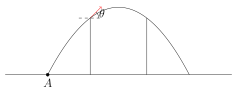
- \(\,\) \begin{align*} \bf{COE}: && \frac12 m \cdot 5ag &= mg\cdot 2a + \frac12 m v^2 \\ \Rightarrow && v^2 &= ag \\ && v &= \sqrt{ag} \end{align*} If it just clears the second wall, we must have: \begin{align*} && 0 &= \sqrt{ag} \sin \theta t - \frac12 gt^2 \\ \Rightarrow && t &= \frac{2\sqrt{ag}\sin \theta}{g} \\ && a &= \sqrt{ag} \cos \theta t \\ &&&=\sqrt{ag} \cos \theta \frac{2\sqrt{ag}\sin \theta}{g} \\ &&&= a \sin 2 \theta \\ \Rightarrow && \theta &= 45^{\circ} \end{align*} Imagine firing the particle backwards from the top of the wall at \(45^\circ\) then \begin{align*} && -2a &= \sqrt{ag}\cdot \left ( -\frac1{\sqrt{2}} \right) t - \frac12 g t^2 \\ \Rightarrow && 0 &= gt^2+\sqrt{2ag} t -4a \\ &&&= (\sqrt{g}t -\sqrt{2} \sqrt{a})(\sqrt{g}t +2\sqrt{2} \sqrt{a}) \\ \Rightarrow && t &= \sqrt{\frac{2a}{g}} \\ \Rightarrow && s &= \left ( -\frac1{\sqrt{2}} \right) \sqrt{ag} \sqrt{\frac{2a}{g}} \\ &&&= -a \end{align*} Therefore the \(A\) is \(a\) from the wall.
- When it passes over the first wall, \begin{align*} \bf{COE}: && \frac52amg &= (2a+h)mg + \frac12 m v^2 \\ \Rightarrow && v^2 &= (a-2h)g \end{align*} Now imagine firing a particle with this speed in any direction. The question is asking whether we can ever travel \(2a\) without descending more than \(h\). \begin{align*} && a &= \sqrt{(a-2h)g} \cos \beta t \\ \Rightarrow && t &= \frac{a}{\sqrt{(a-2h)g} \cos \beta}\\ && -h &= \sqrt{(a-2h)g} \sin \beta t - \frac12 g t^2 \\ &&&= a \tan \beta - \frac12 \frac{a^2}{(a-2h)} \sec^2 \beta \\ &&&= a \tan \beta - \frac{a^2}{2(a-2h)}(1+ \tan^2 \beta )\\ \Rightarrow && 0 &= \frac{a^2}{2(a-2h)} \tan^2 \beta-a \tan \beta + \frac{a^2-2ah+4h^2}{2(a-2h)} \\ && \Delta &= a^2 - \frac{a^2}{a-2h} \frac{a^2-2ah+4h^2}{a-2h} \\ &&&= \frac{a^2}{(a-2h)^2}\left ( a^2-4ah+4h^2-a^2+2ah-4h^2\right) \\ &&&= \frac{a^2}{(a-2h)^2}\left ( -2ah\right) < 0 \\ \end{align*} So there are no solutions if \(h > 0\)
2016 Paper 1 Q11
The point \(O\) is at the top of a vertical tower of height \(h\) which stands in the middle of a large horizontal plain. A projectile \(P\) is fired from \(O\) at a fixed speed \(u\) and at an angle \(\alpha\) above the horizontal. Show that the distance \(x\) from the base of the tower when \(P\) hits the plain satisfies \[ \frac{gx^2}{u^2} = h(1+\cos 2\alpha) + x \sin 2\alpha \,. \] Show that the greatest value of \(x\) as \(\alpha\) varies occurs when \(x=h\tan2\alpha\) and find the corresponding value of \(\cos 2\alpha\) in terms of \(g\), \(h\) and \(u\). Show further that the greatest achievable distance between \(O\) and the landing point is \(\dfrac {u^2}g +h\,\).
Solution: \begin{align*} \rightarrow: && x &= u \cos \alpha t\\ \Rightarrow && t &= \frac{x}{u \cos \alpha}\\ \uparrow: && -h &= u\sin \alpha t- \frac12gt^2 \\ && - h &= x\tan \alpha - \frac12 g \frac{x^2}{u^2}\sec^2 \alpha \\ \Rightarrow && \frac{gx^2}{u^2} &= h(2\cos^2 \alpha) + x2 \tan \alpha \cos^2 \alpha \\ &&&= h(1 + \cos 2 \alpha) + x \sin 2\alpha \\ \frac{\d}{\d \alpha}: && \frac{g}{u^2} 2 x \frac{\d x}{\d \alpha} &= -2h \sin 2 \alpha + 2x \cos 2 \alpha +\frac{\d x}{\d \alpha} \sin 2 \alpha \\ \Rightarrow && \frac{\d x}{\d \alpha} \left ( \frac{2xg}{u^2} - \sin 2 \alpha \right) &= 2\cos 2 \alpha (x -h \tan 2 \alpha) \end{align*} Since the turning point will be a maximum must be \(x = h \tan 2 \alpha\). Therefore, let \(c = \cos 2 \alpha\) \begin{align*} && \frac{gh^2}{u^2} \tan^2 2 \alpha &= h(1 + \cos 2 \alpha) + h \tan 2 \alpha \sin 2 \alpha \\ \Rightarrow && \frac{gh}{u^2}(c^{-2}-1) &= 1+c+\frac{1-c^2}{c} \\ \Rightarrow && \frac{gh(1-c^2)}{u^2c^2} &= \frac{c+c^2+1-c^2}{c}\\ &&&= \frac{1+c}{c} \\ \Rightarrow && \frac{gh(1-c)}{u^2c} &= 1 \\ \Rightarrow && u^2c &= gh(1-c) \\ \Rightarrow && c(u^2+gh) &= gh \\ \Rightarrow && \cos 2 \alpha &= \frac{gh}{u^2+gh} \\ \\ \Rightarrow && d_{max}^2 &= h^2 + h^2 \tan^2 2 \alpha \\ &&&= h^2\sec^2 2 \alpha \\ &&&= h^2 \frac{(u^2+gh)^2}{g^2h^2} \\ &&&= \frac{(u^2+gh)^2}{g^2} \\ &&&= \left (\frac{u^2}{g}+h \right)^2 \\ \Rightarrow && d_{max} &= \frac{u^2}{g}+h \end{align*}
2016 Paper 2 Q11
- Two particles move on a smooth horizontal surface. The positions, in Cartesian coordinates, of the particles at time \(t\) are \((a+ut\cos\alpha \,,\, ut\sin\alpha)\) and \((vt\cos\beta\,,\, b+vt\sin\beta )\), where \(a\), \(b\), \(u\) and \(v\) are positive constants, \(\alpha\) and \(\beta\) are constant acute angles, and \(t\ge0\). Given that the two particles collide, show that \[ u \sin(\theta+\alpha) = v\sin(\theta +\beta)\,, \] where \(\theta \) is the acute angle satisfying \(\tan\theta = \dfrac b a\).
- A gun is placed on the top of a vertical tower of height \(b\) which stands on horizontal ground. The gun fires a bullet with speed \(v\) and (acute) angle of elevation \(\beta\). Simultaneously, a target is projected from a point on the ground a horizontal distance \(a\) from the foot of the tower. The target is projected with speed \(u\) and (acute) angle of elevation \(\alpha\), in a direction directly away from the tower. Given that the target is hit before it reaches the ground, show that \[ 2u\sin\alpha (u\sin\alpha - v\sin\beta) > bg\,. \] Explain, with reference to part (i), why the target can only be hit if \(\alpha > \beta\).
Solution:
- The particles collide if there exists a time when \begin{align*} && a + ut \cos \alpha &= vt \cos \beta \\ \Rightarrow && t (v \cos \beta-u \cos \alpha) &= a\\ && ut \sin \alpha &= b + vt \sin \beta \\ \Rightarrow && t(u \sin \alpha - v \sin \beta) &= b\\ \Rightarrow && a(u\sin \alpha - v \sin \beta) &= b(v \cos \beta - u \cos \alpha) \\ \Rightarrow && u(a \sin \alpha + b \cos \alpha) &= v (b \cos \beta + a \sin \beta) \\ \Rightarrow && u \sin (\alpha + \theta) &= v \sin (\beta + \theta) \end{align*}
- The path of the bullet is \((vt \cos \beta, b + vt \sin \beta -\frac12 g t^2)\). The path of the target is \((a+ut \cos \alpha, ut \sin \alpha - \frac12 g t^2)\). By comparing components as in part (i) and noting the acceleration doesn't change the story, we can see that \(t(u \sin \alpha - v \sin \beta) = b\) and we also need \(u t \sin \alpha - \frac12 gt^2 >0\) or \(u \sin \alpha - \frac12 gt > 0\) \begin{align*} && u \sin \alpha & > \frac12 gt \\ && 2u \sin \alpha & > g \frac{b}{(u \sin \alpha - v \sin \beta)} \\ \Rightarrow && 2u \sin \alpha( u \sin \alpha - v \sin \beta) & > gb \end{align*} Notice we must have \(u \sin \alpha > v \sin \beta\) and \(u \sin (\alpha + \theta) = v \sin (\beta + \theta)\) so \( \frac{\sin \alpha}{\sin (\alpha + \theta)} > \frac{\sin \beta}{\sin (\beta + \theta)}\), but if we consider \(f(t) = \frac{\sin t}{\sin(t+x)}\) we can see \(f'(t) = \frac{\cos t \sin(t + x) - \sin t \cos(t+x)}{\sin^2(t+x)} = \frac{\sin x}{\sin^2(t+x)} > 0\) is increasing, therefore \(\alpha > \beta\).
2015 Paper 1 Q9
A short-barrelled machine gun stands on horizontal ground. The gun fires bullets, from ground level, at speed \(u\) continuously from \(t=0\) to \(t= \dfrac{\pi}{ 6\lambda}\), where \(\lambda\) is a positive constant, but does not fire outside this time period. During this time period, the angle of elevation \(\alpha\) of the barrel decreases from \(\frac13\pi\) to \(\frac16\pi\) and is given at time \(t\) by \[ \alpha =\tfrac13 \pi - \lambda t\,. \] Let \(k = \dfrac{g}{2\lambda u}\). Show that, in the case \(\frac12 \le k \le \frac12 \sqrt3\), the last bullet to hit the ground does so\\[2pt] at a distance \[ \frac{ 2 k u^2 \sqrt{1-k^2}}{g} \] from the gun. What is the corresponding result if \(k<\frac12\)?
Solution: The bullet fired at time \(t\) will hit the ground at time \(t+\frac{2u \sin (\frac13\pi - \lambda t)}{g}\). To find the last time a bullet hits the ground, we can differentiate, noting that \begin{align*} && T(t) &= t + \frac{2u \sin \alpha}{g} \\ \Rightarrow && T'(t) &= 1 - \frac{2u\lambda}{g} \cos \alpha \\ && T''(t) &= \frac{2u \lambda^2}{g} \sin \alpha > 0 \end{align*} If \(k = \frac{g}{2\lambda u} \in [\frac12, \frac12\sqrt{3}]\) then notice that this turning point is always achieved, and will be a maximum. It will be when \(\cos \alpha = k, \sin \alpha = \sqrt{1-k^2}\). The distance will be \(u \cos \alpha \cdot \frac{2 u \sin \alpha}{g} = \frac{2ku^2\sqrt{1-k^2}}{g}\). If \(k < \frac12\) then the last bullet to hit the ground will be the last bullet fired, ie \(\frac{2u^2 \sin \frac16\pi \cos \frac16\pi}{g} = \frac{u^2 \sin \frac13 \pi}{g} = \frac{\sqrt{3}u^2}{2g}\)
2014 Paper 1 Q9
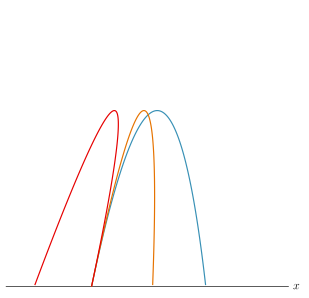
A particle of mass \(m\) is projected due east at speed \(U\) from a point on horizontal ground at an angle \(\theta\) above the horizontal, where \(0 < \theta < 90^\circ\). In addition to the gravitational force \(mg\), it experiences a horizontal force of magnitude \(mkg\), where \(k\) is a positive constant, acting due west in the plane of motion of the particle. Determine expressions in terms of \(U\), \(\theta\) and \(g\) for the time, \(T_H\), at which the particle reaches its greatest height and the time, \(T_L \), at which it lands. Let \(T = U\cos\theta /(kg)\). By considering the relative magnitudes of \(T_H\), \(T_L \) and \(T\), or otherwise, sketch the trajectory of the particle in the cases \(k\tan\theta<\frac12\), \(\frac12 < k\tan\theta<1\), and \(k\tan\theta>1\). What happens when \(k\tan\theta =1\)?
Solution: \begin{align*} && v_{\uparrow} &= U\sin \theta - g t \\ \Rightarrow && T_H &= \frac{U \sin \theta}{g} \\ \\ && s_{\uparrow} &= U \sin \theta t - \frac12 g t^2 \\ \Rightarrow && 0 &= U\sin \theta T_L - \frac12 g T_L^2 \\ && T_L &= \frac{2 U \sin \theta}{g} \end{align*} \(T = U\cos \theta / (kg)\) is the point when the particle's horizontal motion is reversed.
2014 Paper 2 Q10
A particle is projected from a point \(O\) on horizontal ground with initial speed \(u\) and at an angle of \(\theta\) above the ground. The motion takes place in the \(x\)-\(y\) plane, where the \(x\)-axis is horizontal, the \(y\)-axis is vertical and the origin is \(O\). Obtain the Cartesian equation of the particle's trajectory in terms of \(u\), \(g\) and~\(\lambda\), where \(\lambda=\tan\theta\). Now consider the trajectories for different values of \(\theta\) with \(u\)~fixed. Show that for a given value of~\(x\), the coordinate~\(y\) can take all values up to a maximum value,~\(Y\), which you should determine as a function of \(x\), \(u\) and~\(g\). Sketch a graph of \(Y\) against \(x\) and indicate on your graph the set of points that can be reached by a particle projected from \(O\) with speed \(u\). Hence find the furthest distance from \(O\) that can be achieved by such a projectile.
2013 Paper 1 Q9
Two particles, \(A\) and \(B\), are projected simultaneously towards each other from two points which are a distance \(d\) apart in a horizontal plane. Particle \(A\) has mass \(m\) and is projected at speed \(u\) at angle \(\alpha\) above the horizontal. Particle \(B\) has mass \(M\) and is projected at speed \(v\) at angle \(\beta\) above the horizontal. The trajectories of the two particles lie in the same vertical plane. The particles collide directly when each is at its point of greatest height above the plane. Given that both \(A\) and \(B\) return to their starting points, and that momentum is conserved in the collision, show that \[ m\cot \alpha = M \cot \beta\,. \] Show further that the collision occurs at a point which is a horizontal distance \(b\) from the point of projection of \(A\) where \[ b= \frac{Md}{m+M}\, , \] and find, in terms of \(b\) and \(\alpha\), the height above the horizontal plane at which the collision occurs.
Solution: Since \(A\) and \(B\) return to their starting points, and at their highest points there is no vertical component to their velocities, their horizontal must perfectly reverse, ie \begin{align*} && m u \cos \alpha - M v \cos \beta &= -m u \cos \alpha + M v \cos \beta \\ \Rightarrow && mu \cos \alpha &= Mv \cos \beta \end{align*} Since they reach their highest points at the same time, they must have the same initial vertical speed, ie \(u \sin \alpha = v \sin \beta\), so \begin{align*} && m v \frac{\sin \beta}{\sin \alpha} \cos \alpha &= M v \cos \beta \\ \Rightarrow && m \cot \alpha &= M \cot \beta \end{align*} The horizontal distance travelled by \(A\) & \(B\) will be: \begin{align*} && d_A &= u \cos \alpha t \\ && d_B &= v \cos \beta t \\ \Rightarrow && \frac{d_A}{d_A+d_B} &= \frac{u \cos \alpha}{u \cos \alpha + v \cos \beta} \\ &&&= \frac{\frac{M}{m}v \cos \beta}{\frac{M}{m}v \cos \beta + v \cos \beta} \\ &&&= \frac{M}{M+m} \\ \Rightarrow && d_A = b &= \frac{Md}{m+M} \end{align*} Applying \(v^2 = u^2 + 2as\) we see that \begin{align*} && 0 &= u \sin \alpha - gt \\ \Rightarrow && t &= \frac{u \sin \alpha}{g} \\ && b &=u \cos \alpha \frac{u \sin \alpha}{g} \\ \Rightarrow && u^2 &= \frac{2bg}{\sin 2 \alpha} \\ && 0 &= u^2 \sin^2 \alpha - 2g h \\ \Rightarrow && h &= \frac{u^2 \sin^2 \alpha}{2g} \\ &&&= \frac{2bg}{\sin 2 \alpha} \frac{ \sin^2 \alpha}{2g} \\ &&&= \frac12 b \tan \alpha \end{align*}
2013 Paper 2 Q10
A particle is projected at an angle of elevation \(\alpha\) (where \(\alpha>0\)) from a point \(A\) on horizontal ground. At a general point in its trajectory the angle of elevation of the particle from \(A\) is \(\theta\) and its direction of motion is at an angle \(\phi\) above the horizontal (with \(\phi\ge0\) for the first half of the trajectory and \(\phi\le0\) for the second half). Let \(B\) denote the point on the trajectory at which \(\theta = \frac12 \alpha\) and let \(C\) denote the point on the trajectory at which \(\phi = -\frac12\alpha\).
- Show that, at a general point on the trajectory, \(2\tan\theta = \tan \alpha + \tan\phi\,\).
- Show that, if \(B\) and \(C\) are the same point, then \( \alpha = 60^\circ\,\).
- Given that \(\alpha < 60^\circ\,\), determine whether the particle reaches the point \(B\) first or the point \(C\) first.