Problems
Filters
17 problems found
2019 Paper 2 Q1
Let \(f(x) = (x-p)g(x)\), where g is a polynomial. Show that the tangent to the curve \(y = f(x)\) at the point with \(x = a\), where \(a \neq p\), passes through the point \((p, 0)\) if and only if \(g'(a) = 0\). The curve \(C\) has equation $$y = A(x - p)(x - q)(x - r),$$ where \(p\), \(q\) and \(r\) are constants with \(p < q < r\), and \(A\) is a non-zero constant.
- The tangent to \(C\) at the point with \(x = a\), where \(a \neq p\), passes through the point \((p, 0)\). Show that \(2a = q + r\) and find an expression for the gradient of this tangent in terms of \(A\), \(q\) and \(r\).
- The tangent to \(C\) at the point with \(x = c\), where \(c \neq r\), passes through the point \((r, 0)\). Show that this tangent is parallel to the tangent in part (i) if and only if the tangent to \(C\) at the point with \(x = q\) does not meet the curve again.
Solution: The tangent to the curve \(y = f(x)\) at \(x = a\) has the equation \(\frac{y-f(a)}{x-a} = f'(a) = g(a)+(a-p)g'(a)\). This passes through \((p,0)\) iff \begin{align*} && \frac{-f(a)}{p-a} &= g(a)+(a-p)g'(a) \\ \Leftrightarrow && -f(a) &= (p-a)g(a) -(a-p)^2g'(a) \\ \Leftrightarrow && -f(a) &= -f(a) -(a-p)^2g'(a) \\ \Leftrightarrow && 0 &= g'(a) \\ \end{align*}
- In this case \(g(x) = A(x-q)(x-r) = A(x^2-(q+r)x+qr)\) and so we must have that \(g'(a) = 0\), ie \(A(2a-(q+r)) = 0 \Rightarrow 2a = q+r\) The gradient is \(g(a) +(a-p)g'(a) = g(a) = A(a-q)(a-r)\)
- By the same reasoning, but with \(g(x) = A(x-p)(x-q)\) we have the gradient is \(A(c-p)(c-r)\). This is parallel iff \begin{align*} && (c-p)(c-r) &= (a-q)(a-r) \end{align*} The tangent at \(x = q\) is \(\frac{y-0}{x-q} = A(q-p)(q-r)\) or \( y = A(q-p)(q-r)(x-q)\)
2018 Paper 1 Q4
The function \(\f\) is defined by \[ \phantom{\ \ \ \ \ \ \ \ \ \ \ \ (x>0, \ \ x\ne1)} \f(x) = \frac{1}{x\ln x} \left(1 - (\ln x)^2 \right)^2 \ \ \ \ \ \ \ \ \ \ \ \ (x>0, \ \ x\ne1) \,.\] Show that, when \(( \ln x )^2 = 1\,\), both \(\f(x)=0\) and \(\f'(x)=0\,\). The function \(F\) is defined by \begin{align*} F(x) = \begin{cases} \displaystyle \int_{ 1/\text{e}}^x \f(t) \; \mathrm{d}t & \text{ for } 0 < x < 1\,, \\[7mm] \displaystyle \int_{\text{e}}^x \f(t) \; \mathrm{d}t & \text{ for } x > 1\,. \\ \end{cases} \end{align*}
- Find \(F(x)\) explicitly and hence show that \(F(x^{-1})=F(x)\,\).
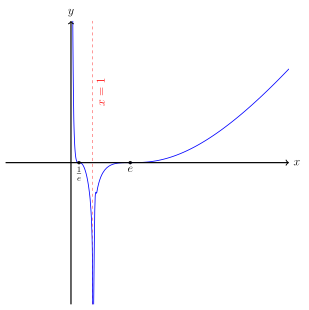
- Sketch the curve with equation \(y=F(x)\,\). [You may assume that \(\dfrac{ (\ln x)^k} x\to 0\) as \(x\to\infty\) for any constant \(k\).]
Solution: When \((\ln x)^2 = 1\) we have \(f(x) = \frac{1}{x\ln x}(1 - 1^2)^2 = 0\) \(f'(x) = \frac{2(1 - (\ln x)^2) \cdot (-2 \ln x ) \cdot \frac1x \cdot (x \ln x) - (\ln x +1)(1-(\ln x)^2)^2}{(x\ln x)^2} = \frac{2\cdot 0 \cdot (-2 \ln x ) \cdot \frac1x \cdot (x \ln x) - (\ln x +1) \cdot 0}{(x\ln x)^2} = 0\)
- First consider \(0 < x < 1\), so \begin{align*} && F(x) &= \int_{1/e}^x f(t) \d t \\ &&&= \int_{1/e}^x \frac{1}{t\ln t} \left(1 - (\ln t)^2 \right)^2 \d t \\ u = \ln t, \d u = \frac1t \d t: &&&= \int_{u=-1}^{u=\ln x} \frac{1}{u}(1-u^2)^2 \d u \\ &&&= \int_{-1}^{\ln x} \left ( u^3 - 2u+\frac1u \right) \d u \\ &&&= \left [ \frac{u^4}{4} - u^2+ \ln |u| \right]_{-1}^{\ln x} \\ &&&= \frac{(\ln x)^4}{4} -(\ln x)^2 + \ln |\ln x| - \frac14+1 \end{align*} Now consider \(x > 1\) \begin{align*} && F(x) &= \int_{e}^x f(t) \d t \\ &&&= \int_{e}^x \frac{1}{t\ln t} \left(1 - (\ln t)^2 \right)^2 \d t \\ u = \ln t, \d u = \frac1t \d t: &&&= \int_{u=1}^{u=\ln x} \frac{1}{u}(1-u^2)^2 \d u \\ &&&= \int_{1}^{\ln x} \left ( u^3 - 2u+\frac1u \right) \d u \\ &&&= \left [ \frac{u^4}{4} - u^2+ \ln |u| \right]_{1}^{\ln x} \\ &&&= \frac{(\ln x)^4}{4} -(\ln x)^2 + \ln| \ln x| - \frac14+1 \end{align*} Notice that \begin{align*} F(x^{-1}) &= \frac{(\ln x^{-1})^4}{4} -(\ln x^{-1})^2 + \ln| \ln x^{-1}| - \frac14+1 \\ &= \frac{(-\ln x)^4}{4} -(-\ln x)^2 + \ln| -\ln x| - \frac14+1 \\ &= \frac{(\ln x)^4}{4} -(\ln x)^2 + \ln| \ln x| - \frac14+1 \\ &= F(x) \end{align*}
- \(\,\)
2018 Paper 1 Q8
The functions \(\s\) and \(\c\) satisfy \(\s(0)= 0\,\), \(\c(0)=1\,\) and \[ \s'(x) = \c(x)^2 ,\] \[ \c'(x)=-\s(x)^2. \] You may assume that \(\s\) and \(\c\) are uniquely defined by these conditions.
- Show that \(\s(x)^3+\c(x)^3\) is constant, and deduce that \(\s(x)^3+\c(x)^3=1\,\).
- Show that \[ \frac{\d }{\d x} \, \Big( \s(x) \c(x) \Big) = 2\c(x)^3-1 \] and find (and simplify) an expression in terms of \(\c(x)\) for $\dfrac{\d }{\d x} \left( \dfrac{\s(x)}{\c(x)} \right) $.
- Find the integrals \[ \int \s(x)^2 \, \d x \ \ \ \ \ \ \text{and} \ \ \ \ \ \ \int \s(x)^5 \, \d x \,. \]
- Given that \(\s\) has an inverse function, \(\s^{-1}\), use the substitution \(u = \s(x)\) to show that \[ \int \frac{1}{(1-u^3)^{\frac{2}{3}}} \, \d u = \s^{-1}(u) \, + \text{constant}. \]
- Find, in terms of \(u\), the integrals \[ \int \frac{1}{{(1-u^3)}^{\frac{4}{3}}} \, \d u \ \ \ \ \ \ \text{and} \ \ \ \ \ \ \int {(1-u^3)}^{\frac{1}{3}} \, \d u \,. \]
Solution: \begin{questionparts} \item \begin{align*} && \dfrac{\d }{\d x} \left( \s(x)^3 + \c(x)^3 \right) &= 3\s(x)^2\s'(x) + 3\c(x)^2 \c'(x) \\ &&&= 3\s(x)^2\c(x)^2 - 3\c(x)^2\s(x)^2 \\ &&&= 0 \\ \\ \Rightarrow && \s(x)^3 + \c(x)^3 &= \text{constant} \\ &&&= \s(0)^3 + \c(0)^3 \\ &&&= 1 \end{align*} \item \begin{align*} \frac{\d }{\d x} \, \Big( \s(x) \c(x) \Big) &= \s'(x) \c(x) + \s(x)\c'(x) \\ &= \c(x)^3 - \s(x)^3 \\ &= \c(x)^3 - (1-\c(x)^3) \\ &= 2\c(x)^3 - 1 \\ \\ \dfrac{\d }{\d x} \left( \dfrac{\s(x)}{\c(x)} \right) &= \frac{\s'(x)\c(x) - \s(x)\c'(x)}{\c(x)^2} \\ &= \frac{\c(x)^3 + \s(x)^3}{\c(x)^2} \\ &= \frac{1}{\c(x)^2} \\ \end{align*} \item \begin{align*} \int \s(x)^2 \d x &= -\int -\s(x)^2 \d x \\ &= -\int \c'(x) \d x \\ &= - \s(x) +C \\ \\ \int \s(x)^5 \, \d x &= \int \s(x)^2 \s(x)^3 \d x \\ &= \int \s(x)^2 (1 - \c(x)^3) \d x \\ &= -\int \c'(x) (1 - \c(x)^3) \d x \\ &= - c(x) + \frac{\c(x)^4}{4} + C \end{align*} \item If \(u = \s(x), \frac{\d u}{\d x} = \c(x)^2\) \begin{align*} \int \frac{1}{(1-u^3)^{\frac{2}{3}}} \, \d u &= \int \frac{1}{(1-\s(x)^3)^{\frac{2}{3}}} \c(x)^2 \d x \\ &= \int 1 \d x \\ &= x + C \\ &= \s^{-1}(u) + C \\ \\ \int \frac{1}{{(1-u^3)^{\frac{4}{3}}}} \d u &= \int \frac1{(1-\s(x)^3)^{\frac43} }\c(x)^2 \d x \\ &= \int \frac1{(\c(x)^3)^{\frac43}} \c(x)^2 \d x \\ &= \int \frac1{\c(x)^2} \d x \\ &= \frac{\s(x)}{\c(x)} + C \\ &= \frac{u}{(1-u^3)^{\frac13}} + C \\ \end{align*} \begin{align*} && \int {(1-u^3)}^{\frac{1}{3}} \, \d u &= \int (1-s(x)^3)^{\frac13} c(x)^2 \d x \\ &&&= \int \c(x)^3 \d x = I\\ &&&= \int \c(x) s'(x) \d x \\ &&&= \left [\c(x) \s(x) \right] + \int \s(x)^2 s(x) \d x \\ &&&= \c(x) \s(x) + \int (1 - \c(x)^3) \d x + C \\ &&&= \c(x) \s(x) + x - I + C \\ \Rightarrow && I &= \frac{x + \c(x) \s(x)}{2} + k \\ \Rightarrow && &= \frac12 \l \s^{-1}(u) + u \sqrt[3](1-u^3)\r + k \end{align*}
2018 Paper 3 Q2
The sequence of functions \(y_0\), \(y_1\), \(y_2\), \(\ldots\,\) is defined by \(y_0=1\) and, for \(n\ge1\,\), \[ y_n = (-1)^n \frac {1}{z} \, \frac{\d^{n} z}{\d x^n} \,, \] where \(z= \e^{-x^2}\!\).
- Show that \(\dfrac{\d y_n}{\hspace{-4.7pt}\d x} = 2x y_n -y_{n+1}\,\) for \(n\ge1\,\).
- Prove by induction that, for \(n\ge1\,\), \[ y_{n+1} = 2x y_n -2ny_{n-1} \,. \] Deduce that, for \(n\ge1\,\), \[ y_{n+1}^2 - {y}_n {y}_{n+2} = 2n (y_n^2 - y_{n-1}y_{n+1}) + 2 y_n^2 \,. \]
- Hence show that $y_{n}^2 - y^2_{n-1} y^2_{n+1} > 0\( for \)n \ge 1$.
Solution:
- \begin{align*} \frac{\d y_n}{\d x} &= \frac{\d}{\d x} \l (-1)^n e^{x^2} \frac{\d^n}{\d x^{n}} \l e^{-x^2}\r \r \\ &= (-1)^n 2xe^{x^2} \frac{\d^n}{\d x^{n}} \l e^{-x^2}\r + (-1)^n e^{x^2} \frac{\d^{n+1}}{\d x^{n+1}} \l e^{-x^2}\r \\ &= 2xy_n - (-1)^{n+1} e^{x^2} \frac{\d^{n+1}}{\d x^{n+1}} \l e^{-x^2}\r \\ &= 2xy_n - y_{n+1} \end{align*}
- \(y_0 = 1\), \(y_1 = (-1) e^{x^2} \cdot (-2x) \cdot e^{-x^2} = 2x\), \(y_2 = e^{x^2} \frac{\d^2}{\d x^2} \l e^{-x^2}\r = e^{x^2} \frac{\d }{\d x}\l -2xe^{-x^2} \r = e^{x^2} \l -2e^{-x^2}+4x^2e^{-x^2}\r = 4x^2-2\). Therefore \(2xy_1 - 2y_0 = 2x \cdot 2x - 2\cdot1 = 4x^2-2 = y_2\) so our statement is true for \(n=1\). Assume the statement is true for \(n=k\), then \begin{align*} && y_{k+1} &= 2xy_k - 2ky_{k-1} \\ \frac{\d }{\d x}: && \frac{\d y_{k+1}}{\d x} &= 2\frac{\d}{\d x}\l xy_k \r - 2k\frac{\d y_{k-1}}{\d x} \\ \Rightarrow && 2xy_{k+1}-y_{k+2} &= 2y_k+2x \l 2xy_k-y_{k+1}\r - 2k \l 2xy_{k-1}-y_k \r \\ \Rightarrow && y_{k+2} &=2y_k+ 4x \cdot y_{k+1}-(4x^2+2k)y_k+2x \cdot 2k y_{k-1} \\ &&&= 4x \cdot y_{k+1}-(4x^2+2(k+1))y_k+2x \l2xy_k - y_{k+1} \r \\ &&&= 2x \cdot y_{k+1} -2(k+1)y_k \end{align*} Therefore since our statement is true for \(n=1\) and if it is true for \(n=k\) it is true for \(n=k=1\), therefore by the principle of mathematical induction it is true for all \(n \geq 1\). Since \(2x = \frac{y_{n+1}+2ny_{n-1}}{y_n}\) for all \(n\), we must have \begin{align*} && \frac{y_{n+1}+2ny_{n-1}}{y_n} &= \frac{y_{n+2}+2(n+1)y_{n}}{y_{n+1}} \\ \Leftrightarrow && y_{n+1}^2+2ny_{n-1}y_{n+1} &= y_ny_{n+2}+2ny_n^2+2y_n^2 \\ \Leftrightarrow && y_{n+1}^2-y_ny_{n+2} &= 2n(y_n^2-y_{n-1}y_{n+1})+2y_n^2 \end{align*}
- Consider the functions \(f_n(x) = y_{n}^2-y_{n-1}y_{n+1}\) then clearly \(f_{n+1} = 2nf_{n} + 2y_n^2 \geq f_{n}\) so to prove \(f_n(x) > 0\) for \(n \geq 1\) it suffices to prove it for \(n = 1\). But \(f_1 = y_1^2 - y_0y_{2} = (2x)^2-(4x^2-2) = 2 > 0\) so we are done.
2017 Paper 3 Q5
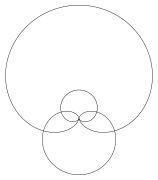
The point with cartesian coordinates \((x,y)\) lies on a curve with polar equation \(r=\f(\theta)\,\). Find an expression for \(\dfrac{\d y}{\d x}\) in terms of \(\f(\theta)\), \(\f'(\theta)\) and \(\tan\theta\,\). Two curves, with polar equations \(r=\f(\theta)\) and \(r=\g(\theta)\), meet at right angles. Show that where they meet \[ \f'(\theta) \g'(\theta) +\f(\theta)\g(\theta) = 0 \,. \] The curve \(C\) has polar equation \(r=\f(\theta)\) and passes through the point given by \(r=4\), \(\theta = - \frac12\pi\). For each positive value of \(a\), the curve with polar equation \(r= a(1+\sin\theta)\) meets~\(C\) at right angles. Find \(\f(\theta)\,\). Sketch on a single diagram the three curves with polar equations \(r= 1+\sin\theta\,\), \ \(r= 4(1+\sin\theta)\) and \(r=\f(\theta)\,\).
Solution: \((x, y) = (f(\theta)\cos(\theta), f(\theta)\sin(\theta))\) so \begin{align*} \frac{dy}{d\theta} &= -f(\theta)\sin(\theta) + f'(\theta)\cos(\theta) \\ \frac{dx}{d\theta} &= f(\theta)\cos(\theta) + f'(\theta)\sin(\theta) \\ \frac{dy}{dx} &= \frac{-f(\theta)\sin(\theta) + f'(\theta)\cos(\theta)}{f(\theta)\cos(\theta) + f'(\theta)\sin(\theta) } \\ &= \frac{-f(\theta)\tan(\theta) + f'(\theta)}{f(\theta) + f'(\theta)\tan(\theta) } \end{align*} If the curves meet at right angles then the product of their gradients is \(-1\), ie \begin{align*} \frac{-f(\theta)\tan(\theta) + f'(\theta)}{f(\theta) + f'(\theta)\tan(\theta) } \cdot \frac{-g(\theta)\tan(\theta) + g'(\theta)}{g(\theta) + g'(\theta)\tan(\theta) } &= -1 \\ f(\theta)g(\theta)\tan^2 \theta - f(\theta)g'(\theta)\tan \theta - f'(\theta)g(\theta)\tan \theta + f'(\theta)g'(\theta) &= \\ \quad - \l f(\theta)g(\theta) + f(\theta)g'(\theta)\tan(\theta) + f'(\theta)g(\theta)\tan(\theta) + f'(\theta)g'(\theta)\tan^2 \theta \r \\ \tan^2\theta \l f(\theta)g(\theta) + f'(\theta)g'(\theta) \r + f'(\theta)g'(\theta) + f(\theta)g(\theta) &= 0 \\ (\tan^2\theta + 1) \l f(\theta)g(\theta) + f'(\theta)g'(\theta) \r &= 0 \\ f(\theta)g(\theta) + f'(\theta)g'(\theta) &= 0 \end{align*} \(g(\theta) = a(1+\sin\theta), g'(\theta) = a\cos\theta\) Therefore \(f'(\theta)a\cos \theta+f(\theta)a(1+\sin(\theta)) = 0\) \begin{align*} && \frac{f'(\theta)}{f(\theta)} &= -\sec(\theta) - \tan(\theta) \\ \Rightarrow && \ln(f(\theta)) &= -\ln |\tan(\theta) + \sec(\theta)| + \ln |\cos(\theta)| + C \\ \Rightarrow && f(\theta) &= A \frac{\cos \theta}{\tan \theta + \sec \theta} \\ &&&= A \frac{\cos^2 \theta}{\sin \theta + 1} \\ &&&= A \frac{1-\sin^2 \theta}{\sin \theta + 1} \\ &&&= A (1-\sin \theta) \end{align*} When \(\theta = -\frac12 \pi, r = 4\), so \(A = 2\).
2016 Paper 1 Q2
Differentiate, with respect to \(x\), \[ (ax^2+bx+c)\,\ln \big( x+\sqrt{1+x^2}\big) +\big(dx+e\big)\sqrt{1+x^2} \,, \] where \(a\), \(b\), \(c\), \(d\) and \(e\) are constants. You should simplify your answer as far as possible. Hence integrate:
- \( \ln \big( x+\sqrt{1+x^2}\,\big) \,;\)
- \(\sqrt{1+x^2} \,; \)
- \( x\ln \big( x+\sqrt{1+x^2}\,\big) \,.\)
Solution: \begin{align*} && y &= (ax^2+bx+c)\,\ln \big( x+\sqrt{1+x^2}\big) +\big(dx+e\big)\sqrt{1+x^2} \\ && y' &= (2ax+b)\,\ln \big( x+\sqrt{1+x^2}\big) + (ax^2+bx+c) \frac{1}{x + \sqrt{1+x^2}} \cdot \left(1 + \frac{x}{\sqrt{1+x^2}} \right) + d\sqrt{1+x^2} + \frac{x(dx+e)}{\sqrt{1+x^2}} \\ &&&= (2ax+b)\,\ln \big( x+\sqrt{1+x^2}\big) + \frac{1}{\sqrt{1+x^2}} \left ( (ax^2+bx+c) + d(1+x^2) + x(dx+e) \right) \\ &&&= (2ax+b)\,\ln \big( x+\sqrt{1+x^2}\big) + \frac{1}{\sqrt{1+x^2}} \left ( (a+2d)x^2+(b+e)x+(d+c) \right) \\ \end{align*}
- We want \(a = 0, b = 1, d = 0, e = -1, c =0\), so \begin{align*} I &= \int \ln \big( x+\sqrt{1+x^2}\,\big) \,\d x \\ &= x\ln(x+\sqrt{1+x^2})-\sqrt{1+x^2}+C \end{align*}
- We want \(a = b =0, e = 0, d = \frac12, c = \frac12\), so \begin{align*} I &= \int \sqrt{1+x^2}\, \d x \\ &= \frac12\ln(x+\sqrt{1+x^2}) + \frac12x\sqrt{1+x^2}+C \end{align*}
- We want \(a = \frac12, b = 0, d = -\frac14, e = 0, c = \frac14\), so \begin{align*} I &= \int x \ln (x+\sqrt{1+x^2}) \, \d x \\ &= \left (\frac12 x^2+\frac14 \right)\ln(x+\sqrt{1+x^2}) -\frac14x\sqrt{1+x^2}+C \end{align*}
2012 Paper 3 Q1
Given that \(\displaystyle z = y^n \left( \frac{\d y}{\d x}\right)^{\!2}\), show that \[ \frac{\d z}{\d x} = y^{n-1} \frac{\d y}{\d x} \left( n \left(\frac{\d y}{\d x}\right)^{\!2} + 2y \frac{\d^2y}{\d x^2}\right) . \]
- Use the above result to show that the solution to the equation \[ \left(\frac{\d y}{\d x}\right)^{\!2} + 2y \frac{\d^2y}{\d x^2} = \sqrt y \ \ \ \ \ \ \ \ \ \ (y>0) \] that satisfies \(y=1\) and \(\dfrac{\d y}{\d x}=0\) when \(x=0\) is \(y= \big ( \frac38 x^2+1\big)^{\frac23}\).
- Find the solution to the equation \[ \left(\frac{\d y}{\d x}\right)^{\!2} -y \frac{\d^2y}{\d x^2} + y^2=0 \] that satisfies \(y=1\) and \(\dfrac{\d y}{\d x}=0\) when \(x=0\).
Solution: \begin{align*} &&z &= y^n \left( \frac{\d y}{\d x}\right)^{2} \\ \Rightarrow && \frac{\d z}{\d x} &= ny^{n-1}\left( \frac{\d y}{\d x}\right)^{3} + y^{n} \cdot 2 \left( \frac{\d y}{\d x}\right) \left( \frac{\d^2 y}{\d x^2}\right) \\ &&&= y^{n-1} \left( \frac{\d y}{\d x}\right) \left (n \left( \frac{\d y}{\d x}\right)^2 + 2y \frac{\d^2 y}{\d x^2} \right) \end{align*}
- Let \(z = y (y')^2\), then \begin{align*} && \frac{\d z}{\d x} &= y' \sqrt{y} \\ &&&= \sqrt{z} \\ \Rightarrow && \int z^{-1/2} \d z &= x+C \\ \Rightarrow && 2\sqrt{z} &= x + C \\ x = 0, z=0: && C &= 0 \\ \Rightarrow && y(y')^2 &= \frac14 x^2 \\ \Rightarrow &&\sqrt{y} \frac{\d y}{\d x} &= \frac{1}{2}x\\ \Rightarrow && \int \sqrt{y} \d y &= \int \frac{1}{2}x\d x \\ \Rightarrow && \frac23y^{3/2} &=\frac14x^2 + K \\ x = 0, y = 1: && K &= \frac23 \\ \Rightarrow && y &= \left (\frac38 x^2 + 1 \right)^{2/3} \end{align*}
- Let \(z = y^{-2} (y')^2\) \begin{align*} && \frac{\d z}{\d x} &= y^{-3} \frac{\d y}{\d x} \left (-2 \left( \frac{\d y}{\d x}\right) + 2y \frac{\d^2 y}{\d x^2} \right) \\ &&&= y^{-3} \frac{\d y}{\d x} 2y^2 \\ &&&= 2y^{-1}(y') = 2 \sqrt{z} \\ \Rightarrow && 2\sqrt{z} &= 2x + C \\ x = 0, z = 0: && C&= 0 \\ \Rightarrow && z &= x^2 \\ \Rightarrow && \frac{\d y}{\d x} &= xy \\ \Rightarrow && \ln |y| &= \frac12 x^2 + K \\ x =0 , y =1; && K &= 0 \\ \Rightarrow && y &= e^{\frac12 x^2} \end{align*}
2011 Paper 2 Q6
For any given function \(\f\), let \[ I = \int [\f'(x)]^2 \,[\f(x)]^n \d x\,, \tag{\(*\)} \] where \(n\) is a positive integer. Show that, if \(\f(x)\) satisfies \(\f''(x) =k \f(x)\f'(x)\) for some constant \(k\), then (\(*\)) can be integrated to obtain an expression for \(I\) in terms of \(\f(x)\), \(\f'(x)\), \(k\) and \(n\).
- Verify your result in the case \(\f(x) = \tan x\,\). Hence find \[ \displaystyle \int \frac{\sin^4x}{\cos^{8}x} \, \d x\;. \]
- Find \[ \displaystyle \int \sec^2x\, (\sec x + \tan x)^6\,\d x\;. \]
Solution: If \(f''(x) = kf(x)f'(x)\) then we can see \begin{align*} && I &= \int [\f'(x)]^2 \,[\f(x)]^n \d x \\ &&&= \int f'(x) \cdot f'(x) [f(x)]^n \d x \\ &&&= \left[ f'(x) \cdot \frac{[f(x)]^{n+1}}{n+1} \right] - \int f''(x) \frac{[f(x)]^{n+1}}{n+1} \d x \\ &&&= \frac{1}{n+1} \left (f'(x) [f(x)]^{n+1} - \int kf'(x) [f(x)]^{n+2} \d x \right) \\ &&&= \frac{1}{n+1} \left (f'(x) [f(x)]^{n+1} - k \frac{[f(x)]^{n+3}}{n+3} \right) +C\\ &&&= \frac{[f(x)]^{n+1}}{n+1} \left ( f'(x) - \frac{k[f(x)]^2}{n+3} \right) + C \end{align*}
- If \(f(x) = \tan x, f'(x) = \sec^2 x, f''(x) = 2 \sec^2 x \tan x = 2 \cdot f(x) \cdot f'(x)\), so \(\tan\) satisfies the conditions for the theorem. \begin{align*} && I &= \int \sec^4 x \tan^n x \d x \\ &&&= \left [\sec^2x \cdot \frac{\tan^{n+1} x}{n+1} \right] - \int 2 \sec^2 x \tan x \cdot \frac{\tan^{n+1} x}{n+1} \d x \\ &&&= \left [\sec^2x \cdot \frac{\tan^{n+1} x}{n+1} \right] - 2 \cdot \frac{\tan^{n+3} x}{(n+1)(n+3)} \\ \end{align*} So \begin{align*} && I &= \int \frac{\sin^4 x}{\cos^8 x} \d x \\ &&&= \int \tan^4 x \sec^4 x \d x \\ &&&= \int [\sec^2 x]^2 [\tan x]^4 \d x \\ &&&= \frac{\tan^{5}x}{5} \left ( \sec^2 x - \frac{2 \tan^2 x}{7} \right) + C \end{align*}
- \begin{align*} && I &= \int \sec^2x\, (\sec x + \tan x)^6\,\d x \\ &&&= \int (\sec x (\sec x + \tan x))^2 \cdot (\sec x + \tan x )^4 \d x \\ &&&= \frac{(\sec x + \tan x)^5}{5} \left ( \sec x (\sec x + \tan x) - \frac{(\sec x + \tan x)^2}{7} \right) + C \end{align*}
2009 Paper 2 Q7
Let \(y= (x-a)^n \e^{bx} \sqrt{1+x^2}\,\), where \(n\) and \(a\) are constants and \(b\) is a non-zero constant. Show that \[ \frac{\d y}{\d x} = \frac{(x-a)^{n-1} \e^{bx} \q(x)}{\sqrt{1+x^2}}\,, \] where \(\q(x)\) is a cubic polynomial. Using this result, determine:
- $\displaystyle \int \frac {(x-4)^{14} \e^{4x}(4x^3-1)} {\sqrt{1+x^2\;}} \, \d x\,;\(
- \)\displaystyle \int \frac{(x-1)^{21}\e^{12x}(12x^4-x^2-11)} {\sqrt{1+x^2\;}}\,\d x\,;\(
- \)\displaystyle \int \frac{(x-2)^{6}\e^{4x}(4x^4+x^3-2)} {\sqrt{1+x^2\;}}\,\d x\,.$
2007 Paper 2 Q6
- Differentiate \(\ln\big (x+\sqrt{3+x^2}\,\big)\) and \(x\sqrt{3+x^2}\) and simplify your answers. Hence find \(\int \! \sqrt{3+x^2}\, \d x\).
- Find the two solutions of the differential equation \[ 3\left(\frac{\d y}{\d x}\right)^{\!2} + 2 x \frac {\d y}{\d x} =1 \] that satisfy \(y=0\) when \(x=1\).
Solution:
- \(\,\) \begin{align*} && y &= \ln (x + \sqrt{3+x^2}) \\ \Rightarrow && y' &= \frac{1}{x + \sqrt{3+x^2}} \cdot \left (1 + \frac{x}{\sqrt{3+x^2}} \right) \\ &&&= \frac{1}{\sqrt{3+x^2}} \\ \\ && y &= x\sqrt{3+x^2} \\ && y' &= \sqrt{3+x^2} + \frac{x^2}{\sqrt{3+x^2}} \\ &&&= 2\sqrt{3+x^2} - \frac{3}{\sqrt{3+x^2}} \\ \\ \Rightarrow && \sqrt{3+x^2} &= \frac12(x \sqrt{3+x^2})' + \frac32(\ln(x+\sqrt{3+x^2})' \\ \Rightarrow && \int \sqrt{3+x^2}\, \d x &= \frac12x\sqrt{3+x^2} + \frac32 \ln (x+\sqrt{3+x^2}) + C \end{align*}
- \(\,\) \begin{align*} && 3 \left ( \frac{\d y}{\d x} \right)^2 + 2x \frac{\d y}{\d x} &= 1 \\ && \frac{\d y}{\d x} &= \frac{-x \pm \sqrt{x^2+3} }3 \\ \Rightarrow && y &= -\frac{x^2}{6} \pm \frac16x\sqrt{3+x^2} \pm \frac12 \ln (x+\sqrt{3+x^2}) + C \\ y = 0, x = 1: && 0 &= -\frac16 \pm \frac13 \pm \frac12 \ln 3 \\ \Rightarrow && y &= -\frac{x^2}{6} \pm \frac12x\sqrt{3+x^2} \pm \frac32 \ln (x+\sqrt{3+x^2}) + \frac16 \mp \frac13 \mp \frac12 \ln 3 \end{align*}
2006 Paper 3 Q8
\(\triangle\) is an operation that takes polynomials in \(x\) to polynomials in \(x\); that is, given any polynomial \(\h(x)\), there is a polynomial called \(\triangle \h(x)\) which is obtained from \(\h(x)\) using the rules that define \(\triangle\). These rules are as follows:
- \(\triangle x = 1\,\);
- \(\triangle \big( \f(x)+\g(x)\big) = \triangle \f(x) + \triangle\g(x)\,\) for any polynomials \(\f(x)\) and \(\g(x)\);
- \(\triangle \big( \lambda \f(x)\big) =\lambda \triangle \f(x)\) for any constant \(\lambda\) and any polynomial \(\f(x)\);
- \(\triangle \big( \f(x)\g(x)\big) = \f(x) \triangle \g(x) +\g(x)\triangle \f(x)\) for any polynomials \(\f(x)\) and \(\g(x)\).
Solution: Claim: If \(f\) is a constant, then \(\triangle f = 0\) Proof: First consider \(f(x) = 1, g(x) = x\) then we must have: \begin{align*} && \triangle (1x) &= 1 \triangle x + x \triangle 1 \tag{iv} \\ &&&= 1 \cdot 1 + x \triangle 1 \tag{i} \\ \Rightarrow && 1 &= 1 + x \triangle 1 \tag{i} \\ \Rightarrow && \triangle 1 &= 0 \\ \Rightarrow && \triangle c &= 0 \tag{iii} \end{align*} \begin{align*} && \triangle (x^2) &= x \triangle x + x \triangle x \tag{iv} \\ &&&= x \cdot 1 + x \cdot 1 \tag{i} \\ &&&= 2x \\ \\ && \triangle (x^3) &= x^2 \triangle x + x \triangle (x^2) \tag{iv} \\ &&&= x^2 \cdot 1 + x \cdot 2x \tag{\(\triangle x^2 = 2x\)}\\ &&&= 3x^2 \end{align*} Claim: \(\triangle h(x) = \frac{\d h(x)}{\d x}\) for any polynomial \(h\) Proof: Since both \(\triangle\) and \(\frac{\d}{\d x}\) are linear (properties \((ii)\) and \((iii)\)) it suffices to prove that: \(\triangle x^n = nx^{n-1}\). For this we proceed by induction. Base cases (we've proved up to \(n = 3\) so we're good). Suppose it's true for some \(n\), then consider \(n + 1\), \begin{align*} && \triangle (x^{n+1}) &= x \triangle (x^n) + x^n \triangle x \tag{iv} \\ &&&= x \cdot n x^{n-1} + x^n \triangle x \tag{Ind. hyp.} \\ &&&= nx^n + x^n \tag{i} \\ &&&= (n+1)x^{n} \end{align*} Therefore it's true for for \(n+1\). Therefore by induction it's true for all \(n\).
2005 Paper 1 Q8
Show that, if \(y^2 = x^k \f(x)\), then $\displaystyle 2xy \frac{\mathrm{d}y }{ \mathrm{d}x} = ky^2 + x^{k+1} \frac{\mathrm{d}\f }{ \mathrm{d}x}$\,.
- By setting \(k=1\) in this result, find the solution of the differential equation \[ \displaystyle 2xy \frac{\mathrm{d}y }{ \mathrm{d}x} = y^2 + x^2 - 1 \] for which \(y=2\) when \(x=1\). Describe geometrically this solution.
- Find the solution of the differential equation \[ 2x^2y\displaystyle \frac{\mathrm{d}y}{\mathrm{d}x} = 2 \ln(x) - xy^2 \] for which \(y=1\) when \(x=1\,\).
2005 Paper 2 Q1
Find the three values of \(x\) for which the derivative of \(x^2 \e^{-x^2}\) is zero. Given that \(a\) and \(b\) are distinct positive numbers, find a polynomial \(\P(x)\) such that the derivative of \(\P(x)\e^{-x^2}\) is zero for \(x=0\), \(x=\pm a\) and \(x=\pm b\,\), but for no other values of \(x\).
Solution: \begin{align*} && y &= x^2e^{-x^2} \\ \Rightarrow && y' &= 2xe^{-x^2} +x^2 \cdot (-2x)e^{-x^2} \\ &&&= e^{-x^2}(2x-2x^3) \\ &&&= 2e^{-x^2}x(1-x^2) \end{align*} Therefore the derivative is zero iff \(x = 0, \pm 1\) \begin{align*} && y &= \P(x) e^{-x^2} \\ \Rightarrow && y' &= e^{-x^2} (\P'(x)-2x\P(x)) \end{align*} Therefore we want \(\P'(x) - 2x\P(x) = Kx(x^2-a^2)(x^2-b^2)\) Since this has degree \(5\), we should look at polynomials degree \(4\) for \(\P\). We can also immediately see that \(0\) is a root of \(\P'(x)\), so \(\P(x) = a_4x^4+a_3x^3+a_2x^2+a_0\). WLOG \(a_4 = 1\) and \(K = -2\), so \begin{align*} && -2(x^5-(a^2+b^2)x^3+a^2b^2x) &= 4x^3+3a_3x^2+2a_2x- 2x(x^4+a_3x^3+a_2x^2+a_0) \\ &&&= -2x^5-2a_3 x^4+(4-2a_2)x^3+(2a_2-2a_0)x \\ \Rightarrow && a_3 &= 0 \\ && a^2+b^2 &= 2-a_2 \\ \Rightarrow && a_2 &= 2-a^2-b^2 \\ && a^2b^2 &= a_0-a_2 \\ \Rightarrow && a_0 &= a^2b^2 + 2-a^2-b^2 \\ \Rightarrow && \P(x) &= x^4+(2-a^2-b^2)x^2+(a^2-1)(b^2-1)x \end{align*}
1994 Paper 2 Q2
If \(\mathrm{Q}\) is a polynomial, \(m\) is an integer, \(m\geqslant1\) and \(\mathrm{P}(x)=(x-a)^{m}\mathrm{Q}(x),\) show that \[ \mathrm{P}'(x)=(x-a)^{m-1}\mathrm{R}(x) \] where \(\mathrm{R}\) is a polynomial. Explain why \(\mathrm{P}^{(r)}(a)=0\) whenever \(1\leqslant r\leqslant m-1\). (\(\mathrm{P}^{(r)}\) is the \(r\)th derivative of \(\mathrm{P}.\)) If \[ \mathrm{P}_{n}(x)=\frac{\mathrm{d}^{n}}{\mathrm{d}x^{n}}(x^{2}-1)^{n} \] for \(n\geqslant1\) show that \(\mathrm{P}_{n}\) is a polynomial of degree \(n\). By repeated integration by parts, or otherwise, show that, if \(n-1\geqslant m\geqslant0,\) \[ \int_{-1}^{1}x^{m}\mathrm{P}_{n}(x)\,\mathrm{d}x=0 \] and find the value of \[ \int_{-1}^{1}x^{n}\mathrm{P}_{n}(x)\,\mathrm{d}x. \] {[}Hint. \textit{You may use the formula \[ \int_{0}^{\frac{\pi}{2}}\cos^{2n+1}t\,\mathrm{d}t=\frac{(2^{2n})(n!)^{2}}{(2n+1)!} \] without proof if you need it. However some ways of doing this question do not use this formula.}{]}
Solution: \begin{align*} && P(x) &= (x-a)^mQ(x) \\ \Rightarrow && P'(x) &= m(x-a)^{m-1}Q(x) + (x-a)^mQ'(x) \\ &&&= (x-a)^{m-1}(\underbrace{mQ(x) + (x-a)Q'(x)}_{\text{a polynomial}}) \\ &&&= (x-a)^{m-1}R(x) \end{align*} Therefore \(P^{(r)}(a) = 0\) for \(1 \leq r \leq m-1\) since each time we differentiate we will have a factor of \((x-a)^{m-r}\) which is zero when we evaluate at \(x = a\). If \(P_n(x) = \frac{\d^n}{\d x^n}(x^2-1)^n\) then we are differentiating a degree \(2n\) polynomial \(n\) times. Each time we differentiate we reduce the degree by \(1\), therefore the degree of \(P_n\) is \(n\). \begin{align*} && \int_{-1}^1 x^mP_n(x) \d x &= \left [x^m \underbrace{\frac{\d^{n-1}}{\d x^{n-1}}\left ( (x-1)^{n} (x+1)^{n} \right)}_{\text{has a factor of }x-1\text{ and }x+1}\right]_{-1}^1 - \int_{-1}^1 mx^{m-1}\frac{\d^{n-1}}{\d x^{n-1}}\left ( (x-1)^{n} (x+1)^{n} \right) \d x\\ &&&= 0 - \int_{-1}^1 mx^{m-1}\frac{\d^{n-1}}{\d x^{n-1}}\left ( (x-1)^{n} (x+1)^{n} \right) \d x\\ &&&= -\left [mx^{m-1} \underbrace{\frac{\d^{n-2}}{\d x^{n-2}}\left ( (x-1)^{n} (x+1)^{n} \right)}_{\text{has a factor of }x-1\text{ and }x+1}\right]_{-1}^1+ \int_{-1}^1 m(m-1)x^{m-2}\frac{\d^{n-2}}{\d x^{n-2}}\left ( (x-1)^{n} (x+1)^{n} \right) \d x\\ &&&= m(m-1)\int_{-1}^1 x^{m-2}\frac{\d^{n-2}}{\d x^{n-2}}\left ( (x-1)^{n} (x+1)^{n} \right) \d x\\ &&& \cdots \\ &&&= (-1)^m m!\int_{-1}^1 \frac{\d^{n-m}}{\d x^{n-m}} \left ( (x-1)^{n} (x+1)^{n} \right) \d x\\ &&&= 0 \end{align*} If \(n = m\), we have \begin{align*} && \int_{-1}^1 x^n P_n(x) \d x&= (-1)^nn! \int_{-1}^1 (x^2-1)^n \d x \\ && &= (-1)^{2n}n! \cdot 2\int_{0}^1 (1-x^2)^n \d x \\ x = \sin \theta, \d x = \cos \theta \d \theta: &&&= 2 \cdot n!\int_{0}^{\pi/2} \cos^{2n} \theta \cdot \cos \theta \d \theta \\ &&&= 2 \cdot n!\int_{0}^{\pi/2} \cos^{2n+1} \theta \d \theta \\ &&&= 2 \cdot n!\frac{(2^{2n})(n!)^{2}}{(2n+1)!} \\ &&&= \frac{(2^{2n+1})(n!)^{3}}{(2n+1)!} \\ \end{align*}
1992 Paper 2 Q4
\(\lozenge\) is an operation which take polynomials in \(x\) to polynomials in \(x\); that is, given a polynomial \(\mathrm{h}(x)\) there is another polynomial called \(\lozenge\mathrm{h}(x)\). It is given that, if \(\mathrm{f}(x)\) and \(\mathrm{g}(x)\) are any two polynomials in \(x\), the following are always true:
- \(\lozenge(\mathrm{f}(x)\mathrm{g}(x))=\mathrm{g}(x)\lozenge\mathrm{f}(x)+\mathrm{f}(x)\lozenge\mathrm{g}(x),\)
- \(\lozenge(\mathrm{f}(x)+\mathrm{g}(x))=\lozenge\mathrm{f}(x)+\lozenge\mathrm{g}(x),\)
- \(\lozenge x=1\)
- if \(\lambda\) is a constant then \(\lozenge(\lambda\mathrm{f}(x))=\lambda\lozenge\mathrm{f}(x).\)
Solution: Claim: If \(f(x) = c\) then \(\lozenge f(x) = 0\) Proof: Consider \(g(x) = x\) then \begin{align*} (1) && \lozenge(f(x)g(x)) &= g(x) \lozenge f(x) + f(x) \lozenge g(x) \\ \Rightarrow && \lozenge(c x) &= x \lozenge f(x) + c \lozenge x \\ (4) && \lozenge(c x) &= c \lozenge x \\ \Rightarrow && 0 &= x \lozenge f(x) \\ \Rightarrow && \lozenge f(x) &= 0 \end{align*} \begin{align*} (1) && \lozenge(x^2) &= x \lozenge x + x \lozenge x \\ (3) &&&= 2 x \cdot 1 \\ &&&= 2x \\ \\ (1) && \lozenge (x^3) &= x^2 \lozenge x + x \lozenge (x^2) \\ &&&= x^2 \cdot \underbrace{1}_{(3)} + x \cdot\underbrace{ 2x}_{\text{previous part}} \\ &&&= 3x^2 \end{align*} Claim: \(\lozenge h(x) = \frac{\d }{\d x} ( h(x))\) for any polynomial \(h\). Proof: (By (strong) induction on the degree of \(h\)). Base case: True, we proved this in the first part of the question. Inductive step: Assume true for all polynomials of degree less than or equal to \(k\). Then consider \(n = k+1\). We can write \(h(x) = ax^{k+1} + h_k(x)\) where \(h_k(x)\) is a polynomial of degree less than or equal to \(k\). Then notice: \begin{align*} && \lozenge (h(x)) &= \lozenge (ax^{k+1} + h_k(x)) \\ (2) &&&= \lozenge (ax^{k+1})+ \lozenge (h_k(x)) \\ &&&=\underbrace{a\lozenge (x^{k+1})}_{(4)}+ \underbrace{\frac{\d}{\d x} (h_k(x))}_{\text{inductive hypothesis}}\\ &&&= a \underbrace{\left (x \lozenge x^k + x^k \lozenge x \right)}_{(1)} + \frac{\d}{\d x} (h_k(x)) \\ &&&= a \left ( x \cdot \underbrace{k x^{k-1}}_{\text{inductive hyp.}} + x^k \cdot \underbrace{1}_{(3)} \right) + \frac{\d}{\d x} (h_k(x)) \\ &&&= (k+1)a x^k + \frac{\d}{\d x} (h_k(x)) \\ &&&= \frac{\d }{\d x} \left ( ax^{k+1} + h_k(x) \right) \\ &&&= \frac{\d }{\d x} (h(x)) \end{align*} Therefore since our statement is true for \(n=0\) and if it is true for \(n=k\) it is true for \(n=k+1\) by the principle of mathematical induction it is true for all \(n \geq 0\)