Problems
Filters
5 problems found
2022 Paper 3 Q10
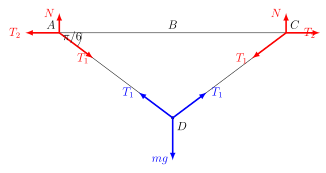
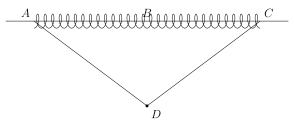
Two light elastic springs each have natural length \(a\). One end of each spring is attached to a particle \(P\) of weight \(W\). The other ends of the springs are attached to the end-points, \(B\) and \(C\), of a fixed horizontal bar \(BC\) of length \(2a\). The moduli of elasticity of the springs \(PB\) and \(PC\) are \(s_1 W\) and \(s_2 W\) respectively; these values are such that the particle \(P\) hangs in equilibrium with angle \(BPC\) equal to \(90^\circ\).
- Let angle \(PBC = \theta\). Show that \(s_1 = \dfrac{\sin\theta}{2\cos\theta - 1}\) and find \(s_2\) in terms of \(\theta\).
- Take the zero level of gravitational potential energy to be the horizontal bar \(BC\) and let the total potential energy of the system be \(-paW\). Show that \(p\) satisfies \[ \frac{1}{2}\sqrt{2} \geqslant p > \frac{1}{4}(1+\sqrt{3}) \] and hence that \(p = 0.7\), correct to one significant figure.
2012 Paper 3 Q11
One end of a thin heavy uniform inextensible perfectly flexible rope of length \(2L\) and mass \(2M\) is attached to a fixed point \(P\). A particle of mass \(m\) is attached to the other end. Initially, the particle is held at \(P\) and the rope hangs vertically in a loop below \(P\). The particle is then released so that it and a section of the rope (of decreasing length) fall vertically as shown in the diagram.
2006 Paper 3 Q9
A long, light, inextensible string passes through a small, smooth ring fixed at the point \(O\). One end of the string is attached to a particle \(P\) of mass \(m\) which hangs freely below \(O\). The other end is attached to a bead, \(B\), also of mass \(m\), which is threaded on a smooth rigid wire fixed in the same vertical plane as \(O\). The distance \(OB\) is \(r\), the distance \(OH\) is \(h\) and the height of the bead above the horizontal plane through~\(O\) is \(y\), as shown in the diagram.
2005 Paper 3 Q11
A horizontal spindle rotates freely in a fixed bearing. Three light rods are each attached by one end to the spindle so that they rotate in a vertical plane. A particle of mass \(m\) is fixed to the other end of each of the three rods. The rods have lengths \(a\), \(b\) and \(c\), with \(a > b > c\,\) and the angle between any pair of rods is \(\frac23 \pi\). The angle between the rod of length \(a\) and the vertical is \(\theta\), as shown in the diagram. \vspace*{-0.1in}
1990 Paper 1 Q12
\(\,\)
Solution: