Problems
Filters
2 problems found
2020 Paper 3 Q4
The plane \(\Pi\) has equation \(\mathbf{r} \cdot \mathbf{n} = 0\) where \(\mathbf{n}\) is a unit vector. Let \(P\) be a point with position vector \(\mathbf{x}\) which does not lie on the plane \(\Pi\). Show that the point \(Q\) with position vector \(\mathbf{x} - (\mathbf{x} \cdot \mathbf{n})\mathbf{n}\) lies on \(\Pi\) and that \(PQ\) is perpendicular to \(\Pi\).
- Let transformation \(T\) be a reflection in the plane \(ax+by+cz=0\), where \(a^2+b^2+c^2=1\). Show that the image of \(\mathbf{i} = \begin{pmatrix} 1 \\ 0 \\ 0 \end{pmatrix}\) under \(T\) is \(\begin{pmatrix} b^2+c^2-a^2 \\ -2ab \\ -2ac \end{pmatrix}\), and find the images of \(\mathbf{j}\) and \(\mathbf{k}\) under \(T\). Write down the matrix \(\mathbf{M}\) which represents transformation \(T\).
- The matrix \[ \begin{pmatrix} 0.64 & 0.48 & 0.6 \\ 0.48 & 0.36 & -0.8 \\ 0.6 & -0.8 & 0 \end{pmatrix} \] represents a reflection in a plane. Find the cartesian equation of the plane.
- The matrix \(\mathbf{N}\) represents a rotation through angle \(\pi\) about the line through the origin parallel to \(\begin{pmatrix} a \\ b \\ c \end{pmatrix}\), where \(a^2+b^2+c^2=1\). Find the matrix \(\mathbf{N}\).
- Identify the single transformation which is represented by the matrix \(\mathbf{NM}\).
1995 Paper 3 Q8
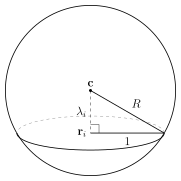
A plane \(\pi\) in 3-dimensional space is given by the vector equation \(\mathbf{r}\cdot\mathbf{n}=p,\) where \(\mathbf{n}\) is a unit vector and \(p\) is a non-negative real number. If \(\mathbf{x}\) is the position vector of a general point \(X\), find the equation of the normal to \(\pi\) through \(X\) and the perpendicular distance of \(X\) from \(\pi\). The unit circles \(C_{i},\) \(i=1,2,\) with centres \(\mathbf{r}_{i},\) lie in the planes \(\pi_{i}\) given by \(\mathbf{r}\cdot\mathbf{n}_{i}=p_{i},\) where the \(\mathbf{n}_{i}\) are unit vectors, and \(p_{i}\) are non-negative real numbers. Prove that there is a sphere whose surface contains both circles only if there is a real number \(\lambda\) such that \[ \mathbf{r}_{1}+\lambda\mathbf{n}_{1}=\mathbf{r}_{2}\pm\lambda\mathbf{n}_{2}. \] Hence, or otherwise, deduce the necessary conditions that \[ (\mathbf{r}_{1}-\mathbf{r}_{2})\cdot(\mathbf{n}_{1}\times\mathbf{n}_{2})=0 \] and that \[ (p_{1}-\mathbf{n}_{1}\cdot\mathbf{r}_{2})^{2}=(p_{2}-\mathbf{n}_{2}\cdot\mathbf{r}_{1})^{2}. \] Interpret each of these two conditions geometrically.
Solution: The equation of the normal to \(\pi\) through \(X\) is \(\mathbf{x} + \lambda \mathbf{n}\). The distance is \(|\mathbf{x}\cdot \mathbf{n}-p|\) We know that the centre of the sphere must lie above the centre of the circle following the normal, ie \(\mathbf{c} = \mathbf{r}_1+\lambda_1 \mathbf{n}_1 = \mathbf{r}_2+\lambda_2 \mathbf{n}_2\)