Problems
Filters
3 problems found
2005 Paper 1 Q9
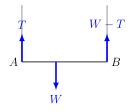
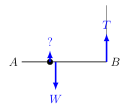
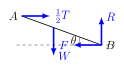
A non-uniform rod \(AB\) has weight \(W\) and length \(3l\). When the rod is suspended horizontally in equilibrium by vertical strings attached to the ends \(A\) and \(B\), the tension in the string attached to \(A\) is \(T\). When instead the rod is held in equilibrium in a horizontal position by means of a smooth pivot at a distance \(l\) from \(A\) and a vertical string attached to \(B\), the tension in the string is \(T\). Show that \(5T = 2W\). When instead the end \(B\) of the rod rests on rough horizontal ground and the rod is held in equilibrium at an angle \(\theta\) to the horizontal by means of a string that is perpendicular to the rod and attached to \(A\), the tension in the string is \(\frac12 T\). Calculate \(\theta\) and find the smallest value of the coefficient of friction between the rod and the ground that will prevent slipping.
Solution:
1991 Paper 2 Q13
A non-uniform rod \(AB\) of mass \(m\) is pivoted at one end \(A\) so that it can swing freely in a vertical plane. Its centre of mass is a distance \(d\) from \(A\) and its moment of inertia about any axis perpendicular to the rod through \(A\) is \(mk^{2}.\) A small ring of mass \(\alpha m\) is free to slide along the rod and the coefficient of friction between the ring and rod is \(\mu.\) The rod is initially held in a horizontal position with the ring a distance \(x\) from \(A\). If \(k^{2} > xd\), show that when the rod is released, the ring will start to slide when the rod makes an angle \(\theta\) with the downward vertical, where \[ \mu\tan\theta=\frac{3\alpha x^{2}+k^{2}+2xd}{k^{2}-xd}. \] Explain what will happen if (i) \(k^{2}=xd\) and (ii) \(k^{2} < xd\).
1987 Paper 2 Q11
A rough ring of radius \(a\) is fixed so that it lies in a plane inclined at an angle \(\alpha\) to the horizontal. A uniform heavy rod of length \(b(>a)\) has one end smoothly pivoted at the centre of the ring, so that the rod is free to move in any direction. It rests on the circumference of the ring, making an angle \(\theta\) with the radius to the highest point on the circumference. Find the relation between \(\alpha,\theta\) and the coefficient of friction, \(\mu,\) which must hold when the rod is in limiting equilibrium.
Solution:

- The mass of the rod
- The reaction where it meets the ring
- The friction at the ring