Problems
Filters
3 problems found
2001 Paper 1 Q1
The points \(A\), \(B\) and \(C\) lie on the sides of a square of side 1 cm and no two points lie on the same side. Show that the length of at least one side of the triangle \(ABC\) must be less than or equal to \((\sqrt6 -\sqrt2)\) cm.
1989 Paper 1 Q4
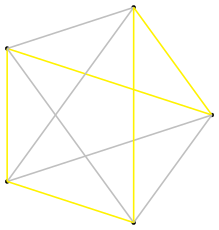
Six points \(A,B,C,D,E\) and \(F\) lie in three dimensional space and are in general positions, that is, no three are collinear and no four lie on a plane. All possible line segments joining pairs of points are drawn and coloured either gold or silver. Prove that there is a triangle whose edges are entirely of one colour. {[}\(Hint\): consider segments radiating from \(A.\){]} Give a sketch showing that the result is false for five points in general positions.
Solution: Consider the \(5\) segements radiating from \(A\). By the pigeonhole principle, at least \(3\) of them must be the same colour (say gold and say reaching \(B,C,D\)). If any of the segments joining any of \(B,C,D\) are gold then we have found a monochromatic gold triangle. But if none of them are gold, they are all silver, therefore \(BCD\) is a monochromatic silver triangle.
1988 Paper 1 Q3
Two points \(P\) and \(Q\) lie within, or on the boundary of, a square of side 1cm, one corner of which is the point \(O\). Show that the length of at least one of the lines \(OP,PQ\) and \(QO\) must be less than or equal to \((\sqrt{6}-\sqrt{2})\) cm.
Solution: First note that \((\sqrt{6} - \sqrt{2})^2 = 8 - 2\sqrt{12} = 8 - 4\sqrt{3}\) and since \(49 > 16 \times 3\) \(\sqrt{6}-\sqrt{2} > 1\). Therefore we can assume without loss of generality that \(P\) and \(Q\) both do not lie on the same side as each other, a side containing \(O\), otherwise one of those lengths would be \(1 \text{ cm} < (\sqrt{6}-\sqrt{2}) \text{ cm} \). Let \(O = (0,0)\), \(P = (1,x)\), \(Q = (y,1)\), then our lengths squared are: \(1 + x^2, 1 + y^2, (1-x)^2+(1-y)^2\). To maximise the length of the smallest side, each side should be equal in length (otherwise we could increase the length of the smallest side by moving the point between the shortest side and the longest side (without affecting the other side). Therefore \(x = y\) and \(1+x^2 = 2(1-x)^2 \Rightarrow x^2-4x+1 = 0 \Rightarrow x = 2 - \sqrt{3} \). Therefore the distances are all \(\sqrt{1+7-4\sqrt{3}} = \sqrt{8-4\sqrt{3}} = (\sqrt{6}-\sqrt{2}) \text{ cm}\)