Problems
Filters
5 problems found
2023 Paper 3 Q8
If \[y = \begin{cases} \mathrm{k}_1(x) & x \leqslant b \\ \mathrm{k}_2(x) & x \geqslant b \end{cases}\] with \(\mathrm{k}_1(b) = \mathrm{k}_2(b)\), then \(y\) is said to be \emph{continuously differentiable} at \(x = b\) if \(\mathrm{k}_1'(b) = \mathrm{k}_2'(b)\).
- Let \(\mathrm{f}(x) = x\mathrm{e}^{-x}\). Verify that, for all real \(x\), \(y = \mathrm{f}(x)\) is a solution to the differential equation \[\frac{\mathrm{d}^2 y}{\mathrm{d}x^2} + 2\frac{\mathrm{d}y}{\mathrm{d}x} + y = 0\] and that \(y = 0\) and \(\dfrac{\mathrm{d}y}{\mathrm{d}x} = 1\) when \(x = 0\). Show that \(\mathrm{f}'(x) \geqslant 0\) for \(x \leqslant 1\).
- You are given the differential equation \[\frac{\mathrm{d}^2 y}{\mathrm{d}x^2} + 2\left|\frac{\mathrm{d}y}{\mathrm{d}x}\right| + y = 0\] where \(y = 0\) and \(\dfrac{\mathrm{d}y}{\mathrm{d}x} = 1\) when \(x = 0\). Let \[y = \begin{cases} \mathrm{g}_1(x) & x \leqslant 1 \\ \mathrm{g}_2(x) & x \geqslant 1 \end{cases}\] be a solution of the differential equation which is continuously differentiable at \(x = 1\). Write down an expression for \(\mathrm{g}_1(x)\) and find an expression for \(\mathrm{g}_2(x)\).
- State the geometrical relationship between the curves \(y = \mathrm{g}_1(x)\) and \(y = \mathrm{g}_2(x)\).
- Prove that if \(y = \mathrm{k}(x)\) is a solution of the differential equation \[\frac{\mathrm{d}^2 y}{\mathrm{d}x^2} + p\frac{\mathrm{d}y}{\mathrm{d}x} + qy = 0\] in the interval \(r \leqslant x \leqslant s\), where \(p\) and \(q\) are constants, then, in a suitable interval which you should state, \(y = \mathrm{k}(c - x)\) satisfies the differential equation \[\frac{\mathrm{d}^2 y}{\mathrm{d}x^2} - p\frac{\mathrm{d}y}{\mathrm{d}x} + qy = 0\,.\]
- You are given the differential equation
\[\frac{\mathrm{d}^2 y}{\mathrm{d}x^2} + 2\left|\frac{\mathrm{d}y}{\mathrm{d}x}\right| + 2y = 0\]
where \(y = 0\) and \(\dfrac{\mathrm{d}y}{\mathrm{d}x} = 1\) when \(x = 0\).
Let \(\mathrm{h}(x) = \mathrm{e}^{-x}\sin x\). Show that \(\mathrm{h}'\!\left(\frac{1}{4}\pi\right) = 0\).
It is given that \(y = \mathrm{h}(x)\) satisfies the differential equation in the interval \(-\frac{3}{4}\pi \leqslant x \leqslant \frac{1}{4}\pi\) and that \(\mathrm{h}'(x) \geqslant 0\) in this interval.
In a solution to the differential equation which is continuously differentiable at \((n + \frac{1}{4})\pi\) for all \(n \in \mathbb{Z}\), find \(y\) in terms of \(x\) in the intervals
- \(\frac{1}{4}\pi \leqslant x \leqslant \frac{5}{4}\pi\),
- \(\frac{5}{4}\pi \leqslant x \leqslant \frac{9}{4}\pi\).
2022 Paper 2 Q4
- Show that the function \(\mathrm{f}\), given by the single formula \(\mathrm{f}(x) = |x| - |x-5| + 1\), can be written without using modulus signs as \[\mathrm{f}(x) = \begin{cases} -4 & x \leqslant 0\,,\\ 2x - 4 & 0 \leqslant x \leqslant 5\,,\\ 6 & 5 \leqslant x\,.\end{cases}\] Sketch the graph with equation \(y = \mathrm{f}(x)\).
- The function \(\mathrm{g}\) is given by: \[\mathrm{g}(x) = \begin{cases} -x & x \leqslant 0\,,\\ 3x & 0 \leqslant x \leqslant 5\,,\\ x + 10 & 5 \leqslant x\,.\end{cases}\] Use modulus signs to write \(\mathrm{g}(x)\) as a single formula.
- Sketch the graph with equation \(y = \mathrm{h}(x)\), where \(\mathrm{h}(x) = x^2 - x - 4|x| + |x(x-5)|\).
- The function \(\mathrm{k}\) is given by: \[\mathrm{k}(x) = \begin{cases} 10x & x \leqslant 0\,,\\ 2x^2 & 0 \leqslant x \leqslant 5\,,\\ 50 & 5 \leqslant x\,.\end{cases}\] Use modulus signs to write \(\mathrm{k}(x)\) as a single formula, explicitly verifying that your formula is correct.
2006 Paper 2 Q5
The notation \({\lfloor } x \rfloor\) denotes the greatest integer less than or equal to the real number \(x\). Thus, for example, \(\lfloor \pi\rfloor =3\,\), \(\lfloor 18\rfloor =18\,\) and \(\lfloor-4.2\rfloor = -5\,\).
- Two curves are given by \(y= x^2+3x-1\) and \(y=x^2 +3\lfloor x\rfloor -1\,\). Sketch the curves, for \(1\le x \le 3\,\), on the same axes. Find the area between the two curves for \(1\le x \le n\), where \(n\) is a positive integer.
- Two curves are given by \(y= x^2+3x-1\) and \(y=\lfloor x\rfloor ^2+3\lfloor x\rfloor -1\,\). Sketch the curves, for \(1\le x \le 3\,\), on the same axes. Show that the area between the two curves for \(1\le x \le n\), where \(n\) is a positive integer, is \[ \tfrac 16 (n-1)(3n+11)\,. \]
Solution:
- \(\,\)
The difference between the curves is \(3x - 3\lfloor x \rfloor\), which has area \(\frac32\) for each step. Therefore the area between the curves from \(1 \leq x \leq n\) is \(\frac32 (n-1)\)

- \(\,\)
The area between the curves is \(x^2 - \lfloor x \rfloor ^2 + 3(x - \lfloor x \rfloor)\). Looking at \begin{align*} && A &= \int_1^n \left ( x^2 - \lfloor x \rfloor ^2 \right )\d x \\ &&&= \frac{n^3-1^3}{3} - \sum_{k=1}^{n-1} k^2 \\ &&&= \frac{(n-1)(n^2+n+1)}{3} - \frac{(n-1)n(2n-1)}{6} \\ &&&= \frac{(n-1) \left (2n^2+2n+2-2n^2+n \right)}{6} \\ &&&= \frac{(n-1)(3n+2)}{6} \end{align*} Therefore the total area is \(\frac{(n-1)(3n+2)}{6}+\frac32(n-1) = \frac{(n-1)}{6}\left ( 3n+2+9\right) =\frac{(n-1)(3n+11)}{6}\)

2003 Paper 2 Q6
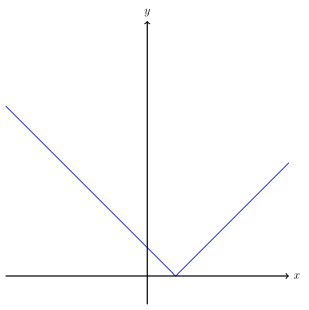
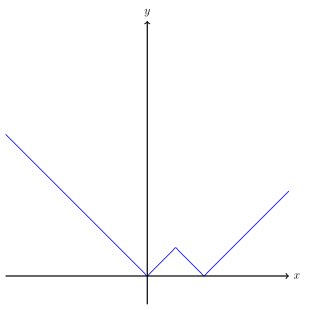
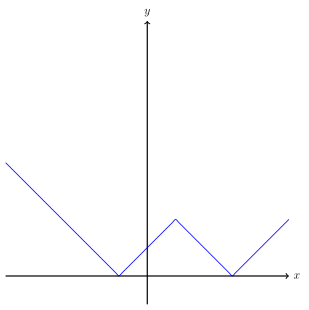
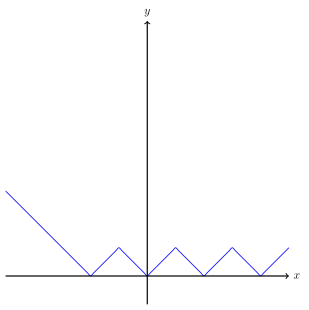
The function \(\f\) is defined by $$ \f(x)= \vert x-1 \vert\;, $$ where the domain is \({\bf R}\,\), the set of all real numbers. The function \(\g_n =\f^n\), with domain \({\bf R}\,\), so for example \(\g_3(x) = \f(\f(\f(x)))\,\). In separate diagrams, sketch graphs of \(\g_1\,\), \(\g_2\,\), \(\g_3\,\) and \(\g_4\,\). The function \(\h\) is defined by \[ \h(x) = |\sin {{{\pi}x} \over 2}|, \] where the domain is \({\bf R}\,\). Show that if \(n\) is even, \[ \int_0^n\,\big( \h(x)-\g_n(x)\big)\,\d x = \frac{2n}{\pi} -\frac{n}2\;. \]
Solution:
2000 Paper 1 Q8
Show that \[ \int_{-1}^1 \vert \, x\e^x \,\vert \d x =- \int_{-1}^0 x\e^x \d x + \int_0^1 x\e^x \d x \] and hence evaluate the integral. Evaluate the following integrals:
- \(\displaystyle \int_0^4 \vert\, x^3-2x^2-x+2 \,\vert \, \d x\,;\)
- \(\displaystyle \int_{-\pi}^\pi \vert\, \sin x +\cos x \,\vert \; \d x\,.\)
Solution: \begin{align*} && \int_{-1}^1 |x e^x |\d x &= \int_{-1}^0 |xe^x| \d x + \int_0^1 |xe^x| \d x \\ &&&= \int_{-1}^0 -xe^x \d x + \int_0^1 x \e^x \d x \\ &&&= -\int_{-1}^0 xe^x \d x + \int_0^1 x \e^x \d x \\ \\ && \int xe^x \d x &= xe^x - \int e^x \d x \\ &&&= xe^x - e^x \\ \\ \Rightarrow && \int_{-1}^1 |x e^x |\d x &= \left [ xe^x - e^x \right]_0^{-1}+ \left [ xe^x - e^x \right]_0^{1} \\ &&&= -e^{-1}-e^{-1} +e^{0} + e^1 - e^1 +e^0 \\ &&&= 2-2e^{-1} \end{align*}
- \(\,\) \begin{align*} && I &= \int_0^4 | x^3-2x^2-x+2| \d x \\ &&&= \int_0^4 |(x-2)(x-1)(x+1)| \d x\\ &&&= \int_0^1( x^3-2x^2-x+2) \d x- \int_1^2 ( x^3-2x^2-x+2) \d x + \int_2^4 ( x^3-2x^2-x+2) \d x \\ &&&= \left [\frac14 x^4-\frac23 x^3- \frac12 x^2 +2x \right]_0^1 - \left [\frac14 x^4-\frac23 x^3- \frac12 x^2 +2x \right]_1^2 + \left [\frac14 x^4-\frac23 x^3- \frac12 x^2 +2x \right]_2^4 \\ &&&= 2 \left ( \frac14 - \frac23 -\frac12 + 2\right) - 2 \left ( \frac14 2^4 - \frac23 2^3 -\frac12 2^2 + 2 \cdot 2\right)+ \left ( \frac14 4^4 - \frac23 4^3 -\frac12 4^2 + 2 \cdot 4\right) \\ &&&= \frac{133}{6} \end{align*}
- \(\,\) \begin{align*} && J &= \int_{-\pi}^\pi | \sin x + \cos x | \d x \\ &&&= \int_{-\pi}^{\pi} | \sqrt{2} \sin(x + \tfrac{\pi}{4})| \d x \\ &&&= 2\sqrt{2}\int_0^\pi \sin x \d x \\ &&&= 4\sqrt{2} \end{align*}