Problems
Filters
1 problem found
2025 Paper 3 Q10
A plank \(AB\) of length \(L\) initially lies horizontally at rest along the \(x\)-axis on a flat surface, with \(A\) at the origin. Point \(C\) on the plank is such that \(AC\) has length \(sL\), where \(0 < s < 1\). End \(A\) is then raised vertically along the \(y\)-axis so that its height above the horizontal surface at time \(t\) is \(h(t)\), while end \(B\) remains in contact with the flat surface and on the \(x\)-axis. The function \(h(t)\) satisfies the differential equation $$\frac{d^2h}{dt^2} = -\omega^2 h, \text{ with } h(0) = 0 \text{ and } \frac{dh}{dt} = \omega L \text{ at } t = 0$$ where \(\omega\) is a positive constant. A particle \(P\) of mass \(m\) remains in contact with the plank at point \(C\).
- Show that the \(x\)-coordinate of \(P\) is \(sL\cos\omega t\), and find a similar expression for its \(y\)-coordinate.
- Find expressions for the \(x\)- and \(y\)-components of the acceleration of the particle.
- \(N\) and \(F\) are the upward normal and frictional components, respectively, of the force of the plank on the particle. Show that $$N = mg(1 - k\sin\omega t)\cos\omega t$$ and that $$F = mgsk\frac{\omega^2}{g}\tan\omega t$$ where \(k = \frac{L\omega^2}{g}\).
- The coefficient of friction between the particle and the plank is \(\tan\alpha\), where \(\alpha\) is an acute angle.
Show that the particle will not slip initially, provided \(sk < \tan\alpha\).
Show further that, in this case, the particle will slip
- while \(N\) is still positive,
- when the plank makes an angle less than \(\alpha\) to the horizontal.
Solution:
- Since we have \(h'' + \omega^2 h = 0\) we must have that \(h(t) = A \cos \omega t + B \sin \omega t\). The initial conditions tell us that \(A = 0\) and \(B = L\), so \(h(t) = L \sin \omega t\).
Therefore we can see the angle at \(B\) is \(\omega t\) and so \(P\) has \(y\)-coordinate \((1-s)L \sin \omega t\) and \(x\)-coordinate \(sL \cos \omega t\)
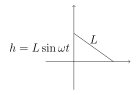
- If the position is \(\binom{sL \cos \omega t}{(1-s) L \sin \omega t}\) then the acceleration is \(-\omega^2 \binom{sL \cos \omega t}{(1-s) L \sin \omega t}\)
- \begin{align*} \text{N2}(\rightarrow): && - F\cos \omega t + N \sin \omega t &= -m\omega^2 sL \cos \omega t\\ \text{N2}(\uparrow): && -mg + F\sin \omega t + N \cos \omega t &= -m\omega^2 (1-s) L \sin \omega t \\ \Rightarrow && \begin{pmatrix} \cos \omega t & -\sin \omega t \\ \sin \omega t & \cos \omega t \end{pmatrix} \begin{pmatrix} F \\ N \end{pmatrix} &= \begin{pmatrix} m\omega^2 s L \cos \omega t \\ mg - m\omega^2(1-s)L \sin \omega t \end{pmatrix} \\ \Rightarrow && \begin{pmatrix}F \\ N \end{pmatrix} &= \begin{pmatrix} \cos \omega t & \sin \omega t \\ -\sin \omega t & \cos \omega t \end{pmatrix} \begin{pmatrix} m\omega^2 s L \cos \omega t \\ mg - m\omega^2(1-s)L \sin \omega t \end{pmatrix} \\ \Rightarrow && N &= m \omega^2 s L (-\sin \omega t \cos \omega t) + mg \cos \omega t - m \omega^2 (1-s)L \sin \omega t \cos \omega t \\ &&&=mg \cos \omega t - m \omega^2 L \sin \omega t \cos \omega t \\ &&&= mg \cos \omega t \left (1 - \frac{L \omega^2}{g} \sin \omega t \right) \\ &&&= mg (1 - k \sin \omega t) \cos \omega t \\ \Rightarrow && F &= m \omega^2 s L \cos^2 \omega t + mg \sin \omega t - m \omega^2 (1-s) L \sin ^2 \omega t \\ &&&= m \omega^2 s L + mg \sin \omega t - m \omega^2 L \sin^2 \omega t \\ &&&= mg \frac{\omega^2 L}{g} s + mg(1-\frac{\omega^2 L}{g} \sin \omega t)\sin \omega t \\ &&&= mg sk + mg(1-k \sin \omega t) \cos \omega t \tan \omega t \\ &&&= mgsk + N \tan \omega t \end{align*}
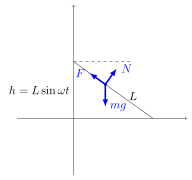
- The particle will not slip if \(F < \tan \alpha N\). When \(t = 0\), \(N = mg, F = mgsk\), but clearly \(sk < \tan \alpha \Rightarrow mgsk = F < \tan \alpha mg = \tan \alpha N\). The particle will slip when: \(F > \tan \alpha N\), but we have \(F = mgsk + N \tan \omega t\). Clearly when \(\omega t = \alpha\) we have reached a point where \(F > \tan \alpha N\). Therefore we must slip before we reach this point, ie at a point where the plank makes an angle of less than \(\alpha\) to the horizontal. Notice also that \(N\) changes sign when \(1-k \sin \omega t = 0\), however, to do this \(N\) must become very small, smaller than \(mgsk\), therefore we must slip before this point too. Since we slip before either condition occurs, we must be in a position when \(N\) is positive AND the plank still makes a shallow angle.