Problems
Filters
2 problems found
2002 Paper 3 Q10
A light hollow cylinder of radius \(a\) can rotate freely about its axis of symmetry, which is fixed and horizontal. A particle of mass \(m\) is fixed to the cylinder, and a second particle, also of mass \(m\), moves on the rough inside surface of the cylinder. Initially, the cylinder is at rest, with the fixed particle on the same horizontal level as its axis and the second particle at rest vertically below this axis. The system is then released. Show that, if \(\theta\) is the angle through which the cylinder has rotated, then \[ \ddot{\theta} = {g \over 2a} \l \cos \theta - \sin \theta \r \,, \] provided that the second particle does not slip. Given that the coefficient of friction is \( (3 + \sqrt{3})/6\), show that the second particle starts to slip when the cylinder has rotated through \(60^\circ\).
1990 Paper 1 Q13
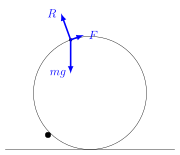
A rough circular cylinder of mass \(M\) and radius \(a\) rests on a rough horizontal plane. The curved surface of the cylinder is in contact with a smooth rail, parallel to the axis of the cylinder, which touches the cylinder at a height \(a/2\) above the plane. Initially the cylinder is held at rest. A particle of mass \(m\) rests in equilibrium on the cylinder, and the normal reaction of the cylinder on the particle makes an angle of \(\theta\) with the upward vertical. The particle is on the same side of the centre of the cylinder as the rail. The coefficient of friction between the cylinder and the particle and between the cylinder and the plane are both \(\mu\). Obtain the condition on \(\theta\) for the particle to rest in equilibrium. Show that, if the cylinder is released, equilibrium of both particle and cylinder is possible provided another inequality involving \(\mu\) and \(\theta\) (which should be found explicitly) is satisfied. Determine the largest possible value of \(\theta\) for equilibrium, if \(m=7M\) and \(\mu=0.75\).
Solution: