Problems
Filters
7 problems found
2018 Paper 3 Q10
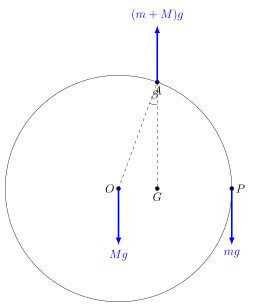
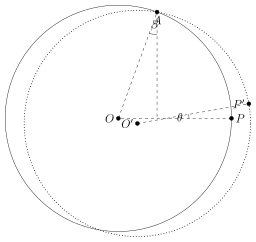
A uniform disc with centre \(O\) and radius \(a\) is suspended from a point \(A\) on its circumference, so that it can swing freely about a horizontal axis \(L\) through \(A\). The plane of the disc is perpendicular to \(L\). A particle \(P\) is attached to a point on the circumference of the disc. The mass of the disc is \(M\) and the mass of the particle is \(m\). In equilibrium, the disc hangs with \(OP\) horizontal, and the angle between \(AO\) and the downward vertical through \(A\) is \(\beta\). Find \(\sin\beta\) in terms of \(M\) and \(m\) and show that \[ \frac{AP}{a} = \sqrt{\frac{2M}{M+m}} \,. \] The disc is rotated about \(L\) and then released. At later time \(t\), the angle between \(OP\) and the horizontal is \(\theta\); when \(P\) is higher than \(O\), \(\theta\) is positive and when \(P\) is lower than \(O\), \(\theta\) is negative. Show that \[ \tfrac12 I \dot\theta^2 + (1-\sin\beta)ma^2 \dot \theta^2 + (m+M)g a\cos\beta \, (1- \cos\theta) \] is constant during the motion, where \(I\) is the moment of inertia of the disc about \(L\). Given that \(m= \frac 32 M\) and that \(I=\frac32Ma^2\), show that the period of small oscillations is \[ 3\pi \sqrt{\frac {3a}{5g}} \,. \]
Solution:

2013 Paper 3 Q10
A uniform rod \(AB\) has mass \(M\) and length \(2a\). The point \(P\) lies on the rod a distance \(a-x\) from~\(A\). Show that the moment of inertia of the rod about an axis through \(P\) and perpendicular to the rod is \[ \tfrac13 M(a^2 +3x^2)\,. \] The rod is free to rotate, in a horizontal plane, about a fixed vertical axis through \(P\). Initially the rod is at rest. The end \(B\) is struck by a particle of mass \(m\) moving horizontally with speed \(u\) in a direction perpendicular to the rod. The coefficient of restitution between the rod and the particle is \(e\). Show that the angular velocity of the rod immediately after impact is \[ \frac{3mu(1+e)(a+x)}{M(a^2+3x^2) +3m(a+x)^2}\,. \] In the case \(m=2M\), find the value of \(x\) for which the angular velocity is greatest and show that this angular velocity is \(u(1+e)/a\,\).
1999 Paper 3 Q11
Calculate the moment of inertia of a uniform thin circular hoop of mass \(m\) and radius \(a\) about an axis perpendicular to the plane of the hoop through a point on its circumference. The hoop, which is rough, rolls with speed \(v\) on a rough horizontal table straight towards the edge and rolls over the edge without initially losing contact with the edge. Show that the hoop will lose contact with the edge when it has rotated about the edge of the table through an angle \(\theta\), where \[ \cos\theta = \frac 12 +\frac {v^2}{2ag}. \] %Give the corresponding result for a smooth hoop and table.
1998 Paper 3 Q9
A uniform right circular cone of mass \(m\) has base of radius \(a\) and perpendicular height \(h\) from base to apex. Show that its moment of inertia about its axis is \({3\over 10} ma^2\), and calculate its moment of inertia about an axis through its apex parallel to its base. \newline[{\em Any theorems used should be stated clearly.}] The cone is now suspended from its apex and allowed to perform small oscillations. Show that their period is $$ 2\pi\sqrt{ 4h^2 + a^2\over 5gh} \,. $$ \newline[{\em You may assume that the centre of mass of the cone is a distance \({3\over 4}h\) from its apex.}]
1993 Paper 3 Q11
In this question, all gravitational forces are to be neglected. A rigid frame is constructed from 12 equal uniform rods, each of length \(a\) and mass \(m,\) forming the edges of a cube. Three of the edges are \(OA,OB\) and \(OC,\) and the vertices opposite \(O,A,B\) and \(C\) are \(O',A',B'\) and \(C'\) respectively. Forces act along the lines as follows, in the directions indicated by the order of the letters: \begin{alignat*}{3} 2mg\mbox{ along }OA, & \qquad & mg\mbox{ along }AC', & \qquad & \sqrt{2}mg\mbox{ along }O'A,\\ \sqrt{2}mg\mbox{ along }OA', & & 2mg\mbox{ along }C'B, & & mg\mbox{ along }A'C. \end{alignat*}
- The frame is freely pivoted at \(O\). Show that the direction of the line about which it will start to rotate is $\begin{pmatrix}1\\ 1\\ 2 \end{pmatrix}$ with respect to axes along \(OA\), \(OB\) and \(OC\) respectively.
- Show that the moment of inertia of the rod \(OA\) about the axis \(OO'\) is \(2ma^2/9\) and about a parallel axis through its mid-point is \(ma^2/18\). Hence find the moment of inertia of \(B'C\) about \(OO'\) and show that the moment of inertia of the frame about \(OO'\) is \(14ma^2/3\). If the frame is freely pivoted about the line \(OO'\) and the forces continue to act along the specified lines, find the initial angular acceleration of the frame.
1990 Paper 3 Q11
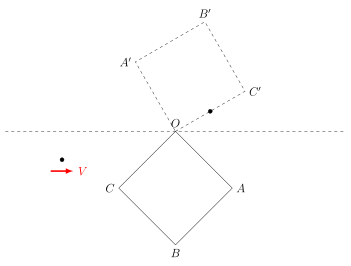
The points \(O,A,B\) and \(C\) are the vertices of a uniform square lamina of mass \(M.\) The lamina can turn freely under gravity about a horizontal axis perpendicular to the plane of the lamina through \(O\). The sides of the lamina are of length \(2a.\) When the lamina is haning at rest with the diagonal \(OB\) vertically downwards it is struck at the midpoint of \(OC\) by a particle of mass \(6M\) moving horizontally in the plane of the lamina with speed \(V\). The particle adheres to the lamina. Find, in terms of \(a,M\) and \(g\), the value which \(V^{2}\) must exceed for the lamina and particle to make complete revolutions about the axis.
Solution:
1989 Paper 2 Q13
A body of mass \(m\) and centre of mass \(O\) is said to be dynamically equivalent to a system of particles of total mass \(m\) and centre of mass \(O\) if the moment of inertia of the system of particles is the same as the moment of inertia of the body, about any axis through \(O\). Show that this implies that the moment of inertia of the system of particles is the same as that of the body about any axis. Show that a uniform rod of length \(2a\) and mass \(m\) is dynamically equivalent to a suitable system of three particles, one at each end of the rod, and one at the midpoint. Use this result to deduce that a uniform rectangular lamina of mass \(M\) is dynamically equivalent to a system consisting of particles each of mass \(\frac{1}{36}M\) at the corners, particles each of mass \(\frac{1}{9}M\) at the midpoint of each side, and a particle of mass \(\frac{4}{9}M\) at the centre. Hence find the moment of inertia of a square lamina, of side \(2a\) and mass \(M,\) about one of its diagonals. The mass per unit length of a thin rod of mass \(m\) is proportional to the distance from one end of the rod, and a dynamically equivalent system consists of one particle at each end of the rod and one at the midpoint. Write down a set of equations which determines these masses, and show that, in fact, only two particles are required.
Solution: This follows from the parallel axis theorem. The moment of inertia of both the system and the body will be equal to the moment of inertia about the axis through the centre of mass plus the distance from the axis. Suppose we have an axis through the centre of the rod, then consider the coordinate frame with the axis and as the \(y\) axis and the intersection between rod and axis at the origin. Suppose the angle between the rod and the \(x\) axis is \(\theta\) Then the moment of inertia for the rod will be: \begin{align*} \int_{-a}^a\frac{M}{2a} x^2 \cos^2 \theta \d x &= \frac{M}{2a}\frac23 a^3 \cos^2 \theta \\ &= \frac13 M \cos^2 \theta a^2 \end{align*} Suppose we put a weights of mass \(\frac16\) at where the end of the rod would be, and a weight of mass \(\frac23\) at the centre, then the moment of inertial would be: \begin{align*} I &= \frac23M \cdot 0^2 + \frac16M (a \cos \theta)^2+\frac16 (a \cos \theta)^2 \\ &= \frac13 M \cos^2 \theta a^2 \end{align*} Therefore it has the same mass (\(M\)), centre of mass (\(O\)) and moment of inertia for any axis through the COM so the two systems are dynamically equivalent. A uniform lamina can be broken down into a system with a rod of mass \(\frac23 M\) through the middle parallel to one side and rods of mass \(\frac16 M\) on each of those parallel sides. Those rods are then equivalent to a particle at the centre mass \(\frac23 \cdot \frac23 M = \frac49 M\) a mass at the centre of those sides of mass \(\frac23 \cdot \frac 16 M = \frac19 M\), a mass at the centre of the parallel sides of mass \(\frac16 \cdot \frac23 M = \frac 19 M\) and masses at the corners of mass \(\frac16 \cdot \frac16 M = \frac1{36} M\) The moment of inertia of a square lamina side length \(2a\) mass \(M\) about a diagonal through the centre will be: \begin{align*} I &= \sum_{\text{points}} md^2 \\ &= 2 \cdot \frac1{36}M \cdot \frac12 (2a)^2 \\ &= \frac19 Ma^2 \end{align*} Suppose the rod is on \([0, 1]\), then we must have: \(\displaystyle \int_0^1 \rho x \d x = m \Rightarrow \rho = 2m\). The centre of mass will be at: \begin{align*} \overline{x} &= \frac1m \int_0^1 2m x^2 \d x \\ &= \frac23 \end{align*} The moment of inertial for a line through \((\frac23, 0)\) with angle \(\theta\) will be: \begin{align*} I &= \int_0^12mx \l\frac23 - x \r^2\cos^2 \theta \d x \\ &= 2m\cos^2 \theta \cdot \frac1{36} \\ &= \frac1{18}m \cos^2 \theta \end{align*} Therefore if the particles have mass \(m_0, m_{1/2}, m_1\) we must have: \begin{align*} &&m &= m_0 + m_{1/2} + m_1 \\ &&\frac23m &= \frac12 m_{1/2} + m_1 \\ &&\frac1{18}m \cos^2 \theta &= m_0\frac49 \cos^2 \theta + m_{1/2}\frac1{36} \cos^2 \theta + m_1 \frac1{9} \cos^2 \theta \\ \Rightarrow && m &= 8 m_0 +\frac12 m_{1/2}+2m_1 \\ \Rightarrow && m_0 &= 0 \\ && m_{1/2} &= \frac23 \\ && m_1 &= \frac13 \end{align*} Since \(m_0 = 0\) the particle at the "thin" end of the rod could be ignored.