A plane \(\pi\) in 3-dimensional space is given by the vector equation \(\mathbf{r}\cdot\mathbf{n}=p,\) where \(\mathbf{n}\) is a unit vector and \(p\) is a non-negative real number. If \(\mathbf{x}\) is the position vector of a general point \(X\), find the equation of the normal to \(\pi\) through \(X\) and the perpendicular distance of \(X\) from \(\pi\).
The unit circles \(C_{i},\) \(i=1,2,\) with centres \(\mathbf{r}_{i},\) lie in the planes \(\pi_{i}\) given by \(\mathbf{r}\cdot\mathbf{n}_{i}=p_{i},\) where the \(\mathbf{n}_{i}\) are unit vectors, and \(p_{i}\) are non-negative real numbers. Prove that there is a sphere whose surface contains both circles only if there is a real number \(\lambda\) such that
\[
\mathbf{r}_{1}+\lambda\mathbf{n}_{1}=\mathbf{r}_{2}\pm\lambda\mathbf{n}_{2}.
\]
Hence, or otherwise, deduce the necessary conditions that
\[
(\mathbf{r}_{1}-\mathbf{r}_{2})\cdot(\mathbf{n}_{1}\times\mathbf{n}_{2})=0
\]
and that
\[
(p_{1}-\mathbf{n}_{1}\cdot\mathbf{r}_{2})^{2}=(p_{2}-\mathbf{n}_{2}\cdot\mathbf{r}_{1})^{2}.
\]
Interpret each of these two conditions geometrically.
Solution: The equation of the normal to \(\pi\) through \(X\) is \(\mathbf{x} + \lambda \mathbf{n}\). The distance is \(|\mathbf{x}\cdot \mathbf{n}-p|\)
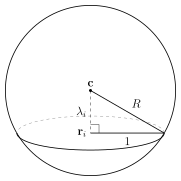
We know that the centre of the sphere must lie above the centre of the circle following the normal, ie \(\mathbf{c} = \mathbf{r}_1+\lambda_1 \mathbf{n}_1 = \mathbf{r}_2+\lambda_2 \mathbf{n}_2\)
We can also see that \(R^2 = 1 + \lambda_1^2 = 1 + \lambda_2^2 \Rightarrow \lambda_1 = \pm \lambda_2 \), from which we obtain the desired result.
Therefore the condition is
\begin{align*}
&& \mathbf{r}_1+\lambda \mathbf{n}_1 &= \mathbf{r}_2 \pm \lambda \mathbf{n}_2 \tag{1}\\
&& \mathbf{r}_1 - \mathbf{r}_2 &= \lambda(\pm \mathbf{n}_1 - \mathbf{n}_2) \\
\Rightarrow && (\mathbf{r}_{1}-\mathbf{r}_{2})\cdot(\mathbf{n}_{1}\times\mathbf{n}_{2}) &= (\lambda(\pm \mathbf{n}_1 - \mathbf{n}_2))\cdot(\mathbf{n}_{1}\times\mathbf{n}_{2}) \\
&&&= \lambda \left (\pm \mathbf{n}_1 \cdot ( \mathbf{n}_{1}\times\mathbf{n}_{2}) - \mathbf{n}_2 \cdot (\mathbf{n}_{1}\times\mathbf{n}_{2})\right) \\
&&&= 0 \\
\\
\mathbf{n}_1 \cdot (1)&& \mathbf{r}_1 \cdot \mathbf{n}_1+\lambda \mathbf{n}_1 \cdot \mathbf{n}_1 &= \mathbf{r}_2 \cdot \mathbf{n}_1 \pm \lambda \mathbf{n}_2 \cdot \mathbf{n}_1 \\
&& p_1 + \lambda &= \mathbf{r}_2 \cdot \mathbf{n}_1 \pm \lambda \mathbf{n}_2 \cdot \mathbf{n}_1 \\ \\
\mathbf{n}_2 \cdot (1)&& \mathbf{r}_1 \cdot \mathbf{n}_2+\lambda \mathbf{n}_1 \cdot \mathbf{n}_2 &= \mathbf{r}_2 \cdot \mathbf{n}_2 \pm \lambda \mathbf{n}_2 \cdot \mathbf{n}_2 \\
&& \mathbf{r}_1 \cdot \mathbf{n}_2+\lambda \mathbf{n}_1 \cdot \mathbf{n}_2 &= p_2 \pm \lambda \\
&& \pm \lambda -\lambda \mathbf{n}_1\cdot\mathbf{n}_2 &= \mathbf{r}_1 \cdot \mathbf{n}_2 - p_2 \\
&&&= \pm (\mathbf{r}_2\cdot \mathbf{n}_1 - p_1) \\
\Rightarrow && (p_{1}-\mathbf{n}_{1}\cdot\mathbf{r}_{2})^{2}&=(p_{2}-\mathbf{n}_{2}\cdot\mathbf{r}_{1})^{2}
\end{align*}
The first condition means the line between the centres lies in the plane spanned by the normal of the two planes \(\pi_1\) and \(\pi_2\).
The second condition means that the distance of the center to the other plane is the same for both centres/planes.