Problems
Filters
4 problems found
2025 Paper 3 Q9
In this question, \(n \geq 2\).
- A solid, of uniform density, is formed by rotating through \(360°\) about the \(y\)-axis the region bounded by the part of the curve \(r^{n-1}y = r^n - x^n\) with \(0 \leq x \leq r\), and the \(x\)- and \(y\)-axes. Show that the \(y\)-coordinate of the centre of mass of this solid is \(\frac{nr}{2(n+1)}\).
- Show that the normal to the curve \(r^{n-1}y = r^n - x^n\) at the point \((rp, r(1-p^n))\), where \(0 < p < 1\), meets the \(y\)-axis at \((0, Y)\), where \(Y = r\left(1 - p^n - \frac{1}{np^{n-2}}\right)\). In the case \(n = 4\), show that the greatest value of \(Y\) is \(\frac{1}{4}r\).
- A solid is formed by rotating through \(360°\) about the \(y\)-axis the region bounded by the curves \(r^3y = r^4 - x^4\) and \(ry = -(r^2 - x^2)\), both for \(0 \leq x \leq r\). \(A\) and \(B\) are the points \((0, -r)\) and \((0, r)\), respectively, on the surface of the solid. Show that the solid can rest in equilibrium on a horizontal surface with the vector \(\overrightarrow{AB}\) at three different, non-zero, angles to the upward vertical. You should not attempt to find these angles.
Solution:
- By symmetry, the centre of mass will lie on the \(y\) axis. Notice that a single slice (when revolved around the \(y\)-axis) has volume \(y \cdot \pi \cdot ((x+ \delta x)^2 - x^2) = 2 \pi x y \delta x\), and COM at height \(\frac12 y\) so we can conclude: \[ \overline{y} \sum_{\delta x} 2 \pi x y \delta x = \sum_{\delta x} \pi xy^2 \delta x\] \begin{align*} && \overline{y} \int_0^r 2xy \d x &= \int_0^r y^2 x \d x \\ \Rightarrow && \overline{y} 2\int_0^r \left (r - \frac{x^n}{r^{n-1}} \right)x \d x &= \int_0^r \left (r - \frac{x^n}{r^{n-1}} \right)^2 x \d x \\ \Rightarrow && \overline{y} \left [r \frac{x^2}{2} - \frac{1}{r^{n-1}} \frac{x^{n+2}}{n+2} \right]_0^r &= \left [r^2 \frac{x^2}{2} - \frac{2}{r^{n-2}} \frac{x^{n+2}}{n+2} + \frac{1}{r^{2n-2}} \frac{x^{2n+2}}{2n+2} \right]_0^r \\ \Rightarrow && 2\overline{y} \left (\frac{r^3}{2} - \frac{r^3}{n+2} \right) &= \left (\frac12 r^4 - \frac{2}{n+2}r^4 + \frac{1}{2n+2}r^4 \right) \\ \Rightarrow && \overline{y}r^3 \frac{n}{(n+2)} &= r^4\frac{(n+1)(n+2)-2\cdot2\cdot(n+1)+(n+2)}{2(n+1)(n+2)} \\ \Rightarrow && \overline{y} \frac{n}{(n+2)} &= r \left ( \frac{n^2}{2(n+1)(n+2)} \right) \\ \Rightarrow && \overline{y} &= \frac{nr}{2(n+1)} \\ &&&= r \left (1 -p^n \right) \end{align*} as required.

- \begin{align*} && r^{n-1}y &= r^n - x^n \\ \frac{\d}{\d x}: && r^{n-1} \frac{\d y}{\d x} &= -n x^{n-1} \\ && \frac{\d y}{\d x} &= -np^{n-1} \end{align*} Therefor the normal has the equation: \begin{align*} && \frac{y-r(1-p^n)}{x-rp} &= \frac{1}{np^{n-1}} \\ \Rightarrow && Y &= \frac{-rp}{np^{n-1}} + r(1-p^n) \\ &&&= r \left (1 - p^n - \frac{1}{np^{n-2}} \right) \end{align*} If \(n = 4\) then \begin{align*} && Y &= r\left (1 - p^4 - \frac{1}{4p^{2}} \right) \\ \Rightarrow && \frac{\d Y}{\d p} &= r \left (-4p^3 + \frac{1}{2p^3} \right) \end{align*} Therefore there is a stationary point if \(p^6 = \frac18 \Rightarrow p =2^{-1/2}\). Clearly this will be a maximum (sketch or second derivative) therefore, \(Y = r(1 - \frac14 - \frac{2}{4}) = \frac14 r\)
- The centre of mass of this shape can be found using this table: \begin{array}{|c|c|c|} \hline \text{} & \overline{y} & \text{mass} \\ \hline r^3y = r^4 - x^4 & \frac{2r}{5} & \frac{4\pi r^3}{6} = \frac23 \pi r^3\\ ry = -(r^2 - x^2) & -\frac{r}{3}& \frac{2 \pi r^3}{4}=\frac12\pi r^3 \\ \text{combined} & \frac{(\frac25 \cdot \frac23-\frac13 \cdot \frac12)r^4}{\frac76 r^3} = \frac3{35}r & \frac76 \pi r^3\\ \hline \end{array} Normals to the surface through points on the upper surface will meet the \(y\)-axis between \((-\infty, \frac14 r)\), and since \(p = 0 \to -\infty\) and \(p = 1 \to -\frac14 r\), so normals will pass through \((0, \frac3{35}r)\) from two different points. Normals to the surface through points on the lower surface will go through \(-r(1 - p^2 - \frac12) =- r(\frac12 -p^2)\) which ranges monotonically from \(\frac12 r \to -\frac12 r\) so there will be one point where the normal goes through \(\frac3{35}r\). Therefore there are three angles where the vector \(\overrightarrow{AB}\) is not vertical but the normal to the surfaces runs through the centre of mass (ie the the solid can rest in equilibrium)
2021 Paper 3 Q1
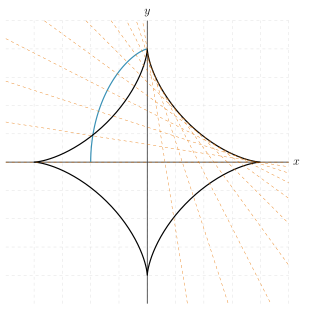
- A curve has parametric equations \[ x = -4\cos^3 t, \qquad y = 12\sin t - 4\sin^3 t. \] Find the equation of the normal to this curve at the point \[ \bigl(-4\cos^3\phi,\; 12\sin\phi - 4\sin^3\phi\bigr), \] where \(0 < \phi < \tfrac{1}{2}\pi\). Verify that this normal is a tangent to the curve \[ x^{2/3} + y^{2/3} = 4 \] at the point \((8\cos^3\phi,\; 8\sin^3\phi)\).
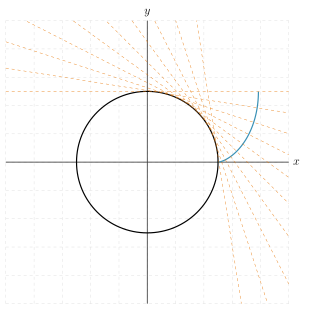
- A curve has parametric equations \[ x = \cos t + t\sin t, \qquad y = \sin t - t\cos t. \] Find the equation of the normal to this curve at the point \[ \bigl(\cos\phi + \phi\sin\phi,\; \sin\phi - \phi\cos\phi\bigr), \] where \(0 < \phi < \tfrac{1}{2}\pi\). Determine the perpendicular distance from the origin to this normal, and hence find the equation of a curve, independent of \(\phi\), to which this normal is a tangent.
Solution:
- \(\,\) \begin{align*}
&& \dot{x} &=12 \cos^2 t \sin t \\
&& \dot{y} &= 12 \cos t - 12 \sin^2 t \cos t \\
&& \frac{\d y}{\d x} &= \frac{12 \cos t - 12 \sin^2 t \cos t}{12 \cos^2 t \sin t} \\
&&&= \frac{1 - \sin^2 t}{\cos t \sin t} \\
&&&= \cot t \\
\\
&& \frac{y - (12\sin\phi - 4\sin^3\phi)}{x - (-4 \cos^3 \phi)} &= - \tan \phi \\
&& y &= -\tan \phi x -4 \cos^3 \phi \tan \phi + 12 \sin \phi -4\sin^3 \phi \\
&&&= -\tan \phi x -4 \cos^2 \phi \sin \phi + 12 \sin \phi -4\sin^3 \phi \\
&&&= -\tan \phi x - 4\sin \phi+12 \sin \phi \\
&&y&= -\tan \phi x + 8 \sin \phi
\end{align*}
Note that when \(x = 8\cos^3 \phi\) we have \(y =-8 \cos^2 \phi \sin \phi + 8 \sin \phi = 8 \sin^3 \phi\). So the point lies on the curve. Notice also that \((8\cos^3 \phi, 8 \sin^ 3\phi)\) is a parametrisation of \(x^{2/3} + y^{2/3} = 4\) and so we can use parametric differentiation to see the gradient is \(\frac{24\sin^2 \phi \cos \phi}{-24\cos^2 \phi\sin\phi} = - \tan \phi\) so it also has the same gradient as required.
- \(\,\) \begin{align*}
&& \dot{x} &= -\sin t + \sin t + t \cos t \\
&&&= t \cos t \\
&& \dot{y} &= \cos t - \cos t + t \sin t \\
&&&= t \sin t \\
&& \frac{\d y}{\d x} &= \frac{t \sin t}{t \cos t} = \tan t \\
\\
&& \frac{y - (\sin \phi - \phi \cos \phi)}{x - (\cos \phi + \phi \sin \phi)} &= -\cot \phi \\
\Rightarrow && y &= -\cot \phi x + (\cos \phi + \phi \sin \phi) \cot \phi + \sin \phi - \phi \cos \phi \\
&&&= -\cot \phi x + \cos \phi \cot \phi + \phi \cos \phi + \sin \phi - \phi \cos \phi \\
&&&= -\cot \phi x + \frac{\cos^2 \phi + \sin^2 \phi}{\sin \phi} \\
&&&= -\cot \phi x + \cosec \phi
\end{align*}
The distance to the origin is \(\displaystyle \frac{|\cosec \phi|}{\sqrt{1 + \cot^2 \phi}} = 1\) so this normal is a tangent to \(x^2 + y^2 = 1\)
2017 Paper 2 Q5
A curve \(C\) is determined by the parametric equations \[ x=at^2 \, , \; y = 2at\,, \] where \(a > 0\).
- Show that the normal to \(C\) at a point \(P\), with non-zero parameter \(p\), meets \(C\) again at a point \(N\), with parameter \(n\), where \[ n= - \left( p + \frac{2}{p} \right). \]
- Show that the distance \(\left| PN \right|\) is given by \[ \vert PN\vert^2 = 16a^2\frac{(p^2+1)^3}{p^4} \] and that this is minimised when \(p^2=2\,\).
- The point \(Q\), with parameter \(q\), is the point at which the circle with diameter \(PN\) cuts \(C\) again. By considering the gradients of \(QP\) and \(QN\), show that \[ 2 = p^2-q^2 + \frac{2q}p. \] Deduce that \(\left| PN \right|\) is at its minimum when \(Q\) is at the origin.
Solution:
- \(\,\) \begin{align*} && \frac{\d x}{\d t} &= 2at \\ && \frac{\d y}{\d t} &= 2a \\ \Rightarrow && \frac{\d y}{\d x} &= \frac1t \\ && -p &= \text{grad of normal} \\ &&&= \frac{y-2ap}{x-ap^2} \\ \Rightarrow && y &= -px + ap^3+2ap \\ && 2an &= -pan^2 + ap^3 + 2ap \\ \Rightarrow && 0 &= pan^2+2an-ap(2+p^2) \\ \Rightarrow && n &= p, -\left ( p + \frac2{p}\right) \\ \Rightarrow && n &= -\left ( p + \frac2{p}\right) \end{align*}
- \(\,\) \begin{align*} && |PN|^2 &= (ap^2-an^2)^2 +(2ap-2an)^2 \\ &&&= a^2(p-n)^2(p+n)^2+4a^2(p-n)^2 \\ &&&= a^2(p-n)^2((p+n)^2+4) \\ &&&= a^2\left(p+p+\frac2p \right)^2 \left ( \left ( -\frac2p\right)^2+4\right)\\ &&&= a^2\left(\frac{2p^2+2}p \right)^2 \left ( \frac{4}{p^2}+4\right)\\ &&&= 16a^2 \frac{(p^2+1)^3}{p^4} \\ \\ && \frac{\d |PN|^2}{\d p^2} &= 16a^2\frac{3(p^2+1)^2p^4-2(p^2+1)^3p^2}{p^8} \\ &&&= 16a^2(p^2+1)^2 \frac{3p^2-2(p^2+1)}{p^6} \\ &&&= 16a^2(p^2+1)^2 \frac{p^2-2}{p^6} \end{align*} Therefore minimized when \(p^2=2\) (clearly a minimum by considering behaviour as \(p^2 \to 0, \infty\))
- If \(PN\) is the diameter of \(PNQ\) then \(QP\) and \(QN\) are perpendicular, ie \begin{align*} && -1 &= \frac{2ap-2aq}{ap^2-aq^2} \cdot \frac{2aq-2an}{aq^2-an^2} \\ &&&= \frac{2}{p+q} \cdot \frac{2}{q+n} \\ &&&= \frac{2}{p+q} \cdot \frac{2}{q - p -\frac{2}{p}} \\ \Rightarrow && 4 &= (p+q)(p+\frac2{p}-q) \\ &&&= p^2-q^2 + \frac{2q}{p} + 2 \\ \Rightarrow && 2 &= p^2 - q^2 + \frac{2q}{p} \end{align*} Therefore \(q = 0 \Rightarrow p^2 = 2 \Rightarrow |PN|\) is at it's minimum.
1989 Paper 1 Q6
The normal to the curve \(y=\mathrm{f}(x)\) at the point \(P\) with coordinates \((x,\mathrm{f}(x))\) cuts the \(y\)-axis at the point \(Q\). Derive an expression in terms of \(x\), \(\mathrm{f}(x)\) and \(\mathrm{f}'(x)\) for the \(y\)-coordinate of \(Q\). If, for all \(x\), \(PQ=\sqrt{\mathrm{e}^{x^{2}}+x^{2}}\), find a differential equation satisfied by \(\mathrm{f}(x)\). If the curve also has a minimum point \((0,-2)\), find its equation.
Solution: The normal to the curve \(y = f(x)\) has gradient \(-\frac{1}{f'(x)}\) and so has equation: \begin{align*} && \frac{Y - f(x)}{X - x} &= -\frac{1}{f'(x)} \\ \Rightarrow && Y &= -\frac{1}{f'(x)}X + \frac{x}{f'(x)}+f(x) \end{align*} Hence the \(Q\) is \(\displaystyle \left (0, f(x) + \frac{x}{f'(x)} \right)\). \begin{align*} && |PQ|^2 &= x^2 + \frac{x^2}{(f'(x))^2} \\ \Rightarrow && x^2 + e^{x^2} &= x^2 + \frac{x^2}{(f'(x))^2} \\ \Rightarrow && (f'(x))^2 &=x^2 e^{-x^2} \end{align*} Therefore \(f'(x) = \pm x e^{-x^2/2}\). If \(f(x)\) has a minimum at \((0,-2)\) then \(f''(0) > 0\), and \(f''(x) = \pm (e^{-x^2/2} - x^2e^{-x^2/2}) = \pm e^{-x^2/2}(1-x^2)\) so we should take the positive branch of the solution, ie \(f'(x) = xe^{-x^2/2}\). Therefore \(f(x) = - e^{-x^2/2}+C\). Since \(f(0) = -2\) we must have \(-2 = -1 + C\), ie \(C = -1\). Therefore \(f(x) = -1 - e^{-x^2/2}\)